MathsFreePrintable

Area Exploration Lab

A free maths worksheet ready for your classroom. Open in Kuraplan to grab the print-ready PDF, customize it for your students, or generate a fresh version in seconds.
Area Exploration Lab worksheet preview
Name:Date:

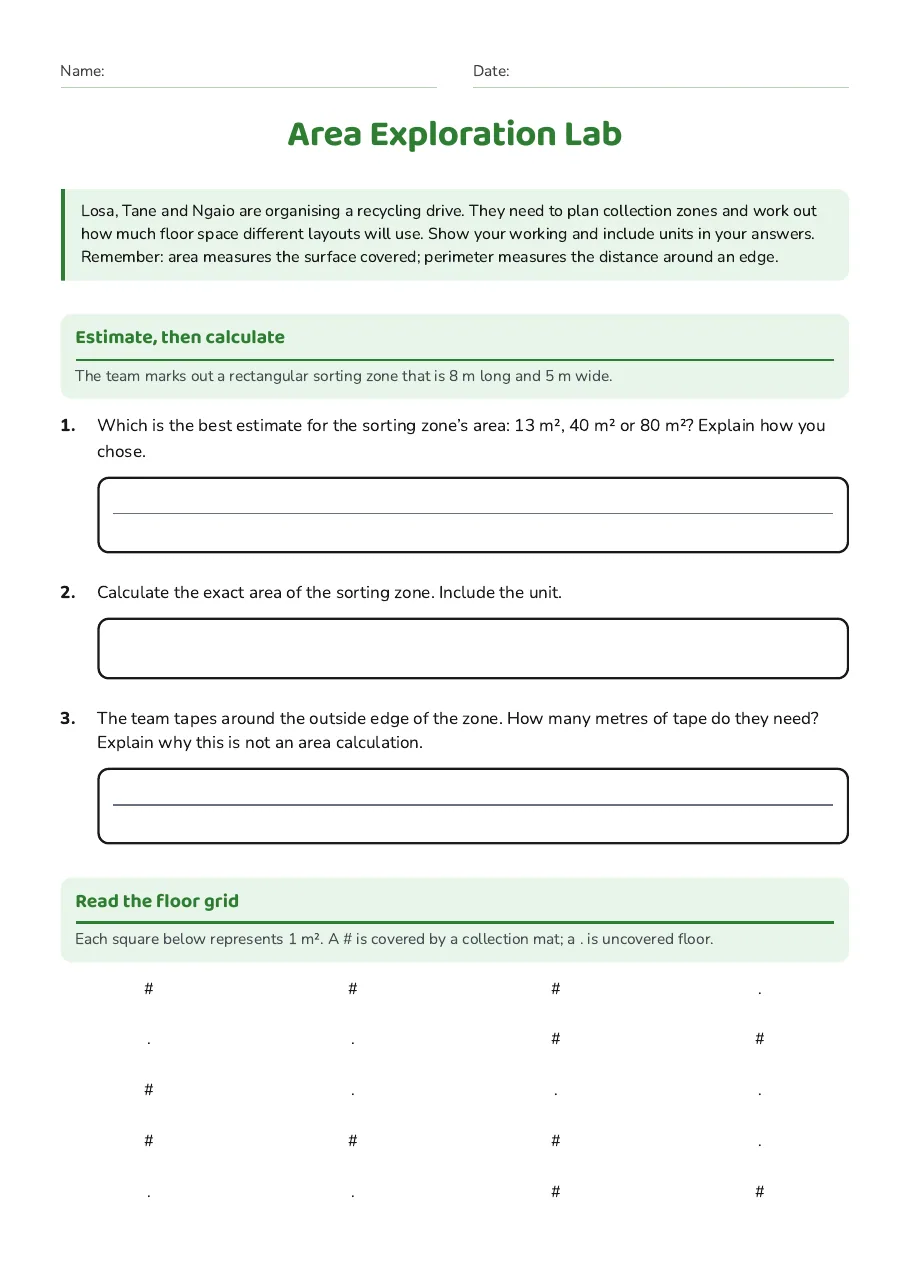
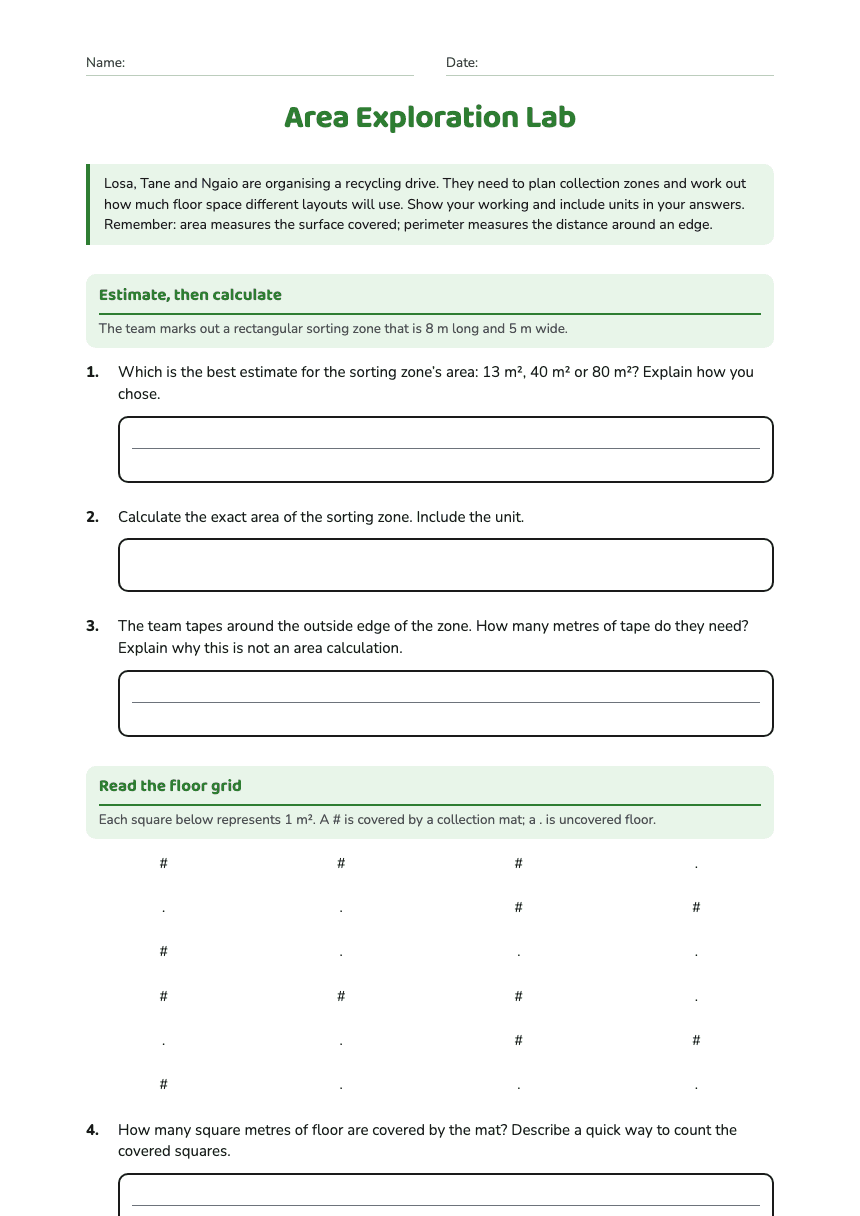
Area Exploration Lab

Losa, Tane and Ngaio are organising a recycling drive. They need to plan collection zones and work out how much floor space different layouts will use. Show your working and include units in your answers. Remember: area measures the surface covered; perimeter measures the distance around an edge.

Estimate, then calculate

The team marks out a rectangular sorting zone that is 8 m long and 5 m wide.

1.Which is the best estimate for the sorting zone’s area: 13 m², 40 m² or 80 m²? Explain how you chose.
2.Calculate the exact area of the sorting zone. Include the unit.
3.The team tapes around the outside edge of the zone. How many metres of tape do they need? Explain why this is not an area calculation.

Read the floor grid

Each square below represents 1 m². A # is covered by a collection mat; a . is uncovered floor.

#

#

#

.

.

.

#

#

#

.

.

.

#

#

#

.

.

.

#

#

#

.

.

.

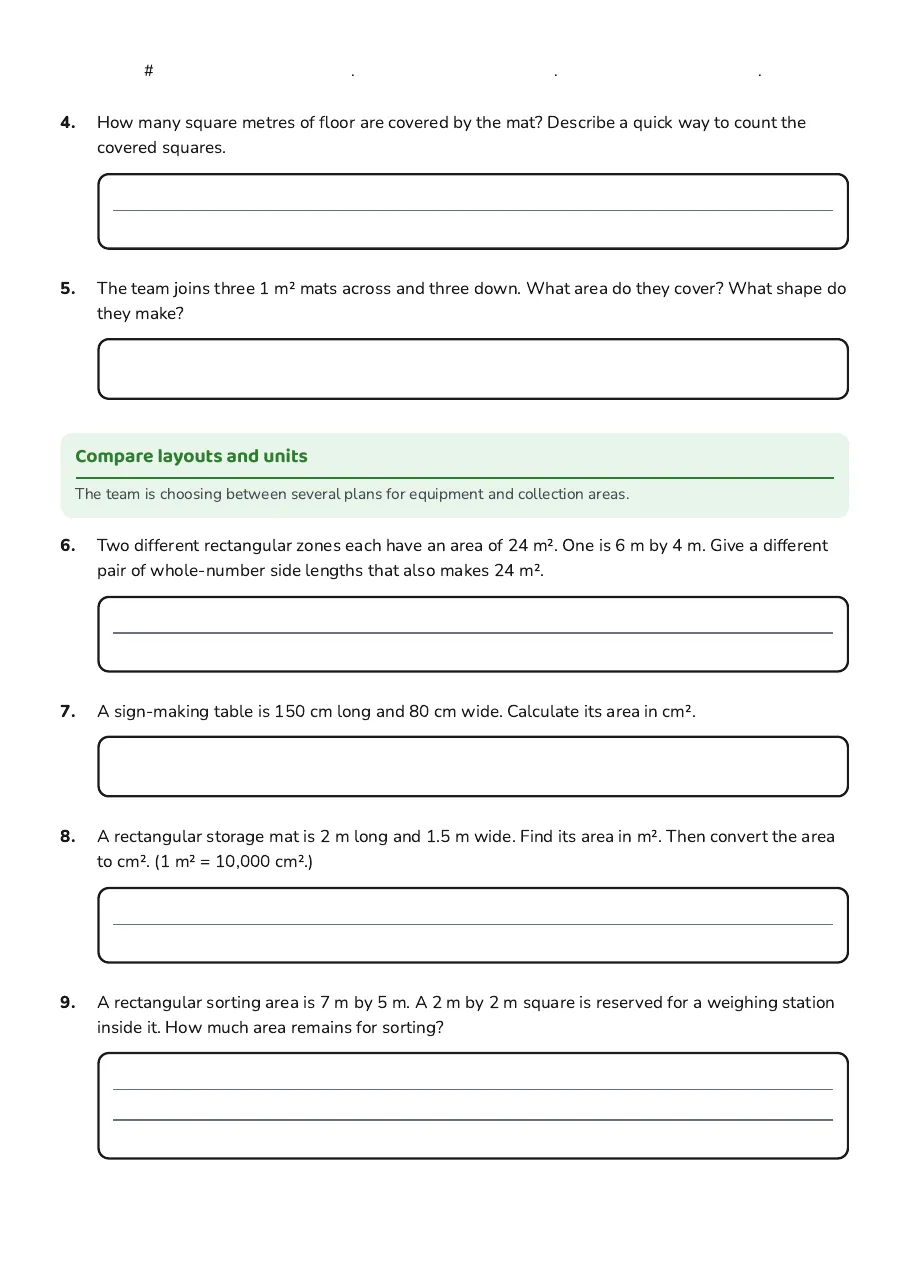
4.How many square metres of floor are covered by the mat? Describe a quick way to count the covered squares.
5.The team joins three 1 m² mats across and three down. What area do they cover? What shape do they make?

Compare layouts and units

The team is choosing between several plans for equipment and collection areas.

6.Two different rectangular zones each have an area of 24 m². One is 6 m by 4 m. Give a different pair of whole-number side lengths that also makes 24 m².
7.A sign-making table is 150 cm long and 80 cm wide. Calculate its area in cm².
8.A rectangular storage mat is 2 m long and 1.5 m wide. Find its area in m². Then convert the area to cm². (1 m² = 10,000 cm².)
9.A rectangular sorting area is 7 m by 5 m. A 2 m by 2 m square is reserved for a weighing station inside it. How much area remains for sorting?
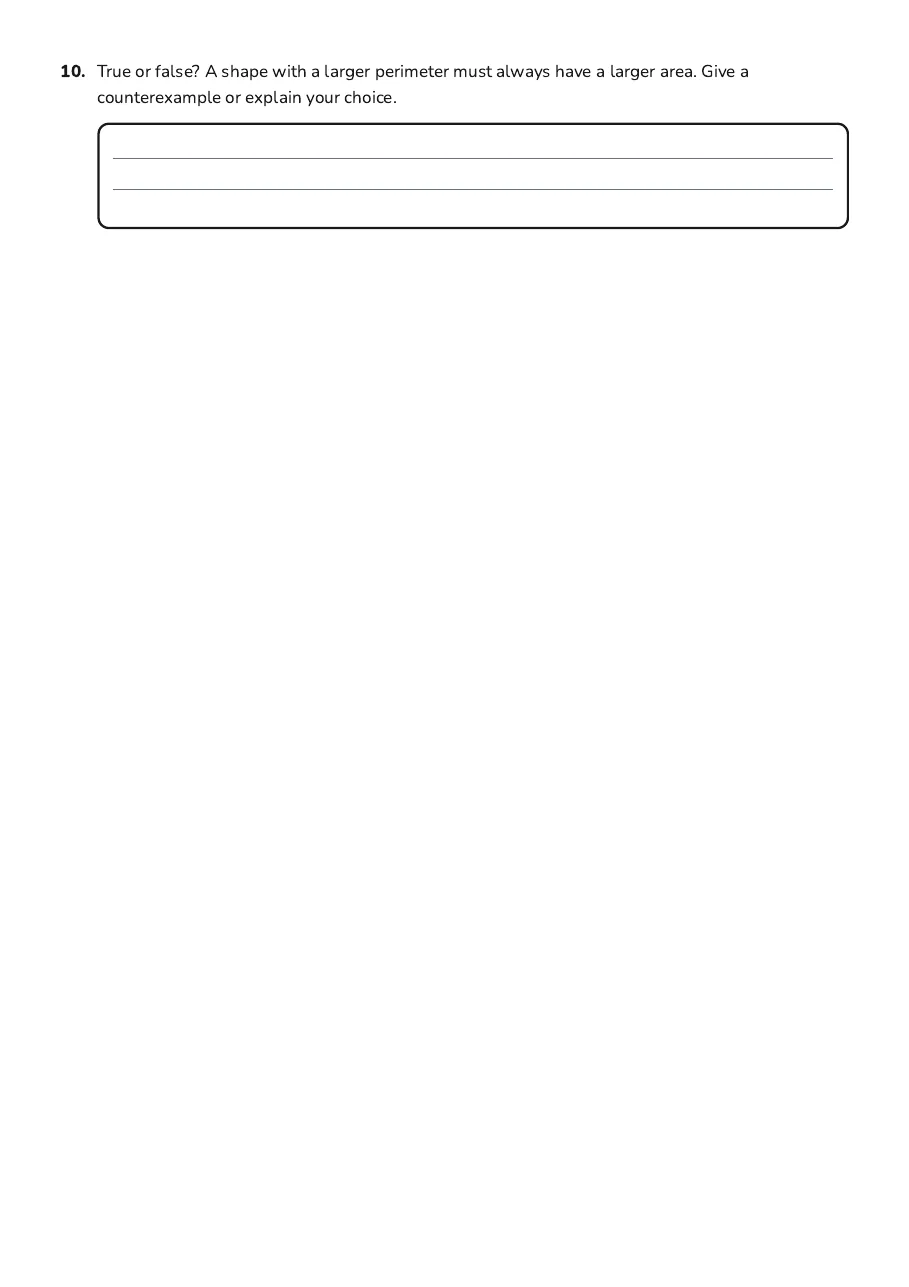
10.True or false? A shape with a larger perimeter must always have a larger area. Give a counterexample or explain your choice.

3 printable pages

  • Area Exploration Lab, page 1 of 3: Estimate, then calculate, Read the floor grid

    Page 1

  • Area Exploration Lab, page 2 of 3: Compare layouts and units

    Page 2

  • Area Exploration Lab, page 3 of 3: 10. True or false? A shape with a larger perimeter must always have a larger area. Give a

    Page 3

About This Worksheet

Free in Kuraplan

Sign up free, grab the PDF, and customize it for your class.

Print-Ready

Formatted for standard paper. Clean layout, easy to read.

AI-Generated

Created with Kuraplan's AI, designed for real classroom use.

For Teachers & Parents

Use in classrooms, for homework, tutoring, or homeschool.

Need a custom version of this worksheet?

Kuraplan's AI generates custom worksheets in seconds — differentiated for every learner, aligned to your curriculum.

Generate Custom Worksheets — Free
No credit card Curriculum-aligned Under 60 seconds