MathsFreePrintable

Body Parts Measuring Game

A free maths worksheet ready for your classroom. Open in Kuraplan to grab the print-ready PDF, customize it for your students, or generate a fresh version in seconds.
Body Parts Measuring Game worksheet preview
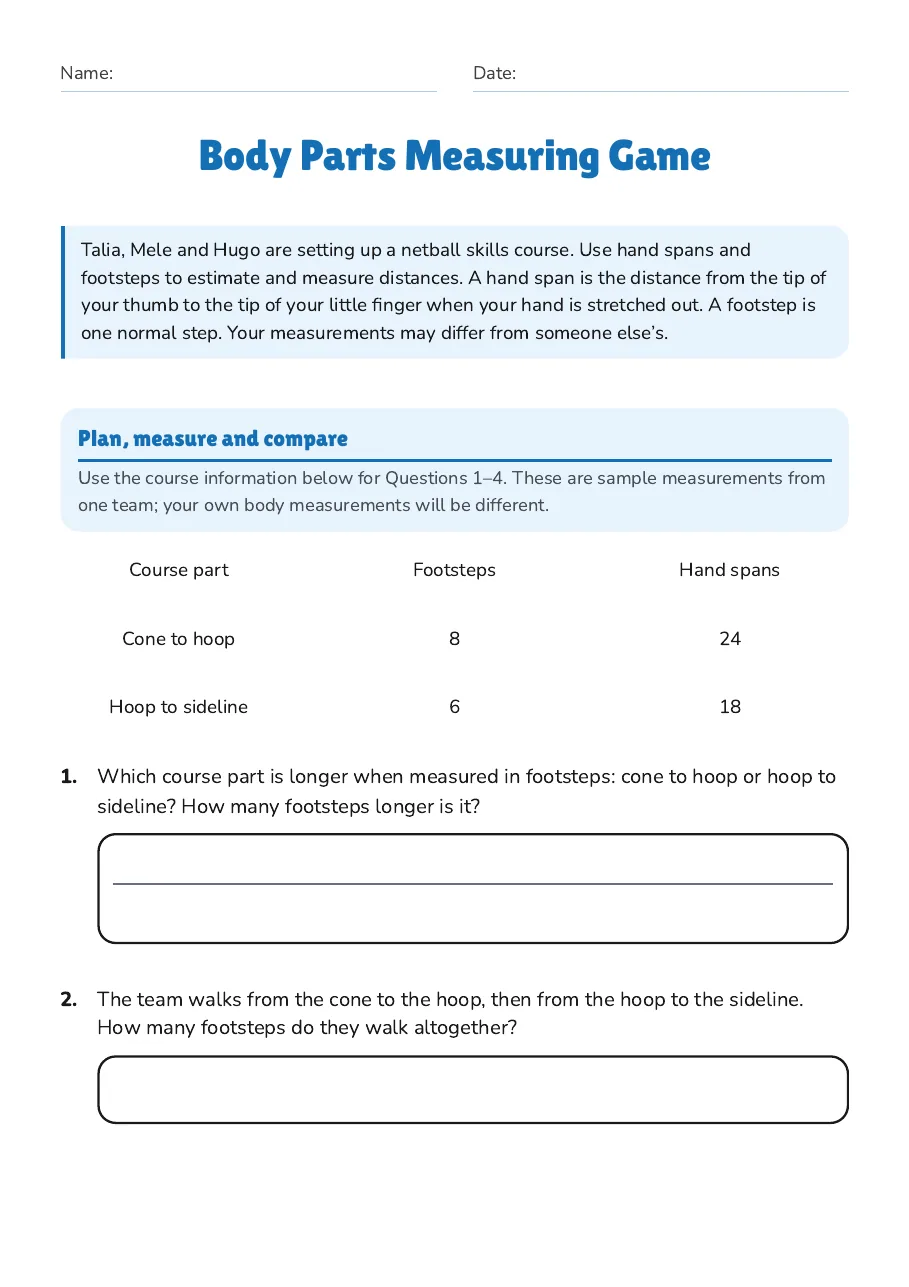
Name:Date:

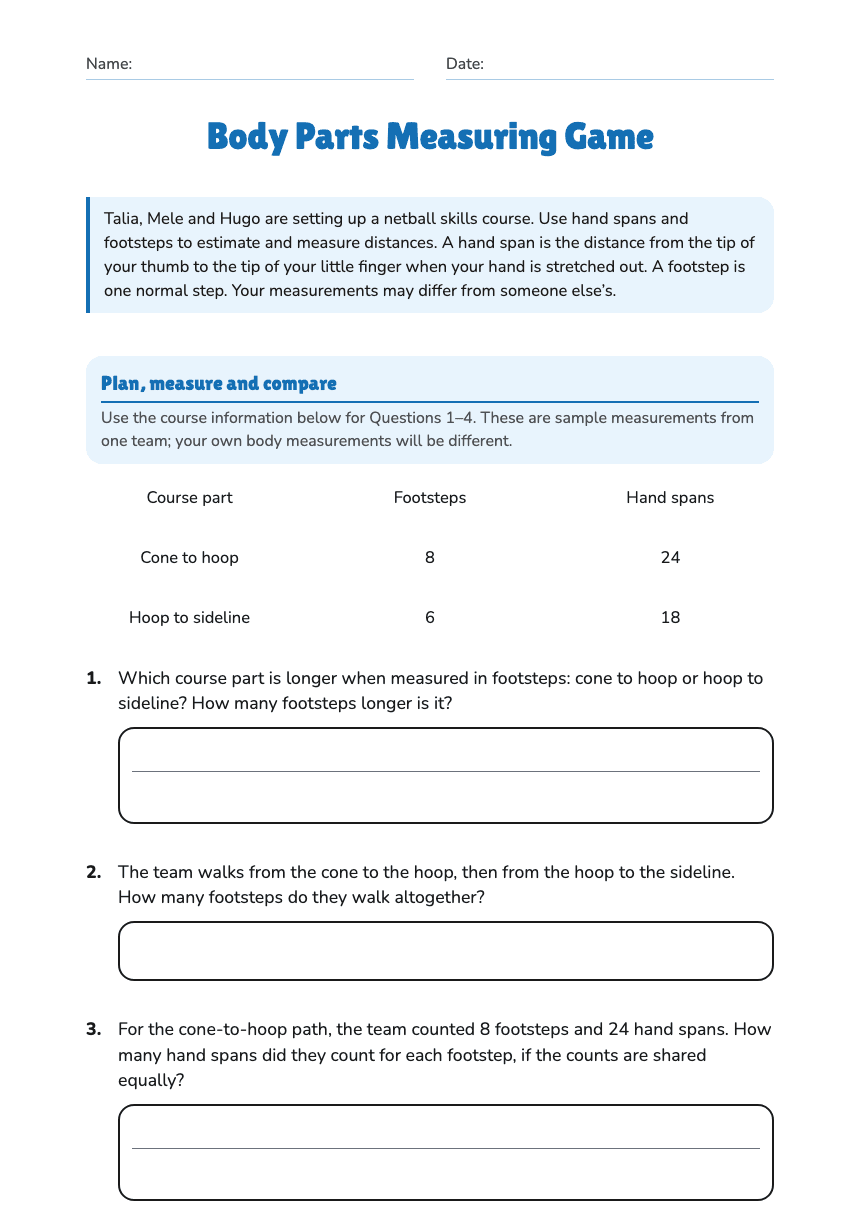
Body Parts Measuring Game

Talia, Mele and Hugo are setting up a netball skills course. Use hand spans and footsteps to estimate and measure distances. A hand span is the distance from the tip of your thumb to the tip of your little finger when your hand is stretched out. A footstep is one normal step. Your measurements may differ from someone else’s.

Plan, measure and compare

Use the course information below for Questions 1–4. These are sample measurements from one team; your own body measurements will be different.

Course part

Footsteps

Hand spans

Cone to hoop

8

24

Hoop to sideline

6

18

1.Which course part is longer when measured in footsteps: cone to hoop or hoop to sideline? How many footsteps longer is it?
2.The team walks from the cone to the hoop, then from the hoop to the sideline. How many footsteps do they walk altogether?
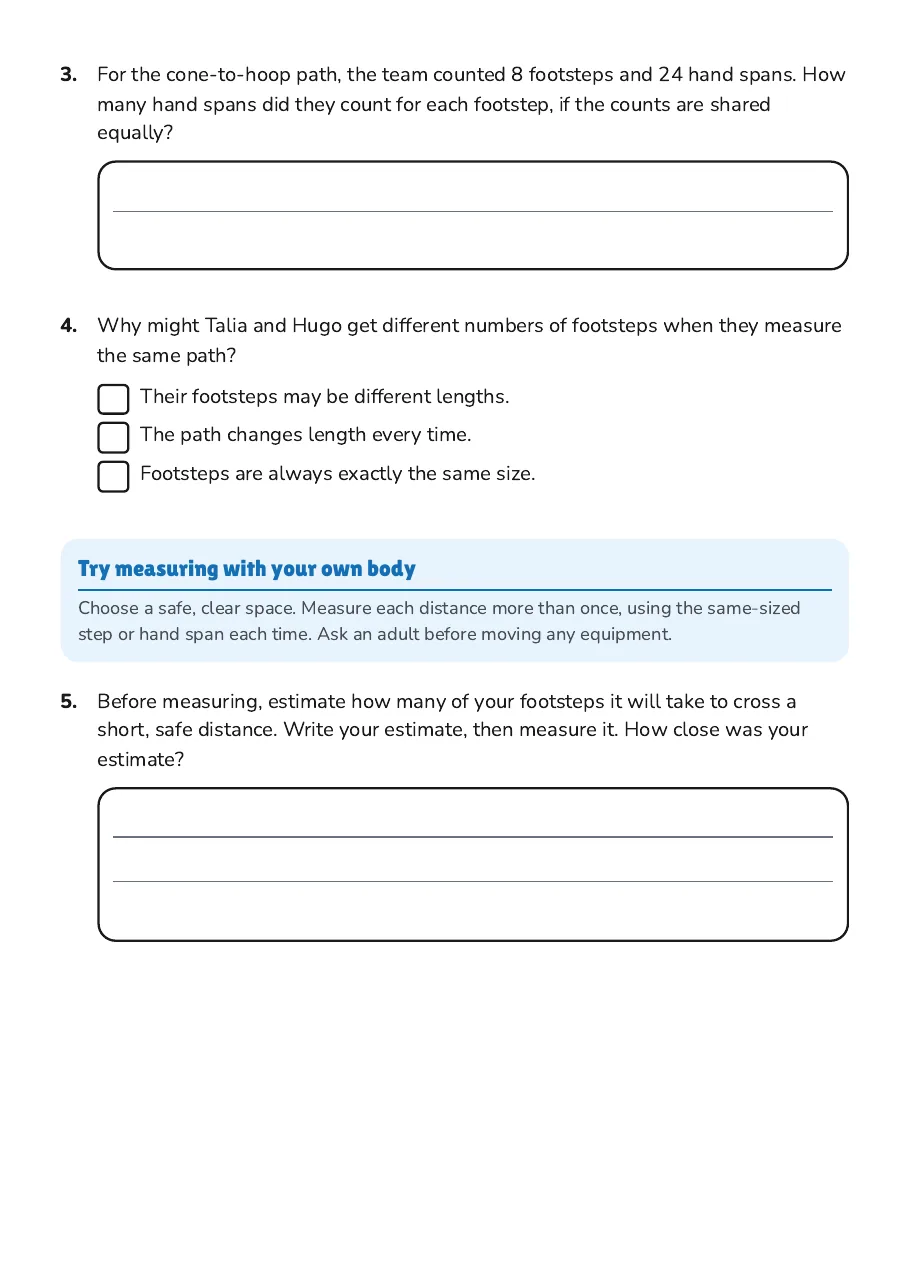
3.For the cone-to-hoop path, the team counted 8 footsteps and 24 hand spans. How many hand spans did they count for each footstep, if the counts are shared equally?
4.Why might Talia and Hugo get different numbers of footsteps when they measure the same path?
  • Their footsteps may be different lengths.
  • The path changes length every time.
  • Footsteps are always exactly the same size.

Try measuring with your own body

Choose a safe, clear space. Measure each distance more than once, using the same-sized step or hand span each time. Ask an adult before moving any equipment.

5.Before measuring, estimate how many of your footsteps it will take to cross a short, safe distance. Write your estimate, then measure it. How close was your estimate?
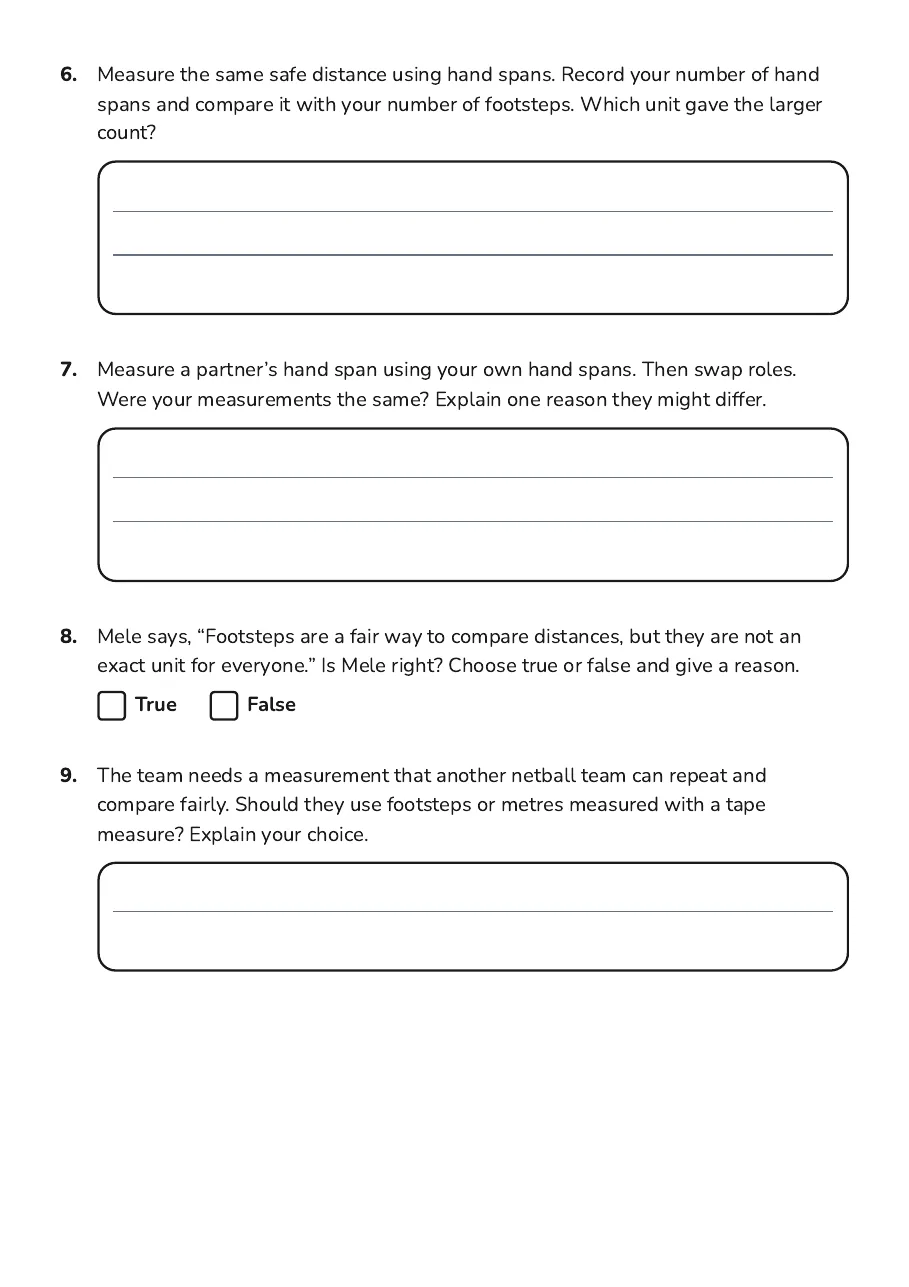
6.Measure the same safe distance using hand spans. Record your number of hand spans and compare it with your number of footsteps. Which unit gave the larger count?
7.Measure a partner’s hand span using your own hand spans. Then swap roles. Were your measurements the same? Explain one reason they might differ.
8.Mele says, “Footsteps are a fair way to compare distances, but they are not an exact unit for everyone.” Is Mele right? Choose true or false and give a reason.
TrueFalse
9.The team needs a measurement that another netball team can repeat and compare fairly. Should they use footsteps or metres measured with a tape measure? Explain your choice.
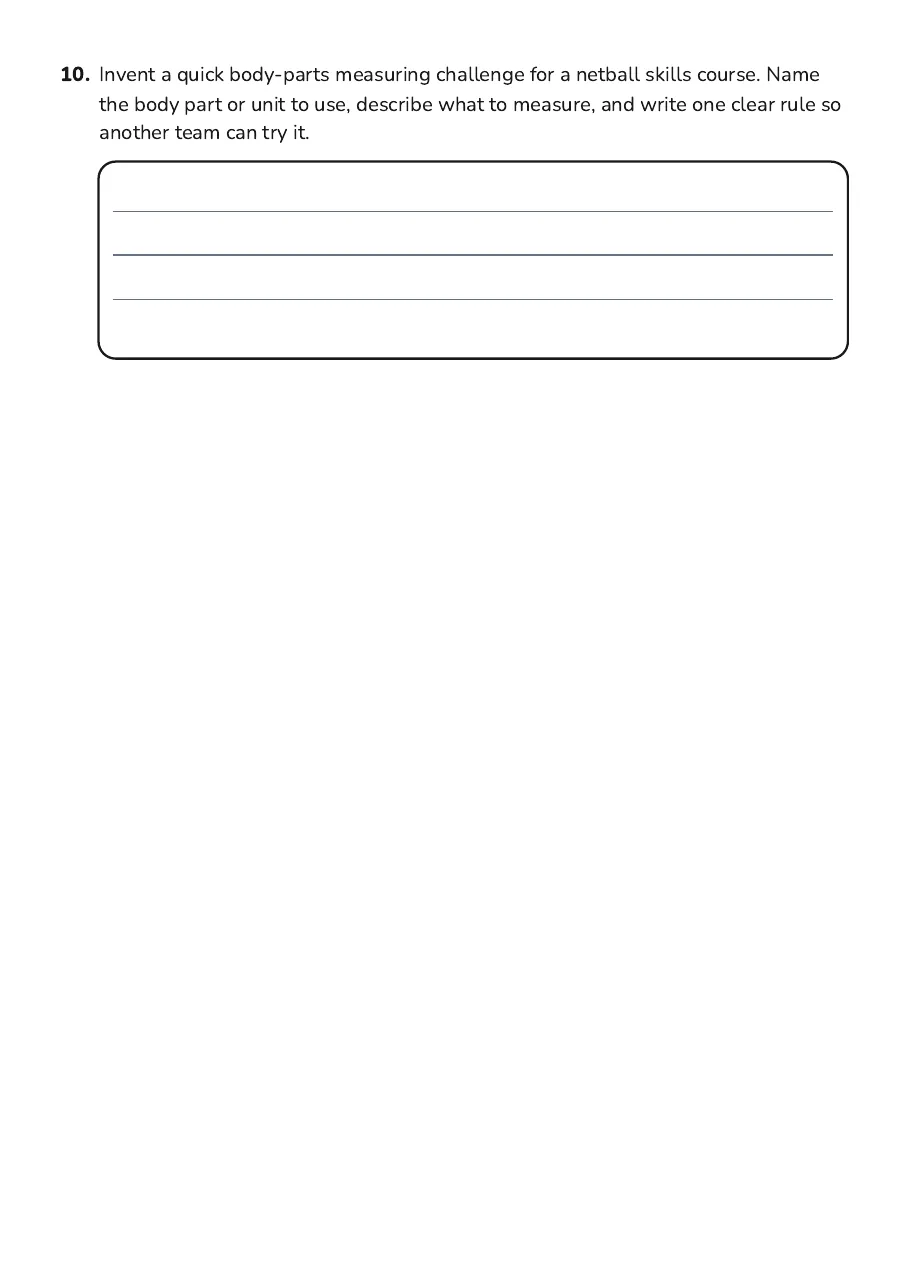
10.Invent a quick body-parts measuring challenge for a netball skills course. Name the body part or unit to use, describe what to measure, and write one clear rule so another team can try it.

4 printable pages

  • Body Parts Measuring Game, page 1 of 4: Plan, measure and compare

    Page 1

  • Body Parts Measuring Game, page 2 of 4: Try measuring with your own body

    Page 2

  • Body Parts Measuring Game, page 3 of 4: 6. Measure the same safe distance using hand spans. Record your number of hand

    Page 3

  • Body Parts Measuring Game, page 4 of 4: 10. Invent a quick body-parts measuring challenge for a netball skills course. Name

    Page 4

About This Worksheet

Free in Kuraplan

Sign up free, grab the PDF, and customize it for your class.

Print-Ready

Formatted for standard paper. Clean layout, easy to read.

AI-Generated

Created with Kuraplan's AI, designed for real classroom use.

For Teachers & Parents

Use in classrooms, for homework, tutoring, or homeschool.

Need a custom version of this worksheet?

Kuraplan's AI generates custom worksheets in seconds — differentiated for every learner, aligned to your curriculum.

Generate Custom Worksheets — Free
No credit card Curriculum-aligned Under 60 seconds