Capacity Word Problem Solving
🥤 Part 1: Basic Capacity Problems
1. Sarah has a 2-litre bottle of juice. She pours 750 millilitres into a glass. How much juice is left in the bottle? Show your working.
Answer: ______________ millilitres
2. A recipe calls for 1.5 litres of water. Tom has already added 800 millilitres. How much more water does he need to add?
Answer: ______________ millilitres
3. Which unit would be most appropriate for measuring the capacity of a swimming pool?
Millilitres
Litres
Kilograms
Metres
🍳 Part 2: Multi-Step Problems
4. Mrs Chen is making smoothies for her class of 24 students. Each smoothie needs 250 millilitres of milk. How many litres of milk does she need altogether?
Answer: ______________ litres
5. A fish tank holds 40 litres when full. It currently has 15.5 litres of water. Jake adds another 8,750 millilitres of water. How much water is in the tank now?
Answer: ______________ litres
6. At the school fair, three drink containers hold the following amounts: Container A has 3.2 litres, Container B has 2,800 millilitres, and Container C has 1.9 litres. What is the total capacity of all three containers in litres?
Answer: ______________ litres
🧪 Part 3: Real-World Applications
7. A science experiment requires mixing three liquids: 450 millilitres of water, 0.3 litres of vinegar, and 125 millilitres of food colouring. What is the total volume of the mixture?
Answer: ______________ millilitres OR ______________ litres
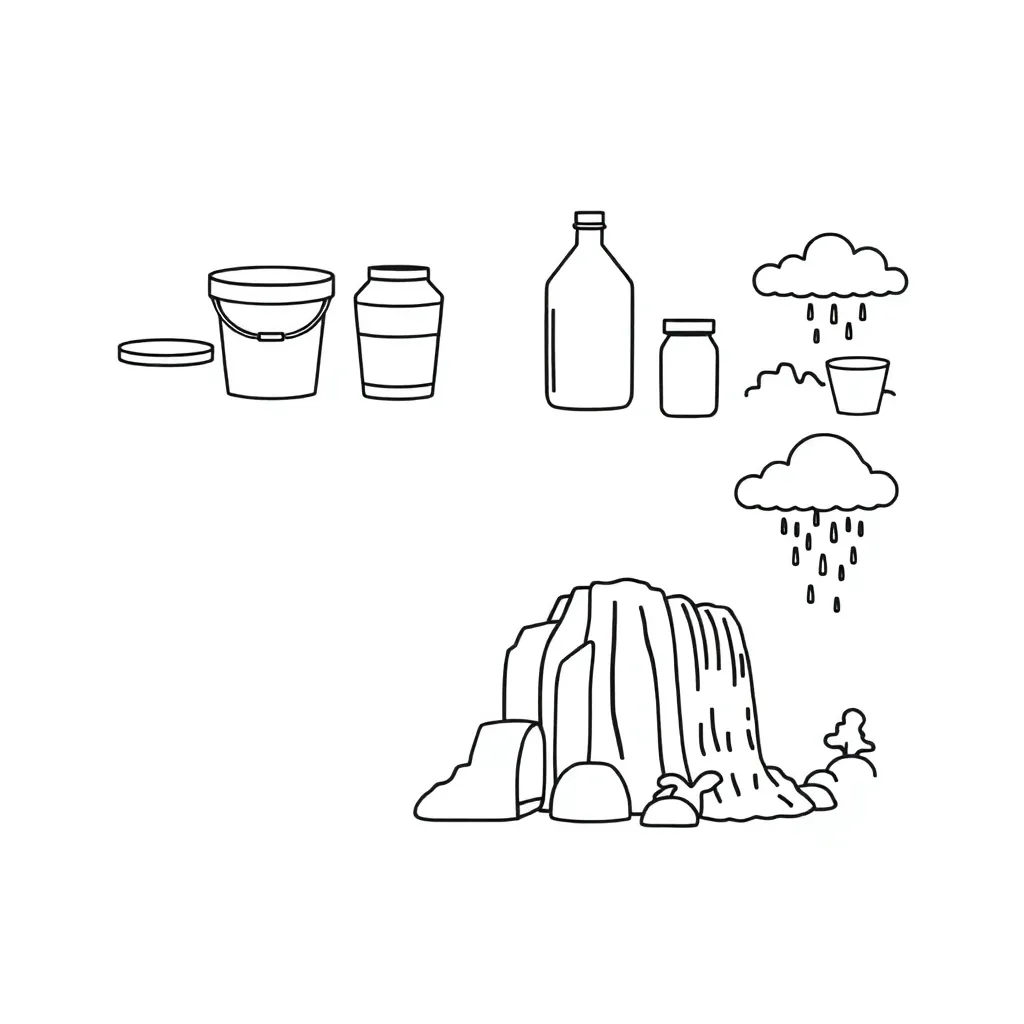
8. Check all the containers that would be appropriate for measuring 2.5 litres of liquid:
A 3-litre measuring jug
A 500-millilitre cup
A 2-litre bottle
A 5-litre bucket
9. The school water cooler dispenses 200 millilitres per cup. If 35 students each have 2 cups of water during lunch, how many litres of water were used?
Answer: ______________ litres
💭 Part 4: Problem-Solving Strategies
10. Explain your thinking: How did you solve problem 6? Describe the steps you took.
11. Create your own capacity word problem involving both litres and millilitres. Then solve it.
Your problem:
Your solution:
12. Match each situation with the most reasonable capacity estimate:
1. A coffee mug
2. A car's petrol tank
3. A medicine spoon
4. A kitchen sink
A. 5 millilitres
B. 250 millilitres
C. 15 litres
D. 60 litres
🎯 Part 5: Challenge Problems
13. A rectangular container is 20 cm long, 15 cm wide, and 10 cm high. If 1 litre = 1000 cubic centimetres, what is the capacity of this container?
Answer: ______________ litres
14. Fill in the blanks: To convert from litres to millilitres, you __________ by __________. To convert from millilitres to litres, you __________ by __________.
15. A tap drips 2 millilitres every minute. How much water would be wasted in one week if the tap is not fixed?
Answer: ______________ litres and ______________ millilitres