MathsFreePrintable

Core Geometry in Art

A free maths worksheet ready for your classroom. Open in Kuraplan to grab the print-ready PDF, customize it for your students, or generate a fresh version in seconds.
Core Geometry in Art worksheet preview
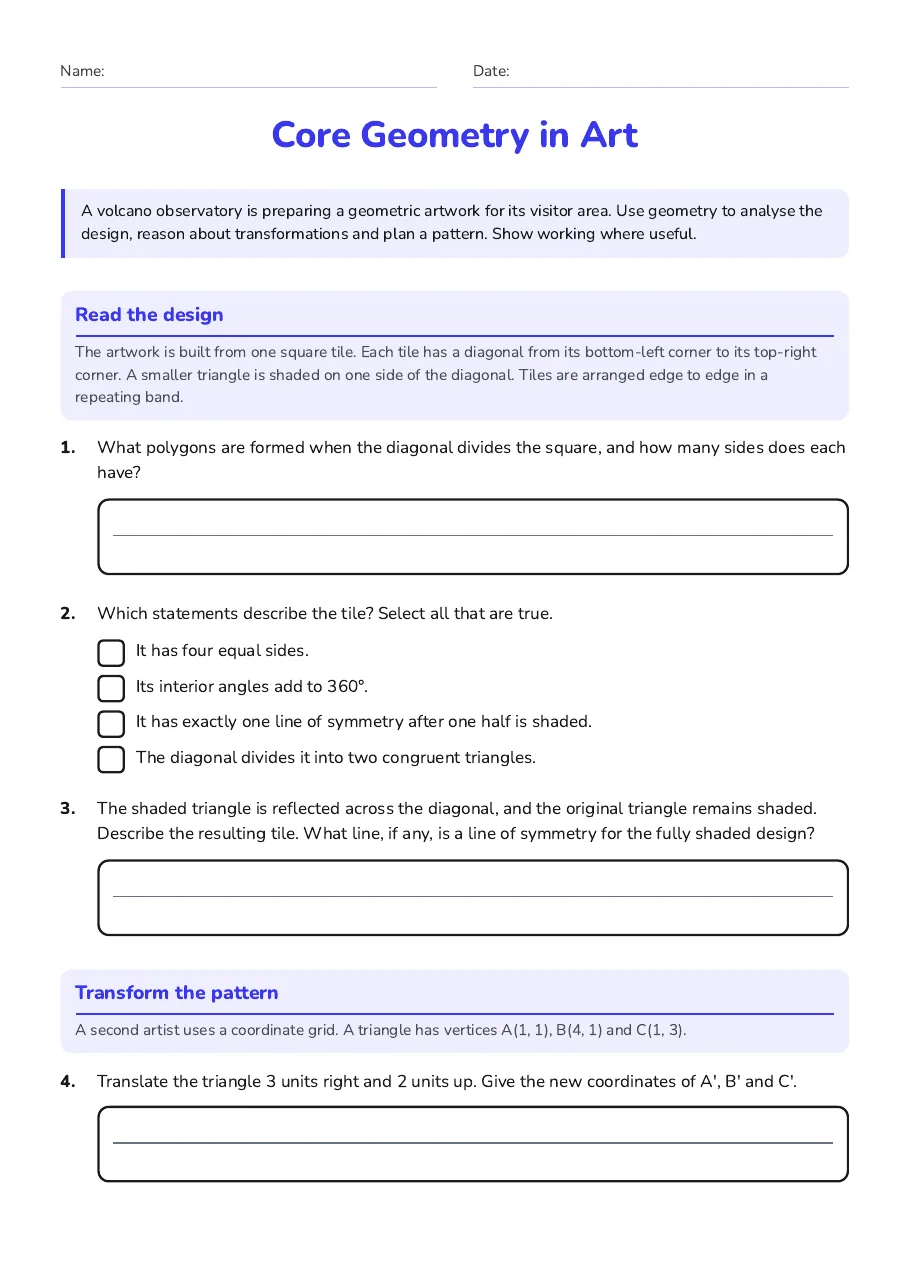
Name:Date:

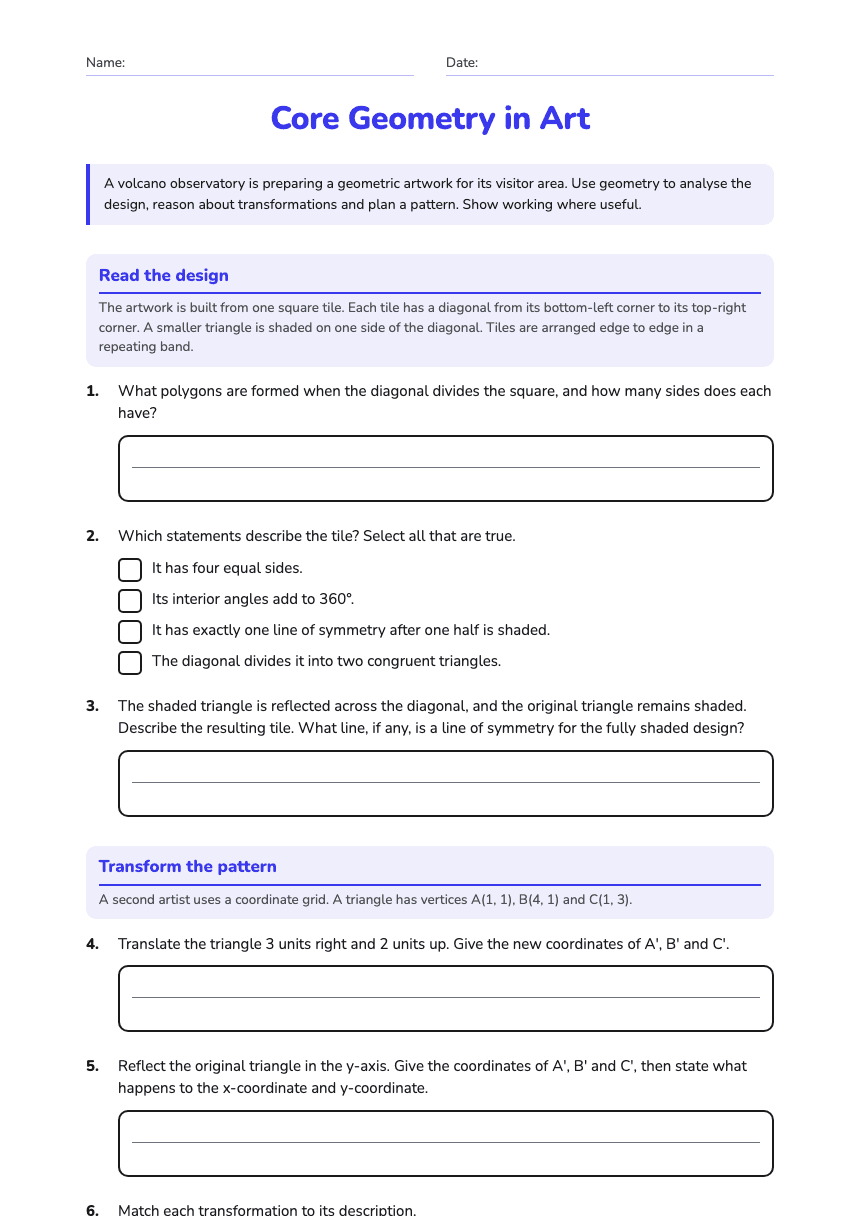
Core Geometry in Art

A volcano observatory is preparing a geometric artwork for its visitor area. Use geometry to analyse the design, reason about transformations and plan a pattern. Show working where useful.

Read the design

The artwork is built from one square tile. Each tile has a diagonal from its bottom-left corner to its top-right corner. A smaller triangle is shaded on one side of the diagonal. Tiles are arranged edge to edge in a repeating band.

1.What polygons are formed when the diagonal divides the square, and how many sides does each have?
2.Which statements describe the tile? Select all that are true.
  • It has four equal sides.
  • Its interior angles add to 360°.
  • It has exactly one line of symmetry after one half is shaded.
  • The diagonal divides it into two congruent triangles.
3.The shaded triangle is reflected across the diagonal, and the original triangle remains shaded. Describe the resulting tile. What line, if any, is a line of symmetry for the fully shaded design?

Transform the pattern

A second artist uses a coordinate grid. A triangle has vertices A(1, 1), B(4, 1) and C(1, 3).

4.Translate the triangle 3 units right and 2 units up. Give the new coordinates of A′, B′ and C′.
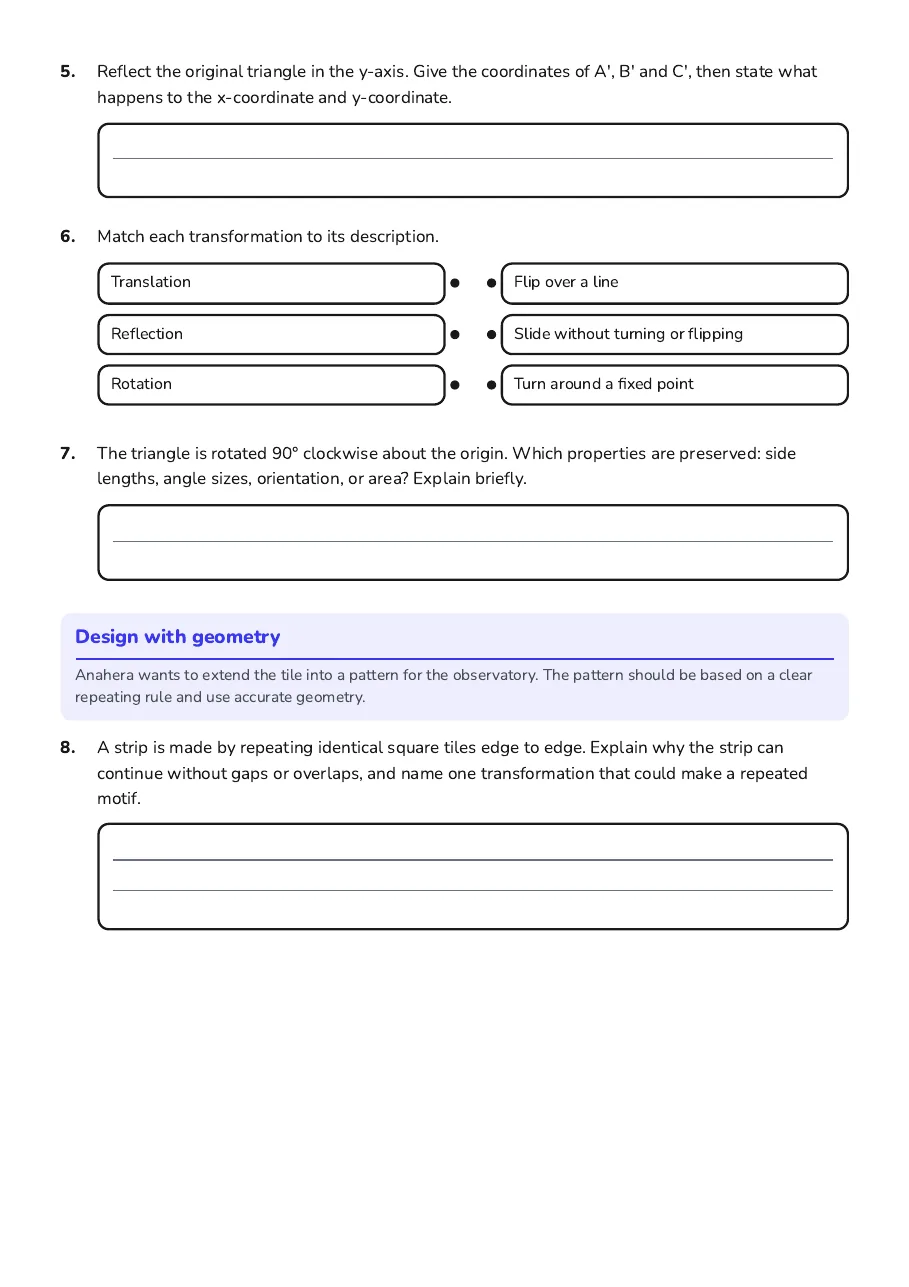
5.Reflect the original triangle in the y-axis. Give the coordinates of A′, B′ and C′, then state what happens to the x-coordinate and y-coordinate.
6.Match each transformation to its description.
  • Translation
  • Reflection
  • Rotation
  • Flip over a line
  • Slide without turning or flipping
  • Turn around a fixed point
7.The triangle is rotated 90° clockwise about the origin. Which properties are preserved: side lengths, angle sizes, orientation, or area? Explain briefly.

Design with geometry

Anahera wants to extend the tile into a pattern for the observatory. The pattern should be based on a clear repeating rule and use accurate geometry.

8.A strip is made by repeating identical square tiles edge to edge. Explain why the strip can continue without gaps or overlaps, and name one transformation that could make a repeated motif.
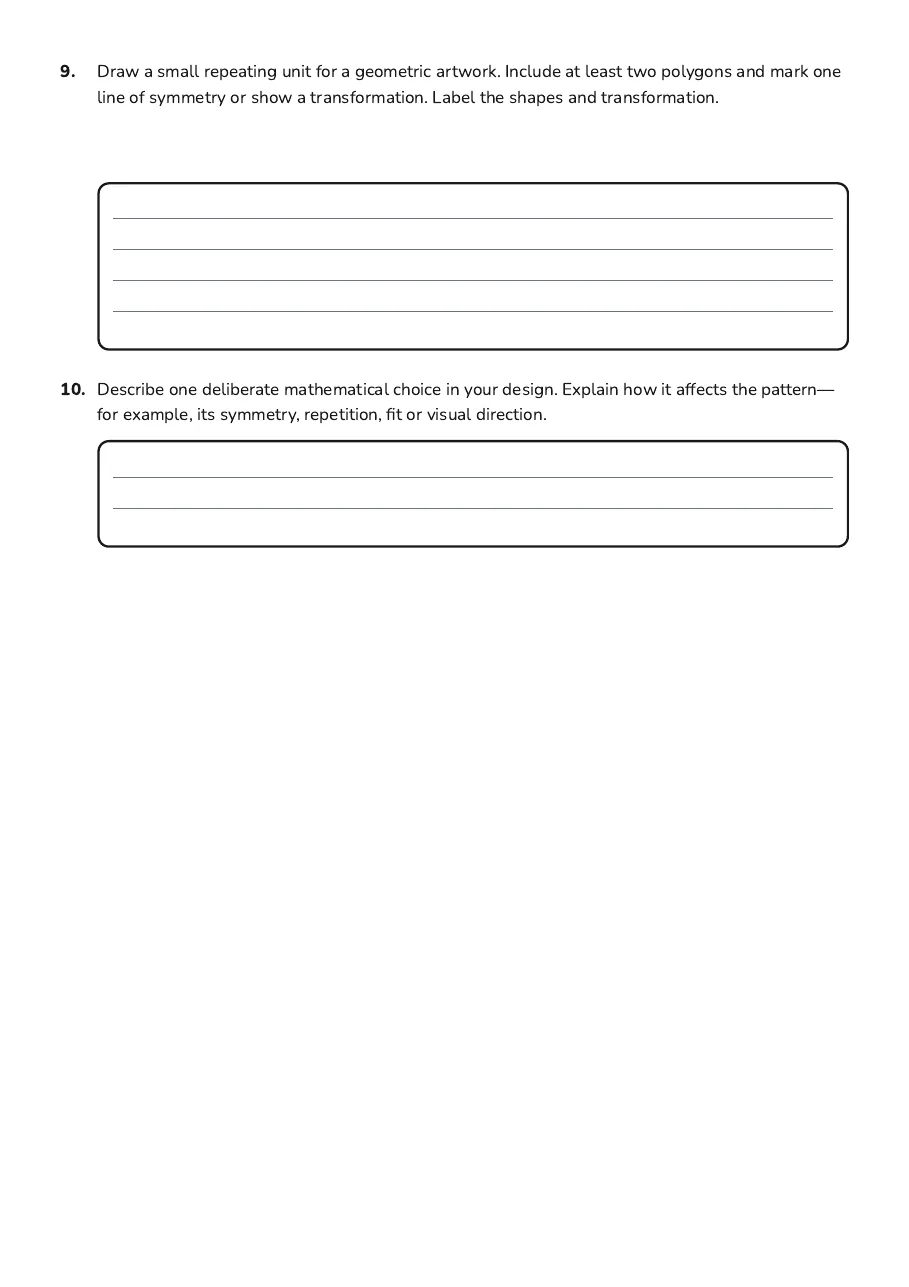
9.Draw a small repeating unit for a geometric artwork. Include at least two polygons and mark one line of symmetry or show a transformation. Label the shapes and transformation.
10.Describe one deliberate mathematical choice in your design. Explain how it affects the pattern—for example, its symmetry, repetition, fit or visual direction.

3 printable pages

  • Core Geometry in Art, page 1 of 3: Read the design, Transform the pattern

    Page 1

  • Core Geometry in Art, page 2 of 3: Design with geometry

    Page 2

  • Core Geometry in Art, page 3 of 3: 9. Draw a small repeating unit for a geometric artwork. Include at least two polygons and…

    Page 3

About This Worksheet

Free in Kuraplan

Sign up free, grab the PDF, and customize it for your class.

Print-Ready

Formatted for standard paper. Clean layout, easy to read.

AI-Generated

Created with Kuraplan's AI, designed for real classroom use.

For Teachers & Parents

Use in classrooms, for homework, tutoring, or homeschool.

Need a custom version of this worksheet?

Kuraplan's AI generates custom worksheets in seconds — differentiated for every learner, aligned to your curriculum.

Generate Custom Worksheets — Free
No credit card Curriculum-aligned Under 60 seconds