MathsFreePrintable
Equivalent Fractions: Year 5
A free maths worksheet ready for your classroom. Open in Kuraplan to grab the print-ready PDF, customize it for your students, or generate a fresh version in seconds.
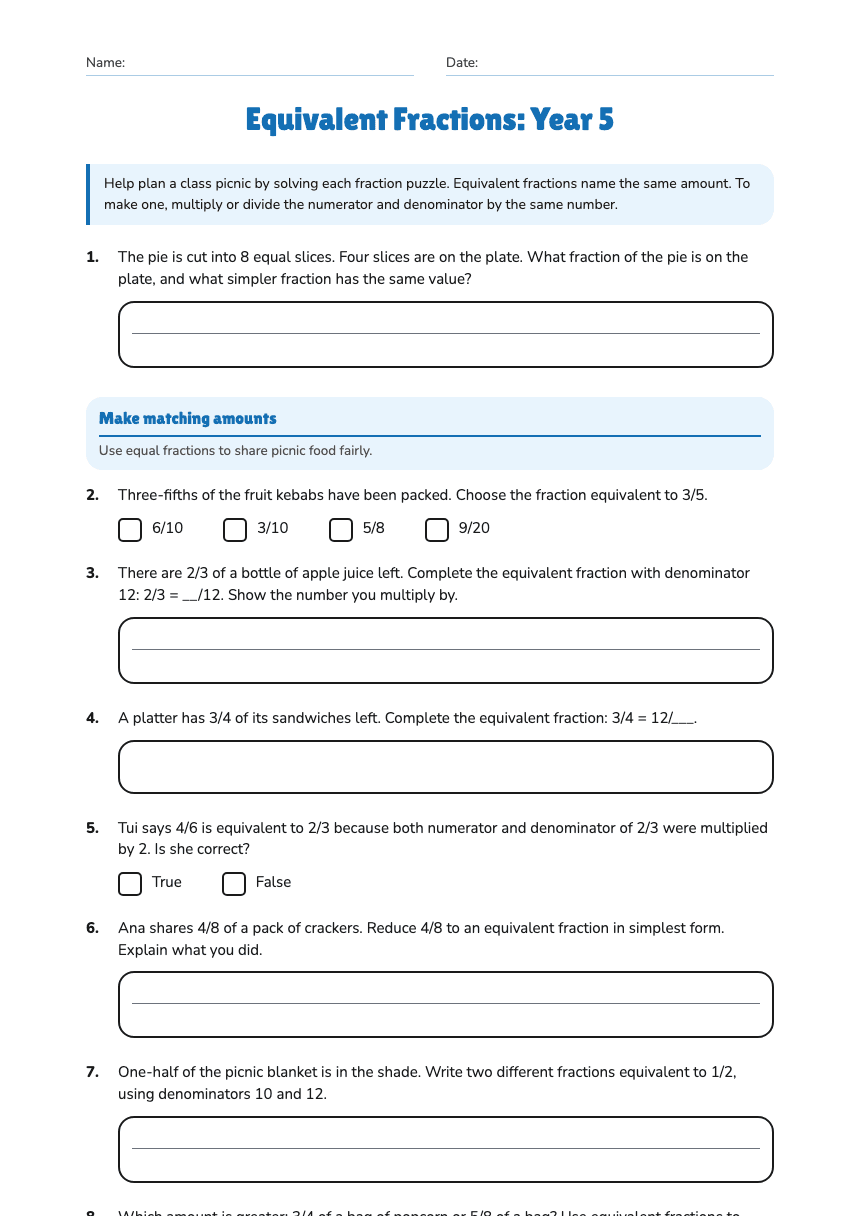
Name:Date:
Equivalent Fractions: Year 5
Help plan a class picnic by solving each fraction puzzle. Equivalent fractions name the same amount. To make one, multiply or divide the numerator and denominator by the same number.
1.The pie is cut into 8 equal slices. Four slices are on the plate. What fraction of the pie is on the plate, and what simpler fraction has the same value?
Make matching amounts
Use equal fractions to share picnic food fairly.
2.Three-fifths of the fruit kebabs have been packed. Choose the fraction equivalent to 3/5.
- 6/10
- 3/10
- 5/8
- 9/20
3.There are 2/3 of a bottle of apple juice left. Complete the equivalent fraction with denominator 12: 2/3 = __/12. Show the number you multiply by.
4.A platter has 3/4 of its sandwiches left. Complete the equivalent fraction: 3/4 = 12/___.
5.Tui says 4/6 is equivalent to 2/3 because both numerator and denominator of 2/3 were multiplied by 2. Is she correct?
- True
- False
6.Ana shares 4/8 of a pack of crackers. Reduce 4/8 to an equivalent fraction in simplest form. Explain what you did.
7.One-half of the picnic blanket is in the shade. Write two different fractions equivalent to 1/2, using denominators 10 and 12.
8.Which amount is greater: 3/4 of a bag of popcorn or 5/8 of a bag? Use equivalent fractions to compare them.
9.Can 3/7 be written as an equivalent fraction with denominator 21? If so, complete it and state the multiplier.
10.A recipe uses 2/5 of a bag of flour. Can 2/5 be written as an equivalent fraction with denominator 12 using a whole-number multiplier? Explain why or why not.
11.Invent a picnic-sharing situation that can be represented by 3/6. Write the situation and another fraction equivalent to 3/6.
2 printable pages
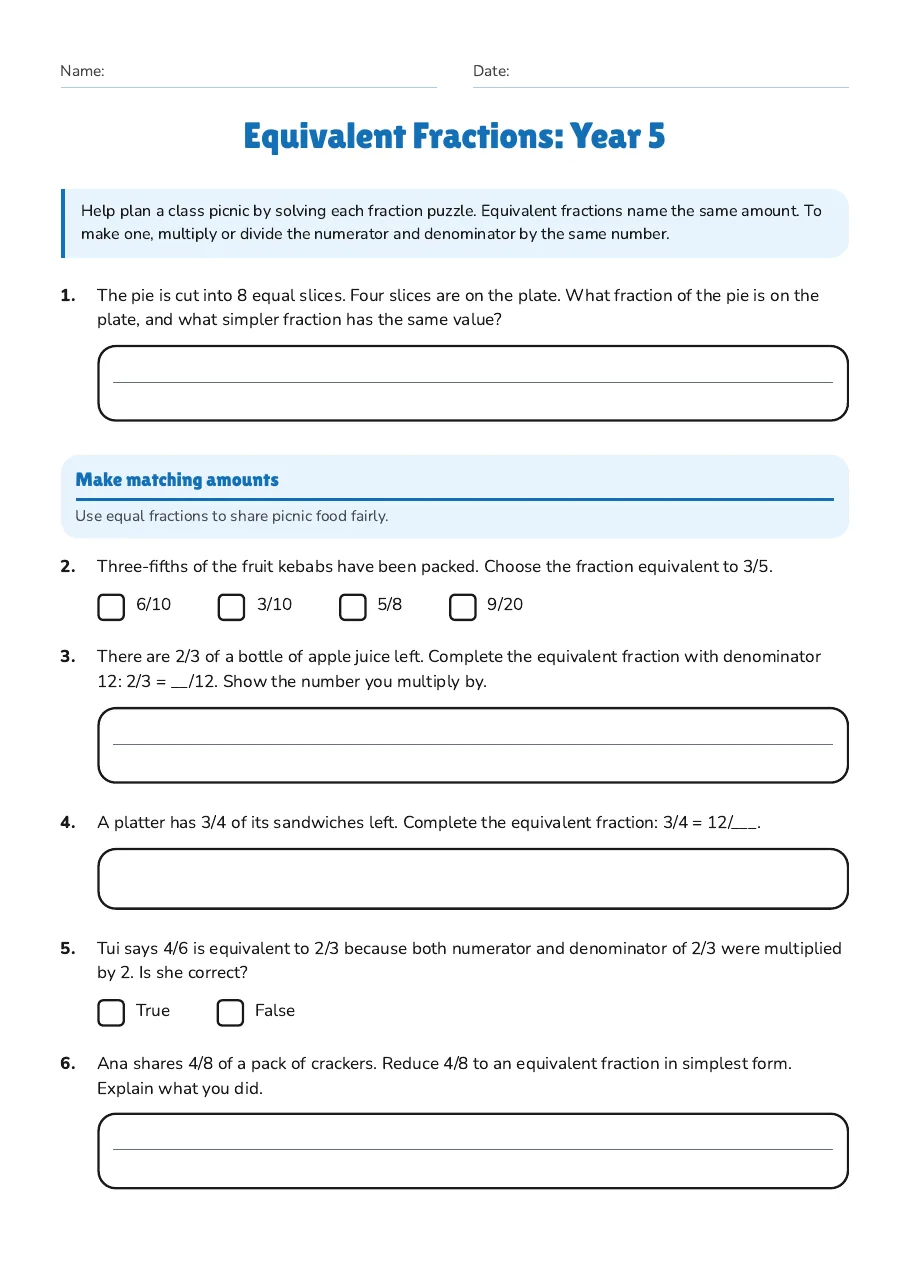
Page 1
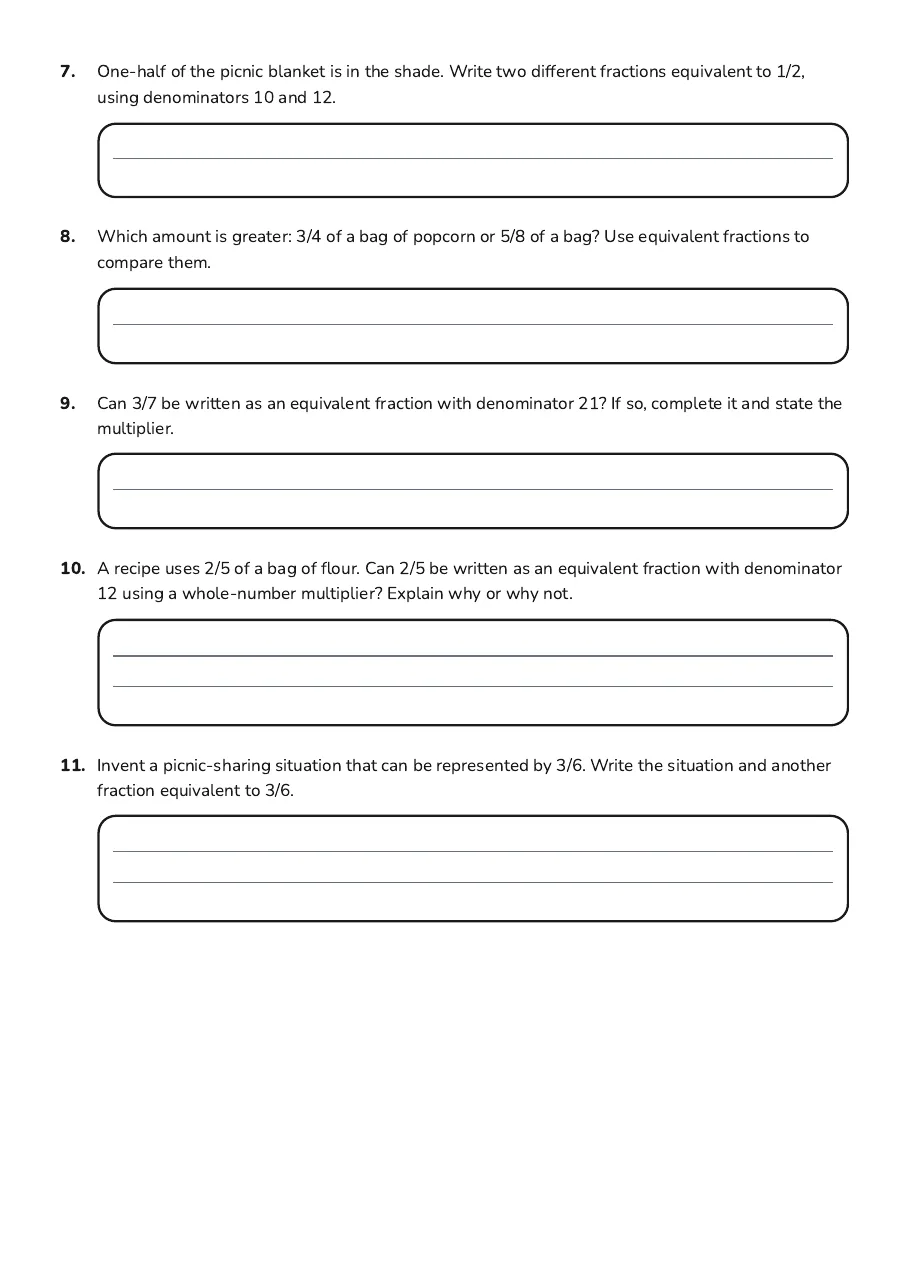
Page 2
About This Worksheet
Free in Kuraplan
Sign up free, grab the PDF, and customize it for your class.
Print-Ready
Formatted for standard paper. Clean layout, easy to read.
AI-Generated
Created with Kuraplan's AI, designed for real classroom use.
For Teachers & Parents
Use in classrooms, for homework, tutoring, or homeschool.
Need a custom version of this worksheet?
Kuraplan's AI generates custom worksheets in seconds — differentiated for every learner, aligned to your curriculum.
Generate Custom Worksheets — Free No credit card Curriculum-aligned Under 60 seconds