MathsFreePrintable

Estimation and Measurement Practice

A free maths worksheet ready for your classroom. Open in Kuraplan to grab the print-ready PDF, customize it for your students, or generate a fresh version in seconds.
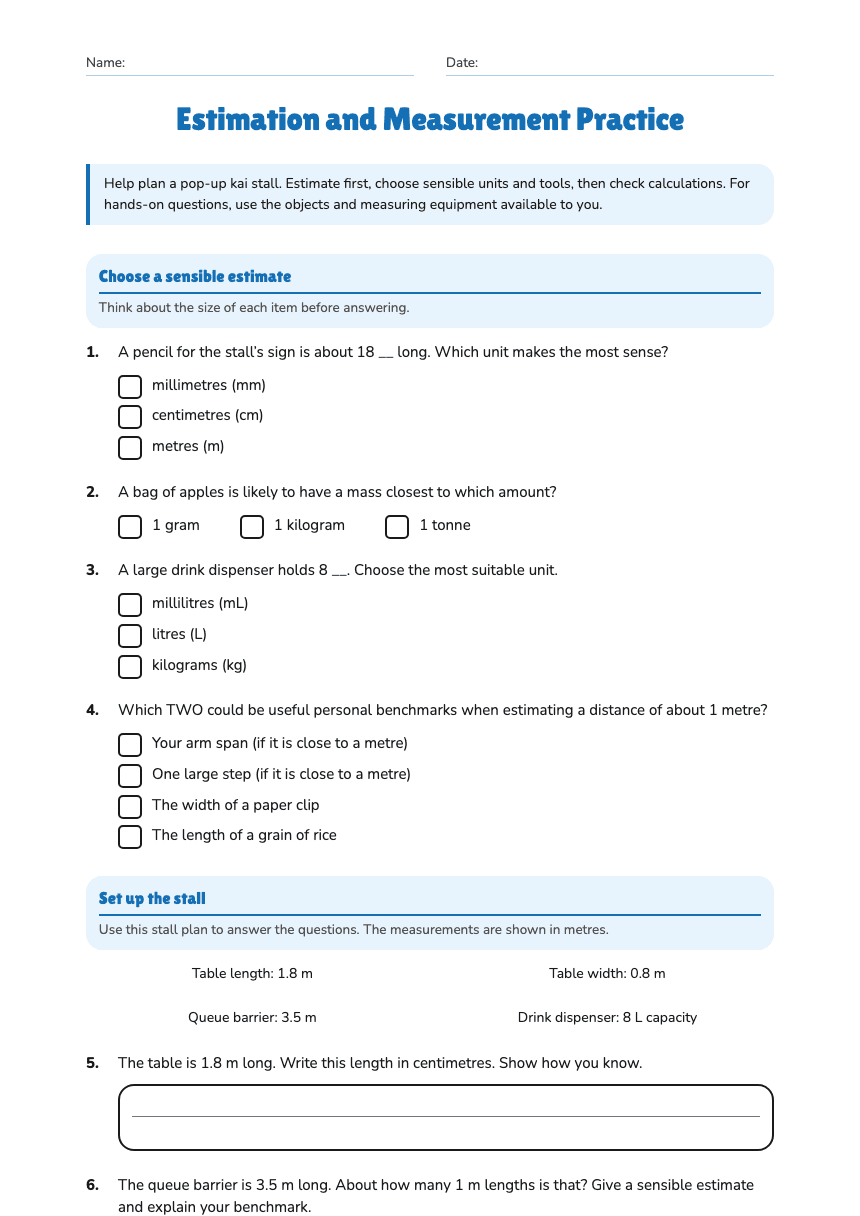
Estimation and Measurement Practice worksheet preview
Name:Date:

Estimation and Measurement Practice

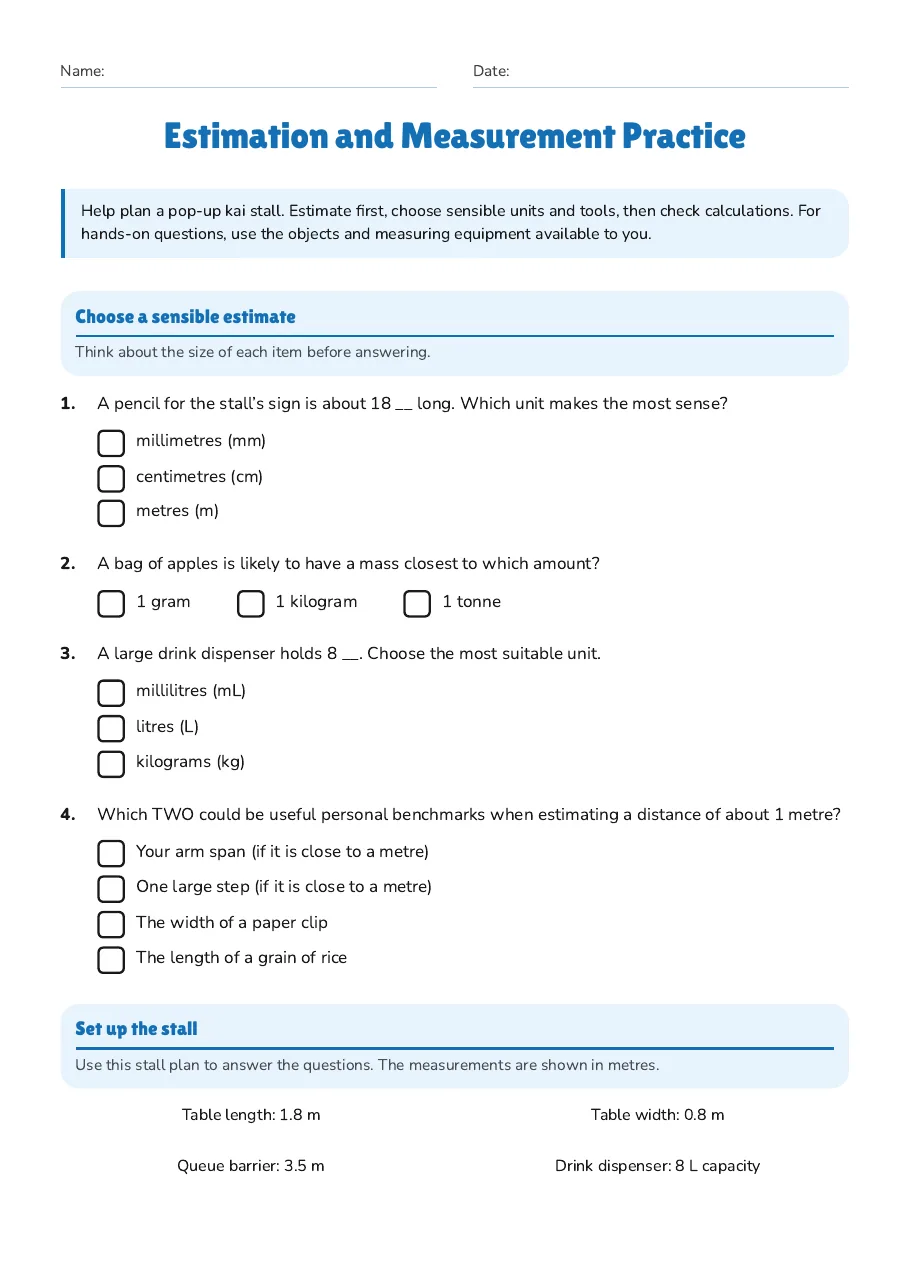
Help plan a pop-up kai stall. Estimate first, choose sensible units and tools, then check calculations. For hands-on questions, use the objects and measuring equipment available to you.

Choose a sensible estimate

Think about the size of each item before answering.

1.A pencil for the stall’s sign is about 18 __ long. Which unit makes the most sense?
  • millimetres (mm)
  • centimetres (cm)
  • metres (m)
2.A bag of apples is likely to have a mass closest to which amount?
  • 1 gram
  • 1 kilogram
  • 1 tonne
3.A large drink dispenser holds 8 __. Choose the most suitable unit.
  • millilitres (mL)
  • litres (L)
  • kilograms (kg)
4.Which TWO could be useful personal benchmarks when estimating a distance of about 1 metre?
  • Your arm span (if it is close to a metre)
  • One large step (if it is close to a metre)
  • The width of a paper clip
  • The length of a grain of rice

Set up the stall

Use this stall plan to answer the questions. The measurements are shown in metres.

Table length: 1.8 m

Table width: 0.8 m

Queue barrier: 3.5 m

Drink dispenser: 8 L capacity

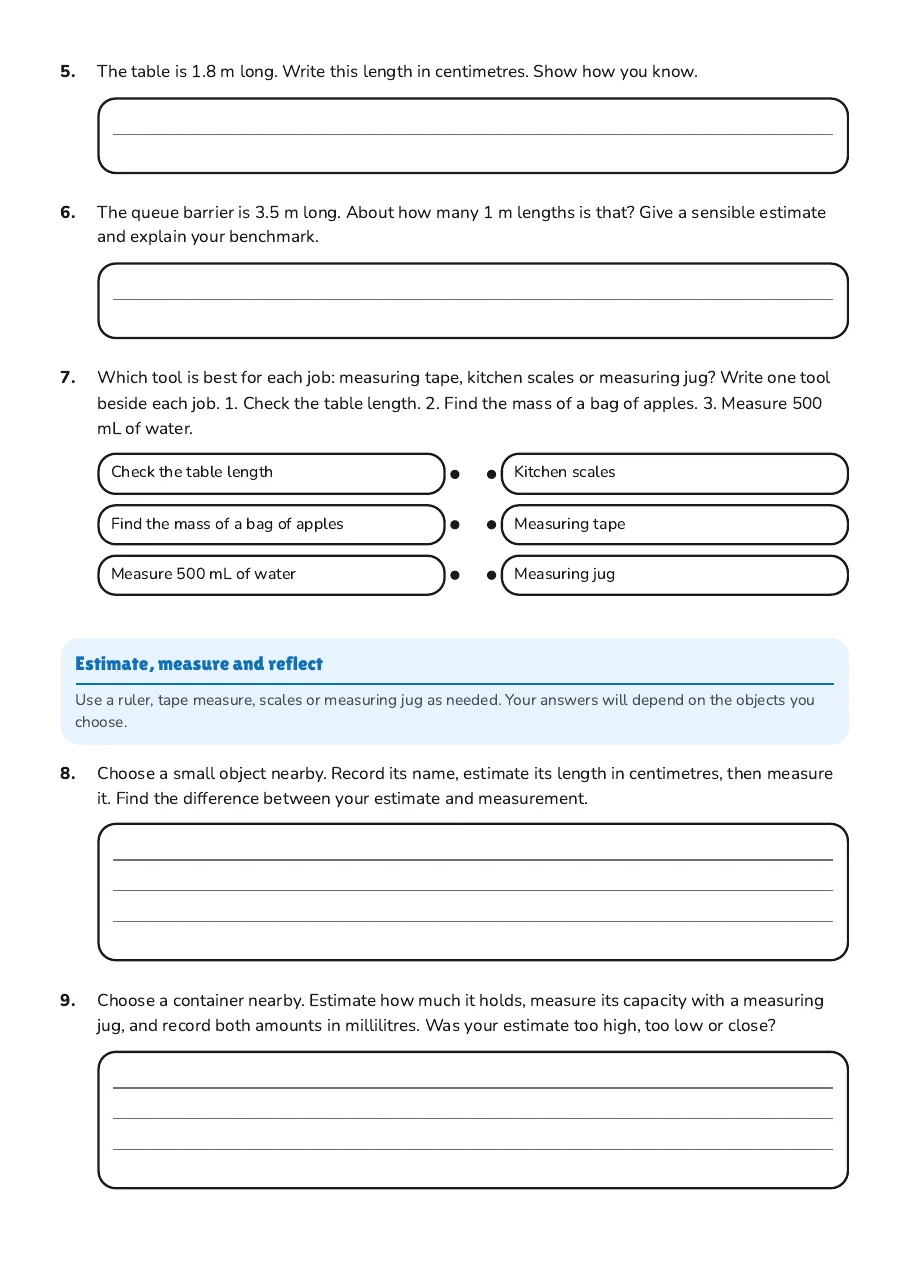
5.The table is 1.8 m long. Write this length in centimetres. Show how you know.
6.The queue barrier is 3.5 m long. About how many 1 m lengths is that? Give a sensible estimate and explain your benchmark.
7.Which tool is best for each job: measuring tape, kitchen scales or measuring jug? Write one tool beside each job. 1. Check the table length. 2. Find the mass of a bag of apples. 3. Measure 500 mL of water.
  • Check the table length
  • Find the mass of a bag of apples
  • Measure 500 mL of water
  • Kitchen scales
  • Measuring tape
  • Measuring jug

Estimate, measure and reflect

Use a ruler, tape measure, scales or measuring jug as needed. Your answers will depend on the objects you choose.

8.Choose a small object nearby. Record its name, estimate its length in centimetres, then measure it. Find the difference between your estimate and measurement.
9.Choose a container nearby. Estimate how much it holds, measure its capacity with a measuring jug, and record both amounts in millilitres. Was your estimate too high, too low or close?
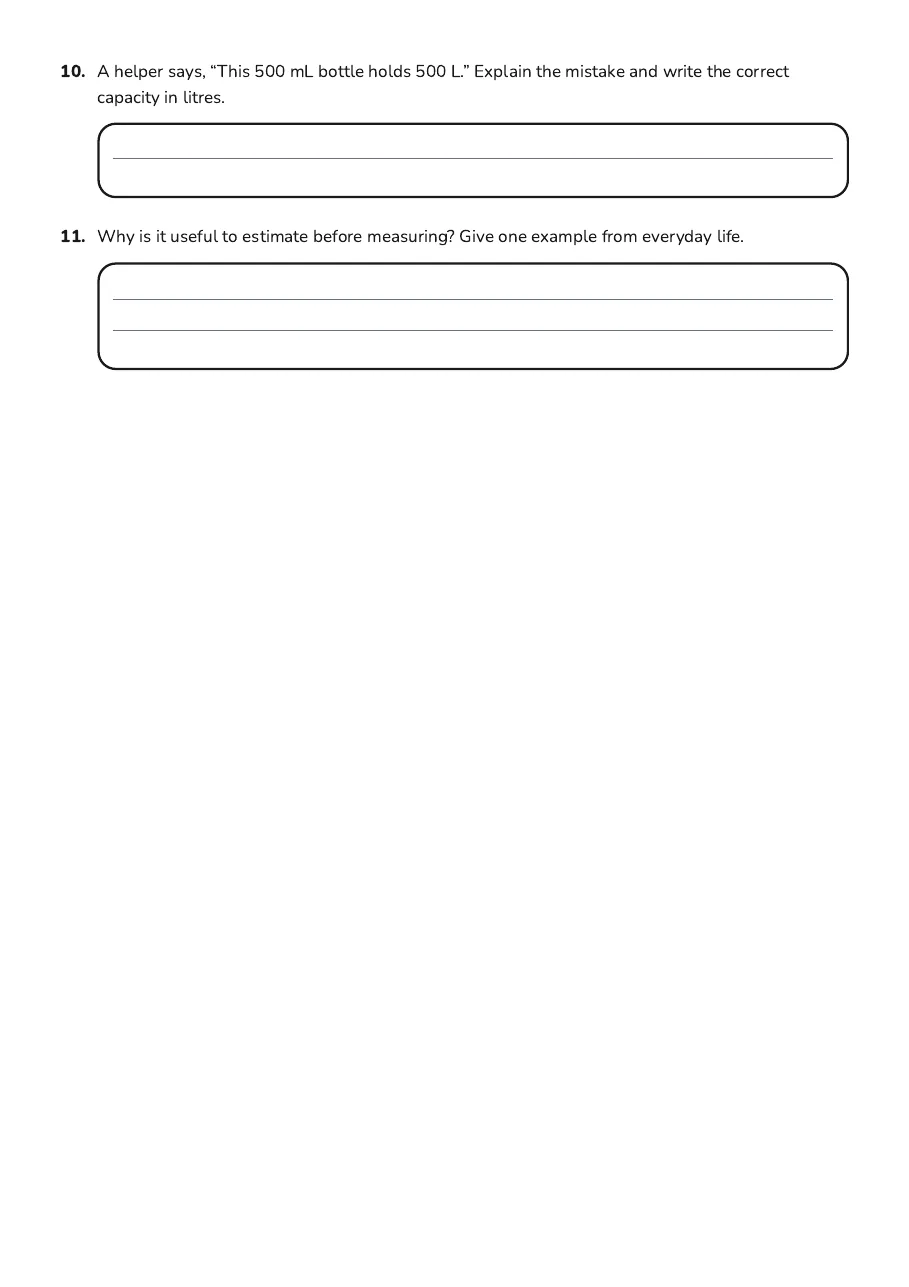
10.A helper says, “This 500 mL bottle holds 500 L.” Explain the mistake and write the correct capacity in litres.
11.Why is it useful to estimate before measuring? Give one example from everyday life.

3 printable pages

  • Estimation and Measurement Practice, page 1 of 3: Choose a sensible estimate, Set up the stall

    Page 1

  • Estimation and Measurement Practice, page 2 of 3: Estimate, measure and reflect

    Page 2

  • Estimation and Measurement Practice, page 3 of 3: 10. A helper says, “This 500 mL bottle holds 500 L.” Explain the mistake and write the…

    Page 3

About This Worksheet

Free in Kuraplan

Sign up free, grab the PDF, and customize it for your class.

Print-Ready

Formatted for standard paper. Clean layout, easy to read.

AI-Generated

Created with Kuraplan's AI, designed for real classroom use.

For Teachers & Parents

Use in classrooms, for homework, tutoring, or homeschool.

Need a custom version of this worksheet?

Kuraplan's AI generates custom worksheets in seconds — differentiated for every learner, aligned to your curriculum.

Generate Custom Worksheets — Free
No credit card Curriculum-aligned Under 60 seconds