MathsFreePrintable

Exploring Measurement Tools

A free maths worksheet ready for your classroom. Open in Kuraplan to grab the print-ready PDF, customize it for your students, or generate a fresh version in seconds.
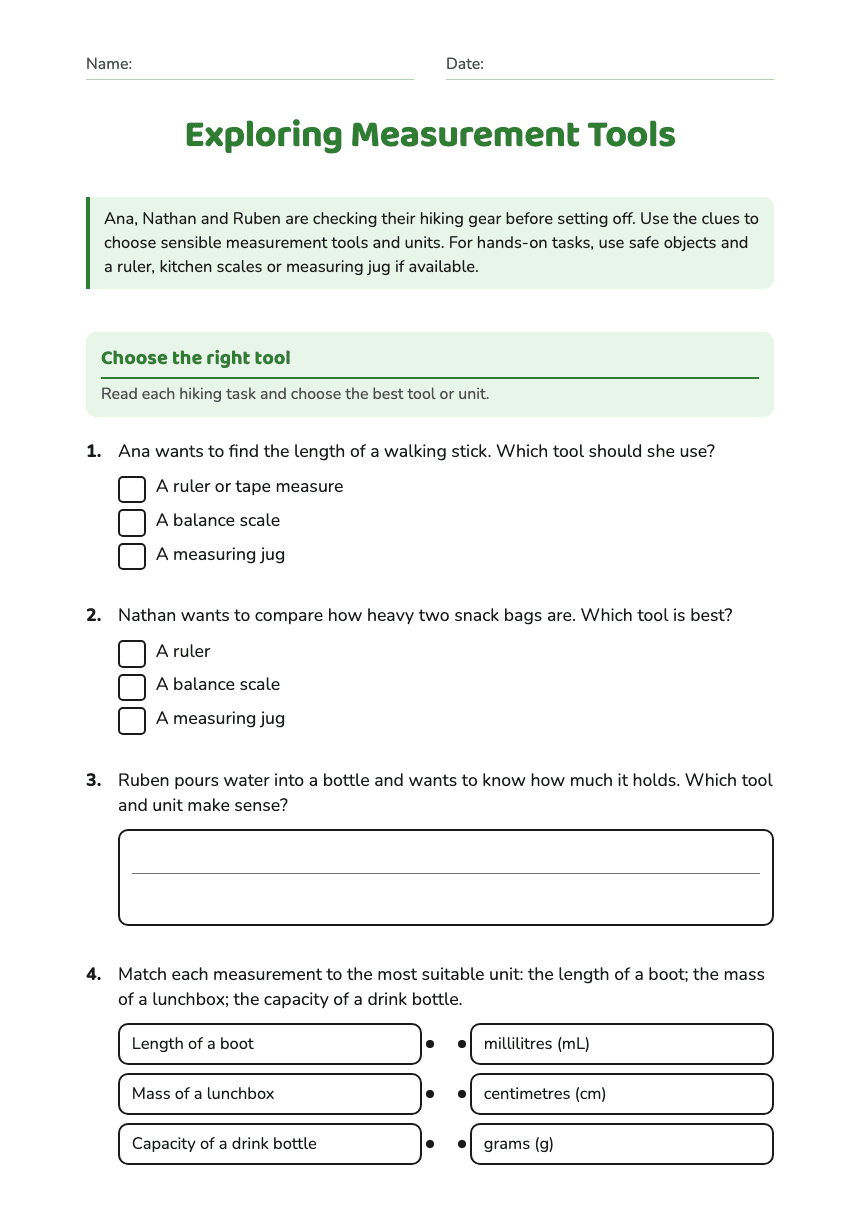
Exploring Measurement Tools worksheet preview
Name:Date:

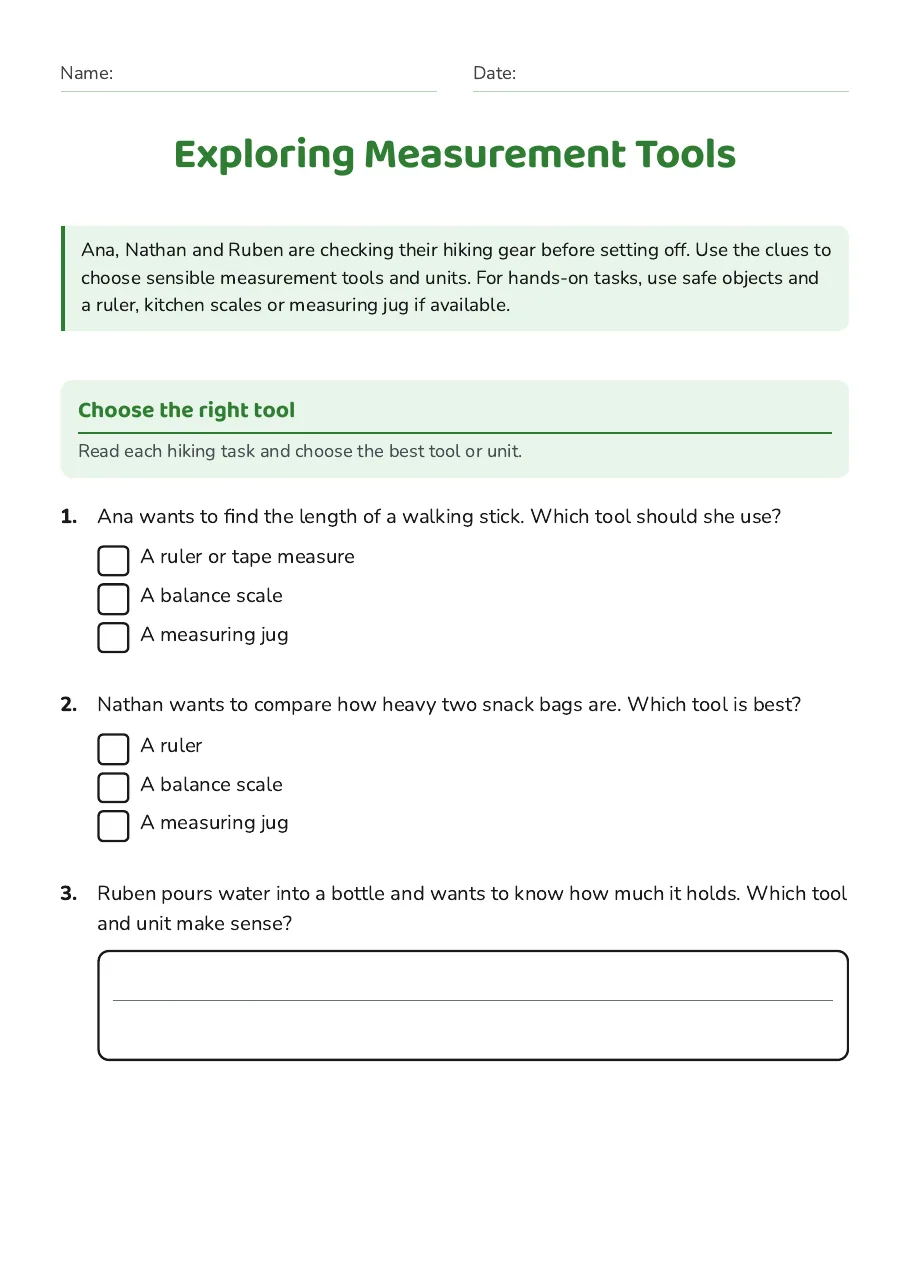
Exploring Measurement Tools

Ana, Nathan and Ruben are checking their hiking gear before setting off. Use the clues to choose sensible measurement tools and units. For hands-on tasks, use safe objects and a ruler, kitchen scales or measuring jug if available.

Choose the right tool

Read each hiking task and choose the best tool or unit.

1.Ana wants to find the length of a walking stick. Which tool should she use?
  • A ruler or tape measure
  • A balance scale
  • A measuring jug
2.Nathan wants to compare how heavy two snack bags are. Which tool is best?
  • A ruler
  • A balance scale
  • A measuring jug
3.Ruben pours water into a bottle and wants to know how much it holds. Which tool and unit make sense?
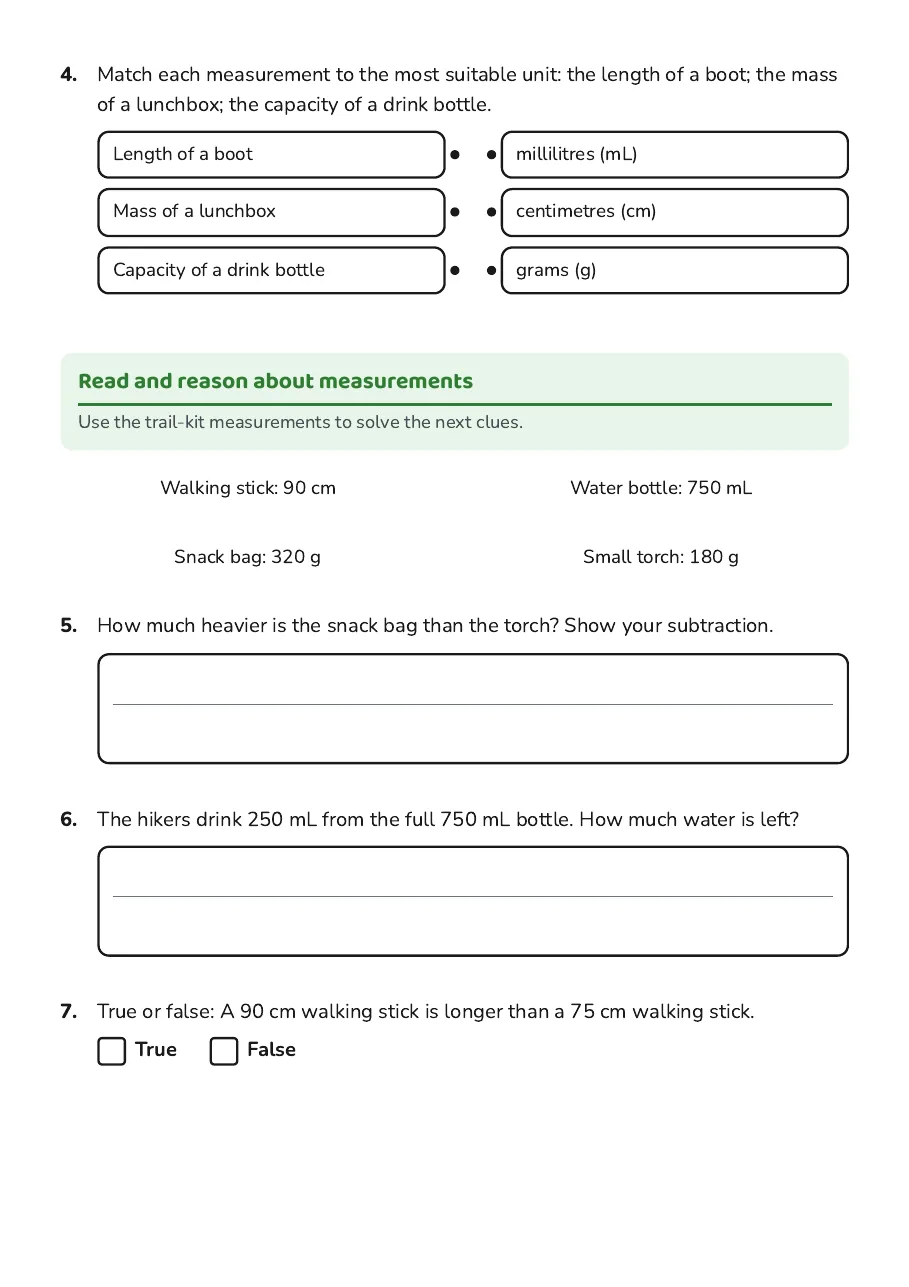
4.Match each measurement to the most suitable unit: the length of a boot; the mass of a lunchbox; the capacity of a drink bottle.
  • Length of a boot
  • Mass of a lunchbox
  • Capacity of a drink bottle
  • millilitres (mL)
  • centimetres (cm)
  • grams (g)

Read and reason about measurements

Use the trail-kit measurements to solve the next clues.

Walking stick: 90 cm

Water bottle: 750 mL

Snack bag: 320 g

Small torch: 180 g

5.How much heavier is the snack bag than the torch? Show your subtraction.
6.The hikers drink 250 mL from the full 750 mL bottle. How much water is left?
7.True or false: A 90 cm walking stick is longer than a 75 cm walking stick.
TrueFalse
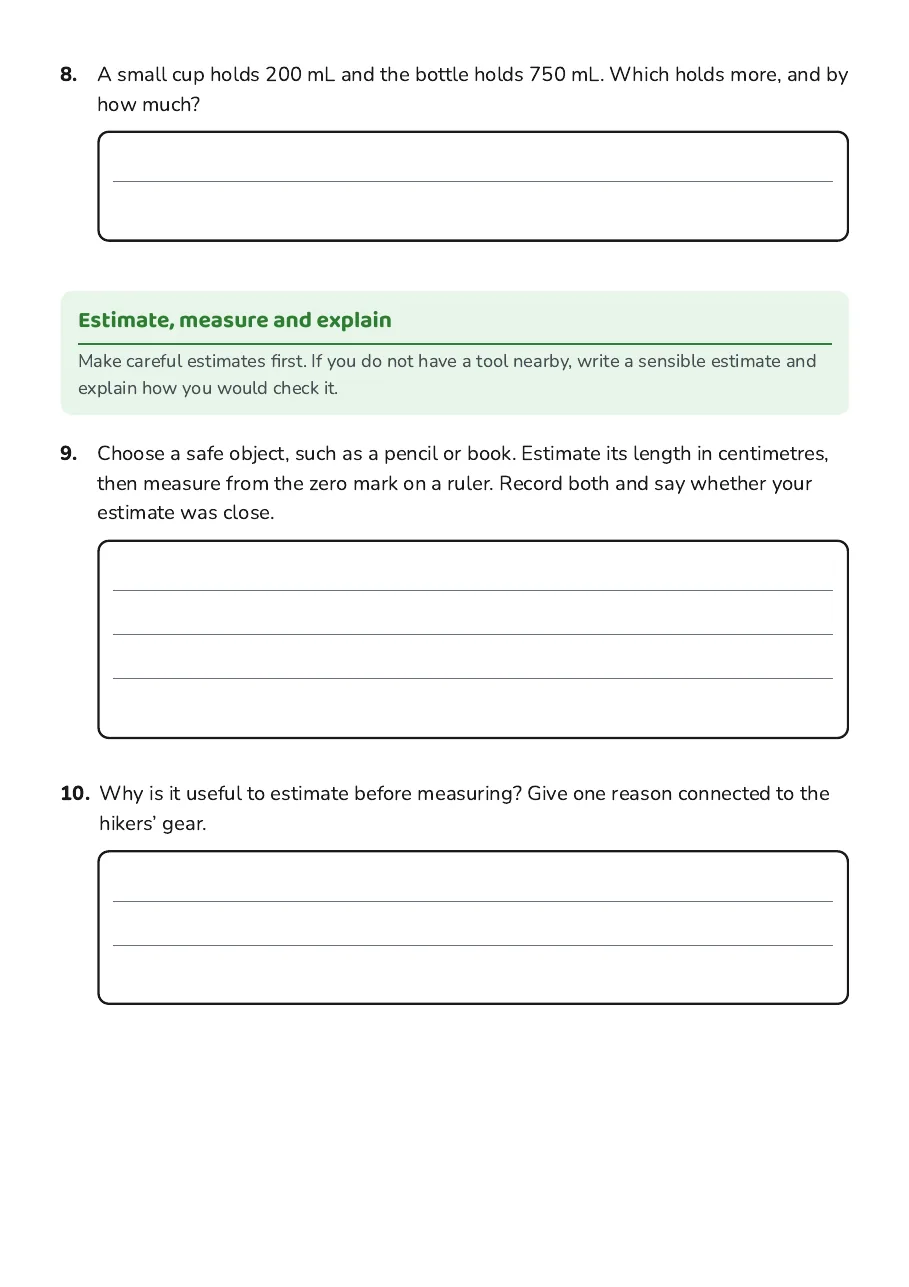
8.A small cup holds 200 mL and the bottle holds 750 mL. Which holds more, and by how much?

Estimate, measure and explain

Make careful estimates first. If you do not have a tool nearby, write a sensible estimate and explain how you would check it.

9.Choose a safe object, such as a pencil or book. Estimate its length in centimetres, then measure from the zero mark on a ruler. Record both and say whether your estimate was close.
10.Why is it useful to estimate before measuring? Give one reason connected to the hikers’ gear.
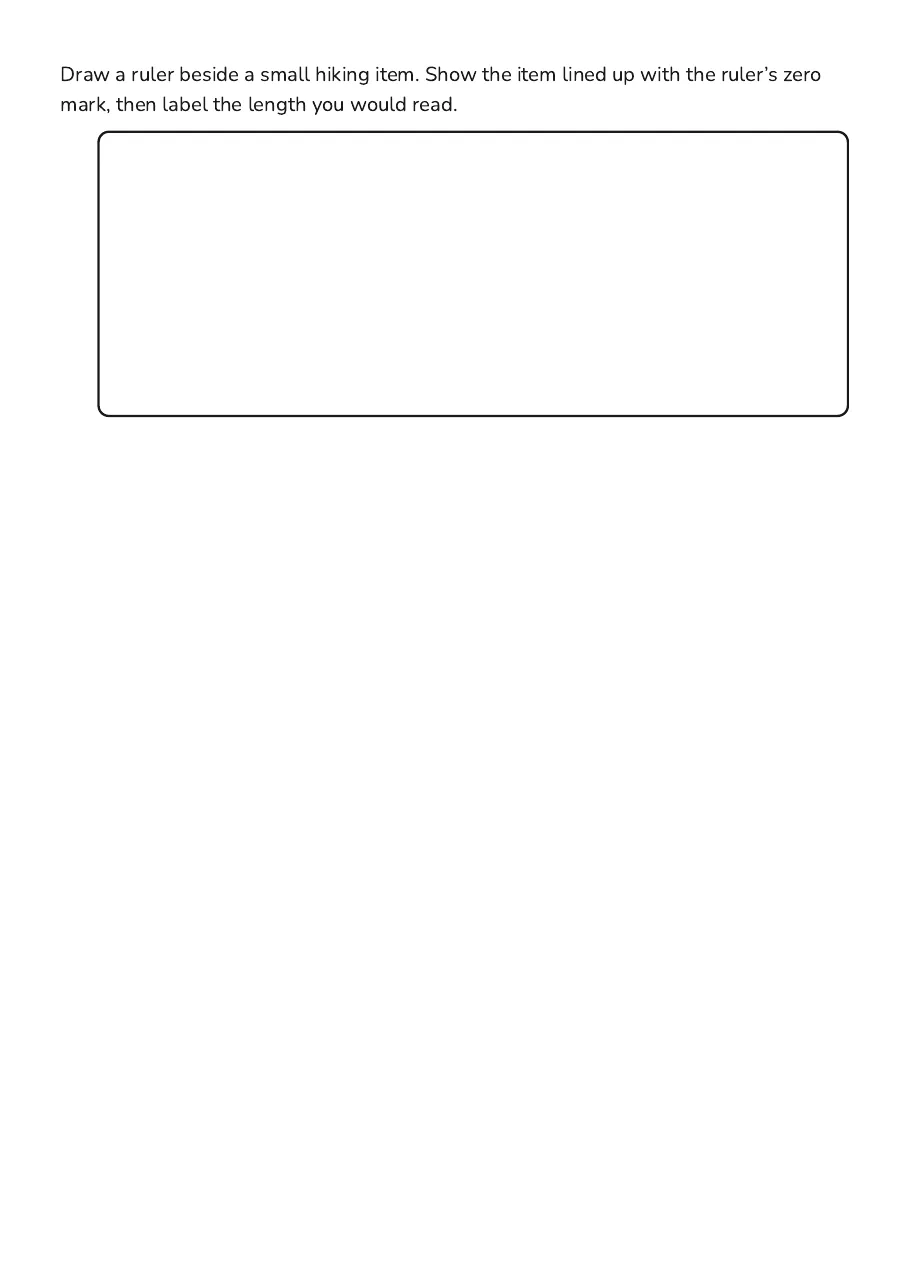
Draw a ruler beside a small hiking item. Show the item lined up with the ruler’s zero mark, then label the length you would read.

4 printable pages

  • Mountain hike measurement mission: hikers and their measuring tools

    Page 1

  • Measurement tools and units for hiking gear

    Page 2

  • Trail-kit measurements: length, mass and capacity clues

    Page 3

  • Estimate and measure items; explain how to measure from zero

    Page 4

About This Worksheet

Free in Kuraplan

Sign up free, grab the PDF, and customize it for your class.

Print-Ready

Formatted for standard paper. Clean layout, easy to read.

AI-Generated

Created with Kuraplan's AI, designed for real classroom use.

For Teachers & Parents

Use in classrooms, for homework, tutoring, or homeschool.

Need a custom version of this worksheet?

Kuraplan's AI generates custom worksheets in seconds — differentiated for every learner, aligned to your curriculum.

Generate Custom Worksheets — Free
No credit card Curriculum-aligned Under 60 seconds