ScienceFreePrintable

Food Webs Energy Transfer

A free science worksheet ready for your classroom. Open in Kuraplan to grab the print-ready PDF, customize it for your students, or generate a fresh version in seconds.
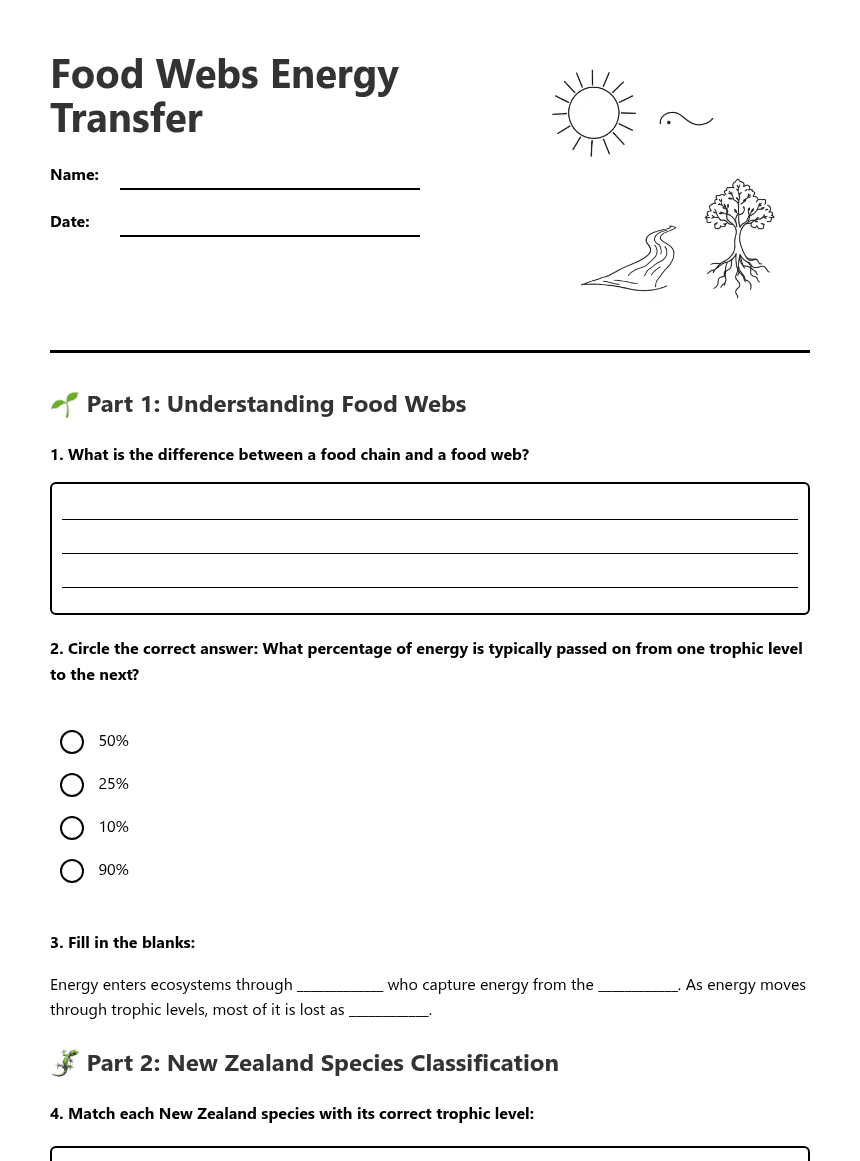
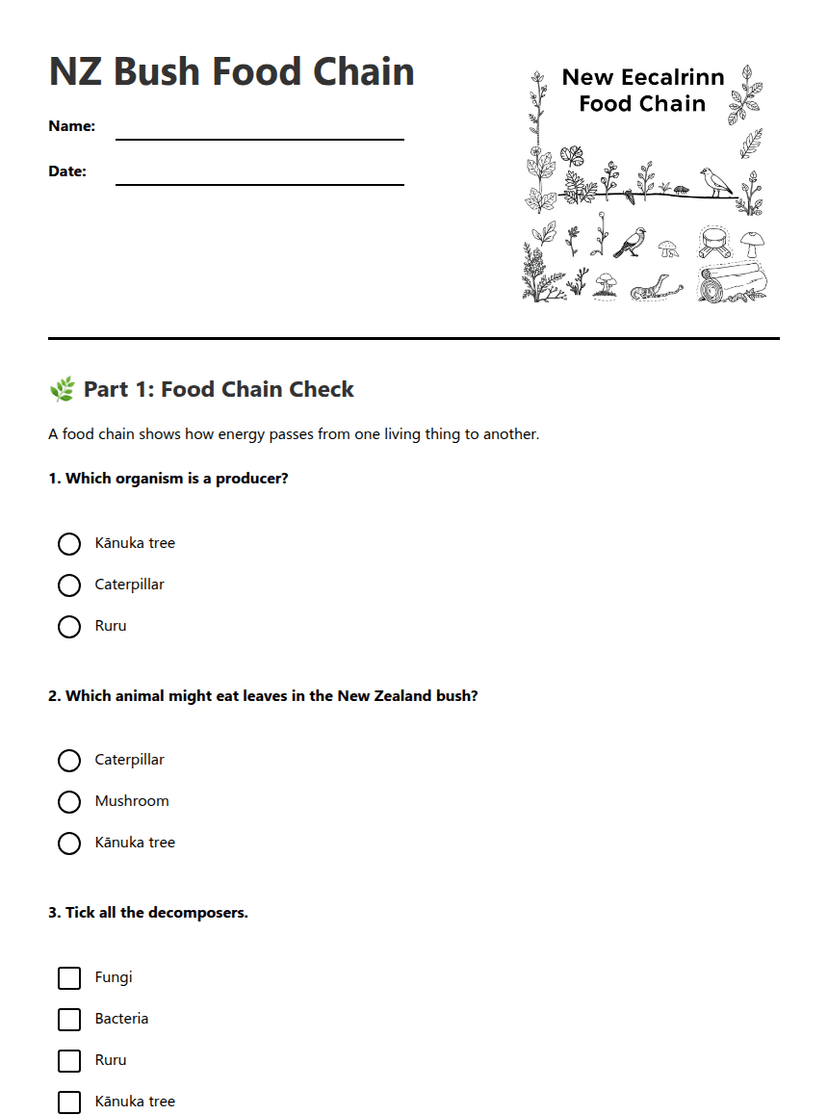
Food Webs Energy Transfer worksheet preview
Food Webs Energy Transfer

Food Webs Energy Transfer

Food web diagram showing energy flow

🌱 Part 1: Understanding Food Webs

1. What is the difference between a food chain and a food web?
2. Circle the correct answer: What percentage of energy is typically passed on from one trophic level to the next?

50%

25%

10%

90%

3. Fill in the blanks:

Energy enters ecosystems through _____________ who capture energy from the ____________. As energy moves through trophic levels, most of it is lost as ____________.

🦎 Part 2: New Zealand Species Classification

4. Match each New Zealand species with its correct trophic level:
1. Flax plant
2. Silvereye
3. Tuatara
4. Fungi
5. Fernbird
A. Primary consumer
B. Secondary consumer
C. Producer
D. Decomposer
E. Tertiary consumer
5. Check all the roles that decomposers play in food webs:

Break down dead organic matter

Return nutrients to the soil

Capture energy from the sun

Complete the nutrient cycle

⚡ Part 3: Energy Transfer Calculations

6. A producer captures 1000 units of energy from the sun. Calculate how much energy reaches each trophic level:

Producer (flax plant): 1000 units

Primary consumer (insects): _______ units

Secondary consumer (silvereye): _______ units

Tertiary consumer (tuatara): _______ units

7. Explain why there are fewer predators than prey animals in ecosystems:

🎨 Part 4: Design Your Food Web

8. Draw a food web using at least 6 New Zealand native species. Include arrows to show energy flow and label each organism's trophic level:
9. Choose one food chain from your web above and describe what would happen if the primary consumer was removed:

🌍 Part 5: Human Impact and Reflection

10. List three ways humans can impact food webs and energy transfer:
11. Circle the statement that best explains why understanding energy flow is important:

It helps us understand why ecosystems can support only limited numbers of top predators

It shows us that all animals need the same amount of food

It proves that plants are not important in ecosystems

It demonstrates that energy increases as it moves up food chains

12. Reflection: Why is it important to protect producers (plants) in New Zealand ecosystems?

About This Worksheet

Free in Kuraplan

Sign up free, grab the PDF, and customize it for your class.

Print-Ready

Formatted for standard paper. Clean layout, easy to read.

AI-Generated

Created with Kuraplan's AI, designed for real classroom use.

For Teachers & Parents

Use in classrooms, for homework, tutoring, or homeschool.

Need a custom version of this worksheet?

Kuraplan's AI generates custom worksheets in seconds — differentiated for every learner, aligned to your curriculum.

Generate Custom Worksheets — Free
No credit card Curriculum-aligned Under 60 seconds