Introduction to Ratios Worksheet
A free mathematics worksheet ready for your classroom. Open in Kuraplan to grab the print-ready PDF, customize it for your students, or generate a fresh version in seconds.
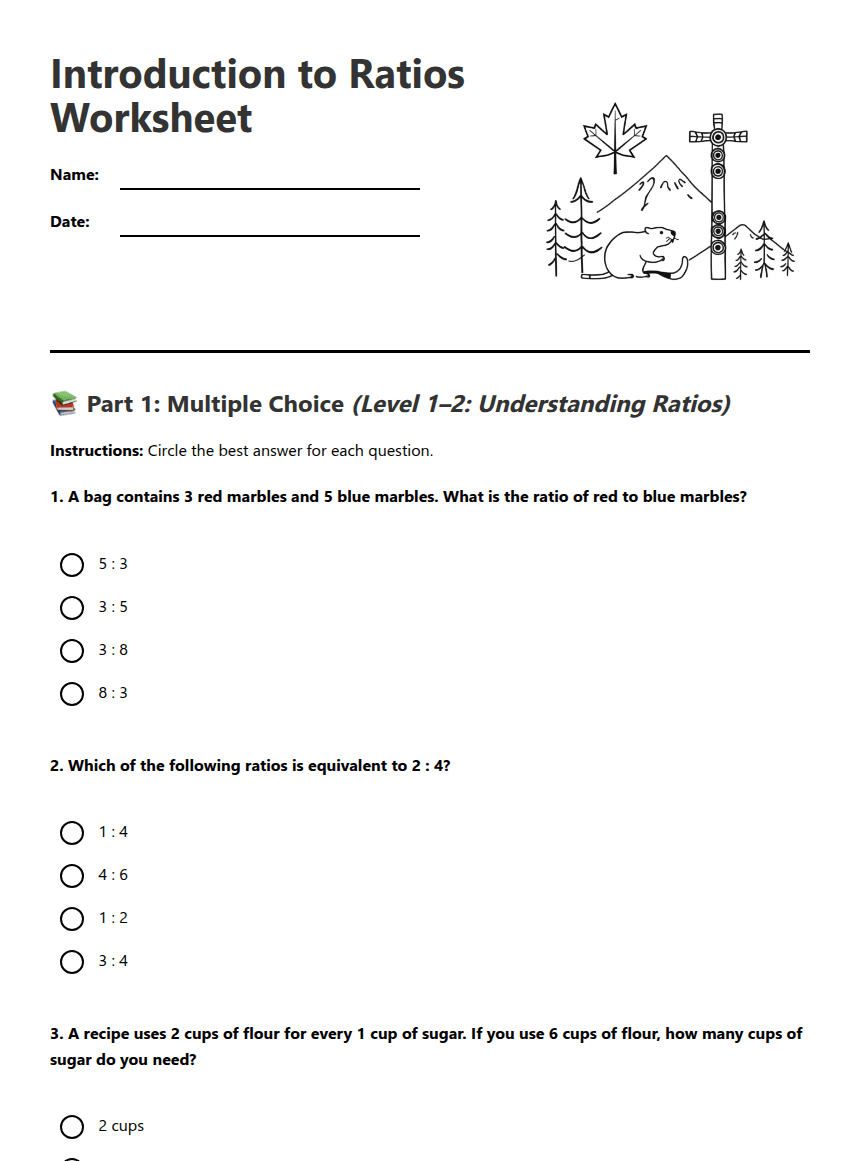
Introduction to Ratios Worksheet

📚 Part 1: Multiple Choice (Level 1–2: Understanding Ratios)
Instructions: Circle the best answer for each question.
🔗 Part 2: Matching (Level 2–3: Simplifying Ratios)
Instructions: Match each ratio on the left to its simplified form on the right.
✏️ Part 3: Short Answer & Application (Level 3–4: Real-Life Ratios)
Instructions: Show your work clearly. Include units where needed.
🌟 Answer Key (For Teacher Use)
Part 1: Multiple Choice
1. ✅ 3 : 5 — Red marbles to blue marbles is 3 to 5.
2. ✅ 1 : 2 — Divide both parts of 2 : 4 by 2 to get 1 : 2.
3. ✅ 3 cups — The ratio is 2 : 1, so 6 cups of flour requires 6 ÷ 2 = 3 cups of sugar.
4. ✅ 3 : 4 — Divide both 12 and 16 by their GCF (4): 12 ÷ 4 = 3, 16 ÷ 4 = 4.
5. ✅ 1 : 2, 6 : 12, 9 : 18 — All three simplify to 1 : 2. (2 : 3 does not.)
6. ✅ 60 : 1 — The ratio of miles to hours is 60 to 1.
7. ✅ 2 : 3 — The ratio of girls to boys is 2 to 3.
8. ✅ 1 : 3 — 5 : 15 simplifies to 1 : 3.
9. ✅ 2 : 5 — The ratio of apples to total fruits is 2 to 5.
10. ✅ 6 cups — 9 cups of water requires 6 cups of rice.
Part 2: Matching
A → 2 : 3 (10 ÷ 5 = 2, 15 ÷ 5 = 3)
B → 2 : 3 (8 ÷ 4 = 2, 12 ÷ 4 = 3)
C → 2 : 3 (6 ÷ 3 = 2, 9 ÷ 3 = 3)
D → 4 : 5 (20 ÷ 5 = 4, 25 ÷ 5 = 5)
E → 1 : 2 (14 ÷ 14 = 1, 28 ÷ 14 = 2)
F → 1 : 3 (9 ÷ 9 = 1, 27 ÷ 9 = 3)
Q11: Accept answers noting that A, B, C, and E all simplify to the same ratio (2 : 3), showing that many different ratios can be equivalent.
Part 3: Short Answer
12. 14 : 10 → divide by 2 → 7 : 5
13. 8 cm × 5 km = 40 km
14. Total parts = 2 + 3 = 5 parts. Each part = 500 ÷ 5 = 100 mL. Orange juice = 2 × 100 = 200 mL. Water = 3 × 100 = 300 mL.
15. Sample answer: A ratio compares two quantities, e.g., 3 : 4 (3 apples for every 4 oranges). A fraction shows part of a whole, e.g., ¾ means 3 out of 4 equal parts. Ratios can compare any two amounts; fractions always relate a part to a whole.
16. 12 cups of flour requires 9 cups of sugar.
17. 20 - 12 = 8 boys → Ratio is 8 : 12 or simplified to 2 : 3.
18. Total flowers = 18 + 6 = 24 → Ratio is 18 : 24 or simplified to 3 : 4.
19. 15 parts of flour requires 6 parts of sugar.
20. 120 miles in 2 hours simplifies to 60 : 1.
About This Worksheet
Free in Kuraplan
Sign up free, grab the PDF, and customize it for your class.
Print-Ready
Formatted for standard paper. Clean layout, easy to read.
AI-Generated
Created with Kuraplan's AI, designed for real classroom use.
For Teachers & Parents
Use in classrooms, for homework, tutoring, or homeschool.
Need a custom version of this worksheet?
Kuraplan's AI generates custom worksheets in seconds — differentiated for every learner, aligned to your curriculum.
Generate Custom Worksheets — FreeMore Mathematics Worksheets
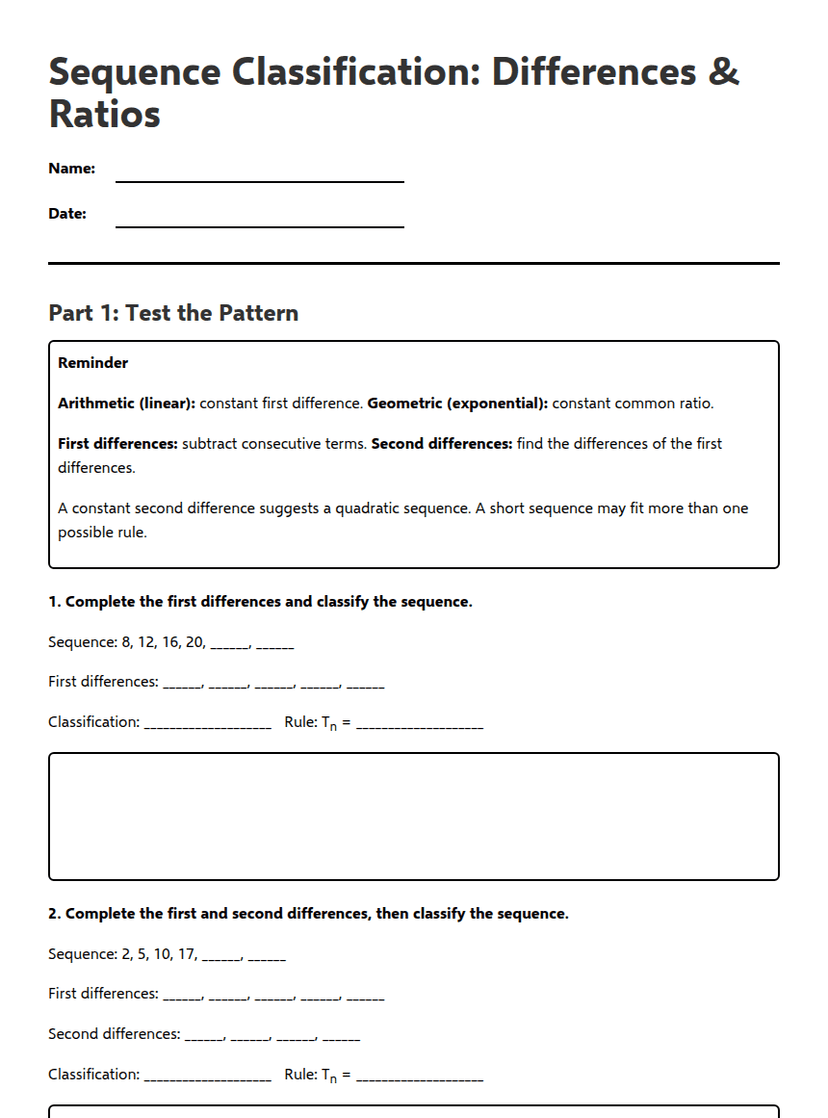
Sequence Classification: Differences & Ratios
Free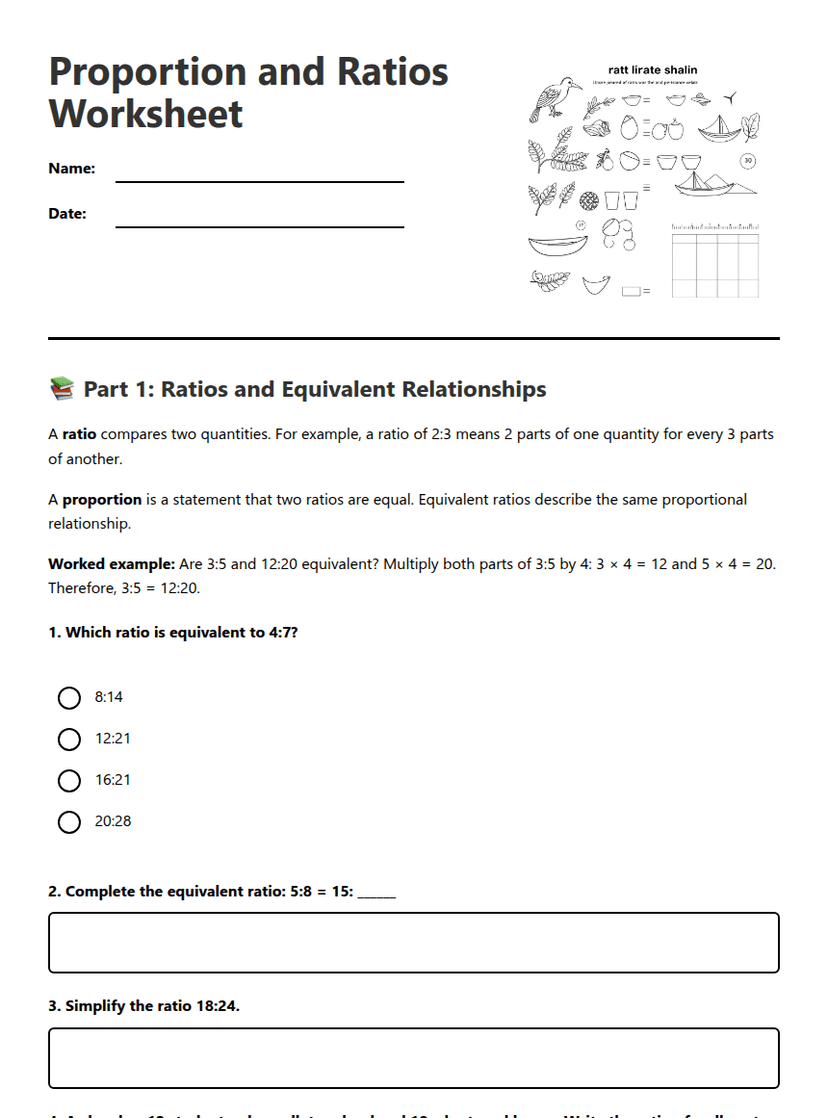
Proportion and Ratios Worksheet
Free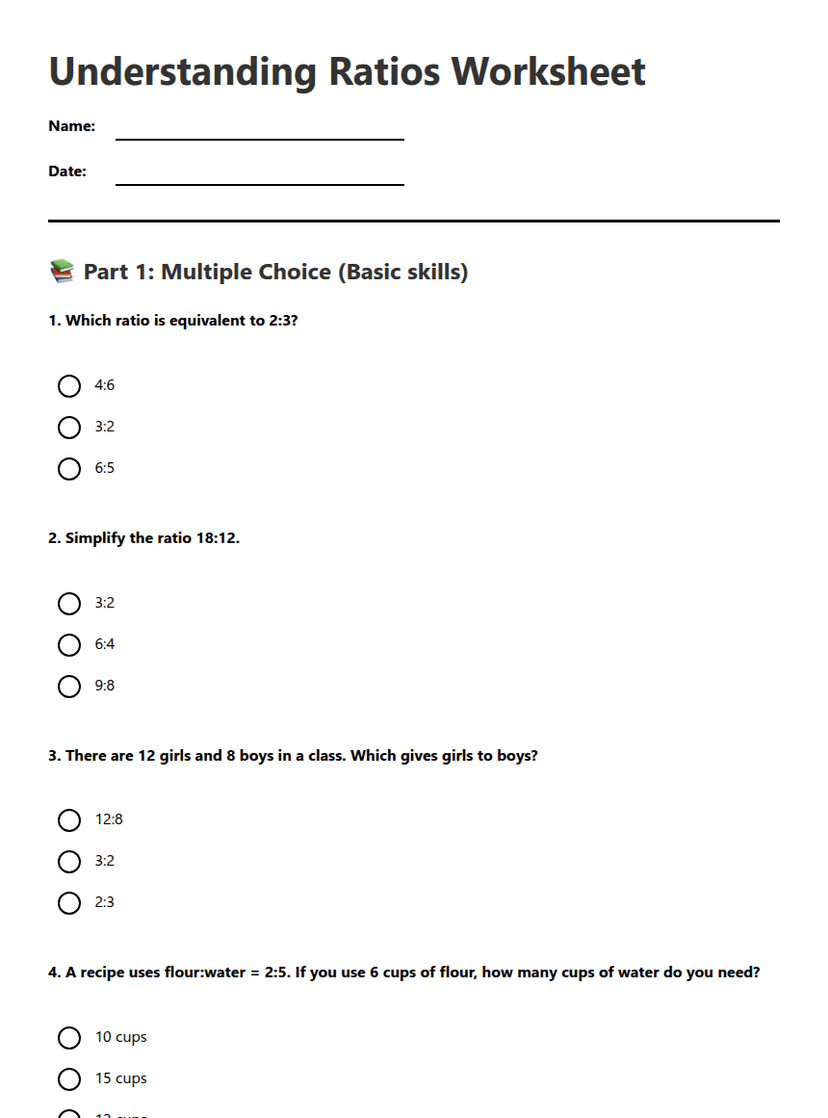
Understanding Ratios Worksheet
Free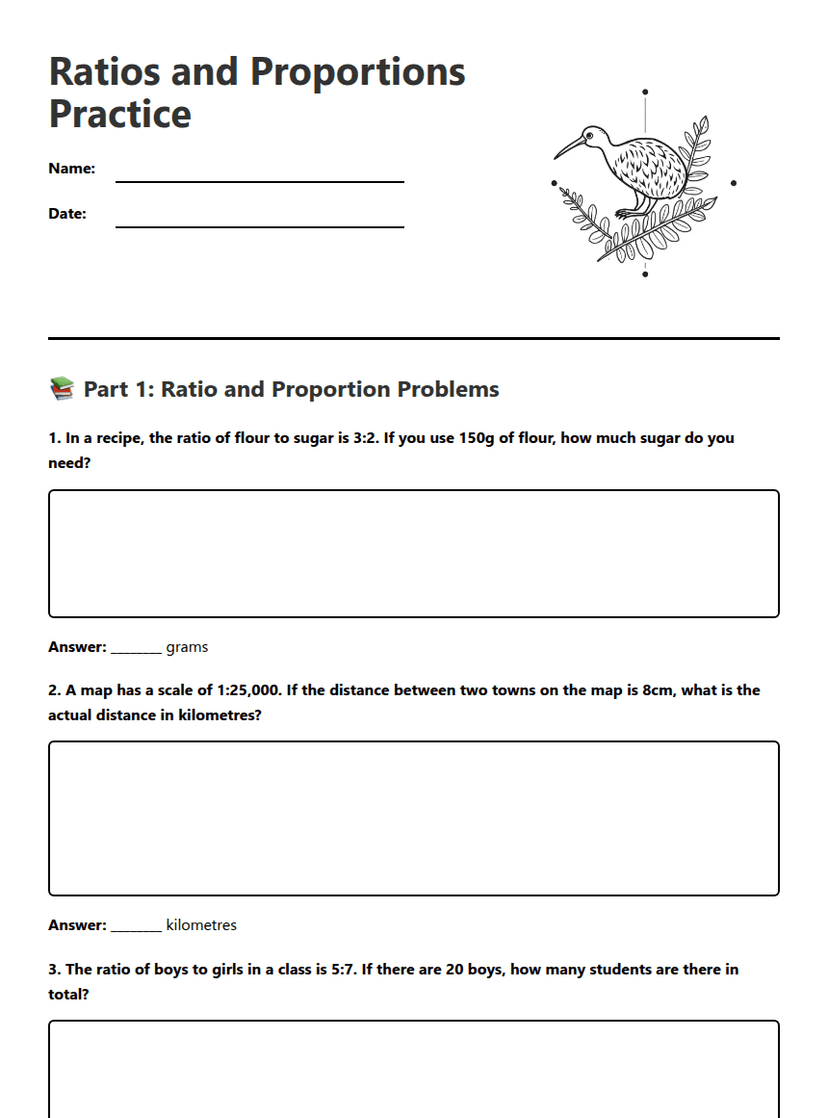
Ratios and Proportions Practice
Free
Mihi Introduction Worksheet
Free
Mastering Ratios Worksheet
Free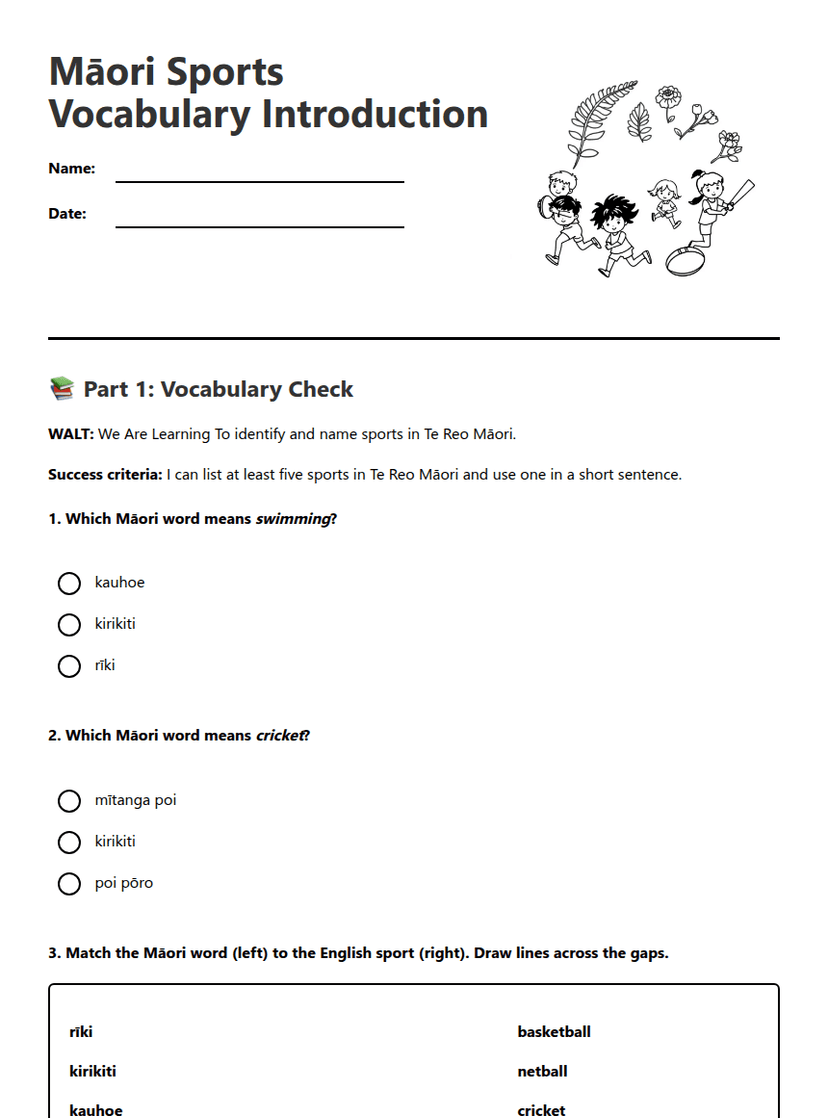
Māori Sports Vocabulary Introduction
Free