Mastering Measurement Concepts
A free maths worksheet ready for your classroom. Open in Kuraplan to grab the print-ready PDF, customize it for your students, or generate a fresh version in seconds.

Mastering Measurement Concepts
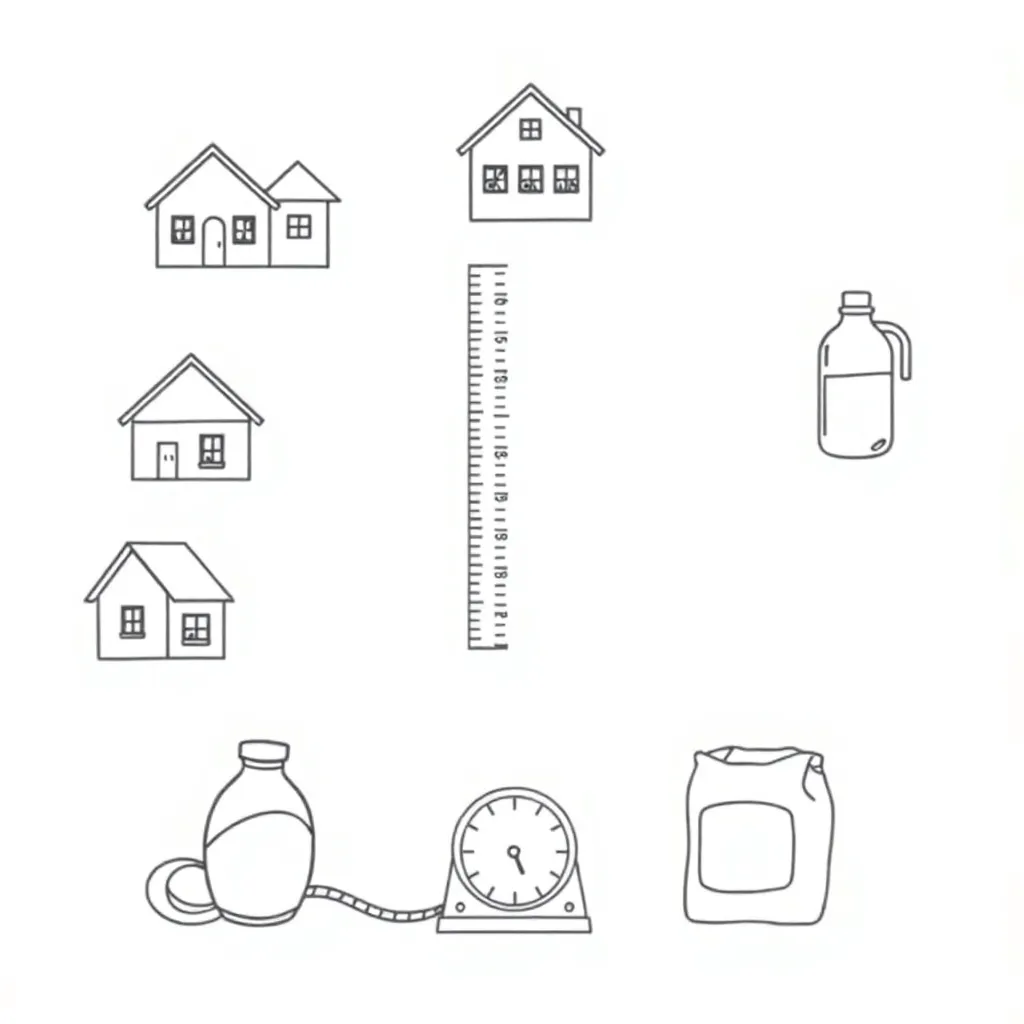
📏 Part 1: Types of Measurement
Measuring the height of your desk:
Finding how much water fits in a bottle:
Calculating the floor space of your bedroom:
📐 Part 2: Choosing Appropriate Units
The length of a rugby field:
The mass of a bag of flour:
The volume of a swimming pool:
The area of a postage stamp:
a) The distance from Auckland to Wellington is approximately 650 ______________.
b) A can of soft drink contains 330 ______________.
c) The mass of a paperclip is about 1 ______________.
d) A football field has an area of approximately 7000 ______________.
🔄 Part 3: Metric System Conversions
a) 2.5 metres = __________ centimetres
b) 3000 grams = __________ kilograms
c) 1.5 litres = __________ millilitres
d) 450 centimetres = __________ metres
Problem A: Sarah needs 2.5 kg of flour for baking. She has a 750g bag and a 1200g bag. Does she have enough flour? Show your working.
Problem B: A rectangular garden bed is 3.5m long and 2m wide. What is its area in square metres?
🤔 Part 4: Reflection and Real-World Applications
🌟 Part 5: Extension Challenge (Advanced Learners)
About This Worksheet
Free in Kuraplan
Sign up free, grab the PDF, and customize it for your class.
Print-Ready
Formatted for standard paper. Clean layout, easy to read.
AI-Generated
Created with Kuraplan's AI, designed for real classroom use.
For Teachers & Parents
Use in classrooms, for homework, tutoring, or homeschool.
Need a custom version of this worksheet?
Kuraplan's AI generates custom worksheets in seconds — differentiated for every learner, aligned to your curriculum.
Generate Custom Worksheets — Free