Te Reo MāoriFreePrintable

Matariki Whānau Connections Worksheet

A free te reo māori worksheet ready for your classroom. Open in Kuraplan to grab the print-ready PDF, customize it for your students, or generate a fresh version in seconds.
Matariki Whānau Connections Worksheet worksheet preview
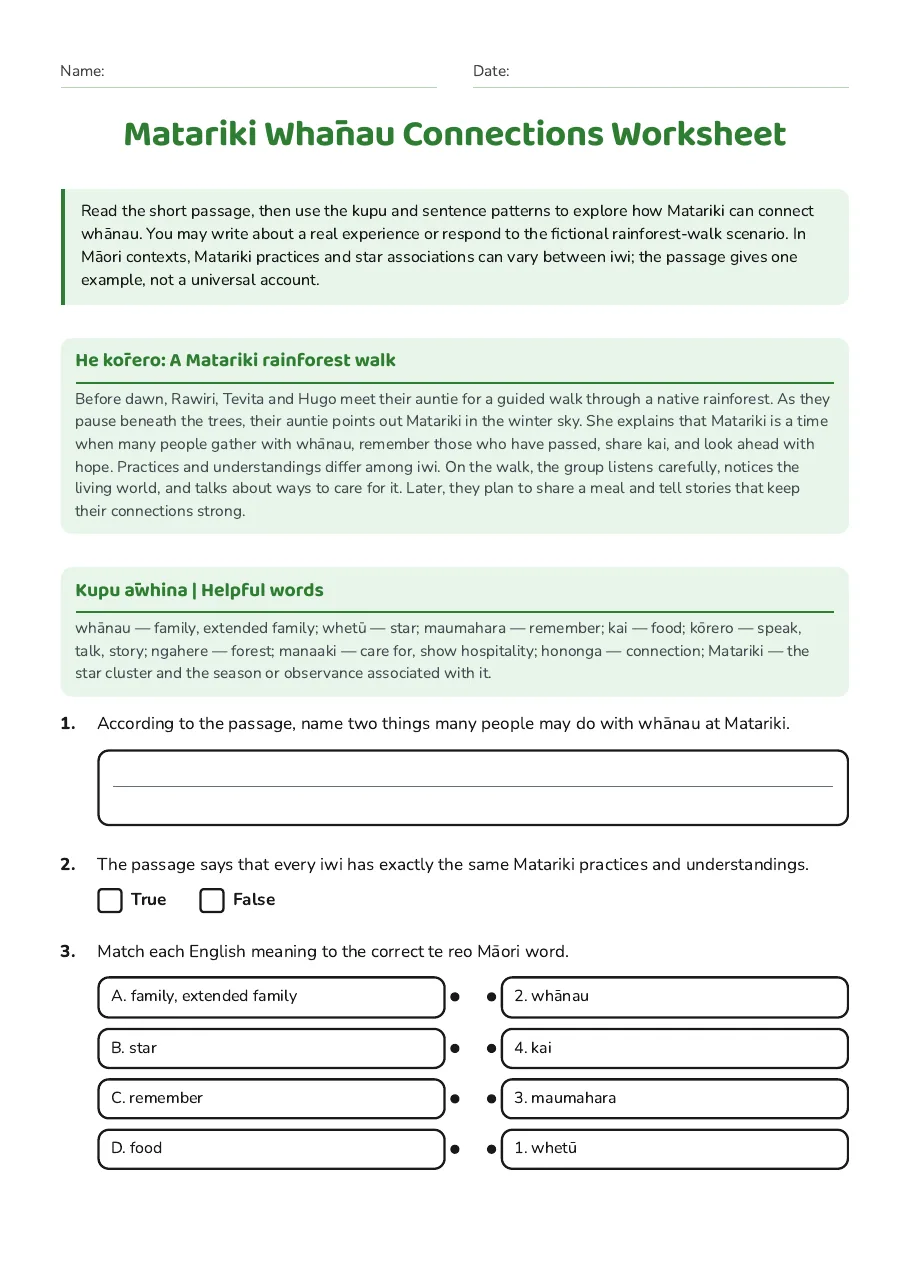
Name:Date:

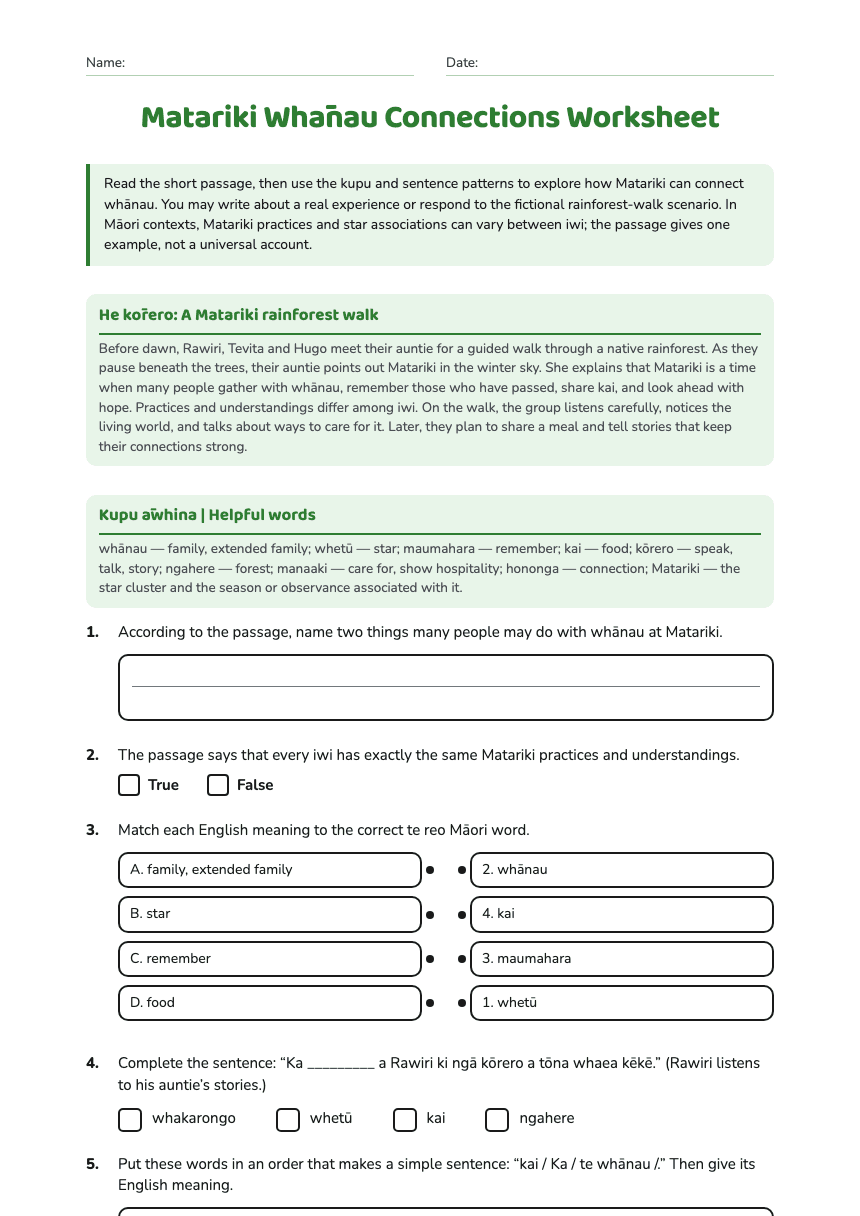
Matariki Whānau Connections Worksheet

Read the short passage, then use the kupu and sentence patterns to explore how Matariki can connect whānau. You may write about a real experience or respond to the fictional rainforest-walk scenario. In Māori contexts, Matariki practices and star associations can vary between iwi; the passage gives one example, not a universal account.

He kōrero: A Matariki rainforest walk

Before dawn, Rawiri, Tevita and Hugo meet their auntie for a guided walk through a native rainforest. As they pause beneath the trees, their auntie points out Matariki in the winter sky. She explains that Matariki is a time when many people gather with whānau, remember those who have passed, share kai, and look ahead with hope. Practices and understandings differ among iwi. On the walk, the group listens carefully, notices the living world, and talks about ways to care for it. Later, they plan to share a meal and tell stories that keep their connections strong.

Kupu āwhina | Helpful words

whānau — family, extended family; whetū — star; maumahara — remember; kai — food; kōrero — speak, talk, story; ngahere — forest; manaaki — care for, show hospitality; hononga — connection; Matariki — the star cluster and the season or observance associated with it.

1.According to the passage, name two things many people may do with whānau at Matariki.
2.The passage says that every iwi has exactly the same Matariki practices and understandings.
TrueFalse
3.Match each English meaning to the correct te reo Māori word.
  • A. family, extended family
  • B. star
  • C. remember
  • D. food
  • 2. whānau
  • 4. kai
  • 3. maumahara
  • 1. whetū
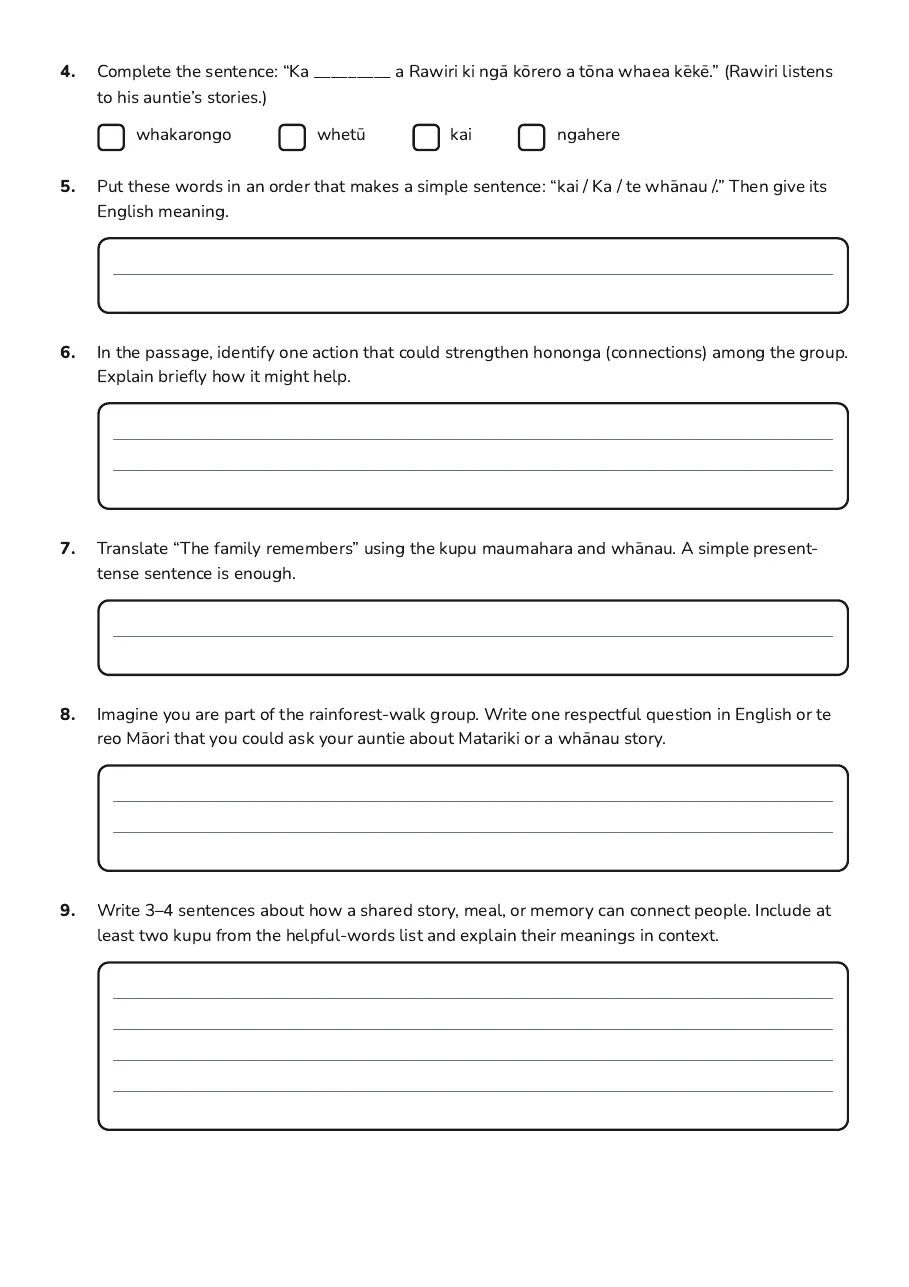
4.Complete the sentence: “Ka _________ a Rawiri ki ngā kōrero a tōna whaea kēkē.” (Rawiri listens to his auntie’s stories.)
  • whakarongo
  • whetū
  • kai
  • ngahere
5.Put these words in an order that makes a simple sentence: “kai / Ka / te whānau /.” Then give its English meaning.
6.In the passage, identify one action that could strengthen hononga (connections) among the group. Explain briefly how it might help.
7.Translate “The family remembers” using the kupu maumahara and whānau. A simple present-tense sentence is enough.
8.Imagine you are part of the rainforest-walk group. Write one respectful question in English or te reo Māori that you could ask your auntie about Matariki or a whānau story.
9.Write 3–4 sentences about how a shared story, meal, or memory can connect people. Include at least two kupu from the helpful-words list and explain their meanings in context.
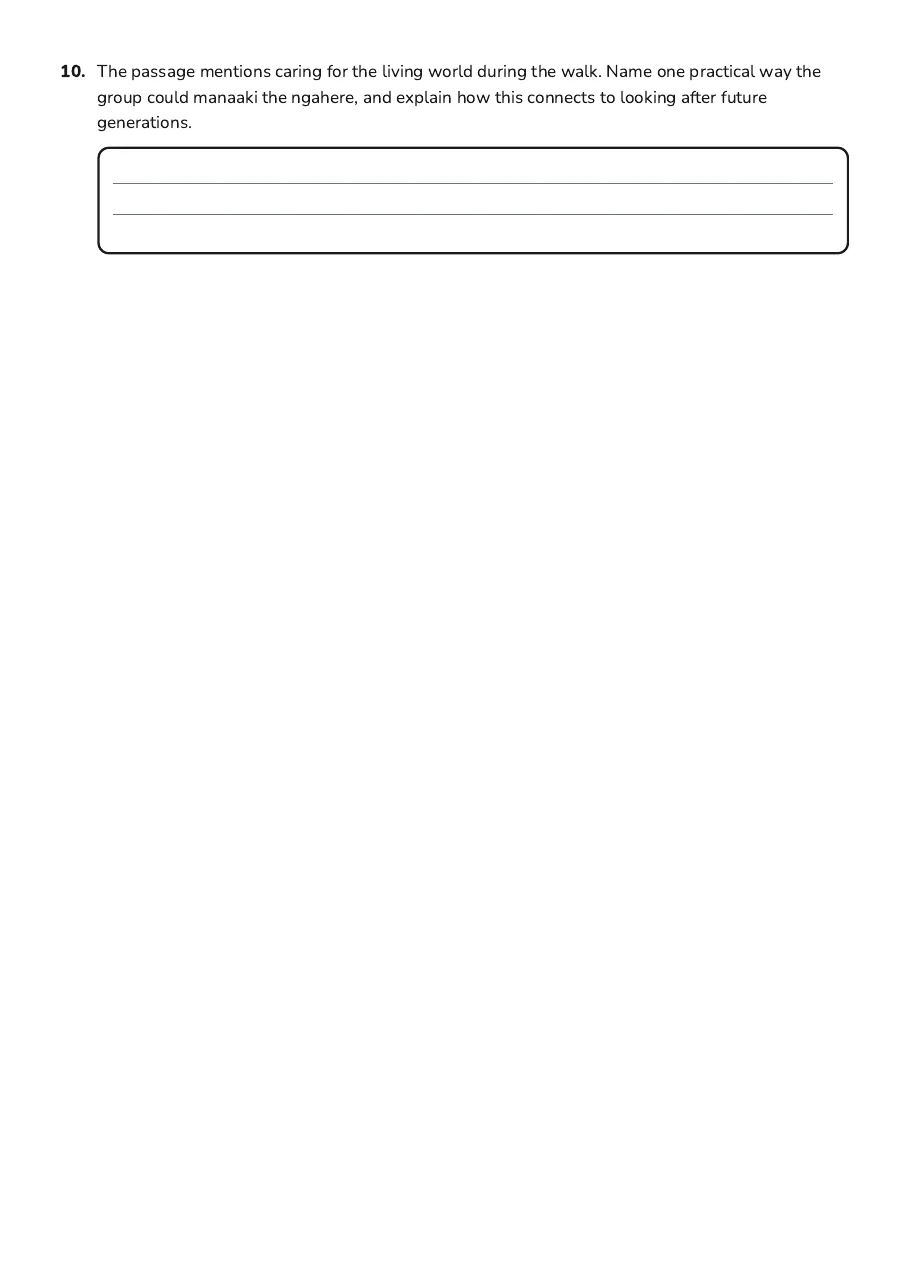
10.The passage mentions caring for the living world during the walk. Name one practical way the group could manaaki the ngahere, and explain how this connects to looking after future generations.

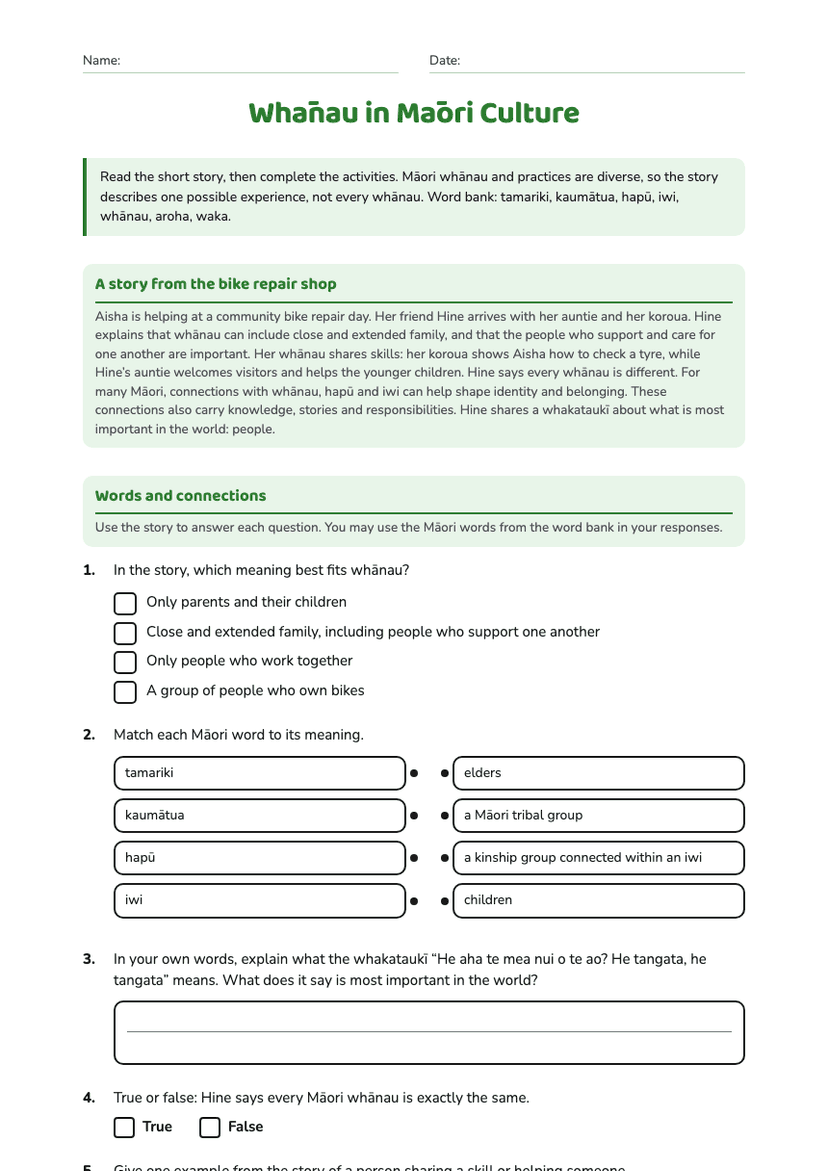
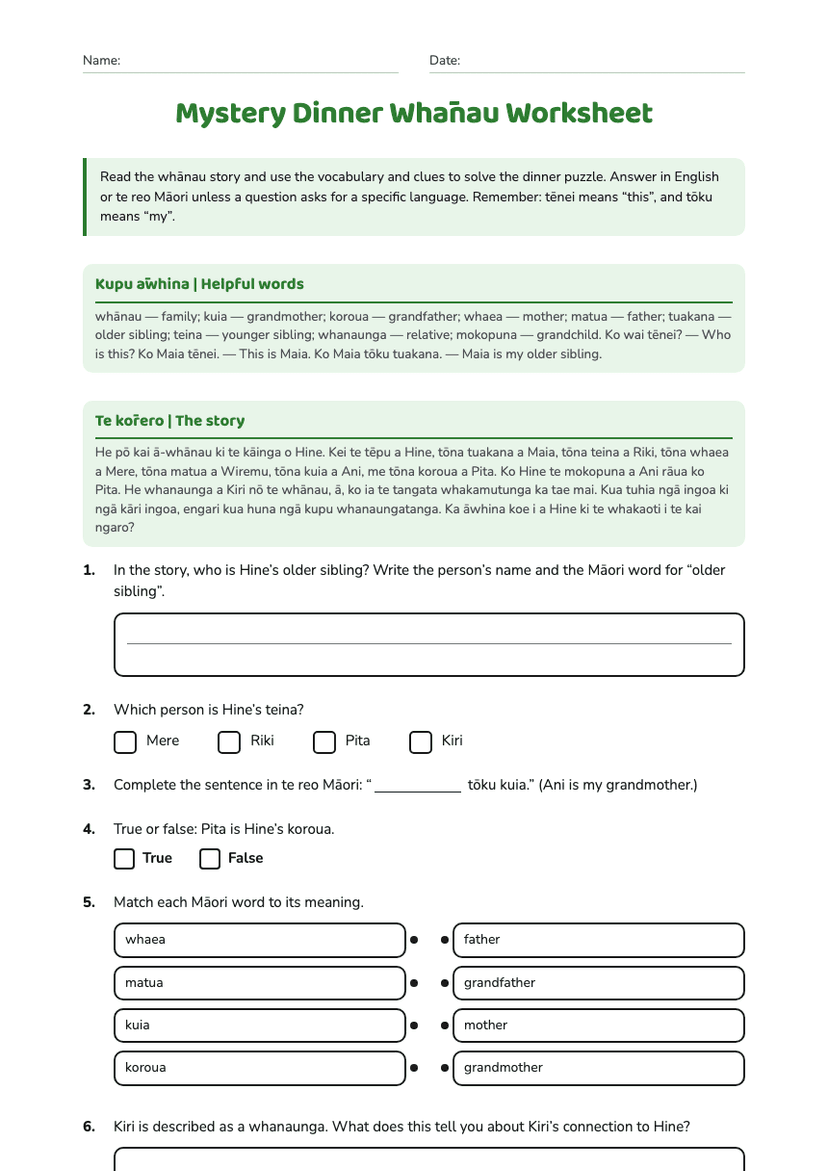
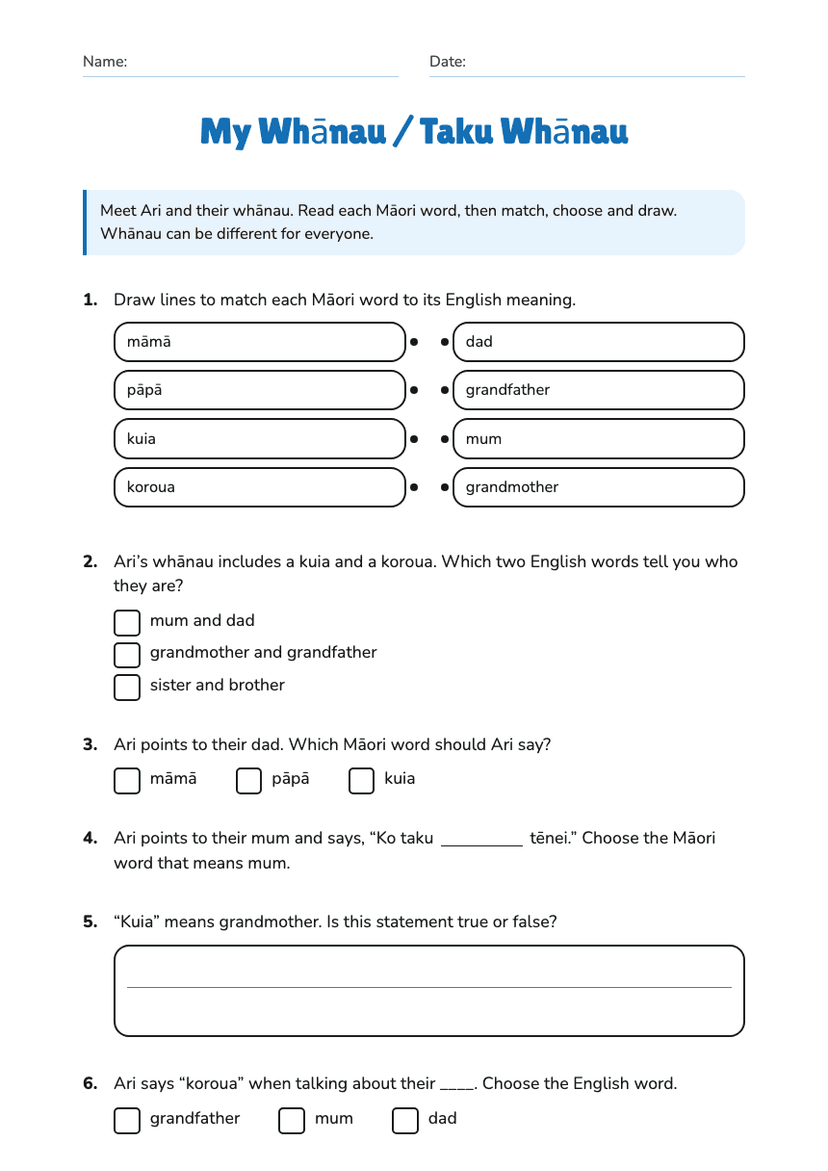
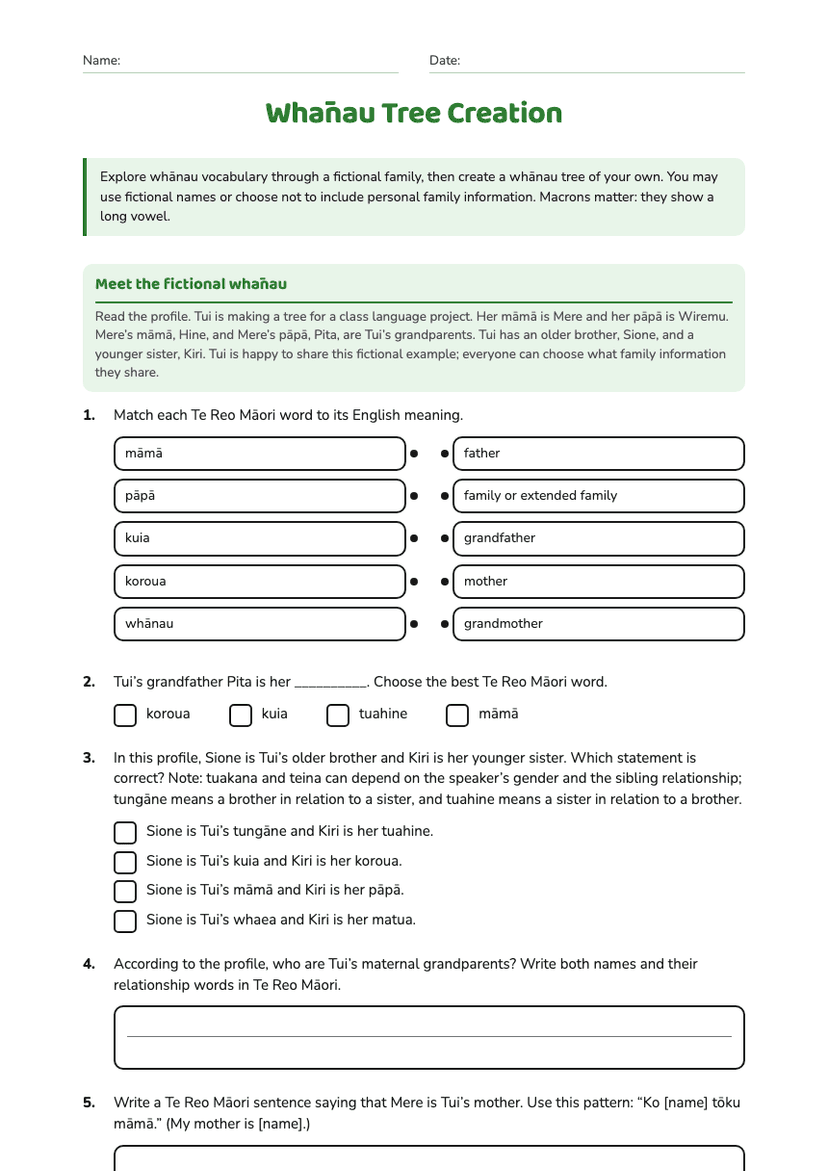
3 printable pages

  • Matariki Whānau Connections Worksheet, page 1 of 3: He kōrero: A Matariki rainforest walk, Kupu āwhina | Helpful words

    Page 1

  • Matariki Whānau Connections Worksheet, page 2 of 3: 4. Complete the sentence: “Ka _________ a Rawiri ki ngā kō rero a tō na whaea kē kē .”…

    Page 2

  • Matariki Whānau Connections Worksheet, page 3 of 3: 10. The passage mentions caring for the living world during the walk. Name one practical…

    Page 3

About This Worksheet

Free in Kuraplan

Sign up free, grab the PDF, and customize it for your class.

Print-Ready

Formatted for standard paper. Clean layout, easy to read.

AI-Generated

Created with Kuraplan's AI, designed for real classroom use.

For Teachers & Parents

Use in classrooms, for homework, tutoring, or homeschool.

Need a custom version of this worksheet?

Kuraplan's AI generates custom worksheets in seconds — differentiated for every learner, aligned to your curriculum.

Generate Custom Worksheets — Free
No credit card Curriculum-aligned Under 60 seconds

Explore more free resources