Metric Measurement Introduction
A free maths worksheet ready for your classroom. Open in Kuraplan to grab the print-ready PDF, customize it for your students, or generate a fresh version in seconds.
Metric Measurement Introduction
📏 Part 1: Understanding Metric Units
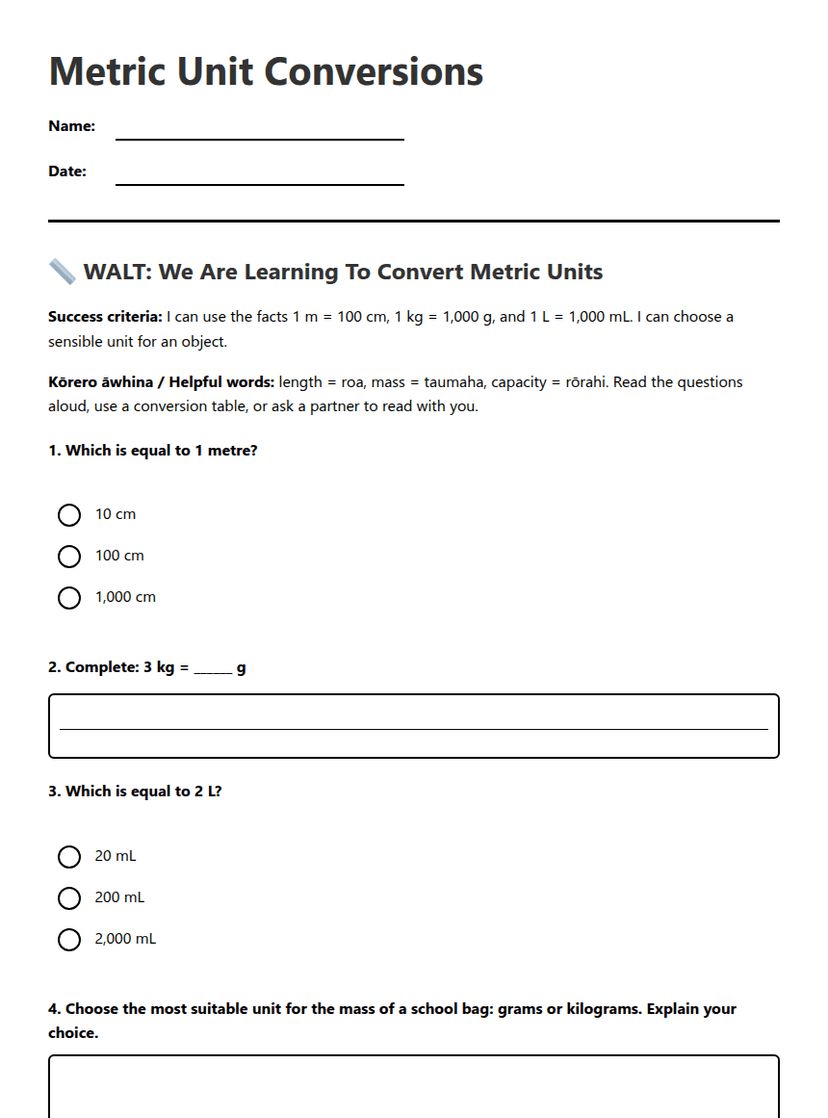
a) Kilo- means _____________ times bigger than the base unit
b) Centi- means _____________ of the base unit (or 1/100)
c) Milli- means _____________ of the base unit (or 1/1000)
🎯 Part 2: Choosing the Right Unit
Height of a Year 8 student:
Mass of a textbook:
Capacity of a water bottle:
📐 Part 3: Estimation Practice
a) Length of your desk: __________ ____
b) Mass of your pencil case: __________ ____
c) Capacity of a coffee mug: __________ ____
d) Temperature of the classroom: __________ ____
e) Thickness of this worksheet: __________ ____
a) Desk length: ____________________
b) Pencil case mass: ____________________
c) Mug capacity: ____________________
d) Room temperature: ____________________
e) Paper thickness: ____________________
🔍 Part 4: Real-World Applications
Centimetres (cm) would be used for:
Kilograms (kg) would be used for:
🎨 Part 5: Design Challenge
Object: ____________________
What I would measure: ____________________
Unit I would use: ____________________
My estimate: ____________________
About This Worksheet
Free in Kuraplan
Sign up free, grab the PDF, and customize it for your class.
Print-Ready
Formatted for standard paper. Clean layout, easy to read.
AI-Generated
Created with Kuraplan's AI, designed for real classroom use.
For Teachers & Parents
Use in classrooms, for homework, tutoring, or homeschool.
Need a custom version of this worksheet?
Kuraplan's AI generates custom worksheets in seconds — differentiated for every learner, aligned to your curriculum.
Generate Custom Worksheets — Free