MathsFreePrintable

Metric Volume Measurement

A free maths worksheet ready for your classroom. Open in Kuraplan to grab the print-ready PDF, customize it for your students, or generate a fresh version in seconds.
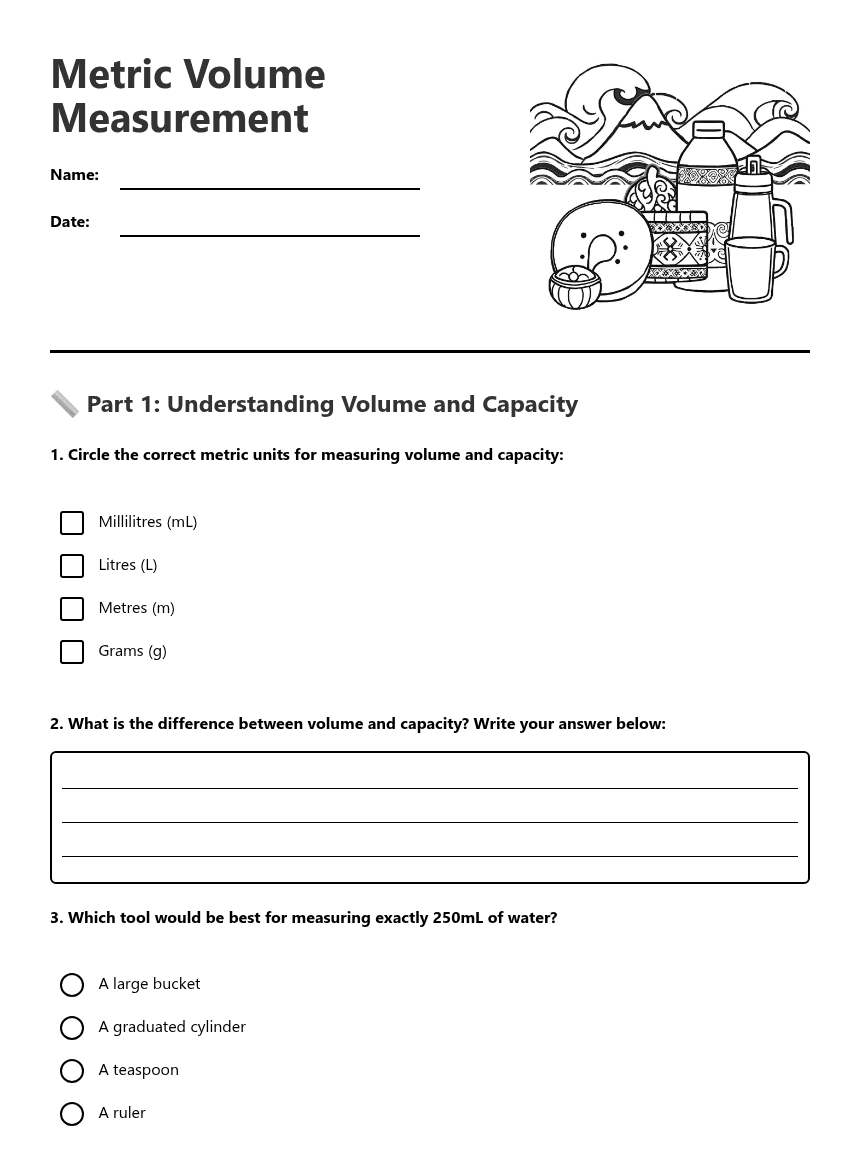
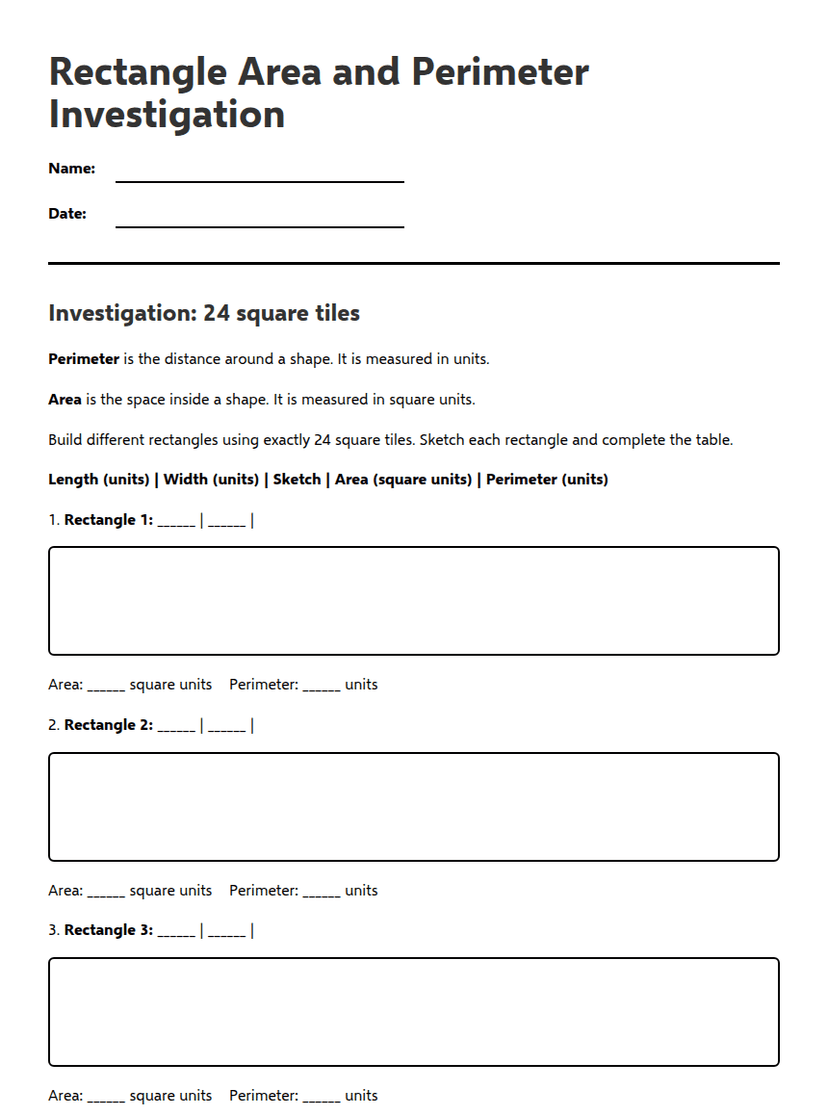
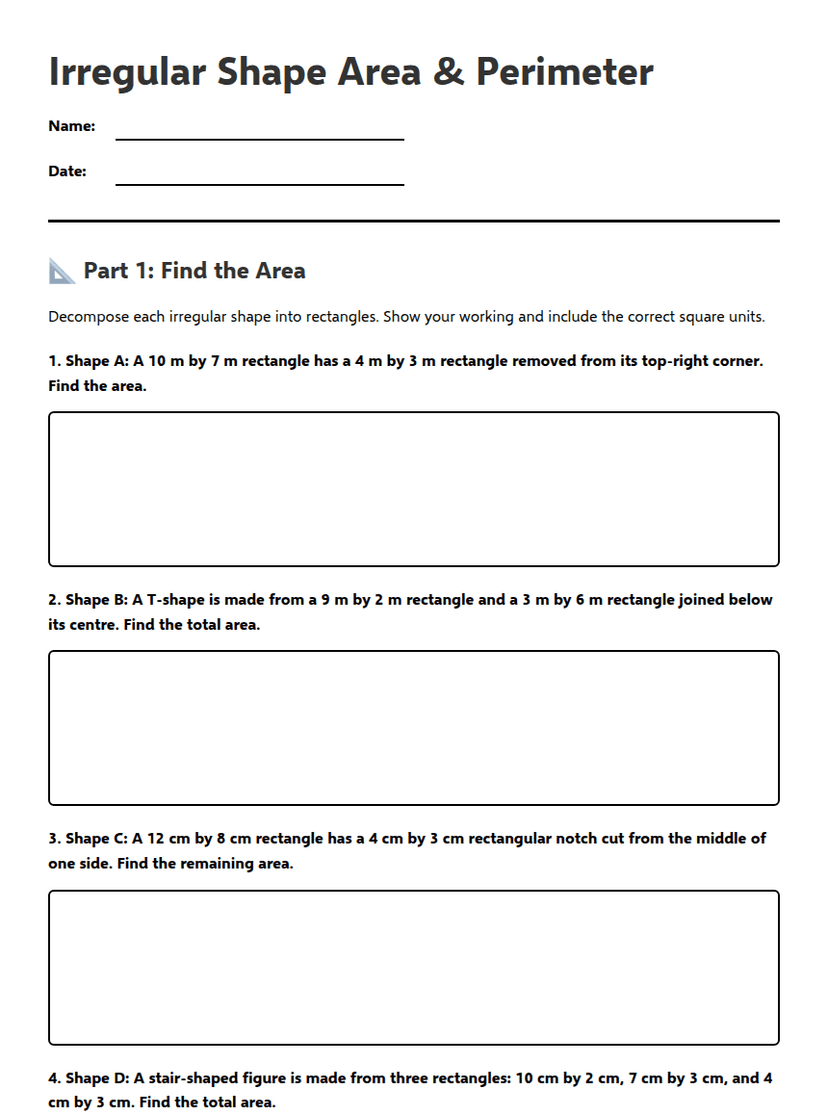
Metric Volume Measurement worksheet preview
Metric Volume Measurement

Metric Volume Measurement

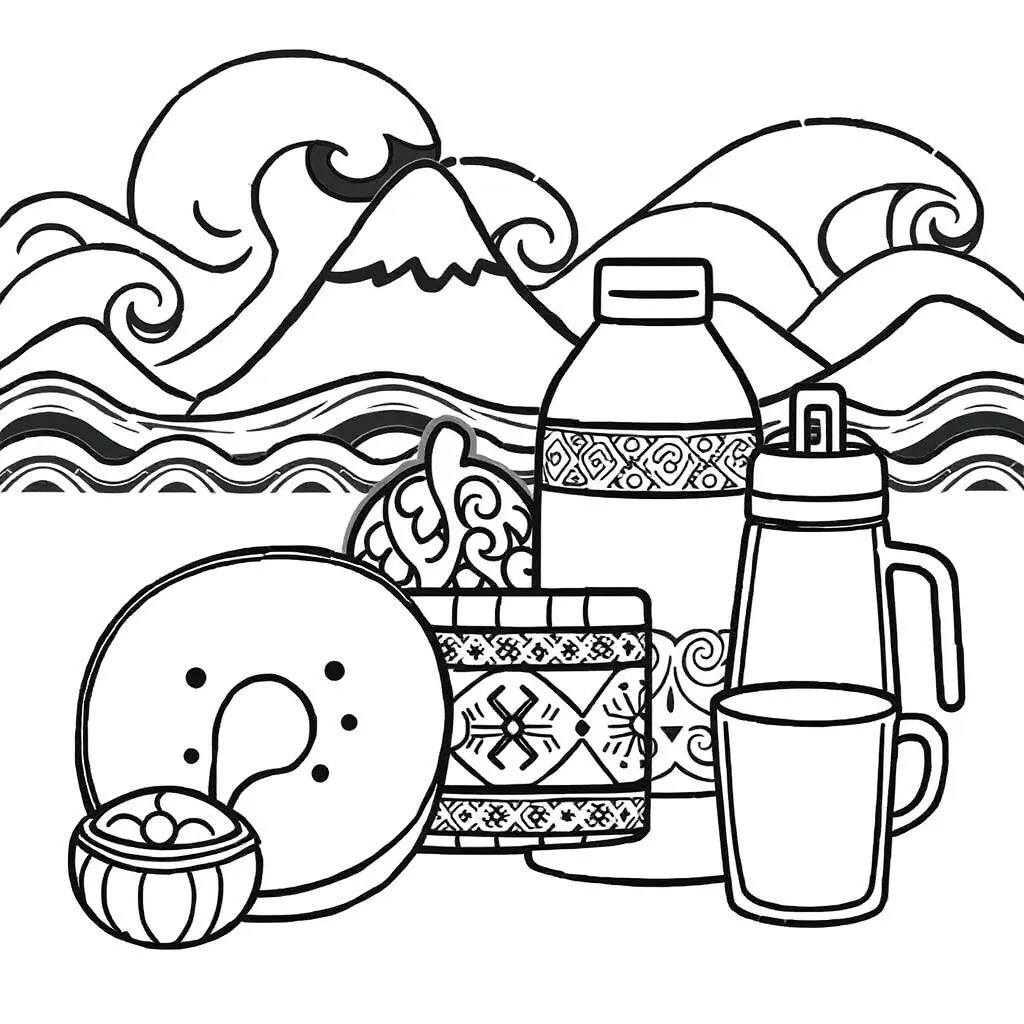
Measuring cylinder and beakers illustration

📏 Part 1: Understanding Volume and Capacity

1. Circle the correct metric units for measuring volume and capacity:

Millilitres (mL)

Litres (L)

Metres (m)

Grams (g)

2. What is the difference between volume and capacity? Write your answer below:
3. Which tool would be best for measuring exactly 250mL of water?

A large bucket

A graduated cylinder

A teaspoon

A ruler

🔄 Part 2: Converting Between Units

4. Complete these conversions:

a) 1000 mL = _______ L

b) 2.5 L = _______ mL

c) 750 mL = _______ L

d) 0.25 L = _______ mL

e) 3500 mL = _______ L

5. Fill in the missing numbers to complete the conversion chart:

500 mL = _______ L

1.2 L = _______ mL

_______ mL = 0.8 L

4000 mL = _______ L

📊 Part 3: Reading Measurements

6. When reading a graduated cylinder, you should read at the bottom of the meniscus (curved surface). Draw what a meniscus looks like in the box below:
7. Estimate the capacity of these common items. Write your estimates with the correct units:

a) A standard water bottle: _____________

b) A coffee mug: _____________

c) A kitchen sink: _____________

d) A teaspoon: _____________

e) A bathtub: _____________

🧪 Part 4: Practical Measurement Problems

8. Sarah is making cordial. She needs to mix 150mL of cordial concentrate with 850mL of water. What is the total volume of cordial she will make? Show your working:
9. A recipe calls for 0.75L of milk, but Tom only has a measuring cup marked in millilitres. How many millilitres of milk does he need?
10. Match the measurement tools with their best use:
1. Graduated cylinder
2. Measuring cup
3. Medicine dropper
4. Large jug
A. Measuring large volumes of liquid
B. Precise measurement of small volumes
C. Measuring very small amounts (drops)
D. Cooking measurements

🤔 Part 5: Problem Solving and Reflection

11. Jamie has three containers: Container A holds 1.2L, Container B holds 850mL, and Container C holds 0.95L. Which container holds the most? Show your working by converting all measurements to the same unit:
12. Explain why it's important to use the correct measuring tool when measuring volume. Give two reasons:
13. A fish tank measures 50cm × 30cm × 40cm. If you wanted to find out how much water it could hold, what would you need to do? (Hint: Think about the relationship between volume and capacity)
14. Challenge: If 1 litre of water has a mass of 1 kilogram, what would be the mass of 2.5 litres of water?

About This Worksheet

Free in Kuraplan

Sign up free, grab the PDF, and customize it for your class.

Print-Ready

Formatted for standard paper. Clean layout, easy to read.

AI-Generated

Created with Kuraplan's AI, designed for real classroom use.

For Teachers & Parents

Use in classrooms, for homework, tutoring, or homeschool.

Need a custom version of this worksheet?

Kuraplan's AI generates custom worksheets in seconds — differentiated for every learner, aligned to your curriculum.

Generate Custom Worksheets — Free
No credit card Curriculum-aligned Under 60 seconds