Māori Environmental Whakataukī
A free science worksheet ready for your classroom. Open in Kuraplan to grab the print-ready PDF, customize it for your students, or generate a fresh version in seconds.
Māori Environmental Whakataukī

🌿 Part 1: Understanding Whakataukī
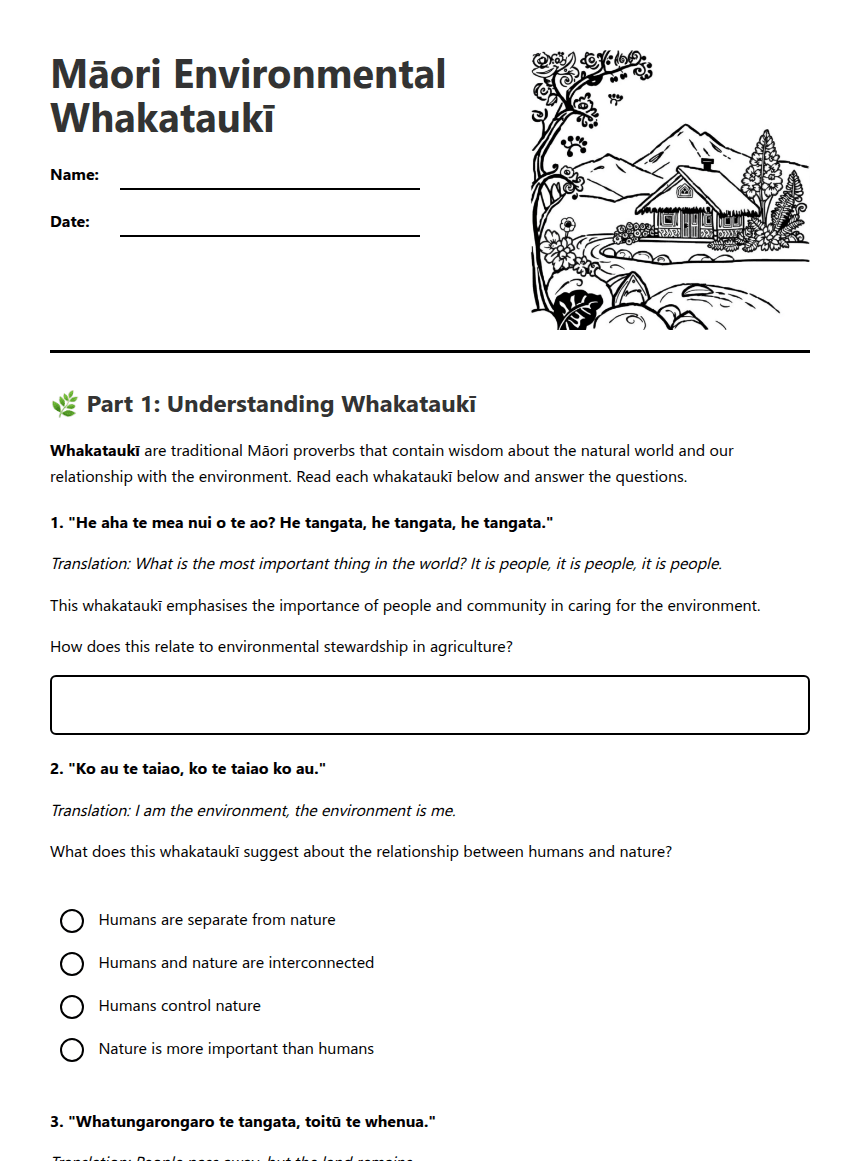
Whakataukī are traditional Māori proverbs that contain wisdom about the natural world and our relationship with the environment. Read each whakataukī below and answer the questions.
Translation: What is the most important thing in the world? It is people, it is people, it is people.
This whakataukī emphasises the importance of people and community in caring for the environment.
How does this relate to environmental stewardship in agriculture?
Translation: I am the environment, the environment is me.
What does this whakataukī suggest about the relationship between humans and nature?
Translation: People pass away, but the land remains.
How might this whakataukī influence decisions about nitrogen fertiliser use on farms?
Translation: Care for the land, care for the people, go forward.
Which of these actions would align with this whakataukī? (Select all that apply)
🌊 Part 2: Connecting to the Nitrogen Cycle
Translation: Whether water is polluted or clean, it is for people to decide.
Explain how this whakataukī relates to nitrogen run-off from Canterbury dairy farms:
Translation: I walk backwards into the future with my eyes fixed on my past.
How could traditional Māori land management practices inform modern sustainable agriculture? Give two examples:
Example 1: _________________________________________________
Example 2: _________________________________________________
Translation: Water is a treasure, land is a treasure.
If water and land are treasures, how should this influence farming practices regarding the nitrogen cycle?
🌱 Part 3: Applying Māori Values to Science
Action 1: _______________________________________________
Action 2: _______________________________________________
Action 3: _______________________________________________
About This Worksheet
Free in Kuraplan
Sign up free, grab the PDF, and customize it for your class.
Print-Ready
Formatted for standard paper. Clean layout, easy to read.
AI-Generated
Created with Kuraplan's AI, designed for real classroom use.
For Teachers & Parents
Use in classrooms, for homework, tutoring, or homeschool.
Need a custom version of this worksheet?
Kuraplan's AI generates custom worksheets in seconds — differentiated for every learner, aligned to your curriculum.
Generate Custom Worksheets — Free