ScienceFreePrintable

New Zealand Food Webs

A free science worksheet ready for your classroom. Open in Kuraplan to grab the print-ready PDF, customize it for your students, or generate a fresh version in seconds.
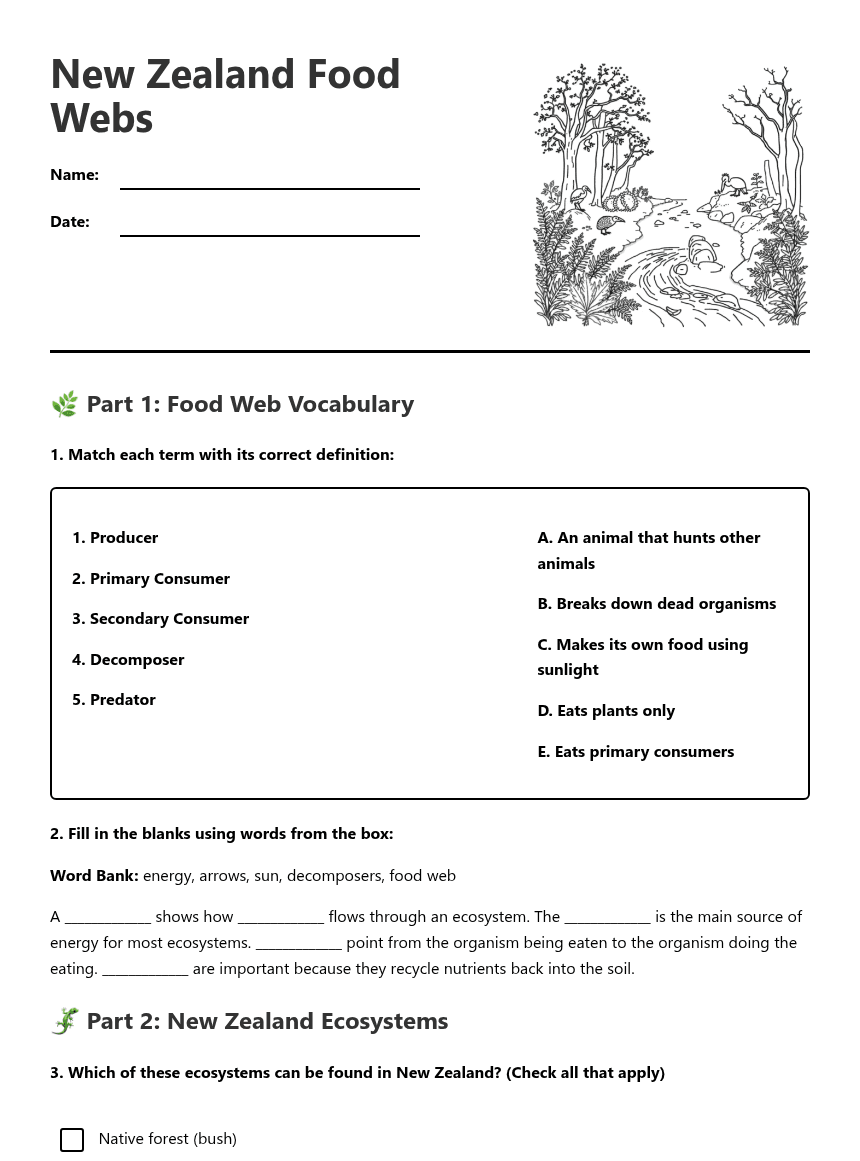
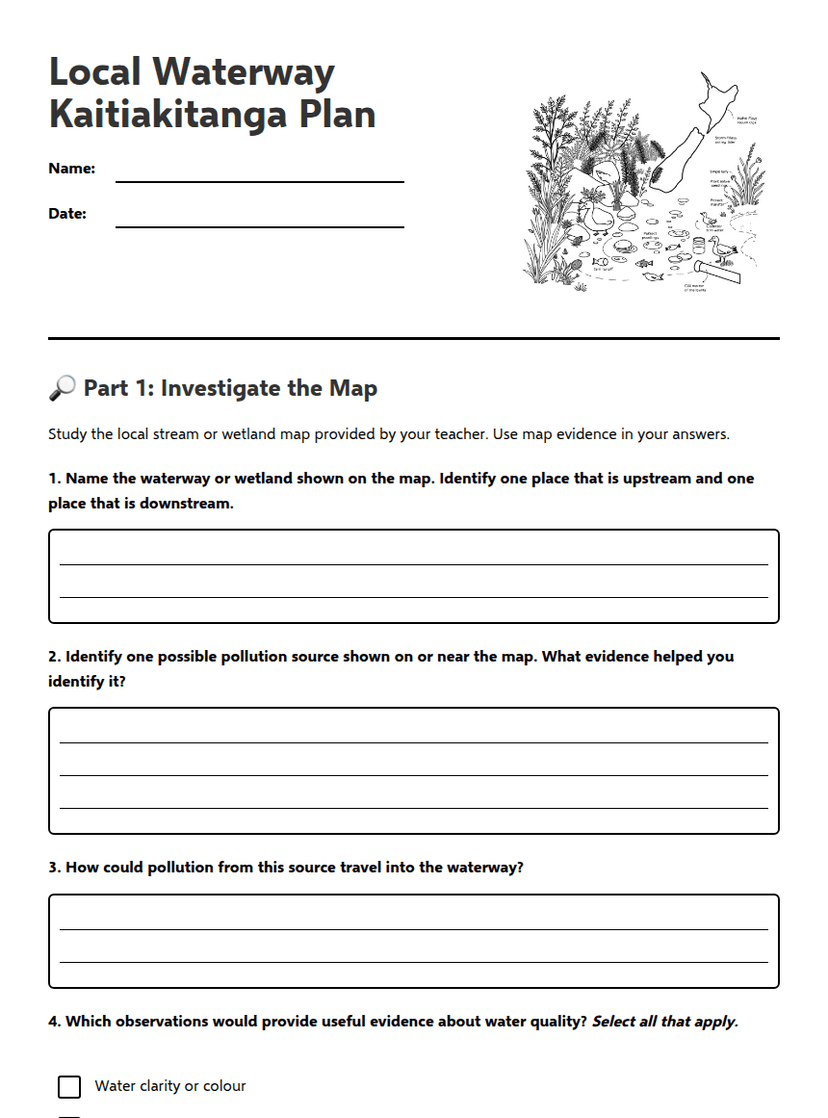
New Zealand Food Webs worksheet preview
New Zealand Food Webs

New Zealand Food Webs

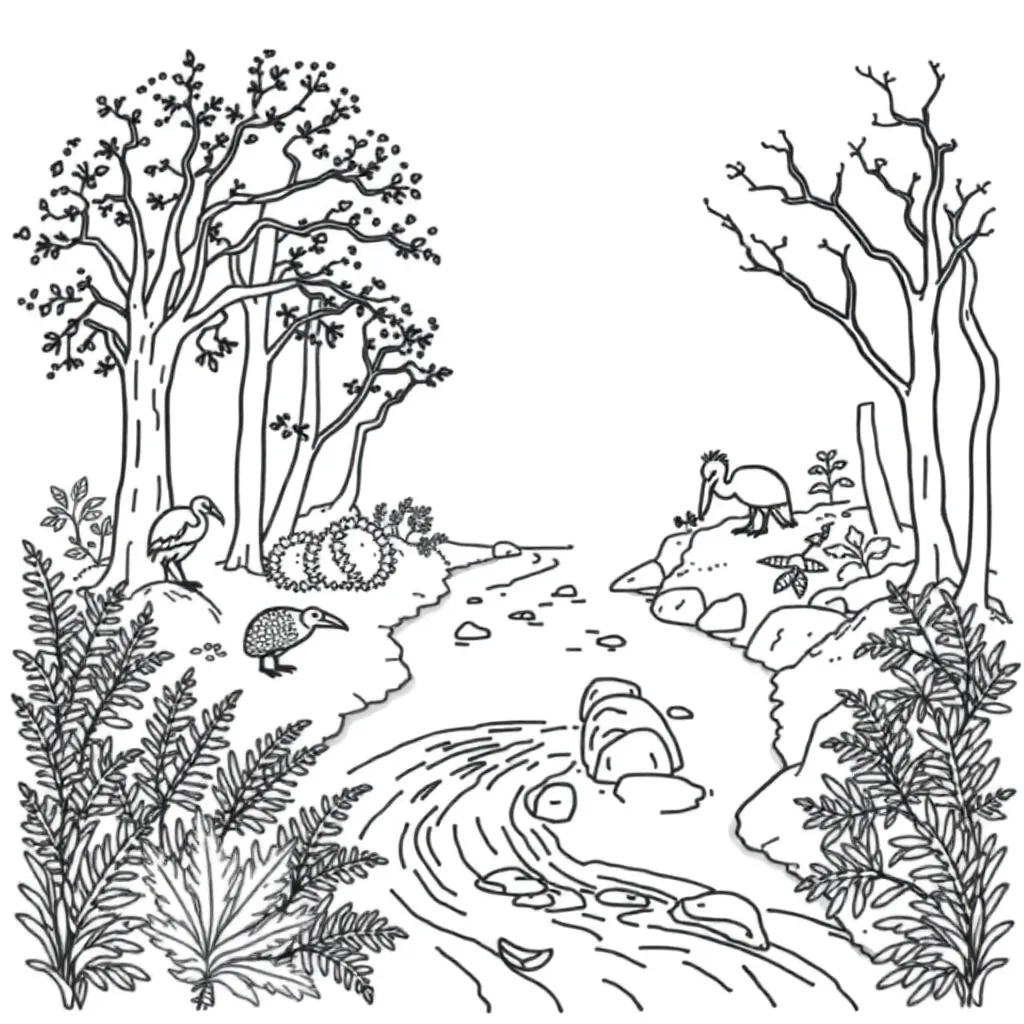
New Zealand ecosystem with native plants and animals

🌿 Part 1: Food Web Vocabulary

1. Match each term with its correct definition:
1. Producer
2. Primary Consumer
3. Secondary Consumer
4. Decomposer
5. Predator
A. An animal that hunts other animals
B. Breaks down dead organisms
C. Makes its own food using sunlight
D. Eats plants only
E. Eats primary consumers
2. Fill in the blanks using words from the box:

Word Bank: energy, arrows, sun, decomposers, food web

A _____________ shows how _____________ flows through an ecosystem. The _____________ is the main source of energy for most ecosystems. _____________ point from the organism being eaten to the organism doing the eating. _____________ are important because they recycle nutrients back into the soil.

🦎 Part 2: New Zealand Ecosystems

3. Which of these ecosystems can be found in New Zealand? (Check all that apply)

Native forest (bush)

Freshwater rivers and lakes

Tropical rainforest

Coastal marine environment

Desert

Alpine regions

4. Circle the correct answer: Which of these is New Zealand's only native land mammal?

Kiwi

Bat (pekapeka)

Tuatara

Weta

5. Name three native New Zealand species and write their Māori names if you know them:

🌊 Part 3: Building a Food Web

6. Look at these New Zealand species. Organise them into the correct levels of a food web by writing them in the boxes below:

Species: Kauri tree, Kererū (wood pigeon), Stoat, Tui, Earthworm, Fern, Weta, Morepork (ruru), Fungi, Rata tree

Producers (make their own food):

Primary Consumers (eat plants):

Secondary Consumers (eat other animals):

Decomposers (break down dead material):

7. Draw a simple food web using at least 6 of the species from question 6. Remember to draw arrows showing the direction of energy flow (from food to feeder):

🔄 Part 4: Ecosystem Connections

8. What would happen if all the stoats were removed from a New Zealand forest ecosystem? Explain your answer:
9. True or False? Circle your answers:

True
False - Energy flows in both directions in a food web

True
False - Introduced species can disrupt native food webs

True
False - All food webs start with the sun as an energy source

True
False - Decomposers are not important in food webs

10. Choose one New Zealand ecosystem (forest, river, marine, or alpine). Describe how mātauranga Māori (traditional Māori knowledge) helps us understand the relationships between species in that ecosystem:

🎯 Part 5: Extension Challenge

11. Design your own food web for a specific New Zealand location (e.g., Fiordland, Rotorua lakes, or your local area). Include at least 8 species and show how they are connected. Use both English and Māori names where possible:
12. Explain why your food web shows the interdependence of living things in this ecosystem:

About This Worksheet

Free in Kuraplan

Sign up free, grab the PDF, and customize it for your class.

Print-Ready

Formatted for standard paper. Clean layout, easy to read.

AI-Generated

Created with Kuraplan's AI, designed for real classroom use.

For Teachers & Parents

Use in classrooms, for homework, tutoring, or homeschool.

Need a custom version of this worksheet?

Kuraplan's AI generates custom worksheets in seconds — differentiated for every learner, aligned to your curriculum.

Generate Custom Worksheets — Free
No credit card Curriculum-aligned Under 60 seconds