MathsFreePrintable
Patterns to Algebra
A free maths worksheet ready for your classroom. Open in Kuraplan to grab the print-ready PDF, customize it for your students, or generate a fresh version in seconds.
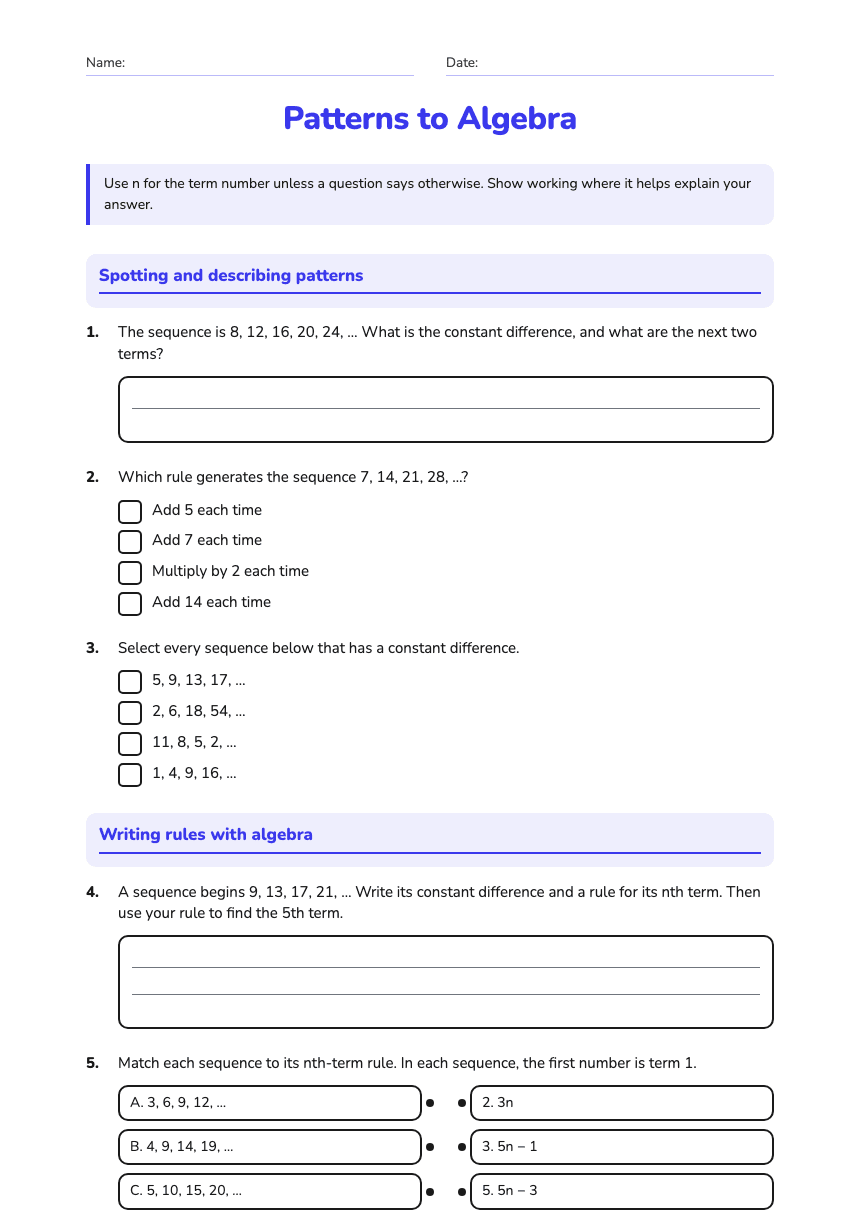
Name:Date:
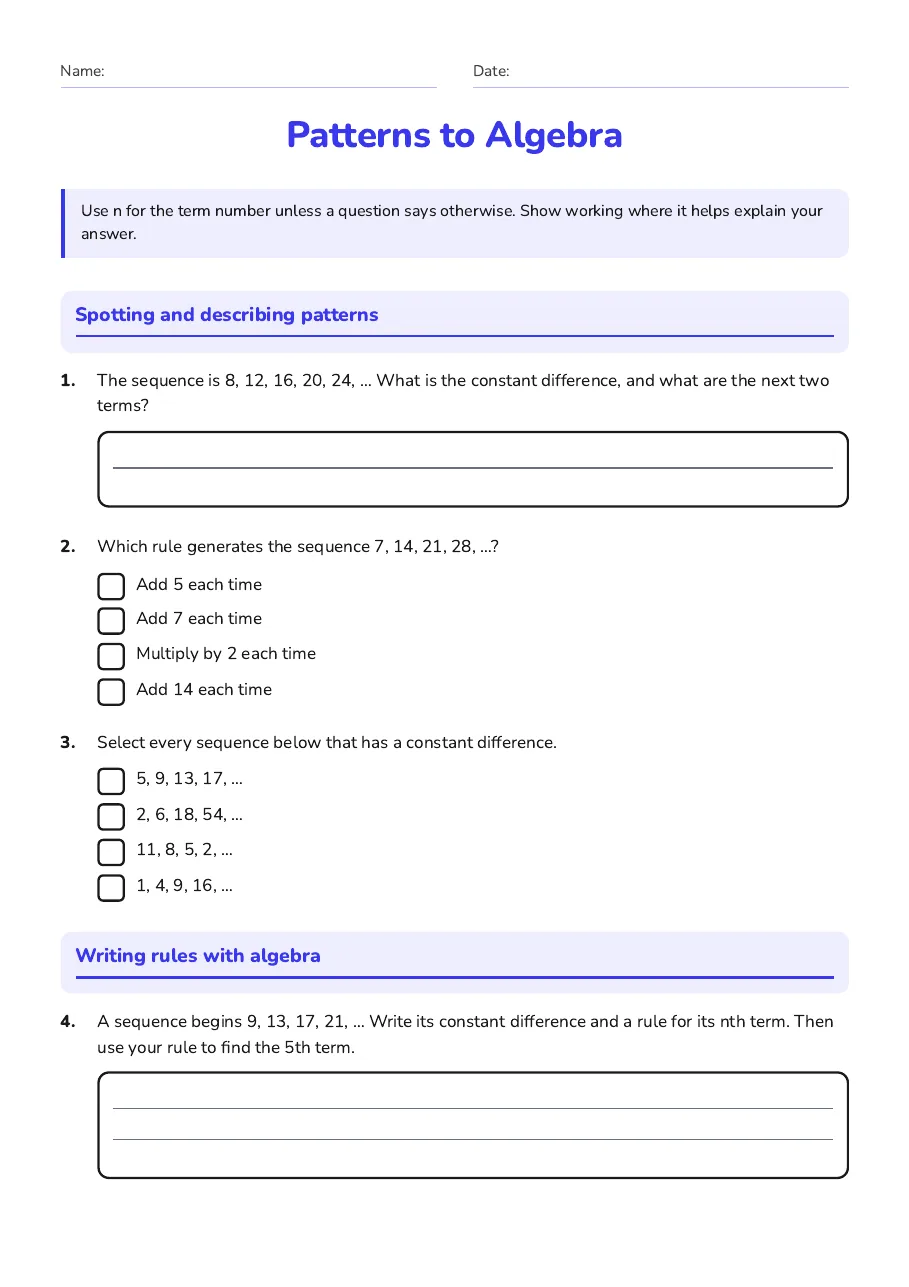
Patterns to Algebra
Use n for the term number unless a question says otherwise. Show working where it helps explain your answer.
Spotting and describing patterns
1.The sequence is 8, 12, 16, 20, 24, … What is the constant difference, and what are the next two terms?
2.Which rule generates the sequence 7, 14, 21, 28, …?
- Add 5 each time
- Add 7 each time
- Multiply by 2 each time
- Add 14 each time
3.Select every sequence below that has a constant difference.
- 5, 9, 13, 17, …
- 2, 6, 18, 54, …
- 11, 8, 5, 2, …
- 1, 4, 9, 16, …
Writing rules with algebra
4.A sequence begins 9, 13, 17, 21, … Write its constant difference and a rule for its nth term. Then use your rule to find the 5th term.
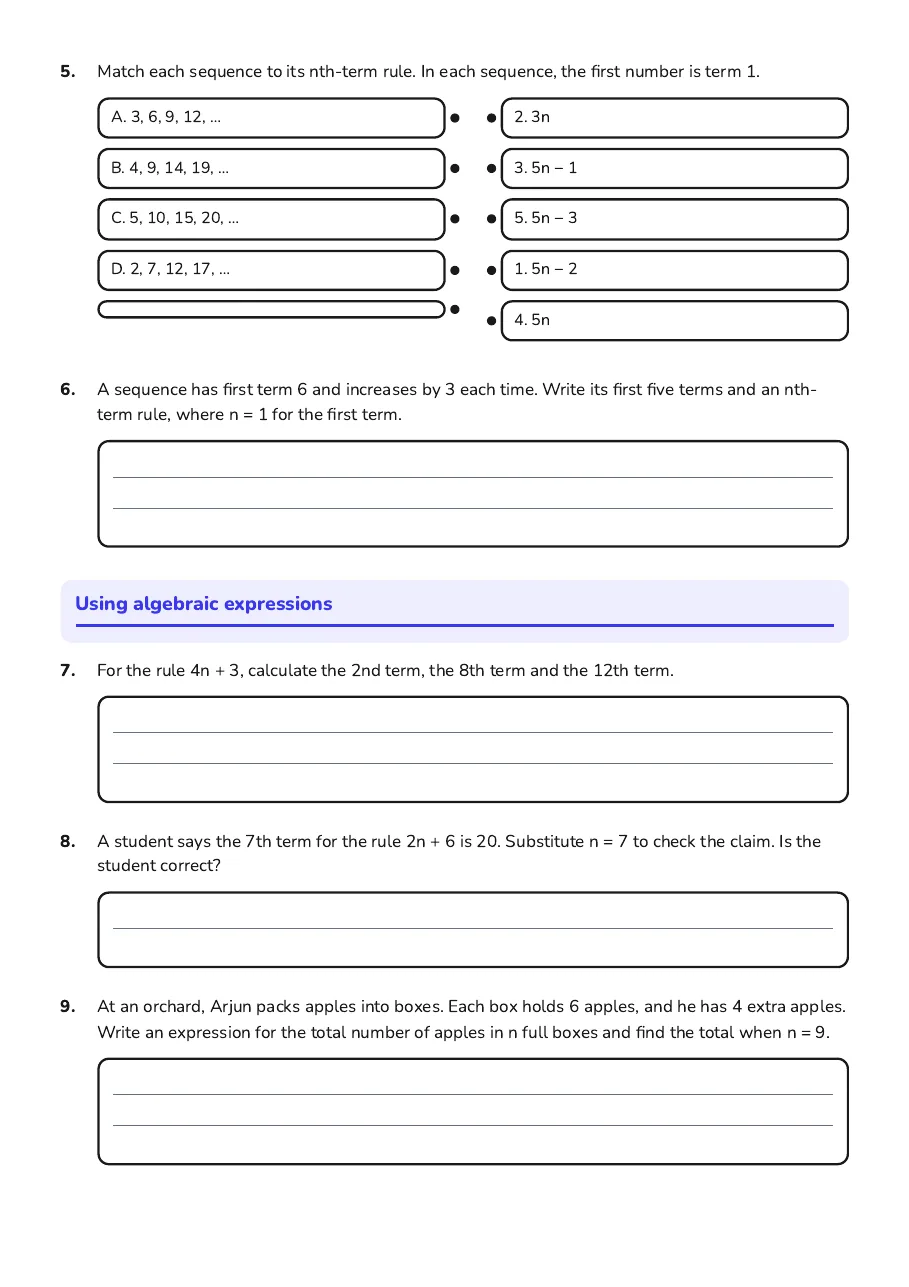
5.Match each sequence to its nth-term rule. In each sequence, the first number is term 1.
- A. 3, 6, 9, 12, …
- B. 4, 9, 14, 19, …
- C. 5, 10, 15, 20, …
- D. 2, 7, 12, 17, …
- 2. 3n
- 3. 5n − 1
- 5. 5n − 3
- 1. 5n − 2
- 4. 5n
6.A sequence has first term 6 and increases by 3 each time. Write its first five terms and an nth-term rule, where n = 1 for the first term.
Using algebraic expressions
7.For the rule 4n + 3, calculate the 2nd term, the 8th term and the 12th term.
8.A student says the 7th term for the rule 2n + 6 is 20. Substitute n = 7 to check the claim. Is the student correct?
9.At an orchard, Arjun packs apples into boxes. Each box holds 6 apples, and he has 4 extra apples. Write an expression for the total number of apples in n full boxes and find the total when n = 9.
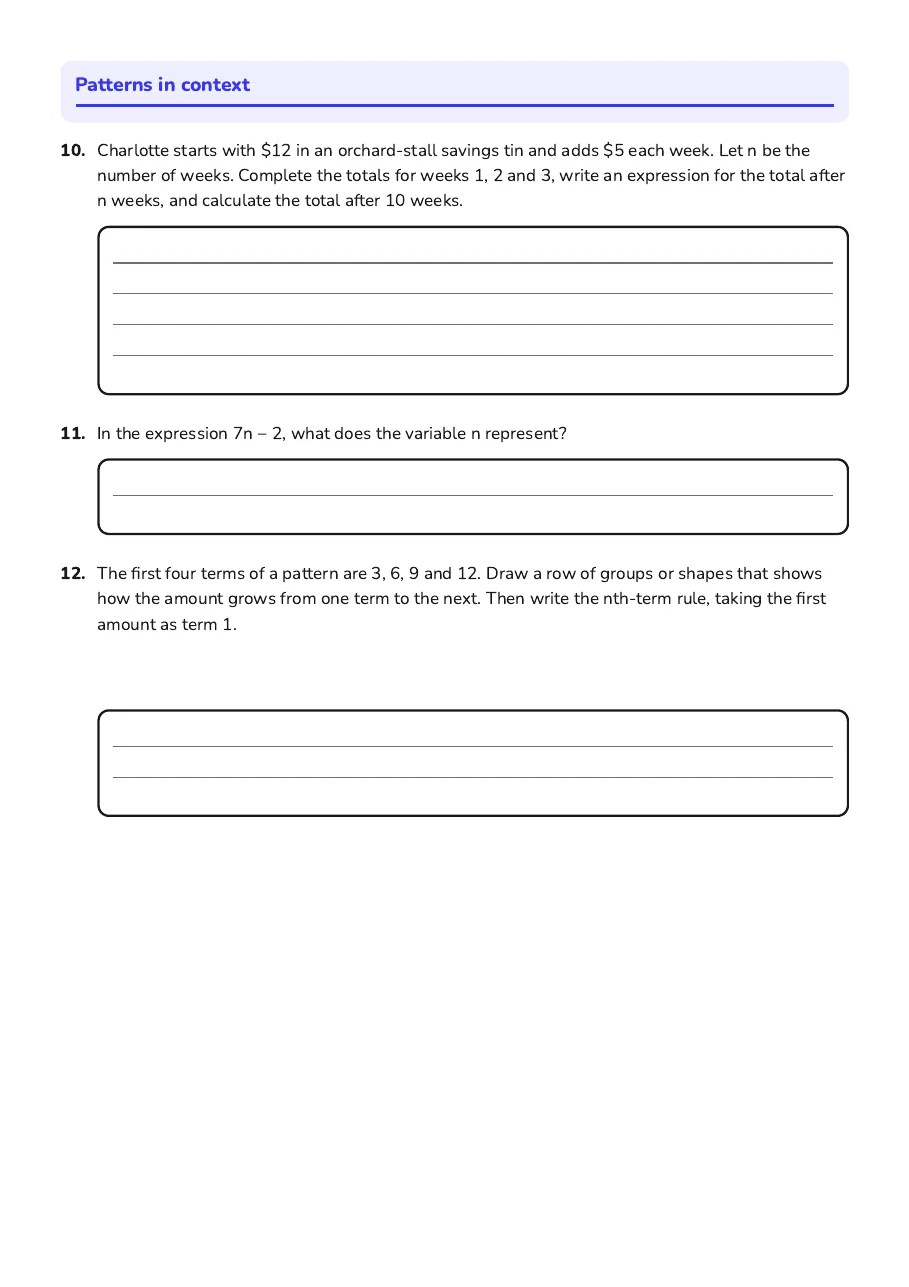
Patterns in context
10.Charlotte starts with $12 in an orchard-stall savings tin and adds $5 each week. Let n be the number of weeks. Complete the totals for weeks 1, 2 and 3, write an expression for the total after n weeks, and calculate the total after 10 weeks.
11.In the expression 7n − 2, what does the variable n represent?
12.The first four terms of a pattern are 3, 6, 9 and 12. Draw a row of groups or shapes that shows how the amount grows from one term to the next. Then write the nth-term rule, taking the first amount as term 1.
3 printable pages
Page 1
Page 2
Page 3
About This Worksheet
Free in Kuraplan
Sign up free, grab the PDF, and customize it for your class.
Print-Ready
Formatted for standard paper. Clean layout, easy to read.
AI-Generated
Created with Kuraplan's AI, designed for real classroom use.
For Teachers & Parents
Use in classrooms, for homework, tutoring, or homeschool.
Need a custom version of this worksheet?
Kuraplan's AI generates custom worksheets in seconds — differentiated for every learner, aligned to your curriculum.
Generate Custom Worksheets — Free No credit card Curriculum-aligned Under 60 seconds
More Maths Worksheets
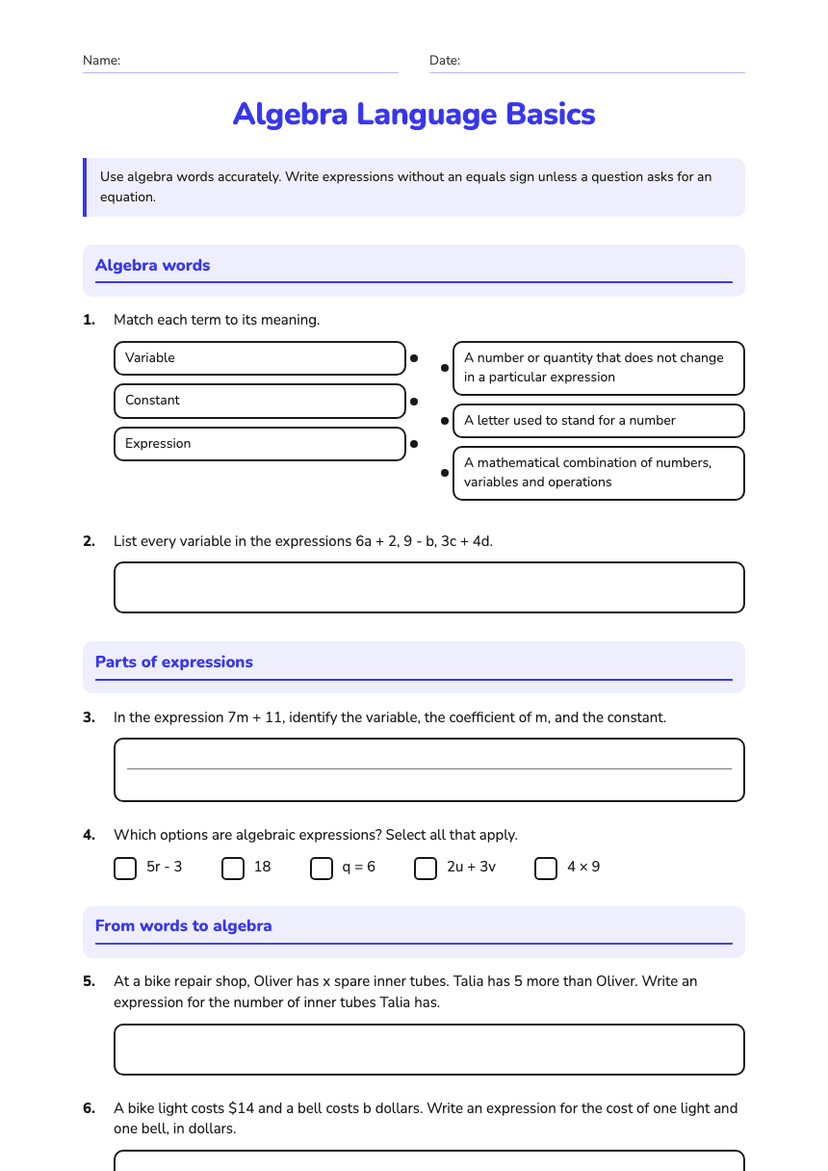
Year 7–8
Algebra Language Basics
Free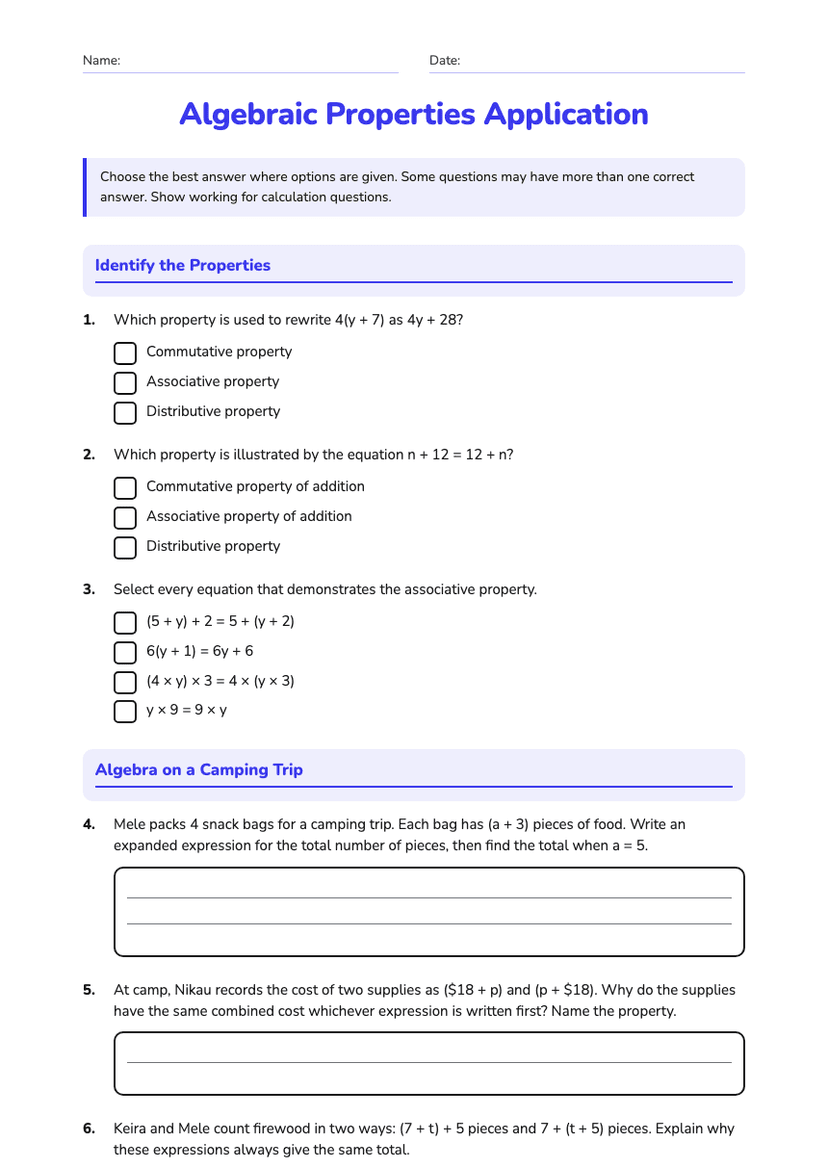
Year 8
Algebraic Properties Application
Free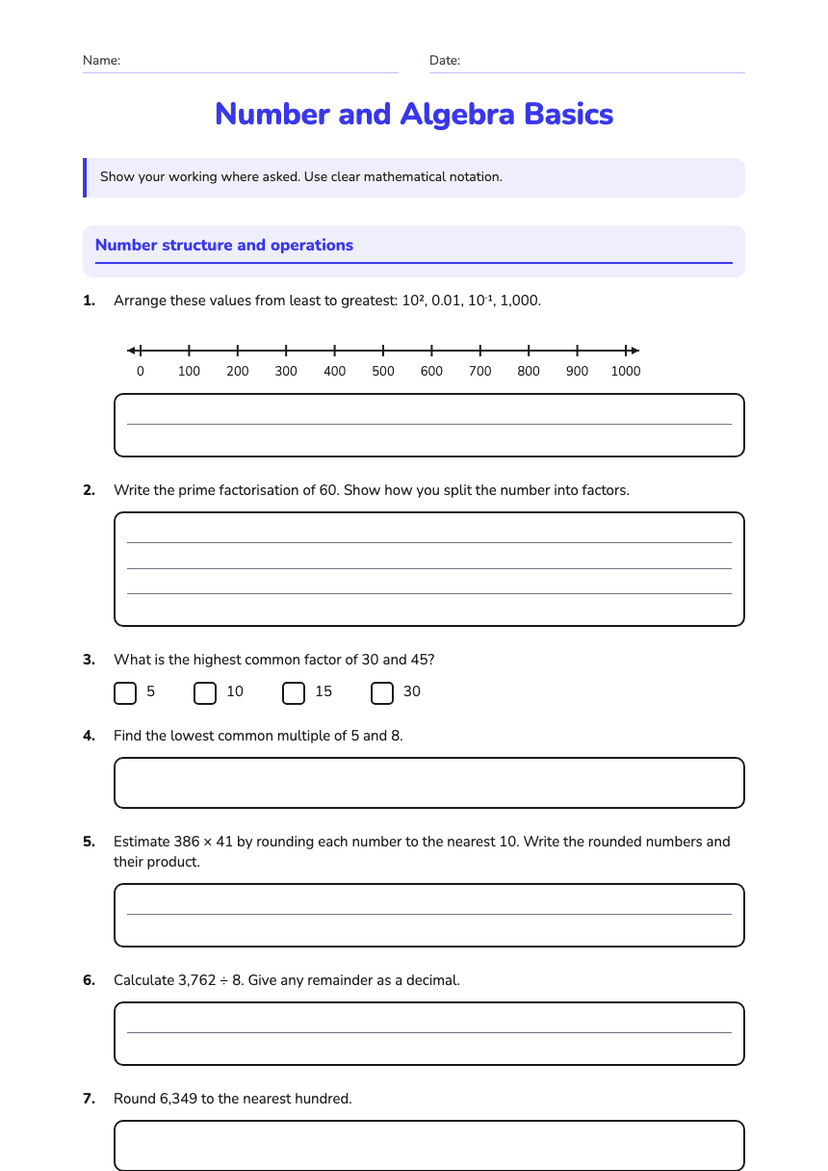
Year 7–8
Number and Algebra Basics
Free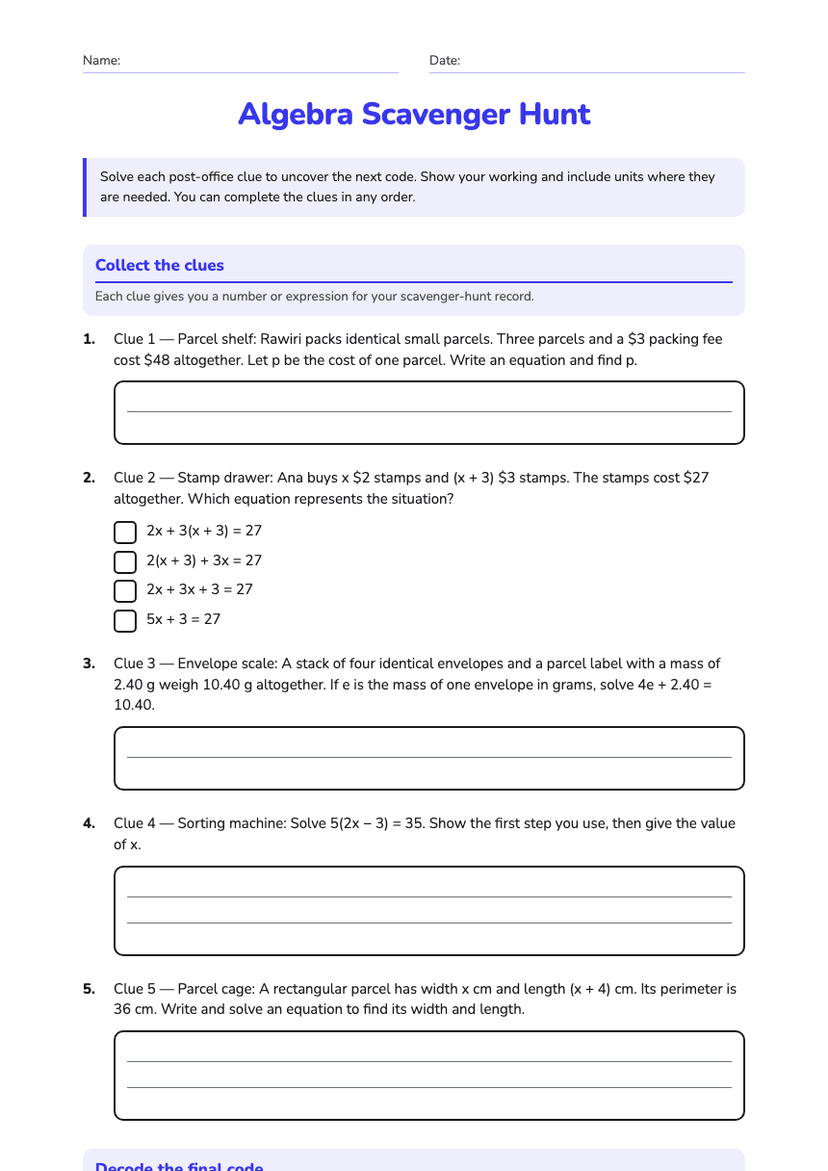
Year 9
Algebra Scavenger Hunt
Free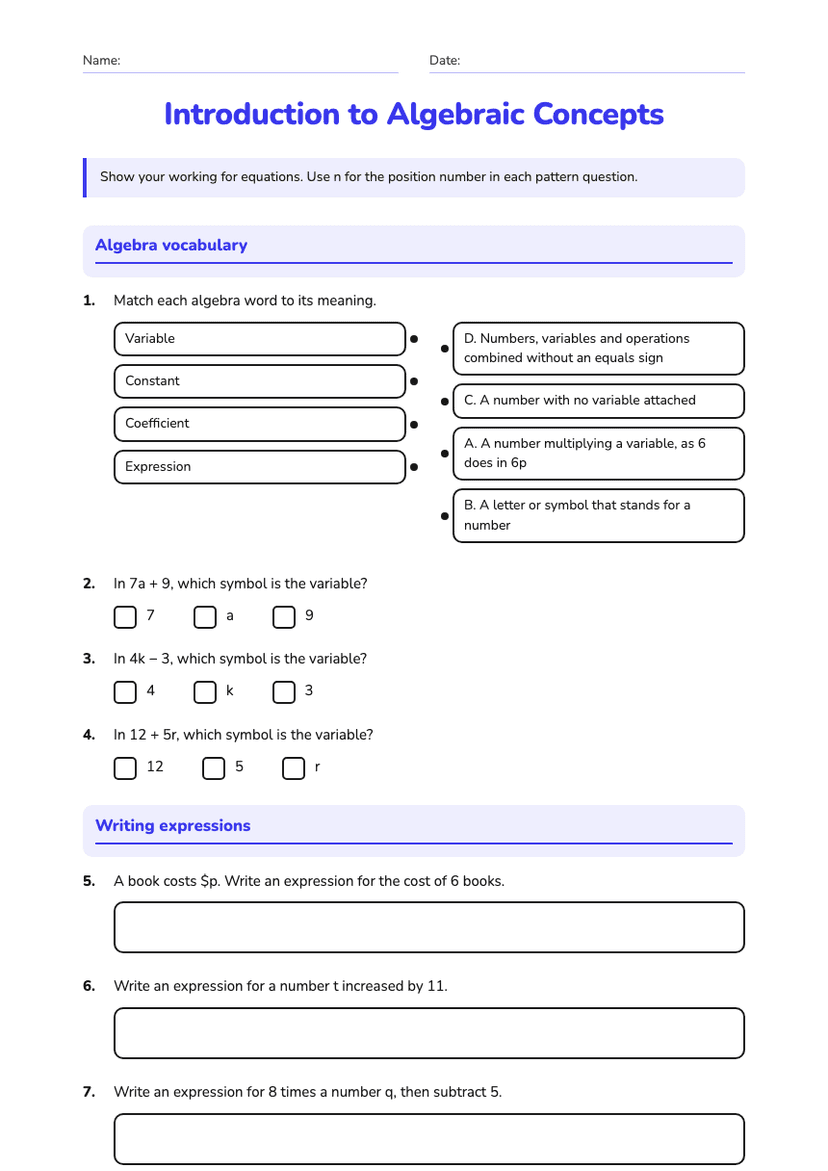
Year 7–8
Introduction to Algebraic Concepts
Free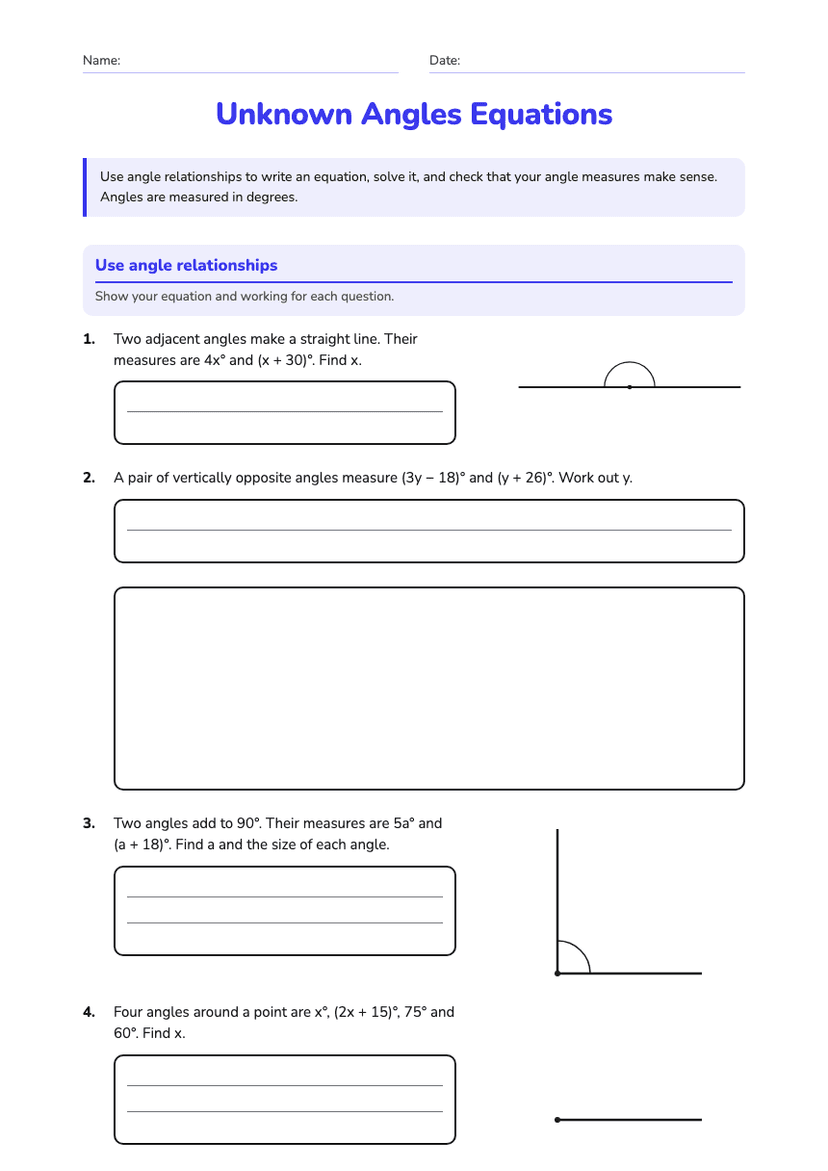
Year 7–8
Unknown Angles Equations
Free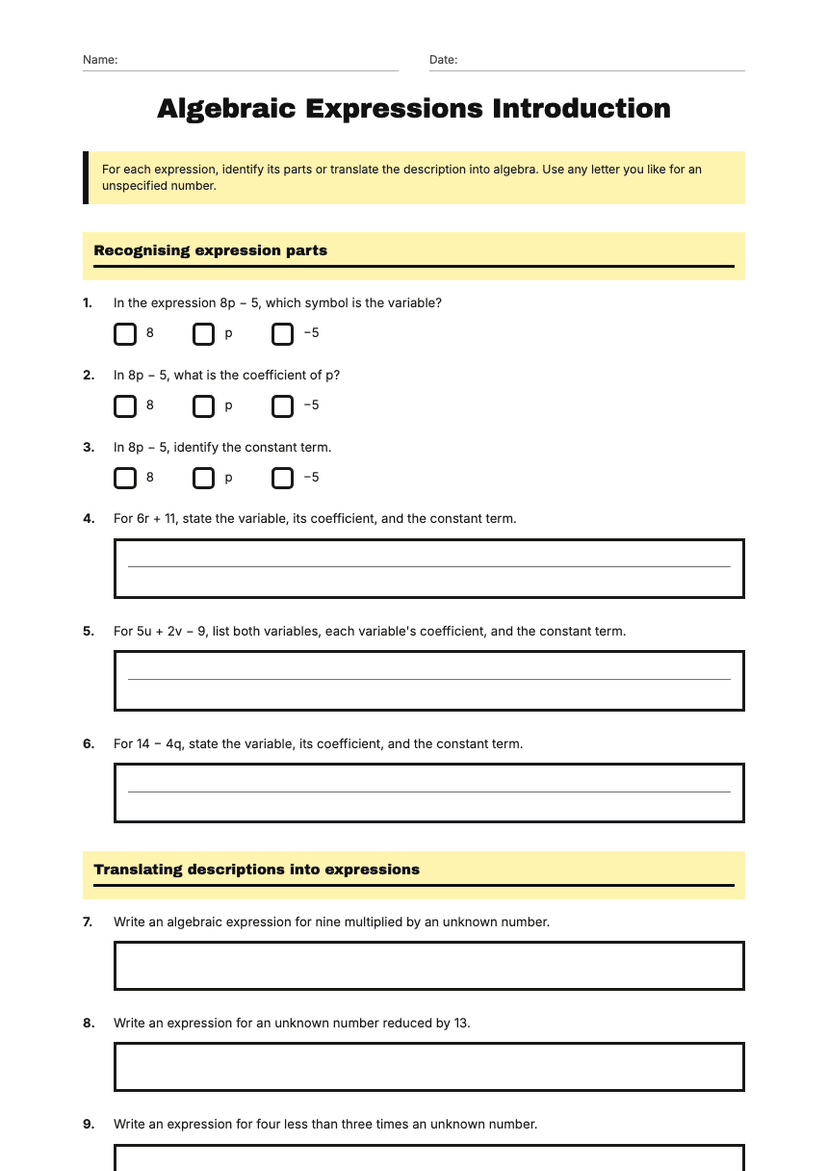
Year 11
Algebraic Expressions Introduction
Free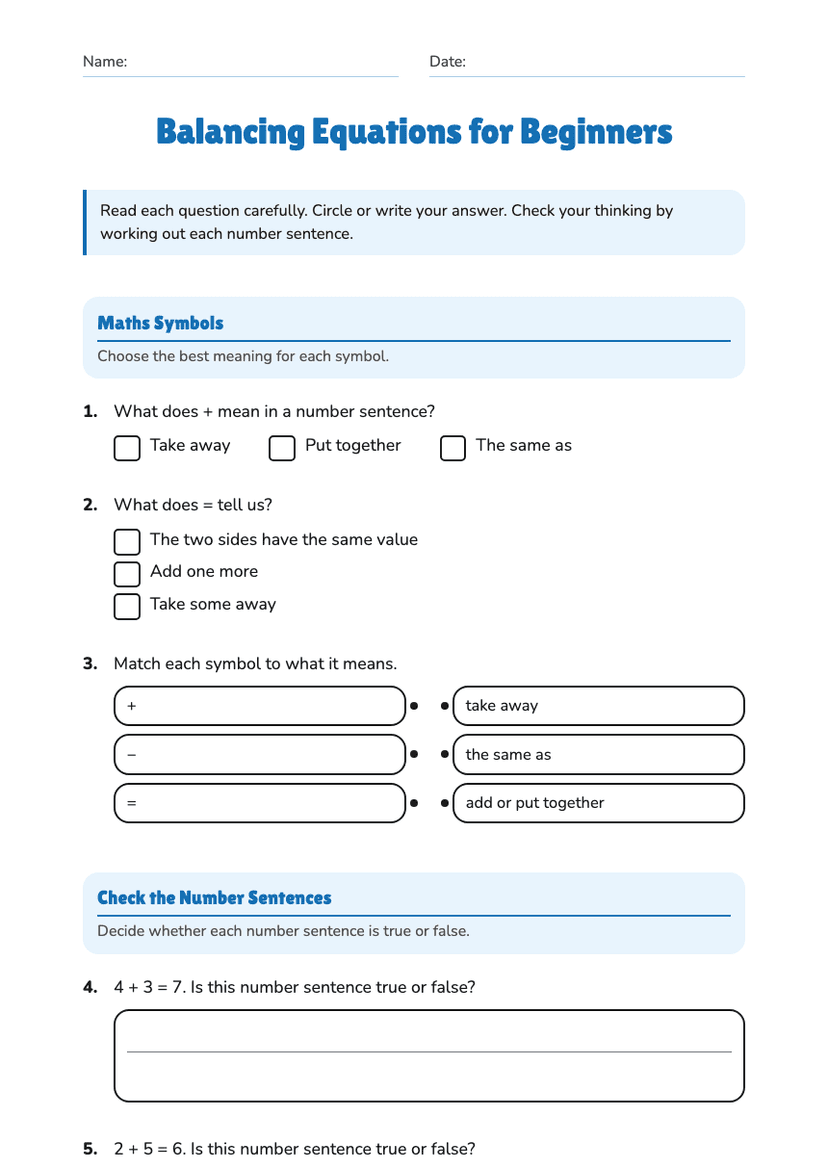
Year 1