Probability Exploration Worksheet
A free maths worksheet ready for your classroom. Open in Kuraplan to grab the print-ready PDF, customize it for your students, or generate a fresh version in seconds.
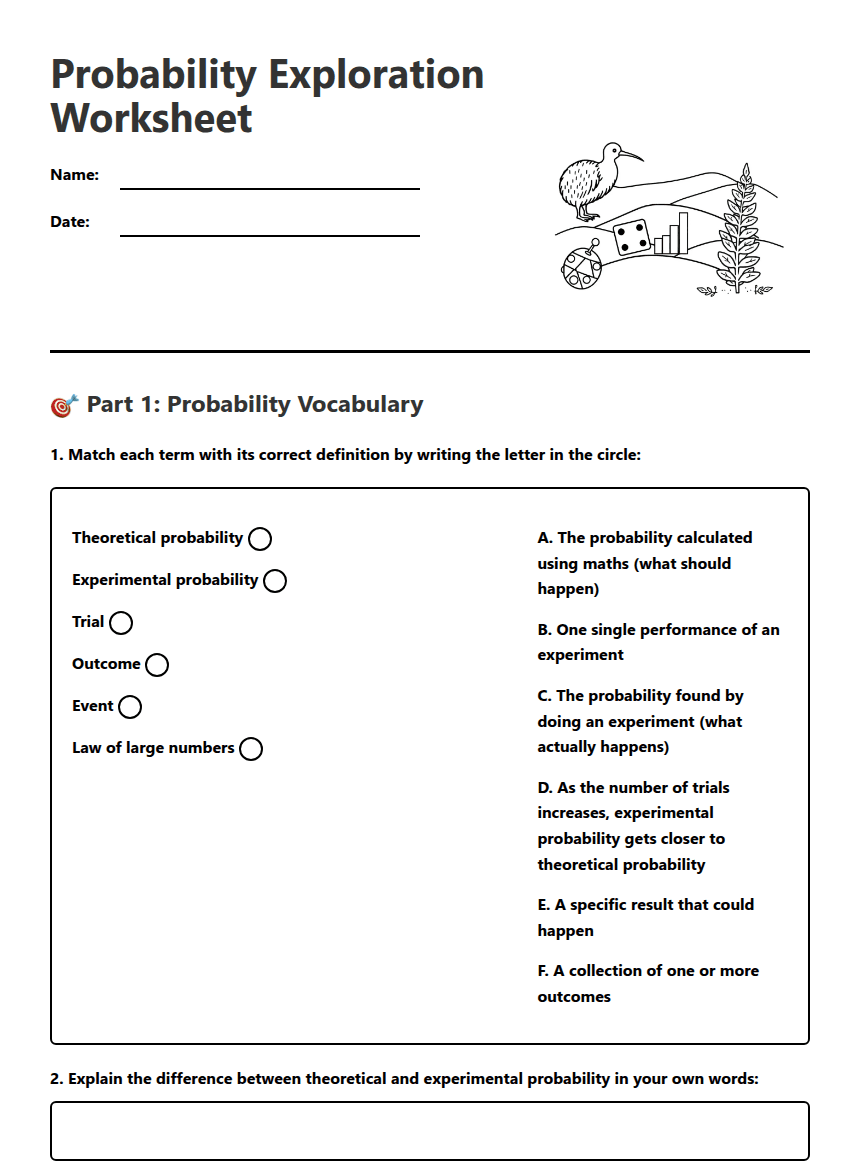
Probability Exploration Worksheet
🎯 Part 1: Probability Vocabulary
🎲 Part 2: Dice Rolling Experiment
Theoretical probability = _________
| Outcome | Tally | Frequency |
|---|---|---|
| 1 | ||
| 2 | ||
| 3 | ||
| 4 | ||
| 5 | ||
| 6 | ||
| Total | 30 |
Experimental probability = Number of times 3 appeared ÷ Total number of trials
Experimental probability = _______ ÷ 30 = _______
📊 Part 3: Analysis and Reflection
Theoretical probability of rolling a 3: _______
Your experimental probability of rolling a 3: _______
Difference: _______
About This Worksheet
Free in Kuraplan
Sign up free, grab the PDF, and customize it for your class.
Print-Ready
Formatted for standard paper. Clean layout, easy to read.
AI-Generated
Created with Kuraplan's AI, designed for real classroom use.
For Teachers & Parents
Use in classrooms, for homework, tutoring, or homeschool.
Need a custom version of this worksheet?
Kuraplan's AI generates custom worksheets in seconds — differentiated for every learner, aligned to your curriculum.
Generate Custom Worksheets — FreeMore Maths Worksheets
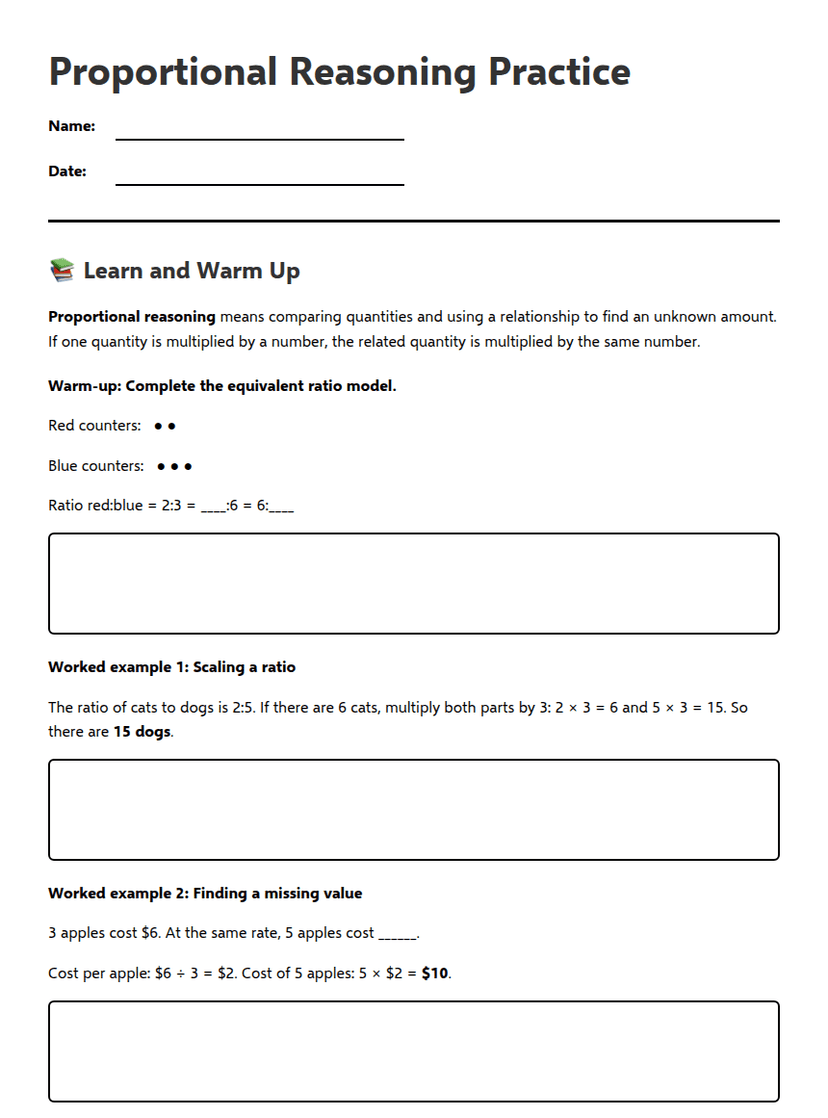
Proportional Reasoning Practice
Free
Find the Whole Proportionally
Free
Core Scale Factors
Free
Advanced Scale factors
Free
Basic Scale Factors Worksheet
Free
Proportion and Ratios Worksheet
Free
Proportional Reasoning Practice
Free