MathsFreePrintable
Properties of Operations
A free maths worksheet ready for your classroom. Open in Kuraplan to grab the print-ready PDF, customize it for your students, or generate a fresh version in seconds.
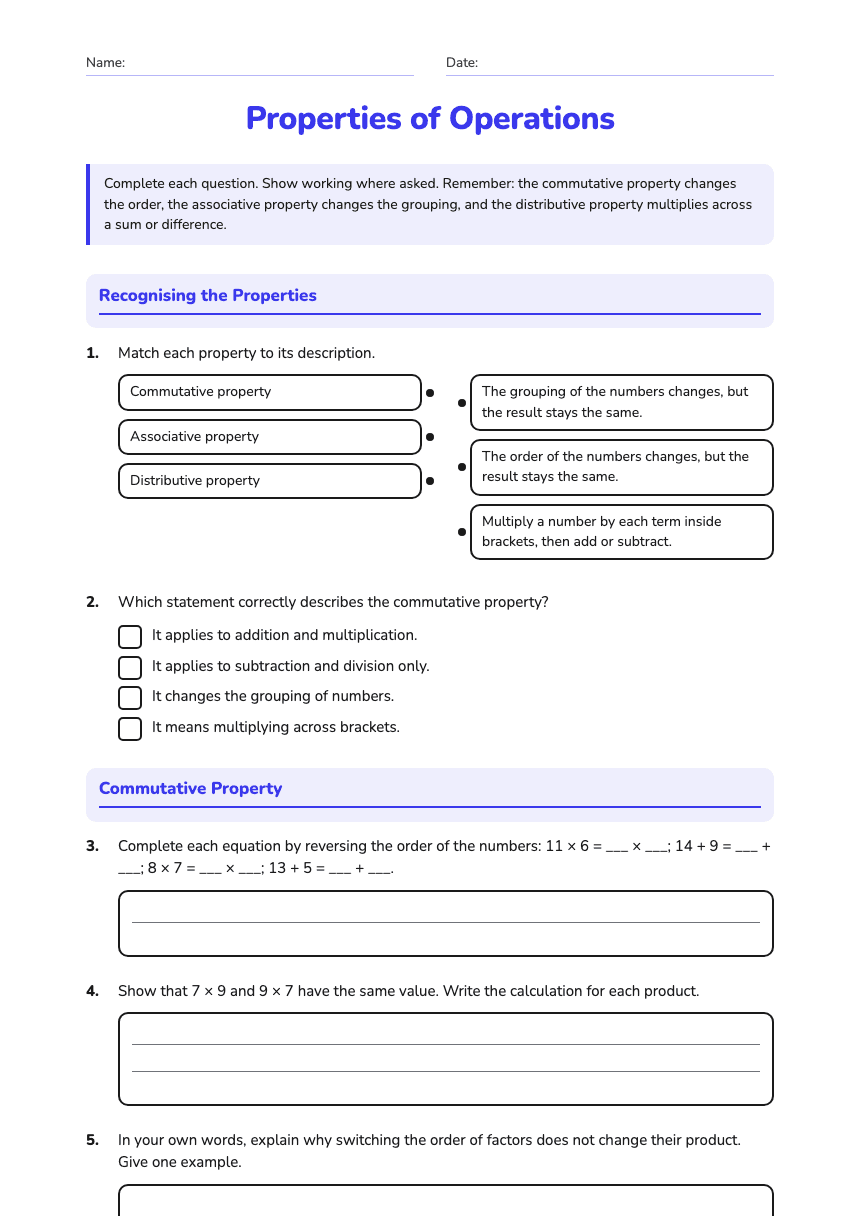
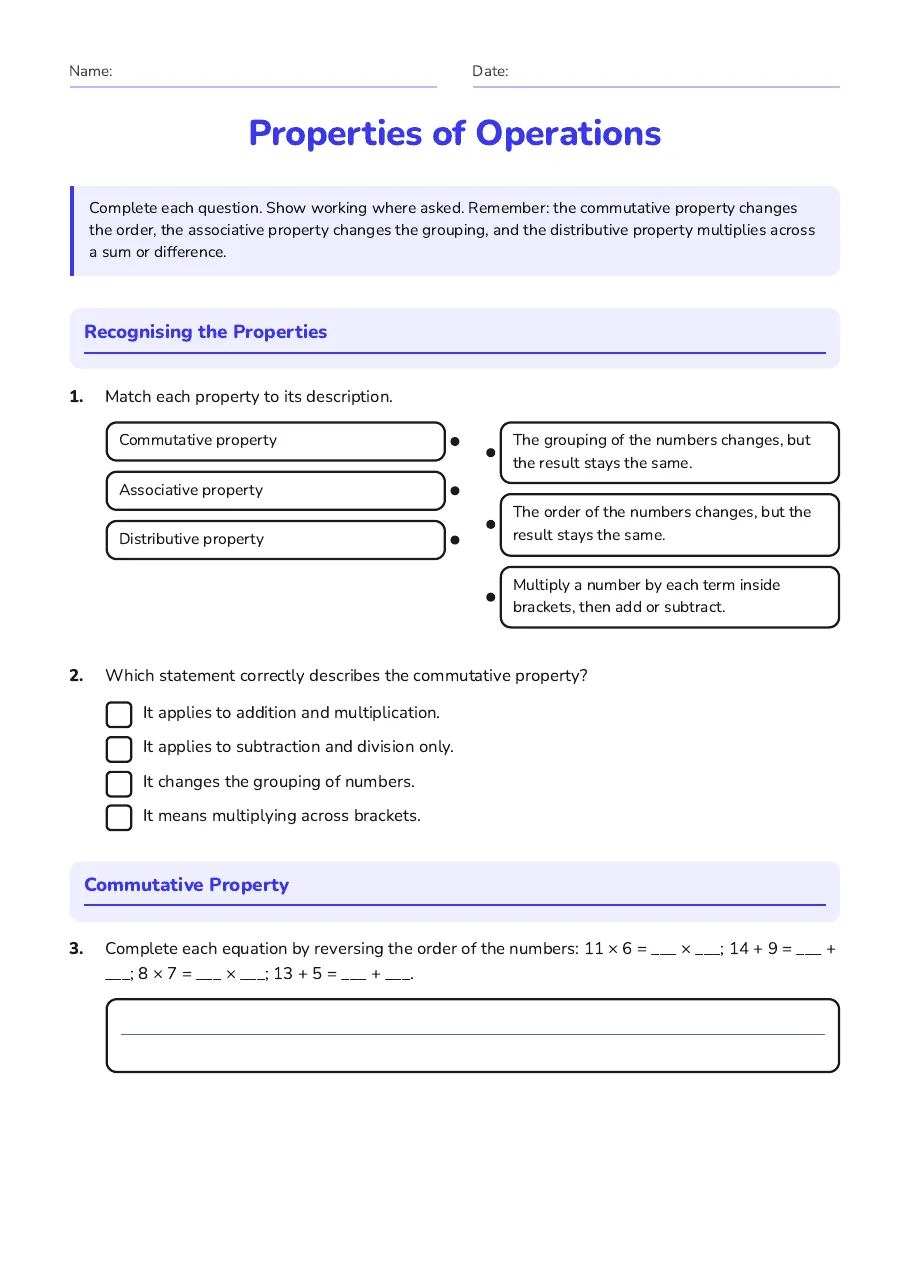
Name:Date:
Properties of Operations
Complete each question. Show working where asked. Remember: the commutative property changes the order, the associative property changes the grouping, and the distributive property multiplies across a sum or difference.
Recognising the Properties
1.Match each property to its description.
- Commutative property
- Associative property
- Distributive property
- The grouping of the numbers changes, but the result stays the same.
- The order of the numbers changes, but the result stays the same.
- Multiply a number by each term inside brackets, then add or subtract.
2.Which statement correctly describes the commutative property?
- It applies to addition and multiplication.
- It applies to subtraction and division only.
- It changes the grouping of numbers.
- It means multiplying across brackets.
Commutative Property
3.Complete each equation by reversing the order of the numbers: 11 × 6 = ___ × ___; 14 + 9 = ___ + ___; 8 × 7 = ___ × ___; 13 + 5 = ___ + ___.
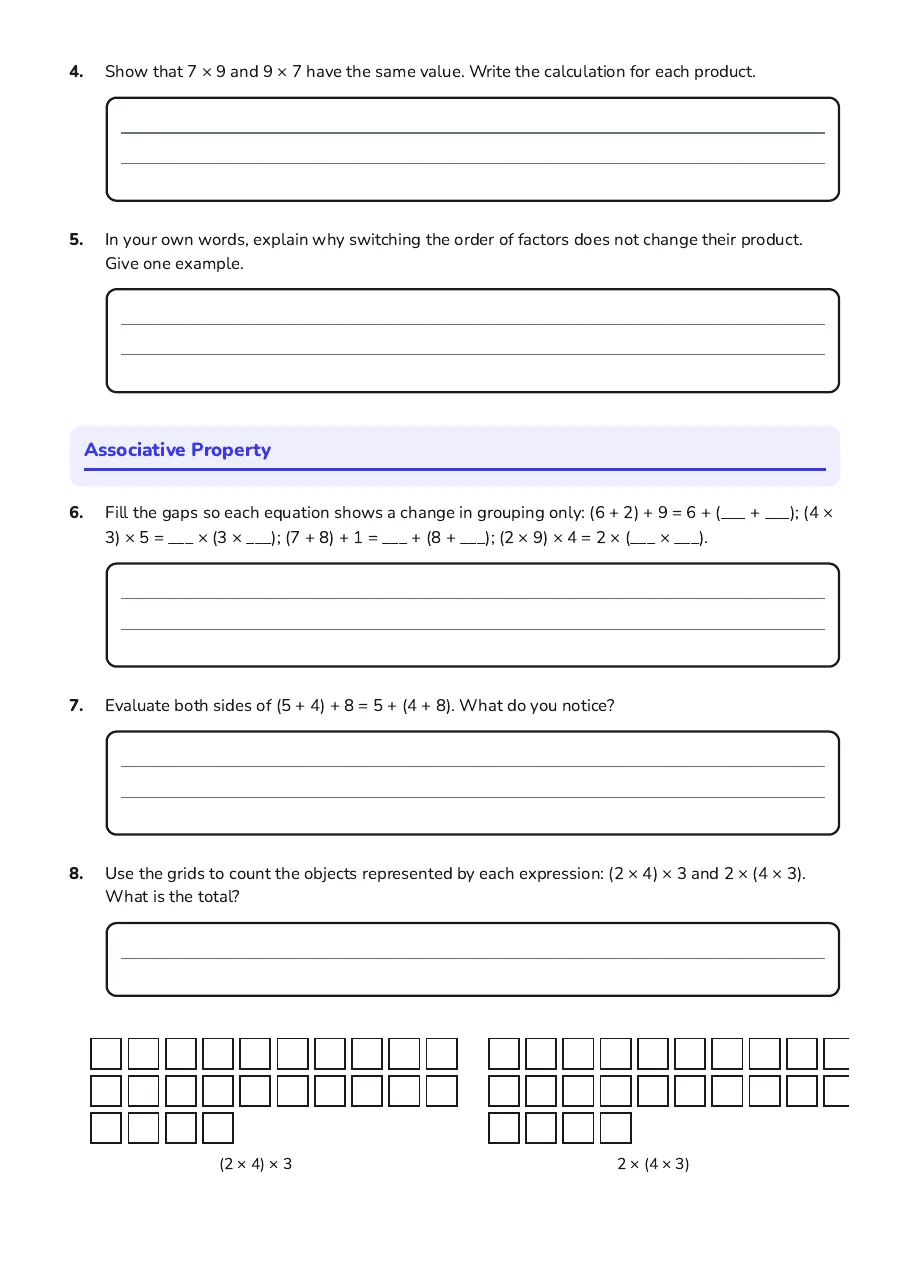
4.Show that 7 × 9 and 9 × 7 have the same value. Write the calculation for each product.
5.In your own words, explain why switching the order of factors does not change their product. Give one example.
Associative Property
6.Fill the gaps so each equation shows a change in grouping only: (6 + 2) + 9 = 6 + (___ + ___); (4 × 3) × 5 = ___ × (3 × ___); (7 + 8) + 1 = ___ + (8 + ___); (2 × 9) × 4 = 2 × (___ × ___).
7.Evaluate both sides of (5 + 4) + 8 = 5 + (4 + 8). What do you notice?
8.Use the grids to count the objects represented by each expression: (2 × 4) × 3 and 2 × (4 × 3). What is the total?
(2 × 4) × 3
2 × (4 × 3)
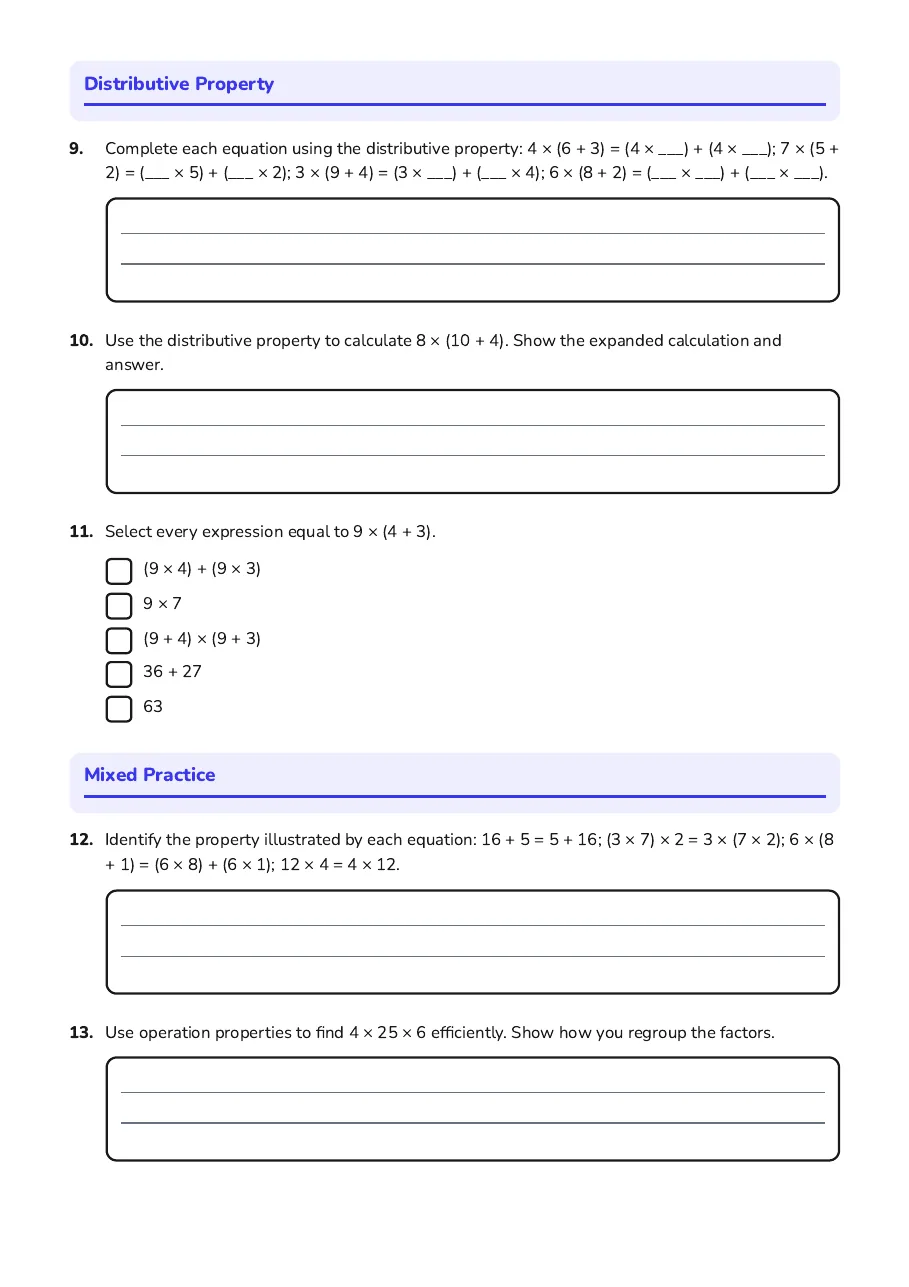
Distributive Property
9.Complete each equation using the distributive property: 4 × (6 + 3) = (4 × ___) + (4 × ___); 7 × (5 + 2) = (___ × 5) + (___ × 2); 3 × (9 + 4) = (3 × ___) + (___ × 4); 6 × (8 + 2) = (___ × ___) + (___ × ___).
10.Use the distributive property to calculate 8 × (10 + 4). Show the expanded calculation and answer.
11.Select every expression equal to 9 × (4 + 3).
- (9 × 4) + (9 × 3)
- 9 × 7
- (9 + 4) × (9 + 3)
- 36 + 27
- 63
Mixed Practice
12.Identify the property illustrated by each equation: 16 + 5 = 5 + 16; (3 × 7) × 2 = 3 × (7 × 2); 6 × (8 + 1) = (6 × 8) + (6 × 1); 12 × 4 = 4 × 12.
13.Use operation properties to find 4 × 25 × 6 efficiently. Show how you regroup the factors.
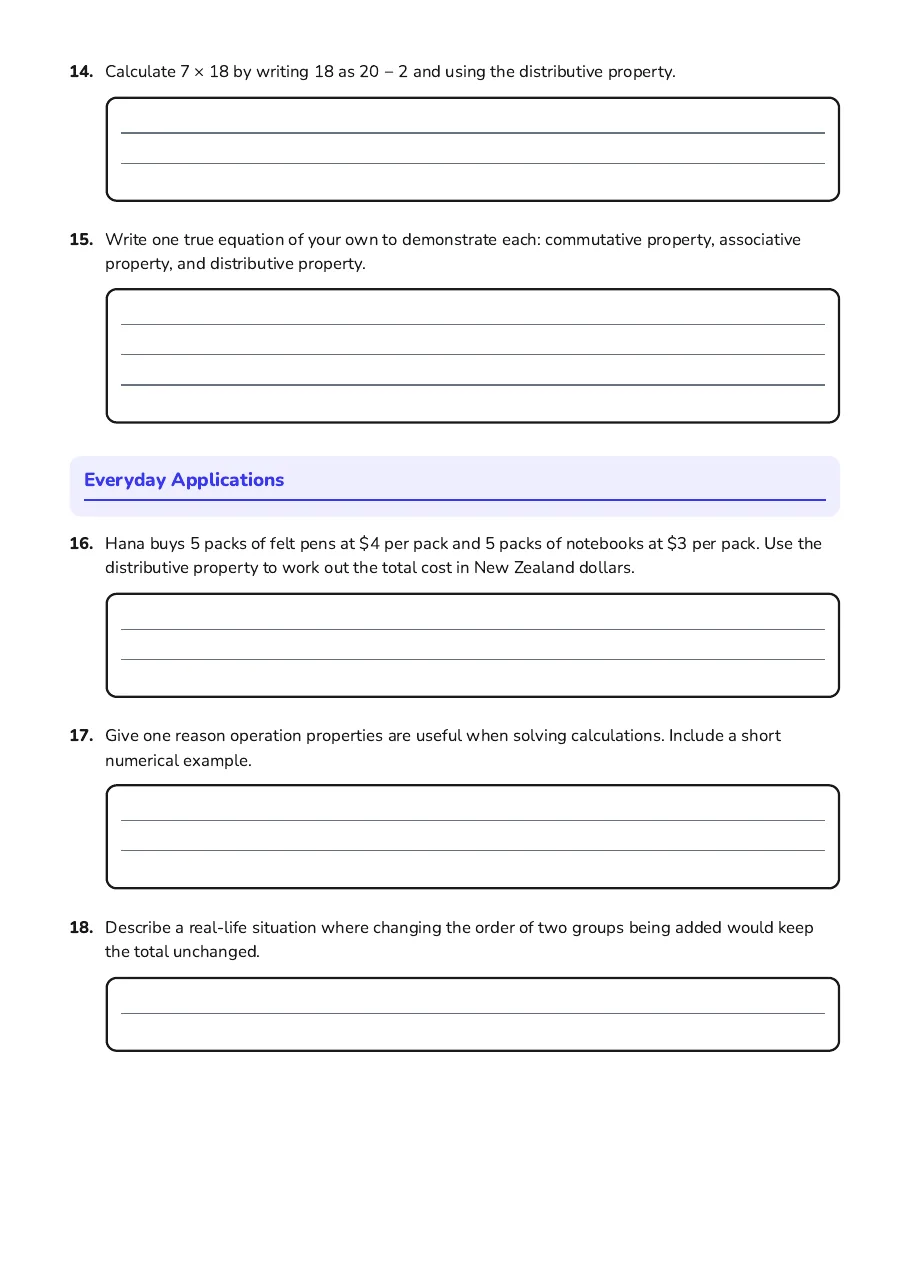
14.Calculate 7 × 18 by writing 18 as 20 − 2 and using the distributive property.
15.Write one true equation of your own to demonstrate each: commutative property, associative property, and distributive property.
Everyday Applications
16.Hana buys 5 packs of felt pens at $4 per pack and 5 packs of notebooks at $3 per pack. Use the distributive property to work out the total cost in New Zealand dollars.
17.Give one reason operation properties are useful when solving calculations. Include a short numerical example.
18.Describe a real-life situation where changing the order of two groups being added would keep the total unchanged.
4 printable pages
Page 1
Page 2
Page 3
Page 4
About This Worksheet
Free in Kuraplan
Sign up free, grab the PDF, and customize it for your class.
Print-Ready
Formatted for standard paper. Clean layout, easy to read.
AI-Generated
Created with Kuraplan's AI, designed for real classroom use.
For Teachers & Parents
Use in classrooms, for homework, tutoring, or homeschool.
Need a custom version of this worksheet?
Kuraplan's AI generates custom worksheets in seconds — differentiated for every learner, aligned to your curriculum.
Generate Custom Worksheets — Free No credit card Curriculum-aligned Under 60 seconds
More Maths Worksheets
Year 7
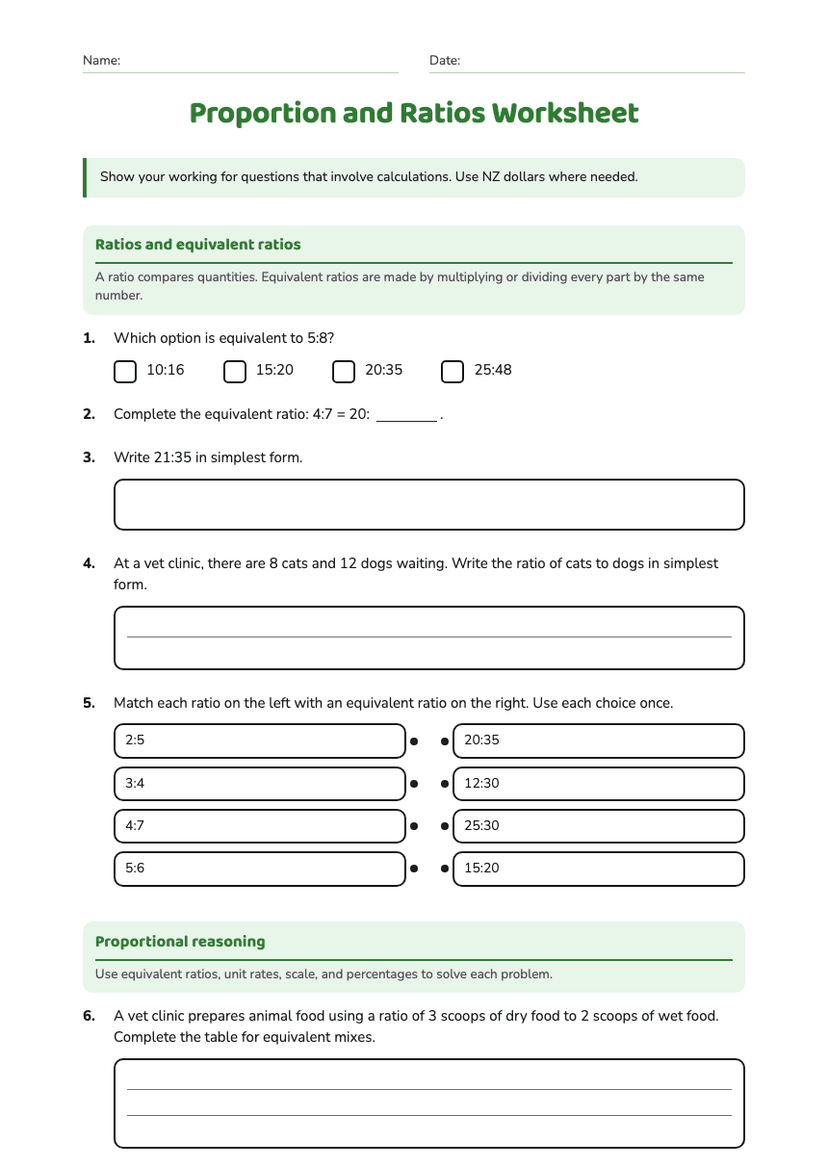
Proportion and Ratios Worksheet
Free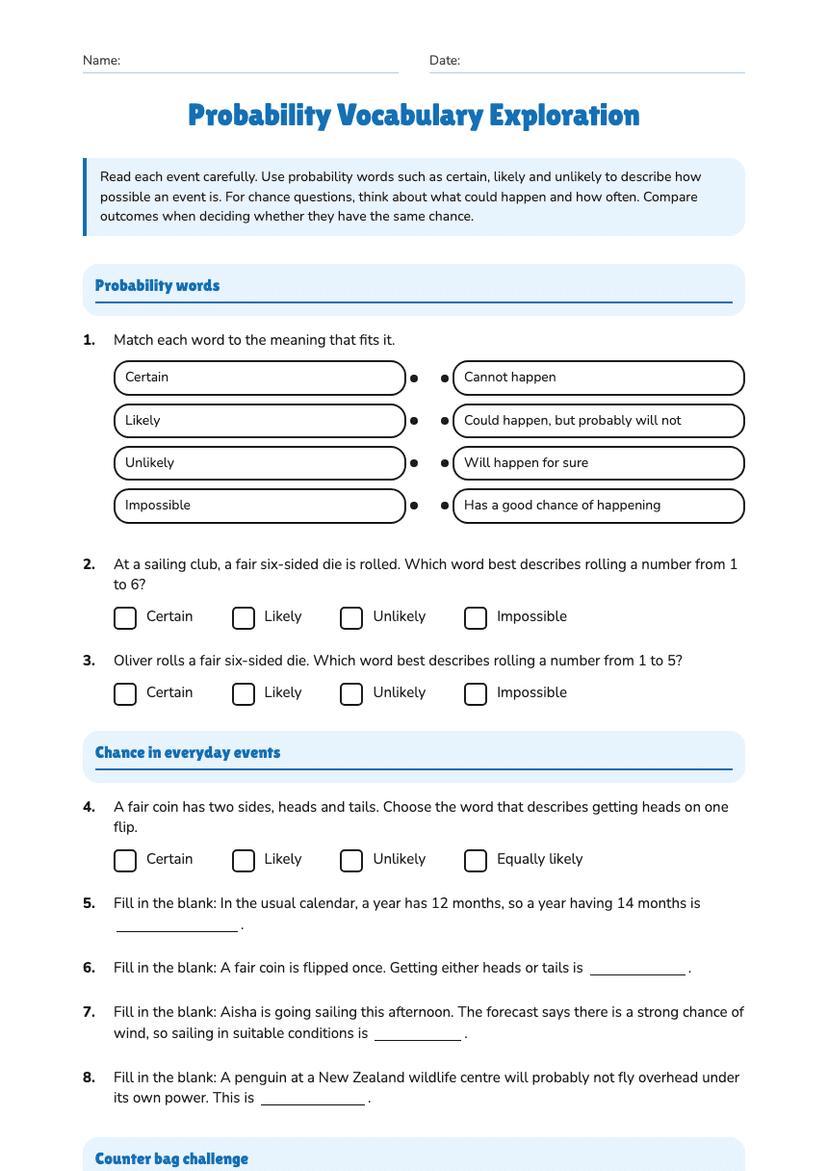
Year 4
Probability Vocabulary Exploration
Free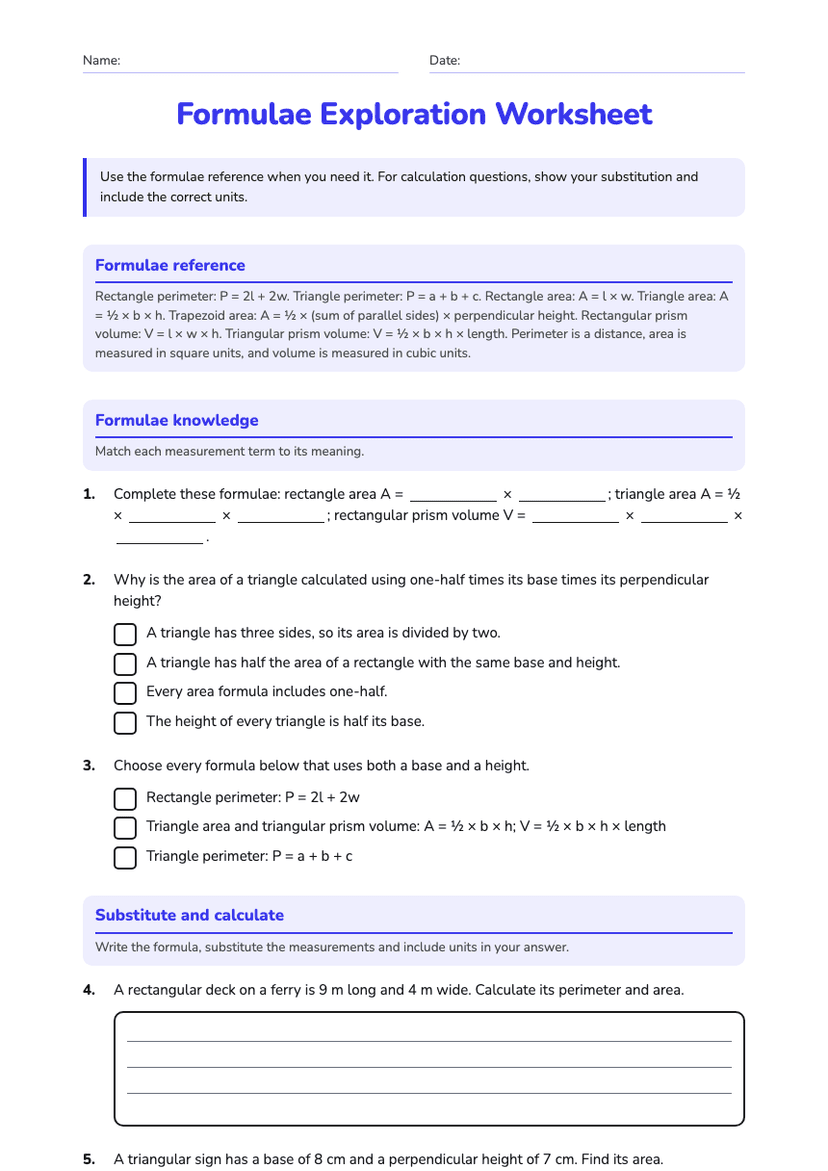
Year 8
Formulae Exploration Worksheet
Free
Year 9
Integer Operations Practice
Free
Year 10
Tessellation Pattern Exploration
Free
Year 3–4
Basic Probability Exploration
Free
Year 7
Time Duration Problem Cards
Free
Year 4