Seeing 3D Shapes from Different Views
A free maths worksheet ready for your classroom. Open in Kuraplan to grab the print-ready PDF, customize it for your students, or generate a fresh version in seconds.
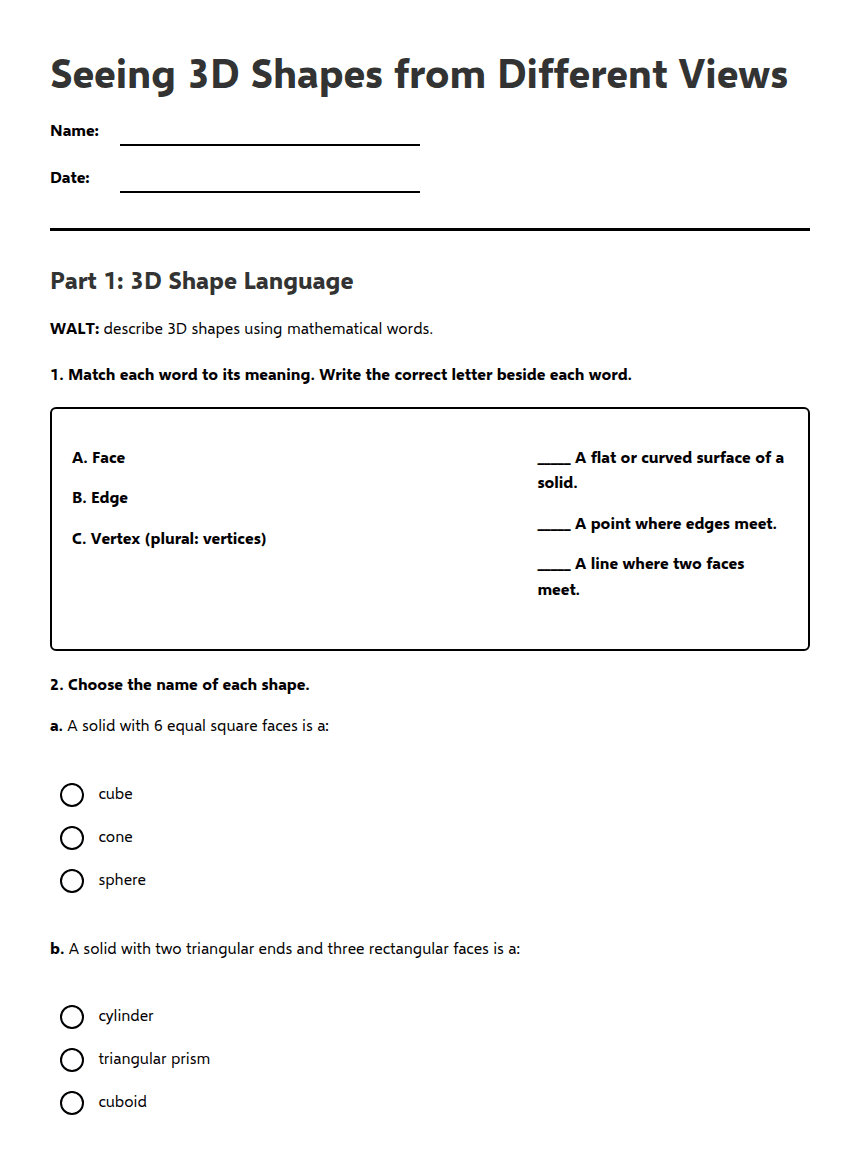
Seeing 3D Shapes from Different Views
Part 1: 3D Shape Language
WALT: describe 3D shapes using mathematical words.
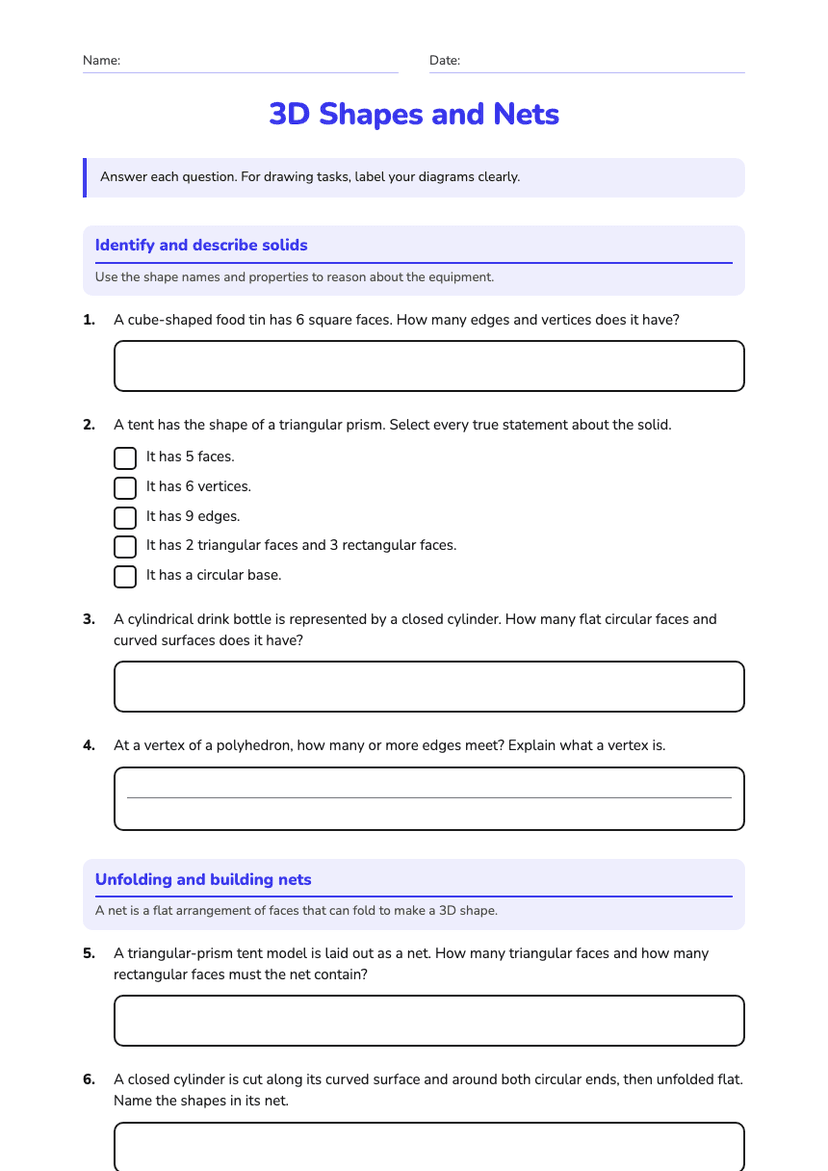
a. A solid with 6 equal square faces is a:
b. A solid with two triangular ends and three rectangular faces is a:
c. A solid with one curved surface and two flat circular faces is a:
Part 2: Front, Side and Top Views
Imagine turning a solid model. A view is a 2D drawing of what you can see from one direction.
I know my two drawings show the same solid because:
Part 3: Exit Ticket and Teacher Answer Key
Teacher Answer Key
1. Face: a flat or curved surface. Edge: a line where two faces meet. Vertex: a point where edges meet.
2a. cube 2b. triangular prism 2c. cylinder
3. Six equal squares joined edge-to-edge in a pattern that folds into a solid.
4. rectangle
5. circle
6. triangle
7. Answers will vary. Check that both drawings represent the same chosen solid and that visible features are labelled accurately.
8. Accept answers such as: “we see different faces or surfaces” or “the object is being viewed from a different direction”.
9–10. Answers will vary. Use responses to identify students who need more support with spatial reasoning and viewpoint language.
About This Worksheet
Free in Kuraplan
Sign up free, grab the PDF, and customize it for your class.
Print-Ready
Formatted for standard paper. Clean layout, easy to read.
AI-Generated
Created with Kuraplan's AI, designed for real classroom use.
For Teachers & Parents
Use in classrooms, for homework, tutoring, or homeschool.
Need a custom version of this worksheet?
Kuraplan's AI generates custom worksheets in seconds — differentiated for every learner, aligned to your curriculum.
Generate Custom Worksheets — Free