Six-Day War Comprehension
A free nz history worksheet ready for your classroom. Open in Kuraplan to grab the print-ready PDF, customize it for your students, or generate a fresh version in seconds.

Six-Day War Comprehension
The Six-Day War, June 1967
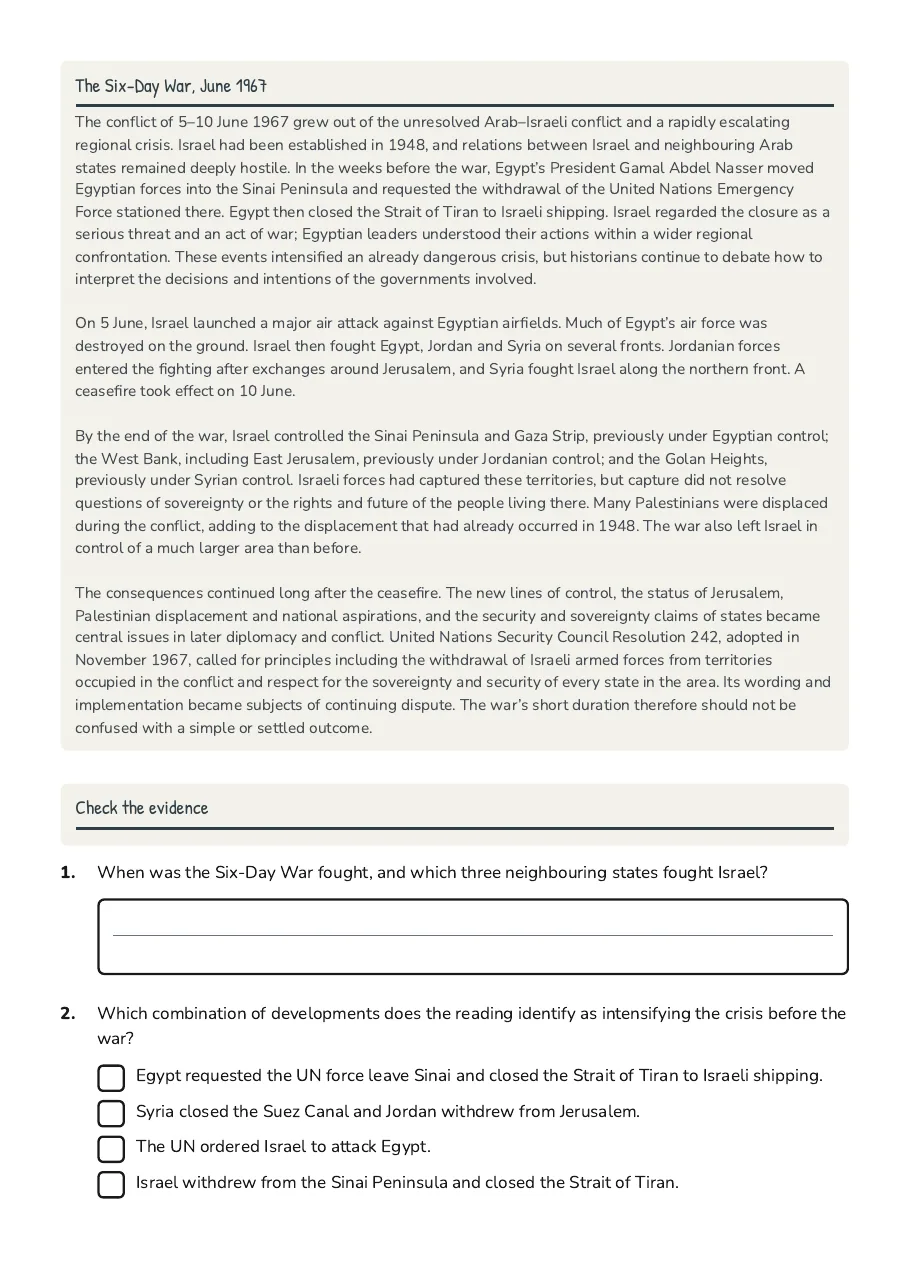
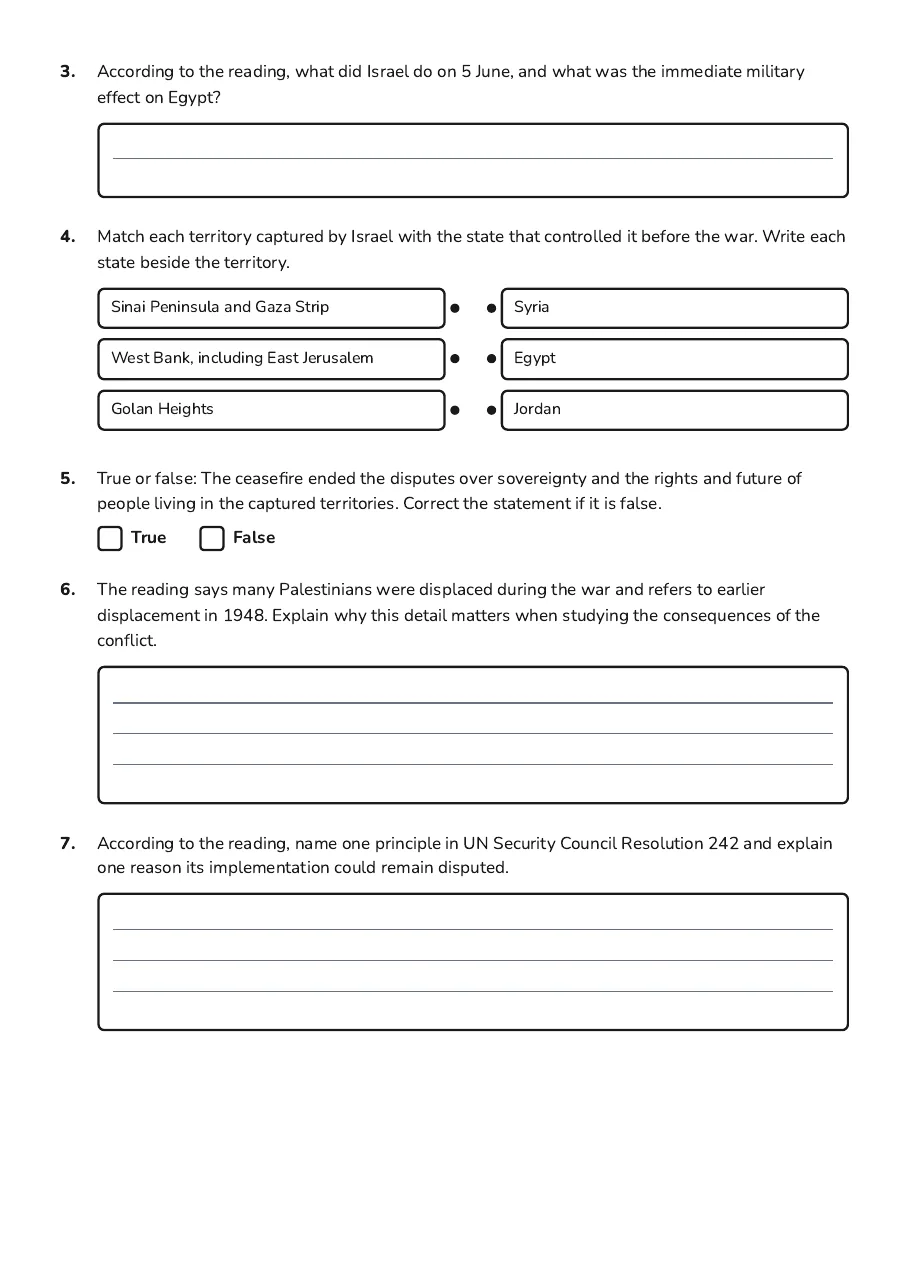
The conflict of 5–10 June 1967 grew out of the unresolved Arab–Israeli conflict and a rapidly escalating regional crisis. Israel had been established in 1948, and relations between Israel and neighbouring Arab states remained deeply hostile. In the weeks before the war, Egypt’s President Gamal Abdel Nasser moved Egyptian forces into the Sinai Peninsula and requested the withdrawal of the United Nations Emergency Force stationed there. Egypt then closed the Strait of Tiran to Israeli shipping. Israel regarded the closure as a serious threat and an act of war; Egyptian leaders understood their actions within a wider regional confrontation. These events intensified an already dangerous crisis, but historians continue to debate how to interpret the decisions and intentions of the governments involved. On 5 June, Israel launched a major air attack against Egyptian airfields. Much of Egypt’s air force was destroyed on the ground. Israel then fought Egypt, Jordan and Syria on several fronts. Jordanian forces entered the fighting after exchanges around Jerusalem, and Syria fought Israel along the northern front. A ceasefire took effect on 10 June. By the end of the war, Israel controlled the Sinai Peninsula and Gaza Strip, previously under Egyptian control; the West Bank, including East Jerusalem, previously under Jordanian control; and the Golan Heights, previously under Syrian control. Israeli forces had captured these territories, but capture did not resolve questions of sovereignty or the rights and future of the people living there. Many Palestinians were displaced during the conflict, adding to the displacement that had already occurred in 1948. The war also left Israel in control of a much larger area than before. The consequences continued long after the ceasefire. The new lines of control, the status of Jerusalem, Palestinian displacement and national aspirations, and the security and sovereignty claims of states became central issues in later diplomacy and conflict. United Nations Security Council Resolution 242, adopted in November 1967, called for principles including the withdrawal of Israeli armed forces from territories occupied in the conflict and respect for the sovereignty and security of every state in the area. Its wording and implementation became subjects of continuing dispute. The war’s short duration therefore should not be confused with a simple or settled outcome.
Check the evidence
- Egypt requested the UN force leave Sinai and closed the Strait of Tiran to Israeli shipping.
- Syria closed the Suez Canal and Jordan withdrew from Jerusalem.
- The UN ordered Israel to attack Egypt.
- Israel withdrew from the Sinai Peninsula and closed the Strait of Tiran.
- Sinai Peninsula and Gaza Strip
- West Bank, including East Jerusalem
- Golan Heights
- Syria
- Egypt
- Jordan
4 printable pages

Page 1
Page 2
Page 3
Page 4
About This Worksheet
Free in Kuraplan
Sign up free, grab the PDF, and customize it for your class.
Print-Ready
Formatted for standard paper. Clean layout, easy to read.
AI-Generated
Created with Kuraplan's AI, designed for real classroom use.
For Teachers & Parents
Use in classrooms, for homework, tutoring, or homeschool.
Need a custom version of this worksheet?
Kuraplan's AI generates custom worksheets in seconds — differentiated for every learner, aligned to your curriculum.
Generate Custom Worksheets — Free