MathsFreePrintable
Tessellation Pattern Exploration
A free maths worksheet ready for your classroom. Open in Kuraplan to grab the print-ready PDF, customize it for your students, or generate a fresh version in seconds.
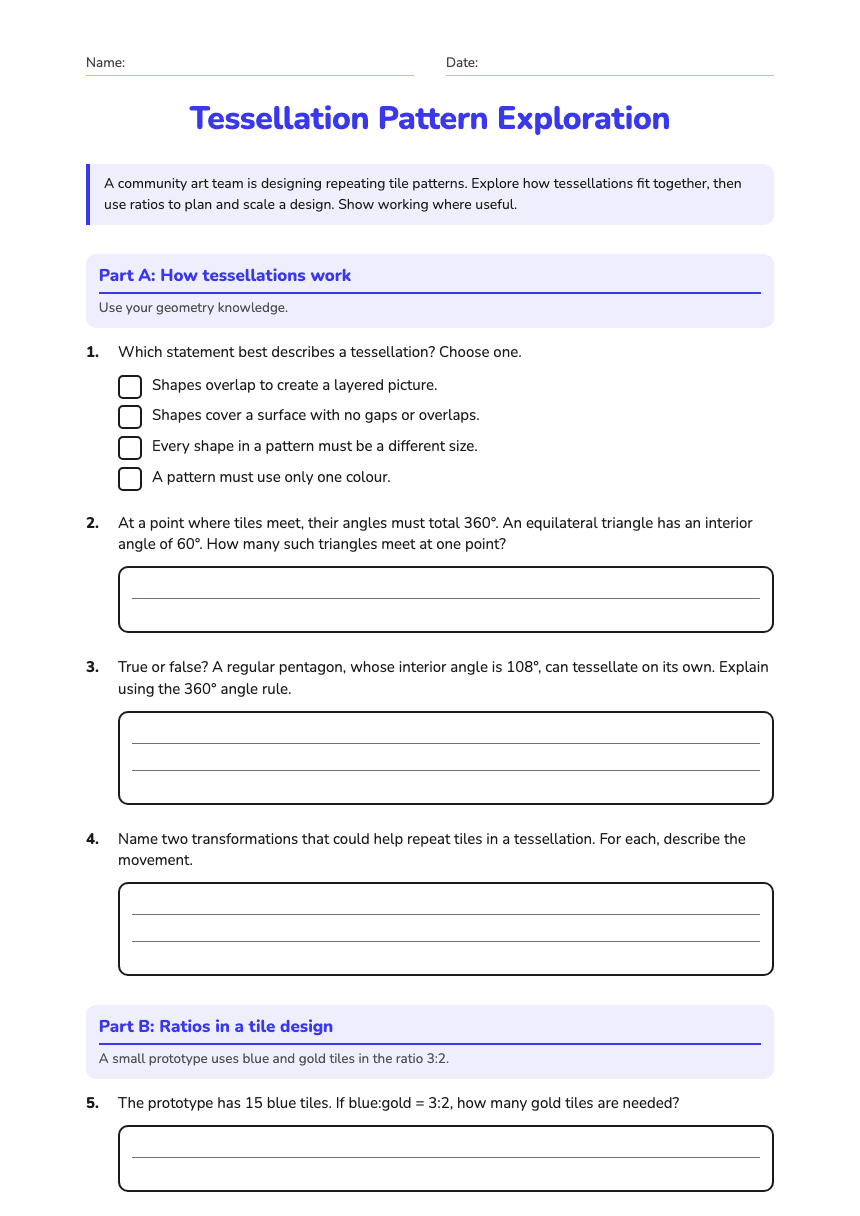
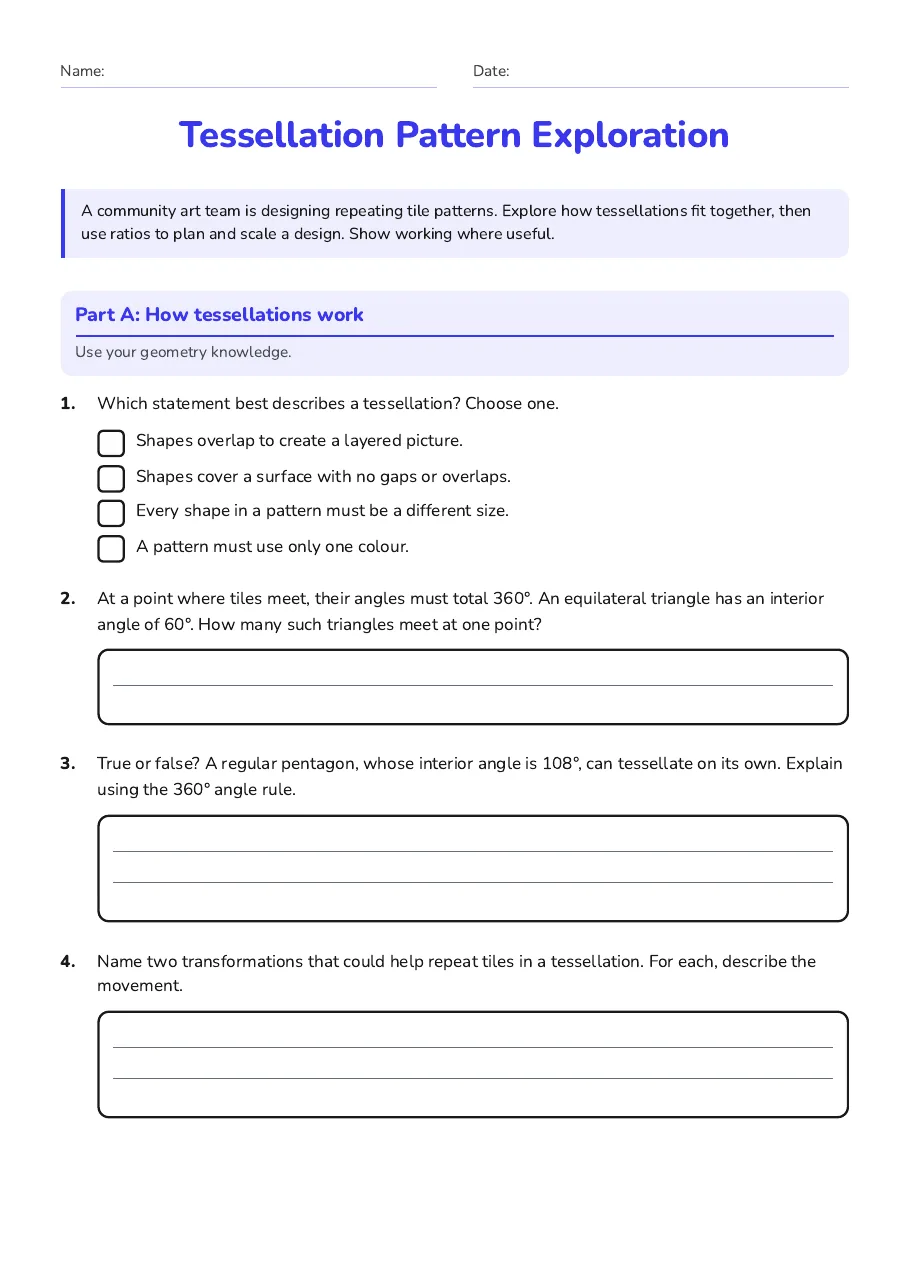
Name:Date:
Tessellation Pattern Exploration
A community art team is designing repeating tile patterns. Explore how tessellations fit together, then use ratios to plan and scale a design. Show working where useful.
Part A: How tessellations work
Use your geometry knowledge.
1.Which statement best describes a tessellation? Choose one.
- Shapes overlap to create a layered picture.
- Shapes cover a surface with no gaps or overlaps.
- Every shape in a pattern must be a different size.
- A pattern must use only one colour.
2.At a point where tiles meet, their angles must total 360°. An equilateral triangle has an interior angle of 60°. How many such triangles meet at one point?
3.True or false? A regular pentagon, whose interior angle is 108°, can tessellate on its own. Explain using the 360° angle rule.
4.Name two transformations that could help repeat tiles in a tessellation. For each, describe the movement.
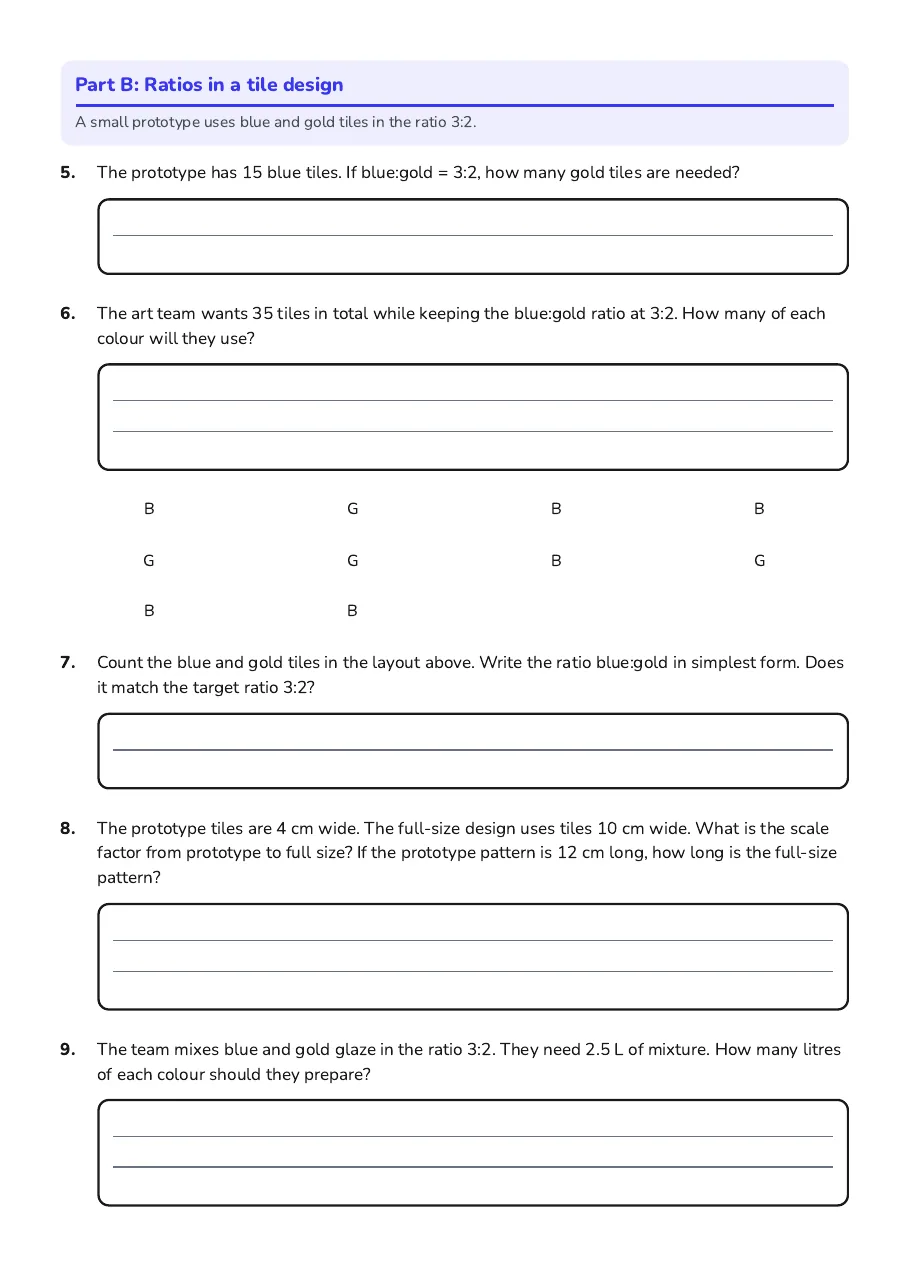
Part B: Ratios in a tile design
A small prototype uses blue and gold tiles in the ratio 3:2.
5.The prototype has 15 blue tiles. If blue:gold = 3:2, how many gold tiles are needed?
6.The art team wants 35 tiles in total while keeping the blue:gold ratio at 3:2. How many of each colour will they use?
B
G
B
B
G
G
B
G
B
B
7.Count the blue and gold tiles in the layout above. Write the ratio blue:gold in simplest form. Does it match the target ratio 3:2?
8.The prototype tiles are 4 cm wide. The full-size design uses tiles 10 cm wide. What is the scale factor from prototype to full size? If the prototype pattern is 12 cm long, how long is the full-size pattern?
9.The team mixes blue and gold glaze in the ratio 3:2. They need 2.5 L of mixture. How many litres of each colour should they prepare?
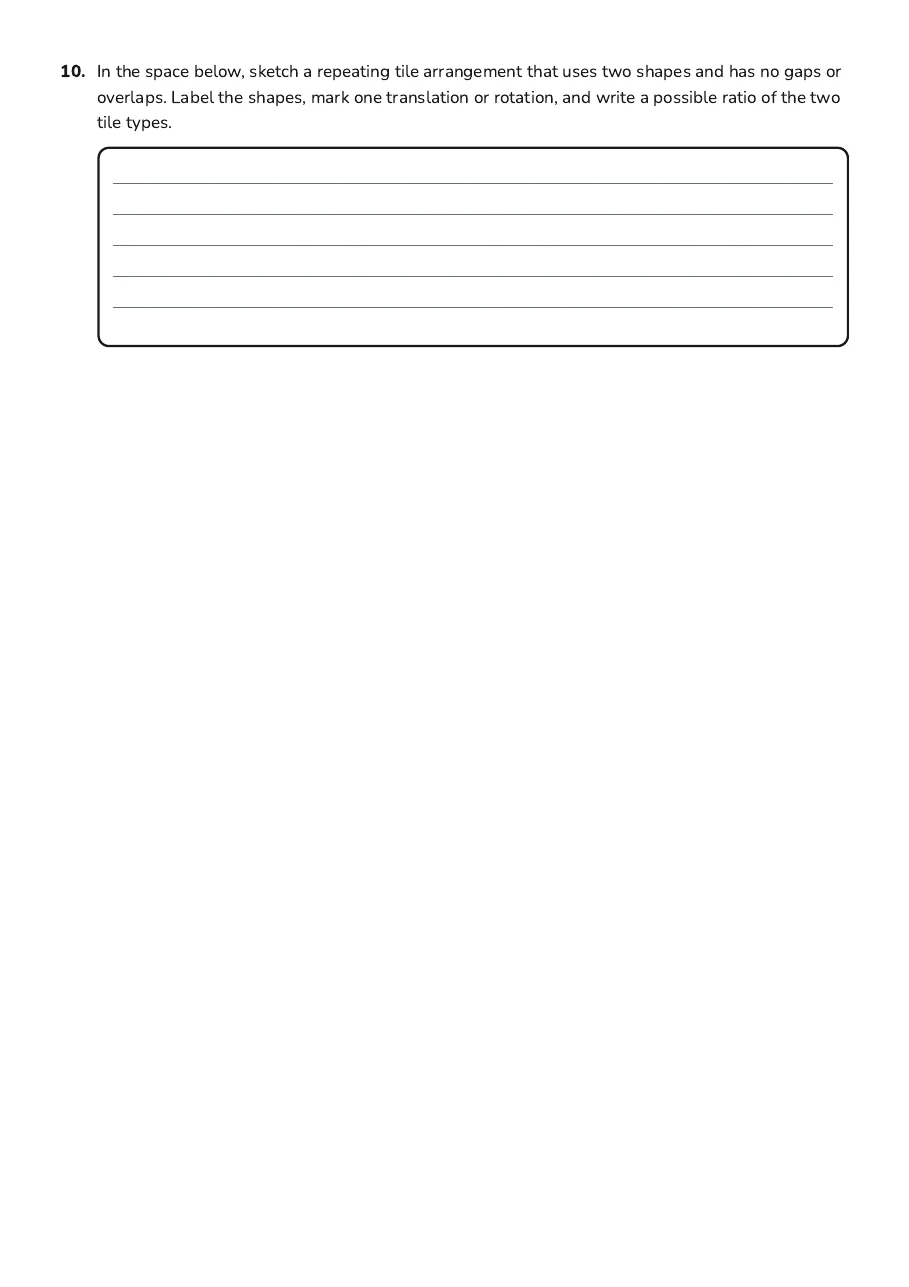
10.In the space below, sketch a repeating tile arrangement that uses two shapes and has no gaps or overlaps. Label the shapes, mark one translation or rotation, and write a possible ratio of the two tile types.
3 printable pages
Page 1
Page 2
Page 3
About This Worksheet
Free in Kuraplan
Sign up free, grab the PDF, and customize it for your class.
Print-Ready
Formatted for standard paper. Clean layout, easy to read.
AI-Generated
Created with Kuraplan's AI, designed for real classroom use.
For Teachers & Parents
Use in classrooms, for homework, tutoring, or homeschool.
Need a custom version of this worksheet?
Kuraplan's AI generates custom worksheets in seconds — differentiated for every learner, aligned to your curriculum.
Generate Custom Worksheets — Free No credit card Curriculum-aligned Under 60 seconds
More Maths Worksheets
Year 7
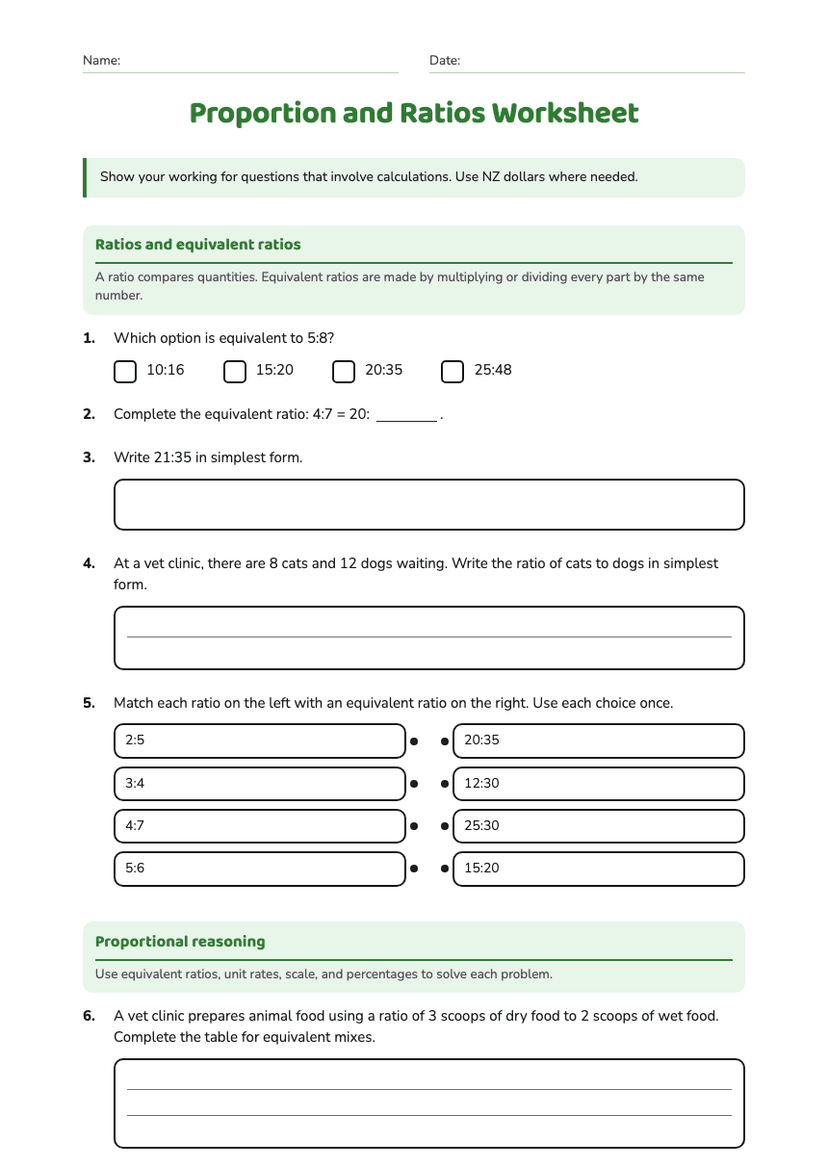
Proportion and Ratios Worksheet
Free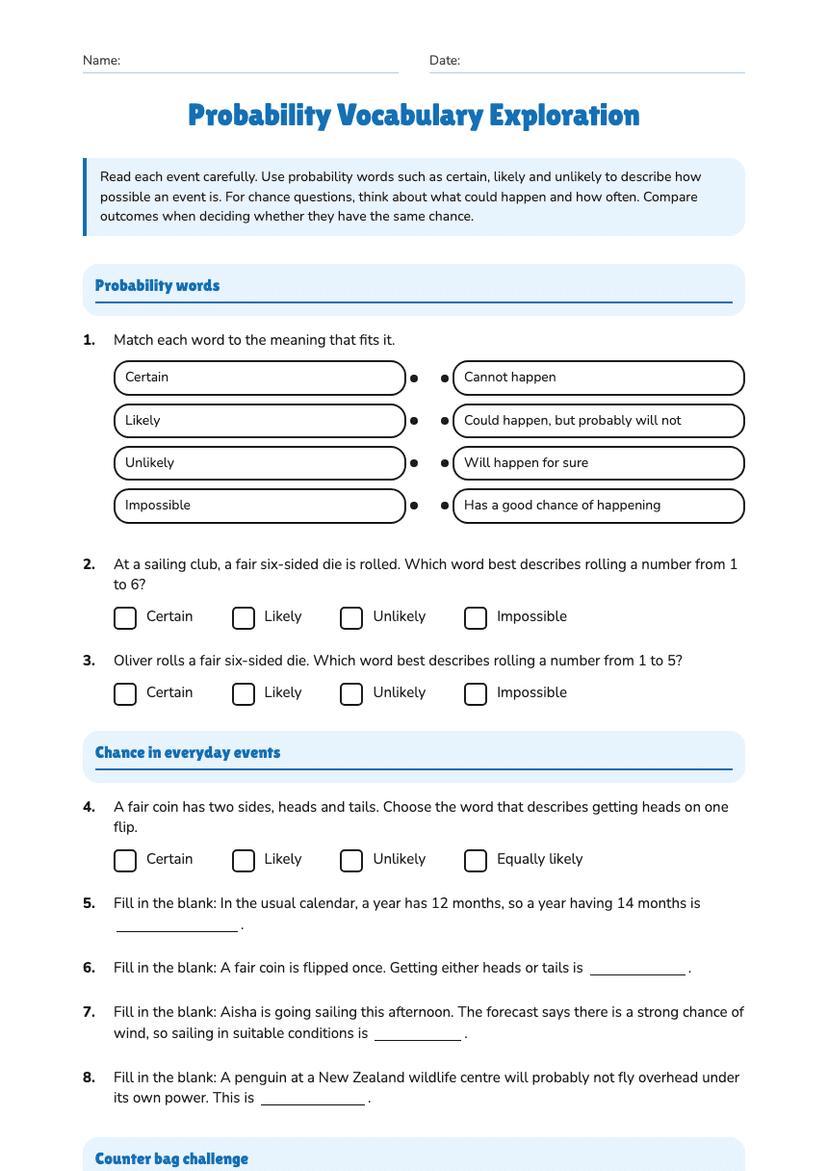
Year 4
Probability Vocabulary Exploration
Free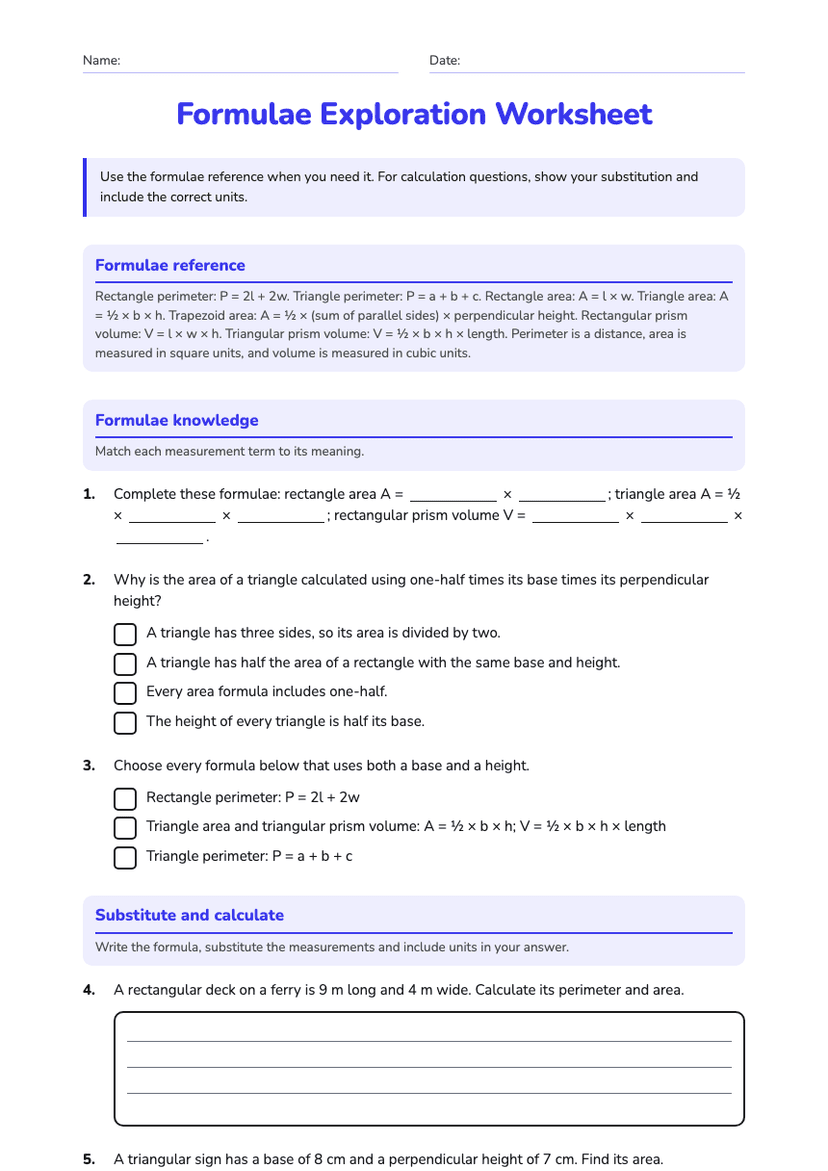
Year 8
Formulae Exploration Worksheet
Free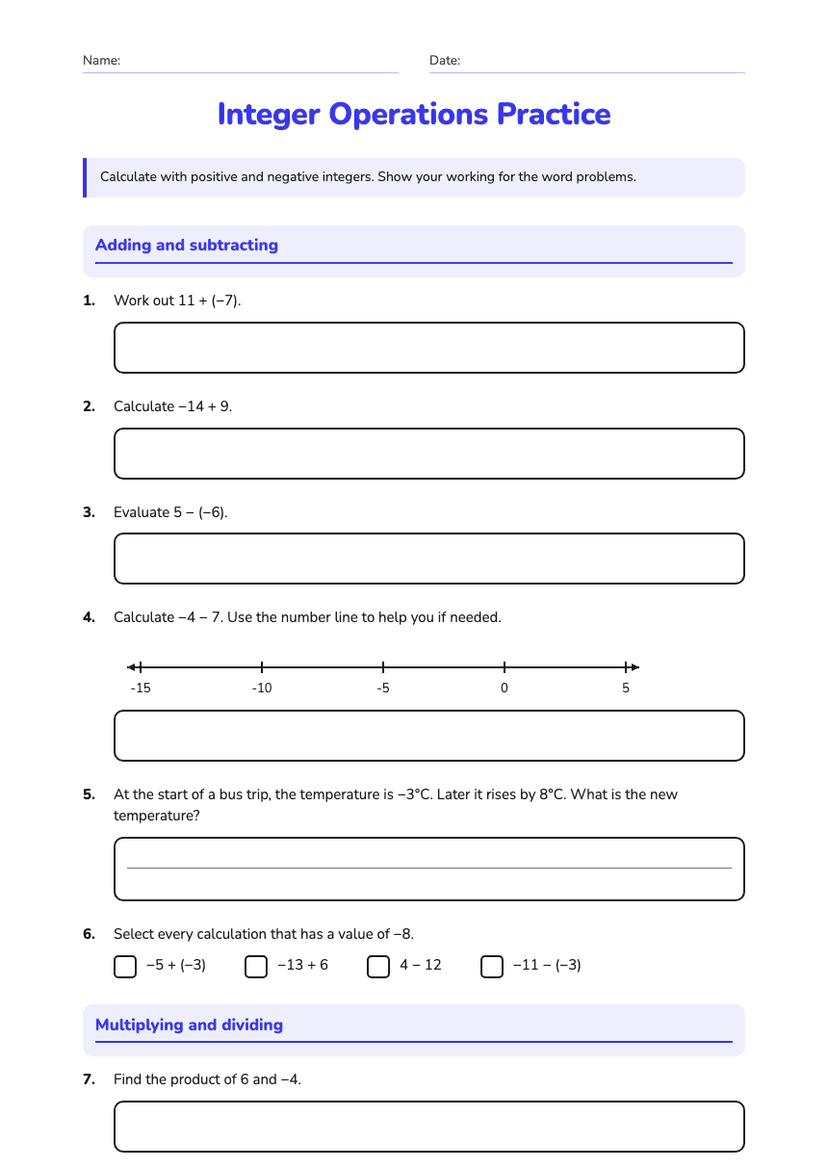
Year 9
Integer Operations Practice
Free
Year 10
Tessellation Pattern Exploration
Free
Year 3–4
Basic Probability Exploration
Free
Year 7
Time Duration Problem Cards
Free
Year 4