Social SciencesFreePrintable
Timeline History Skills Worksheet
A free social sciences worksheet ready for your classroom. Open in Kuraplan to grab the print-ready PDF, customize it for your students, or generate a fresh version in seconds.
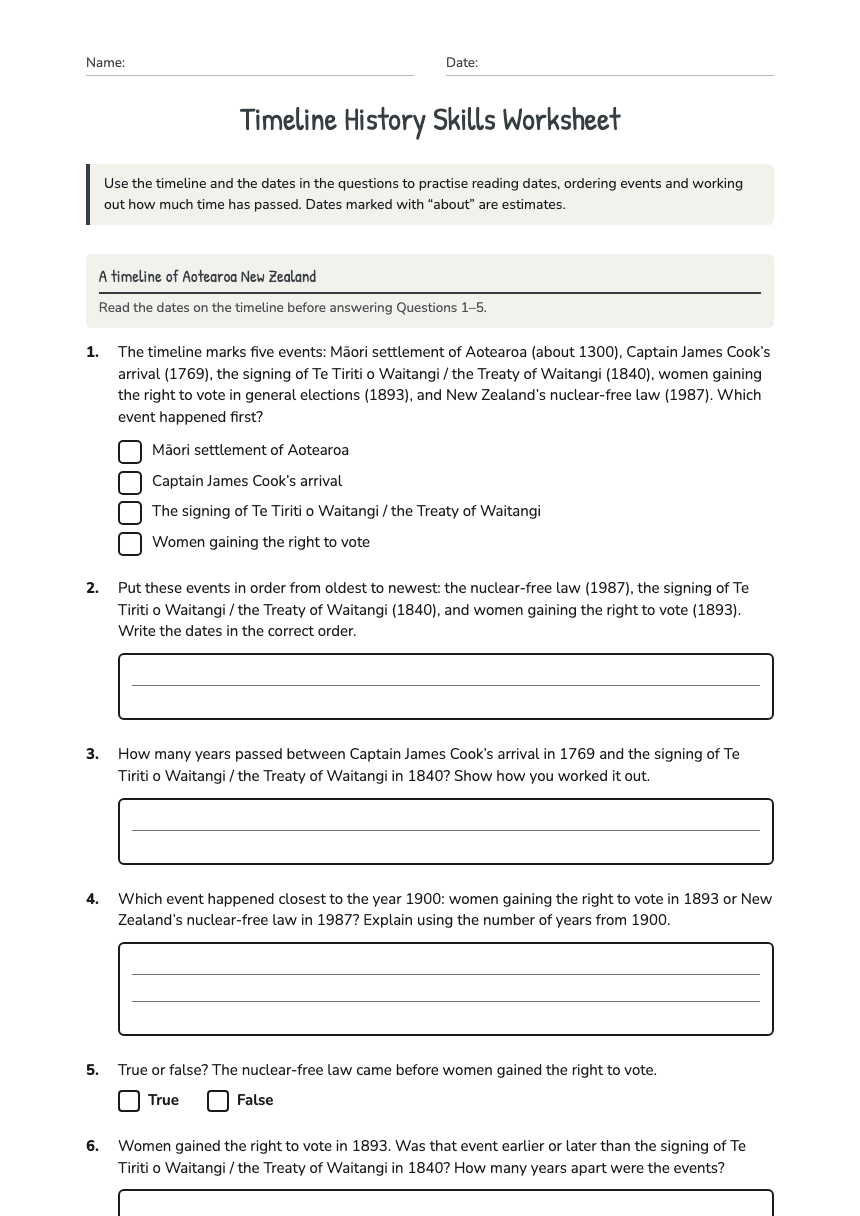
Name:Date:
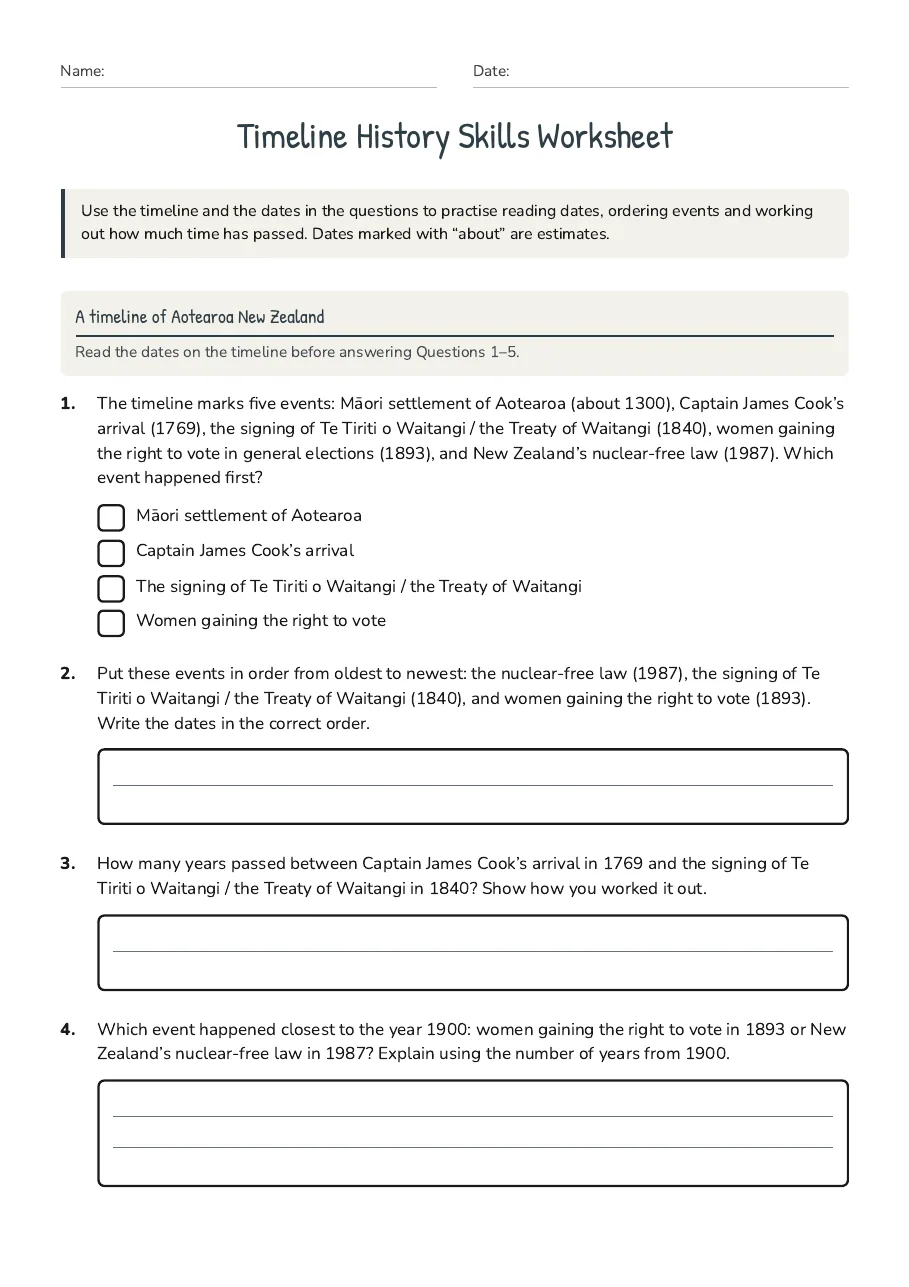
Timeline History Skills Worksheet
Use the timeline and the dates in the questions to practise reading dates, ordering events and working out how much time has passed. Dates marked with “about” are estimates.
A timeline of Aotearoa New Zealand
Read the dates on the timeline before answering Questions 1–5.
1.The timeline marks five events: Māori settlement of Aotearoa (about 1300), Captain James Cook’s arrival (1769), the signing of Te Tiriti o Waitangi / the Treaty of Waitangi (1840), women gaining the right to vote in general elections (1893), and New Zealand’s nuclear-free law (1987). Which event happened first?
- Māori settlement of Aotearoa
- Captain James Cook’s arrival
- The signing of Te Tiriti o Waitangi / the Treaty of Waitangi
- Women gaining the right to vote
2.Put these events in order from oldest to newest: the nuclear-free law (1987), the signing of Te Tiriti o Waitangi / the Treaty of Waitangi (1840), and women gaining the right to vote (1893). Write the dates in the correct order.
3.How many years passed between Captain James Cook’s arrival in 1769 and the signing of Te Tiriti o Waitangi / the Treaty of Waitangi in 1840? Show how you worked it out.
4.Which event happened closest to the year 1900: women gaining the right to vote in 1893 or New Zealand’s nuclear-free law in 1987? Explain using the number of years from 1900.
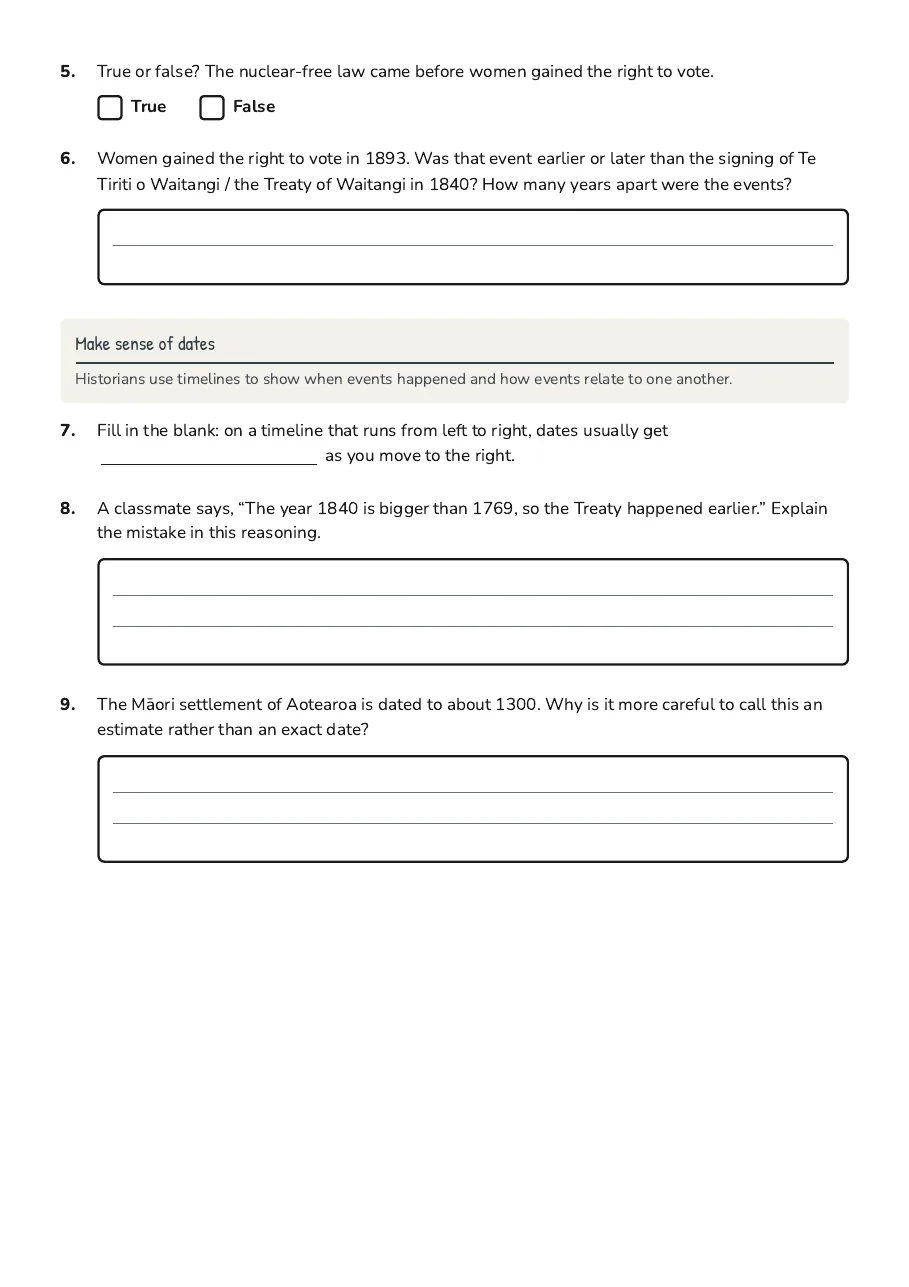
5.True or false? The nuclear-free law came before women gained the right to vote.
TrueFalse
6.Women gained the right to vote in 1893. Was that event earlier or later than the signing of Te Tiriti o Waitangi / the Treaty of Waitangi in 1840? How many years apart were the events?
Make sense of dates
Historians use timelines to show when events happened and how events relate to one another.
7.Fill in the blank: on a timeline that runs from left to right, dates usually get as you move to the right.
8.A classmate says, “The year 1840 is bigger than 1769, so the Treaty happened earlier.” Explain the mistake in this reasoning.
9.The Māori settlement of Aotearoa is dated to about 1300. Why is it more careful to call this an estimate rather than an exact date?
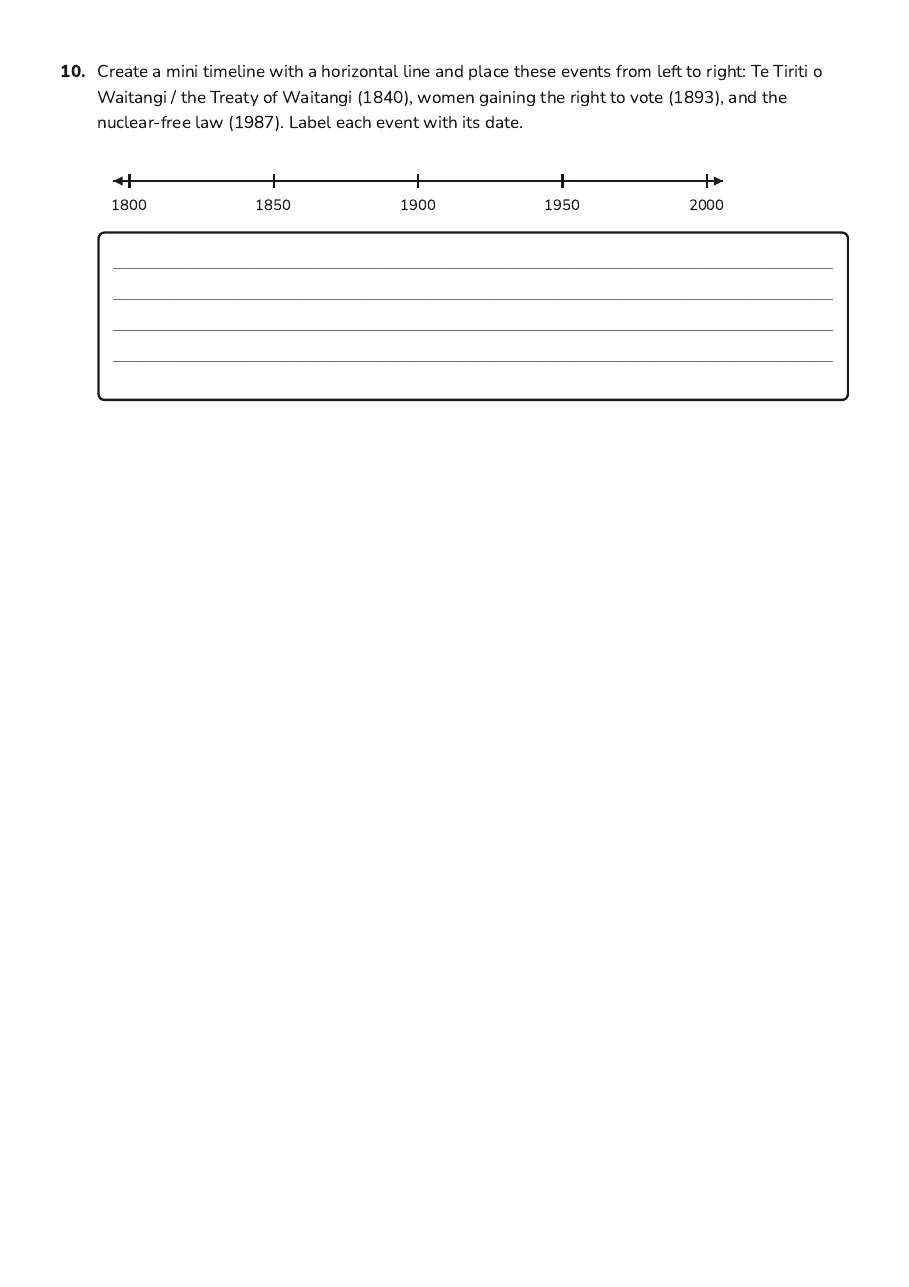
10.Create a mini timeline with a horizontal line and place these events from left to right: Te Tiriti o Waitangi / the Treaty of Waitangi (1840), women gaining the right to vote (1893), and the nuclear-free law (1987). Label each event with its date.
3 printable pages
Page 1
Page 2
Page 3
About This Worksheet
Free in Kuraplan
Sign up free, grab the PDF, and customize it for your class.
Print-Ready
Formatted for standard paper. Clean layout, easy to read.
AI-Generated
Created with Kuraplan's AI, designed for real classroom use.
For Teachers & Parents
Use in classrooms, for homework, tutoring, or homeschool.
Need a custom version of this worksheet?
Kuraplan's AI generates custom worksheets in seconds — differentiated for every learner, aligned to your curriculum.
Generate Custom Worksheets — Free No credit card Curriculum-aligned Under 60 seconds
More Social Sciences Worksheets
Year 7
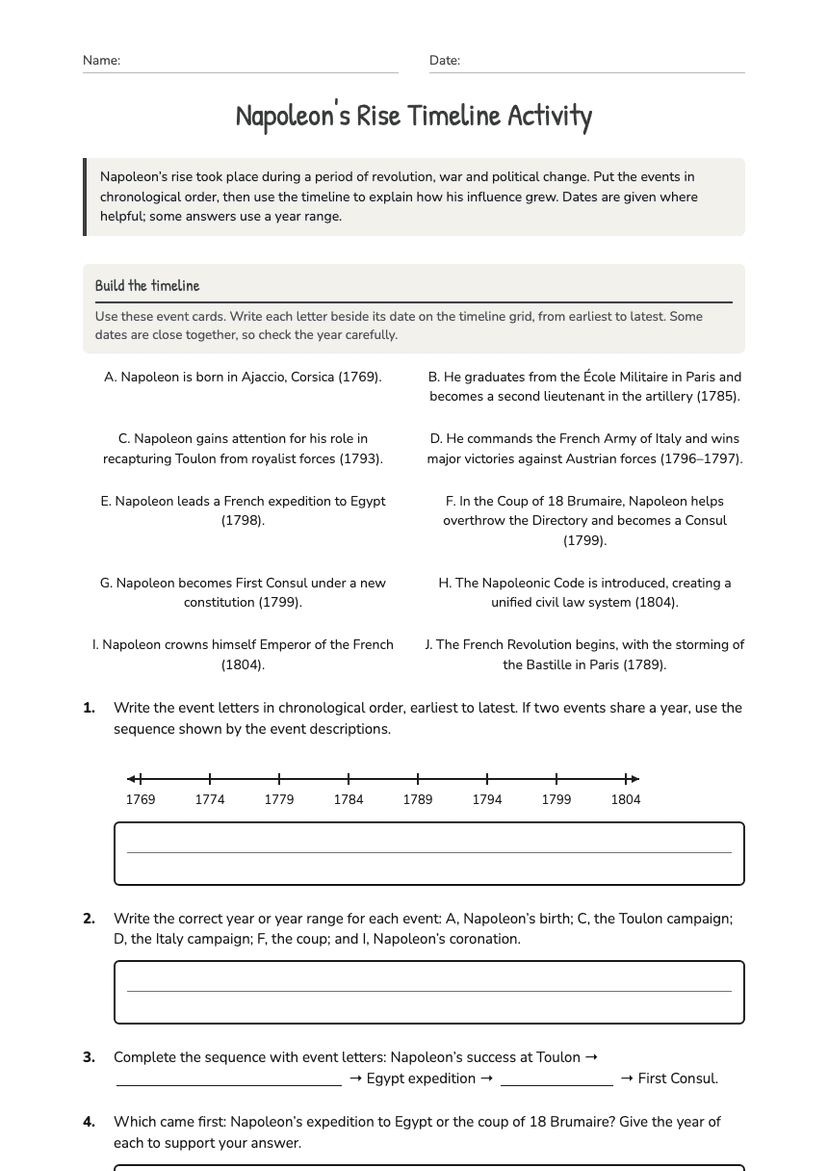
Napoleon's Rise Timeline Activity
Free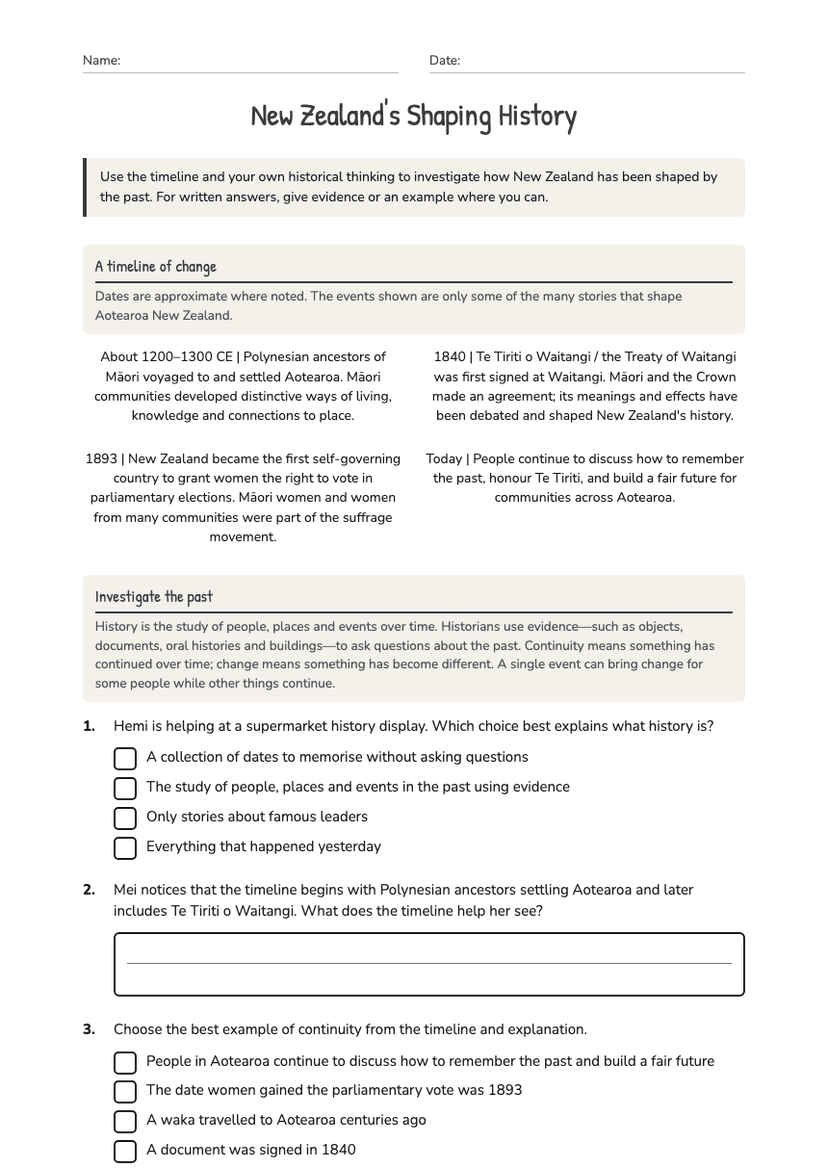
Year 7
New Zealand's Shaping History
Free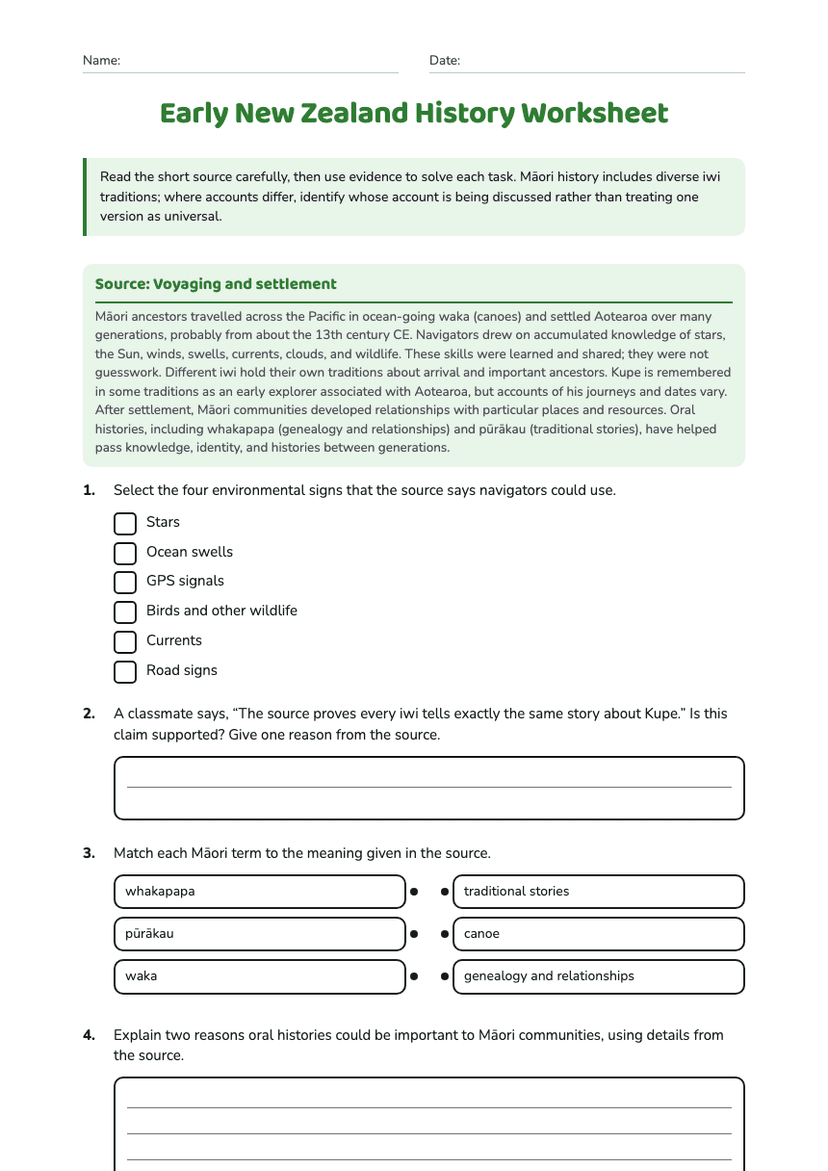
Year 9
Early New Zealand History Worksheet
Free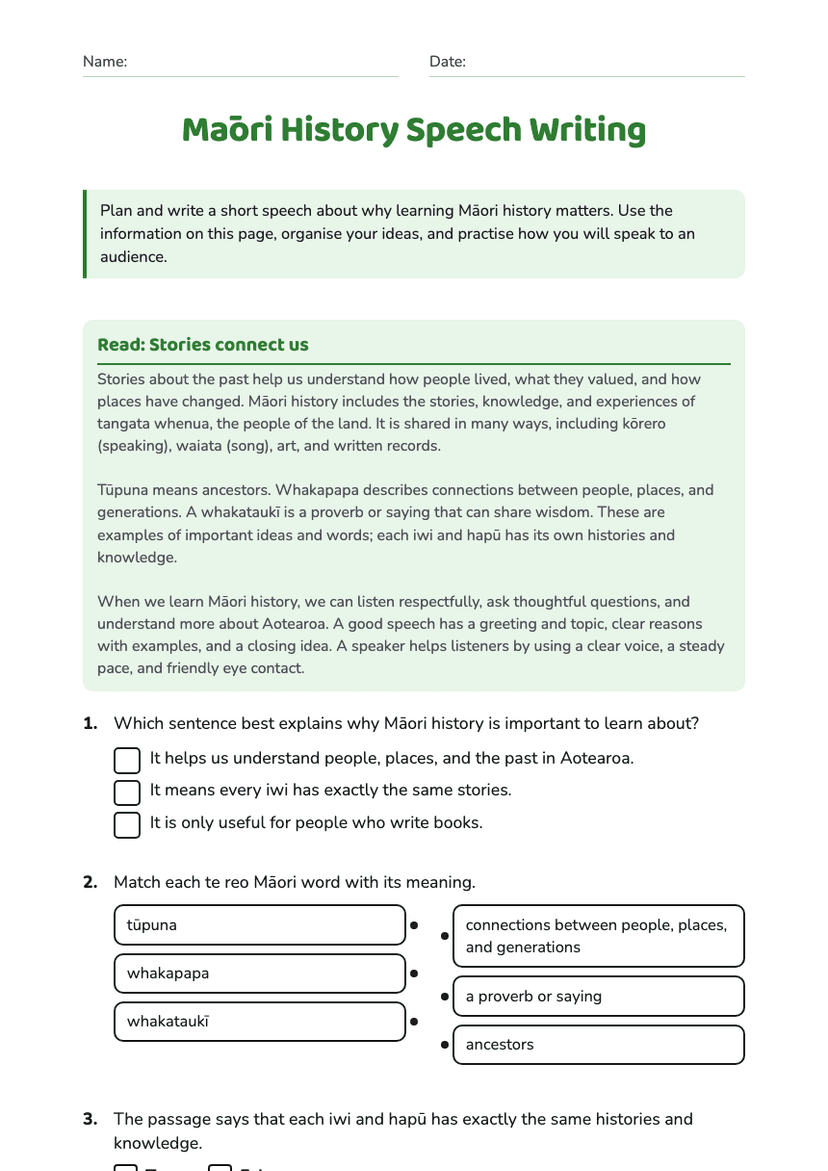
Year 3
Māori History Speech Writing
Free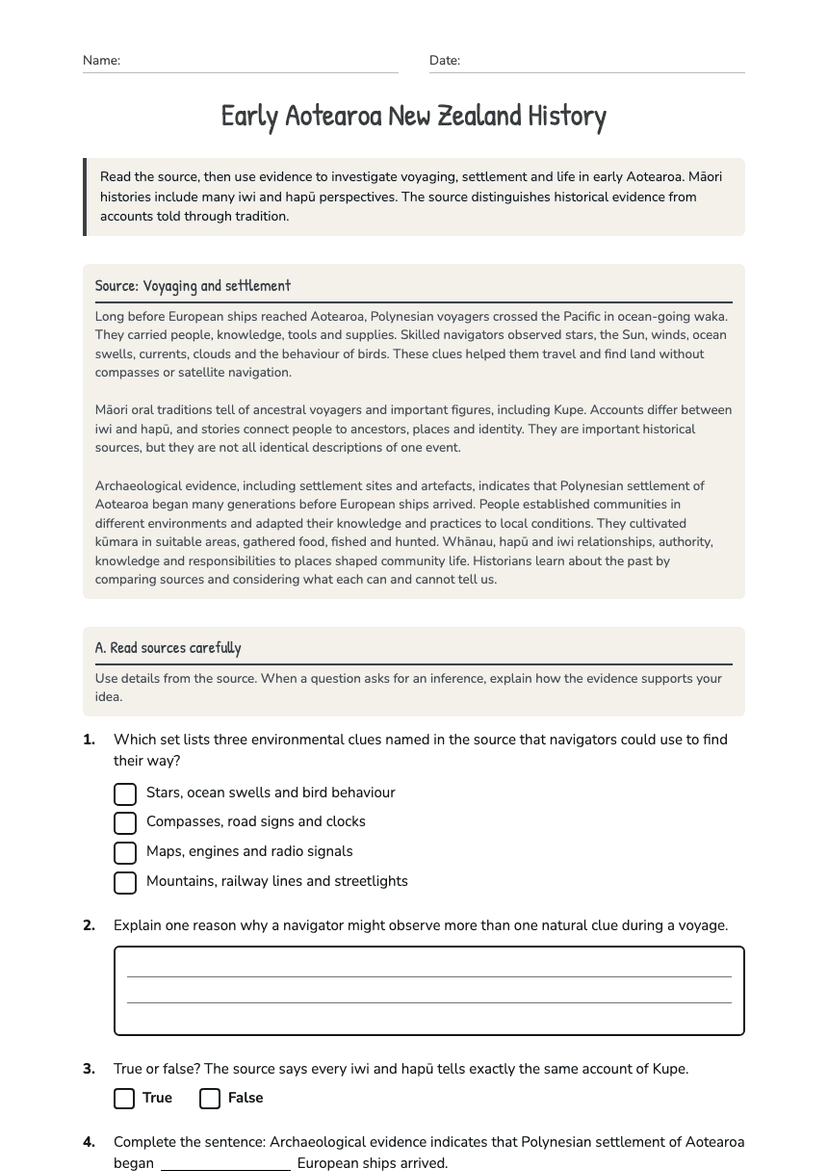
Year 9
Early Aotearoa New Zealand History
Free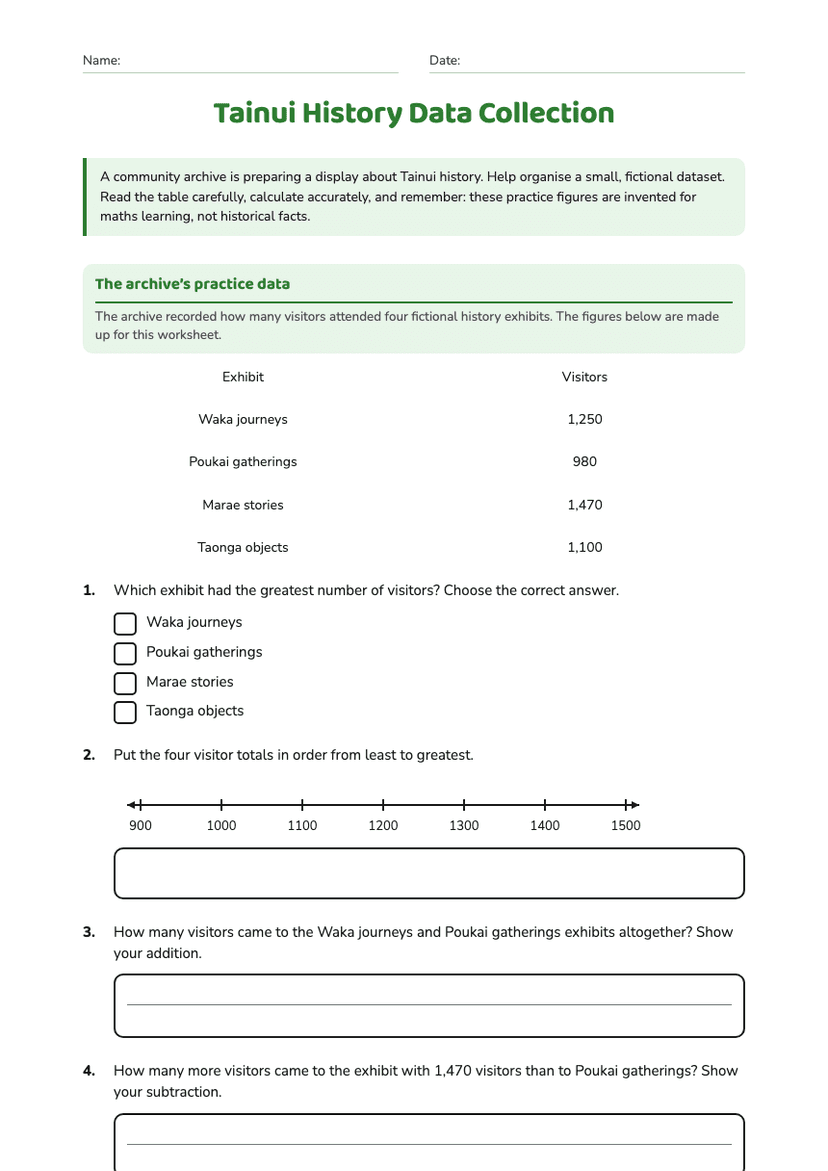
Year 5
Tainui History Data Collection
Free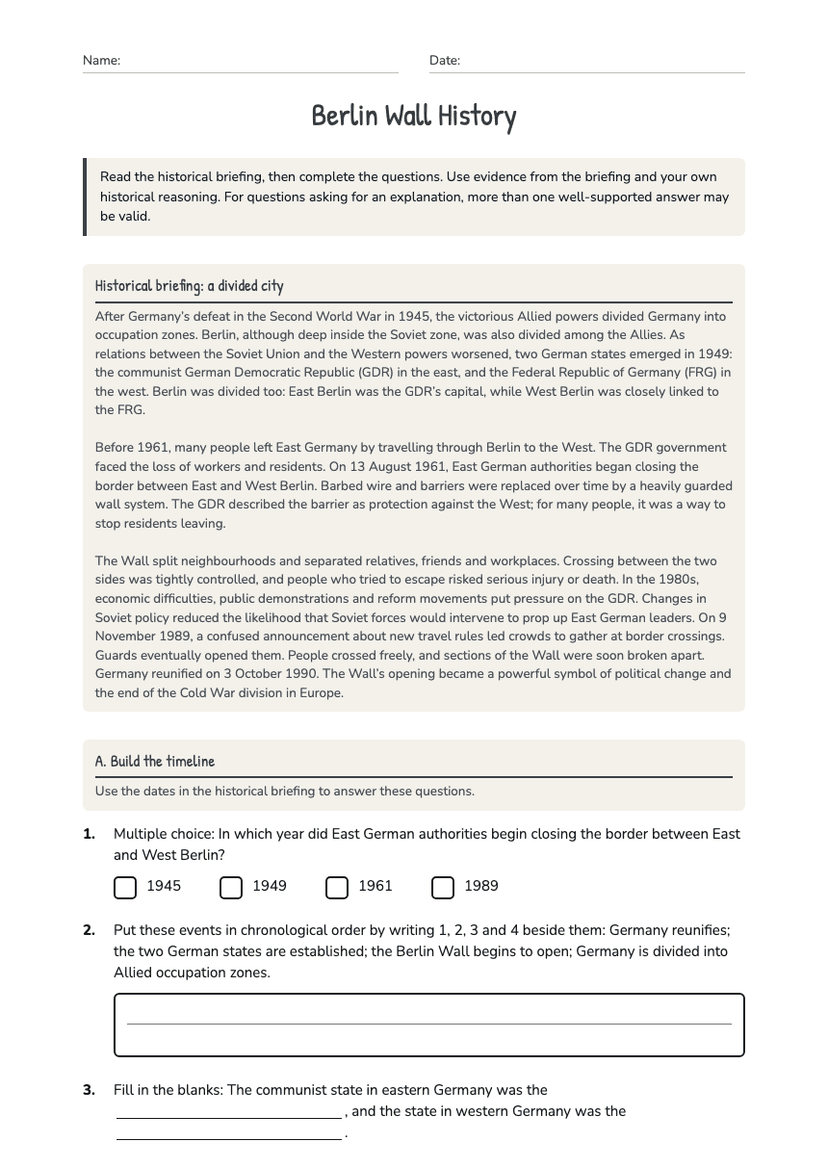
Year 10
Berlin Wall History
Free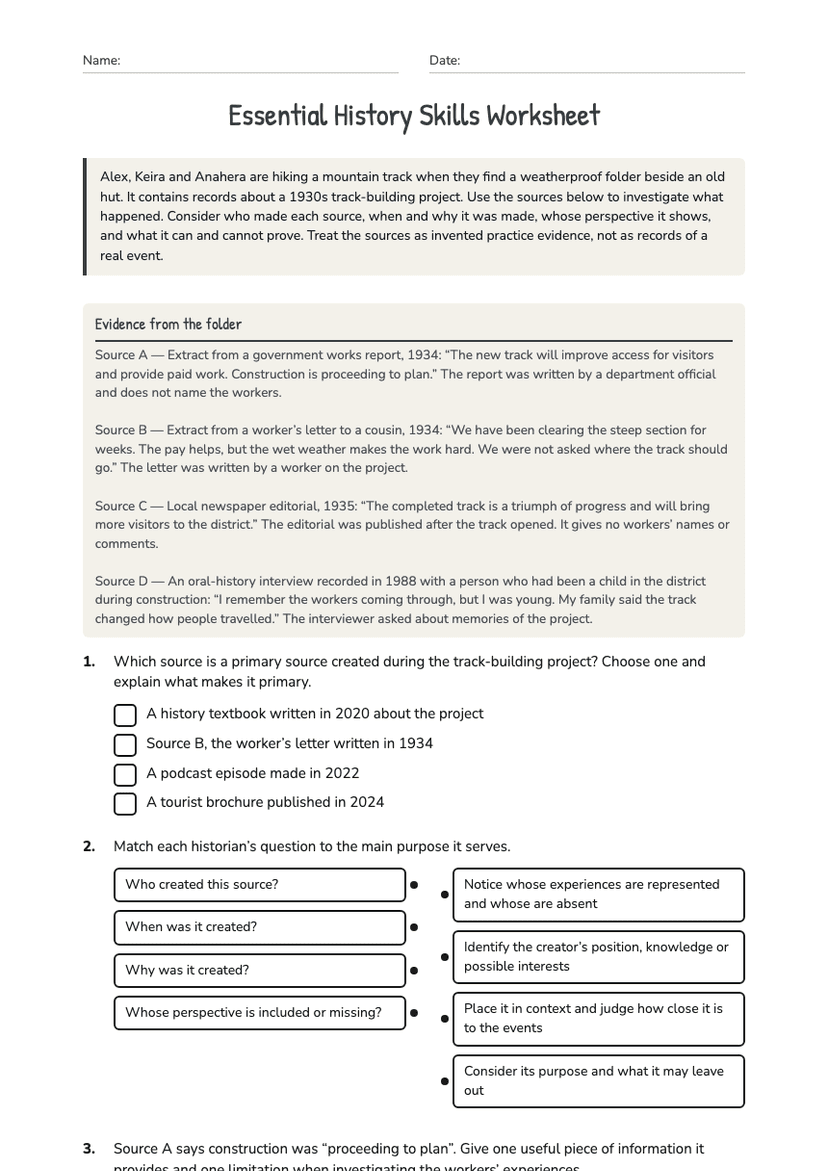
Year 9–10