MathsFreePrintable

Understanding Units of Measurement

A free maths worksheet ready for your classroom. Open in Kuraplan to grab the print-ready PDF, customize it for your students, or generate a fresh version in seconds.
Understanding Units of Measurement worksheet preview
Name:Date:

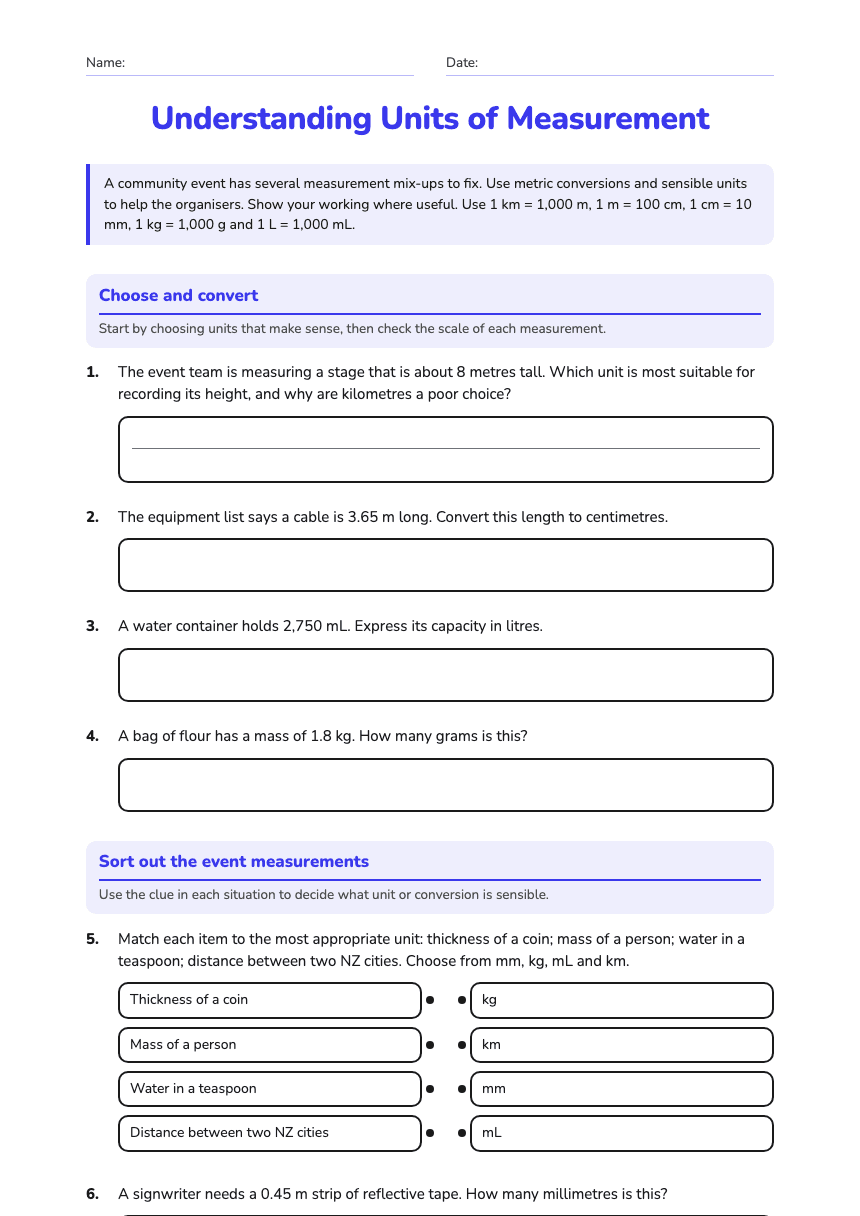
Understanding Units of Measurement

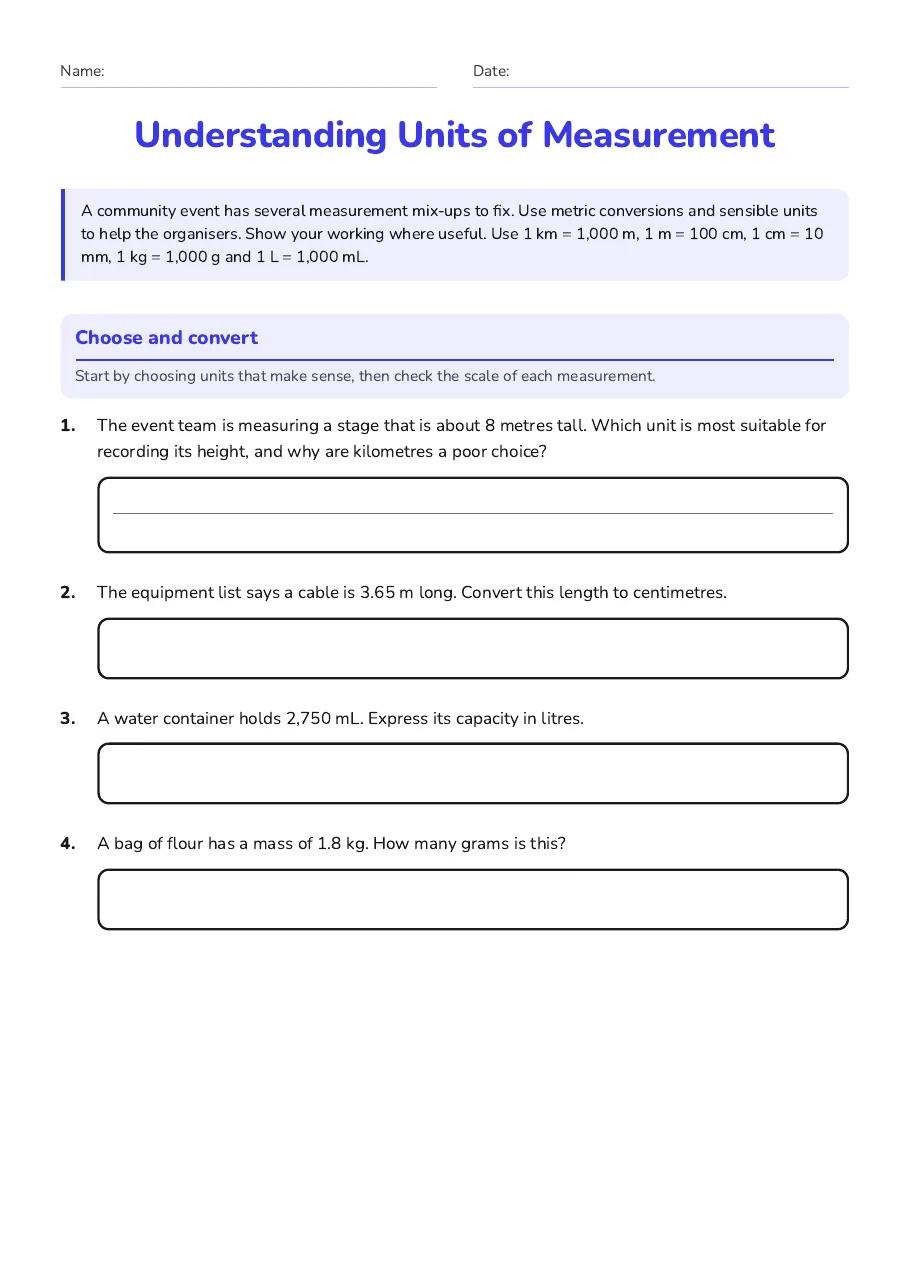
A community event has several measurement mix-ups to fix. Use metric conversions and sensible units to help the organisers. Show your working where useful. Use 1 km = 1,000 m, 1 m = 100 cm, 1 cm = 10 mm, 1 kg = 1,000 g and 1 L = 1,000 mL.

Choose and convert

Start by choosing units that make sense, then check the scale of each measurement.

1.The event team is measuring a stage that is about 8 metres tall. Which unit is most suitable for recording its height, and why are kilometres a poor choice?
2.The equipment list says a cable is 3.65 m long. Convert this length to centimetres.
3.A water container holds 2,750 mL. Express its capacity in litres.
4.A bag of flour has a mass of 1.8 kg. How many grams is this?

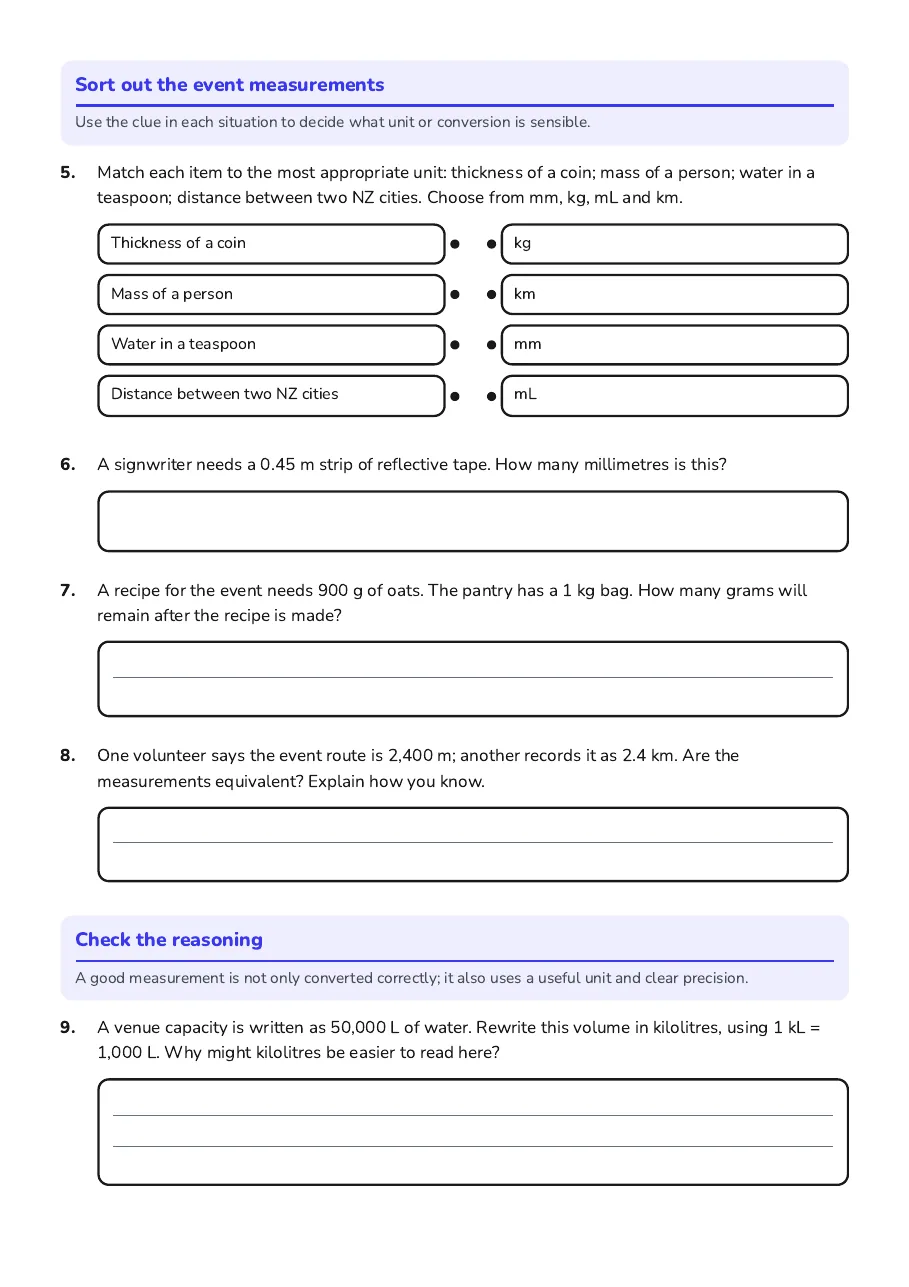
Sort out the event measurements

Use the clue in each situation to decide what unit or conversion is sensible.

5.Match each item to the most appropriate unit: thickness of a coin; mass of a person; water in a teaspoon; distance between two NZ cities. Choose from mm, kg, mL and km.
  • Thickness of a coin
  • Mass of a person
  • Water in a teaspoon
  • Distance between two NZ cities
  • kg
  • km
  • mm
  • mL
6.A signwriter needs a 0.45 m strip of reflective tape. How many millimetres is this?
7.A recipe for the event needs 900 g of oats. The pantry has a 1 kg bag. How many grams will remain after the recipe is made?
8.One volunteer says the event route is 2,400 m; another records it as 2.4 km. Are the measurements equivalent? Explain how you know.

Check the reasoning

A good measurement is not only converted correctly; it also uses a useful unit and clear precision.

9.A venue capacity is written as 50,000 L of water. Rewrite this volume in kilolitres, using 1 kL = 1,000 L. Why might kilolitres be easier to read here?
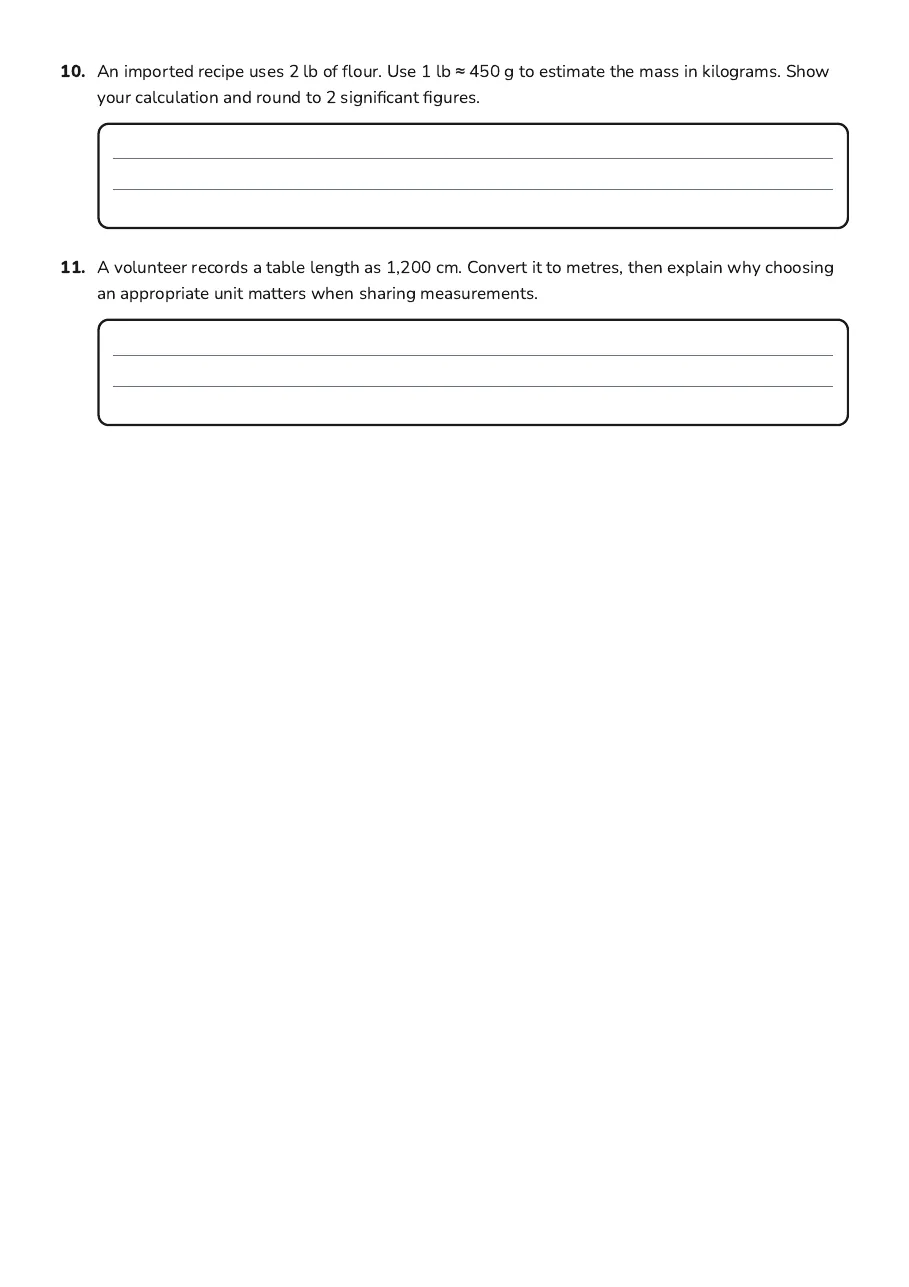
10.An imported recipe uses 2 lb of flour. Use 1 lb ≈ 450 g to estimate the mass in kilograms. Show your calculation and round to 2 significant figures.
11.A volunteer records a table length as 1,200 cm. Convert it to metres, then explain why choosing an appropriate unit matters when sharing measurements.

3 printable pages

  • Understanding Units of Measurement, page 1 of 3: Choose and convert

    Page 1

  • Understanding Units of Measurement, page 2 of 3: Sort out the event measurements, Check the reasoning

    Page 2

  • Understanding Units of Measurement, page 3 of 3: 10. An imported recipe uses 2 lb of flour. Use 1 lb ≈ 450 g to estimate the mass in…

    Page 3

About This Worksheet

Free in Kuraplan

Sign up free, grab the PDF, and customize it for your class.

Print-Ready

Formatted for standard paper. Clean layout, easy to read.

AI-Generated

Created with Kuraplan's AI, designed for real classroom use.

For Teachers & Parents

Use in classrooms, for homework, tutoring, or homeschool.

Need a custom version of this worksheet?

Kuraplan's AI generates custom worksheets in seconds — differentiated for every learner, aligned to your curriculum.

Generate Custom Worksheets — Free
No credit card Curriculum-aligned Under 60 seconds