MathsFreePrintable

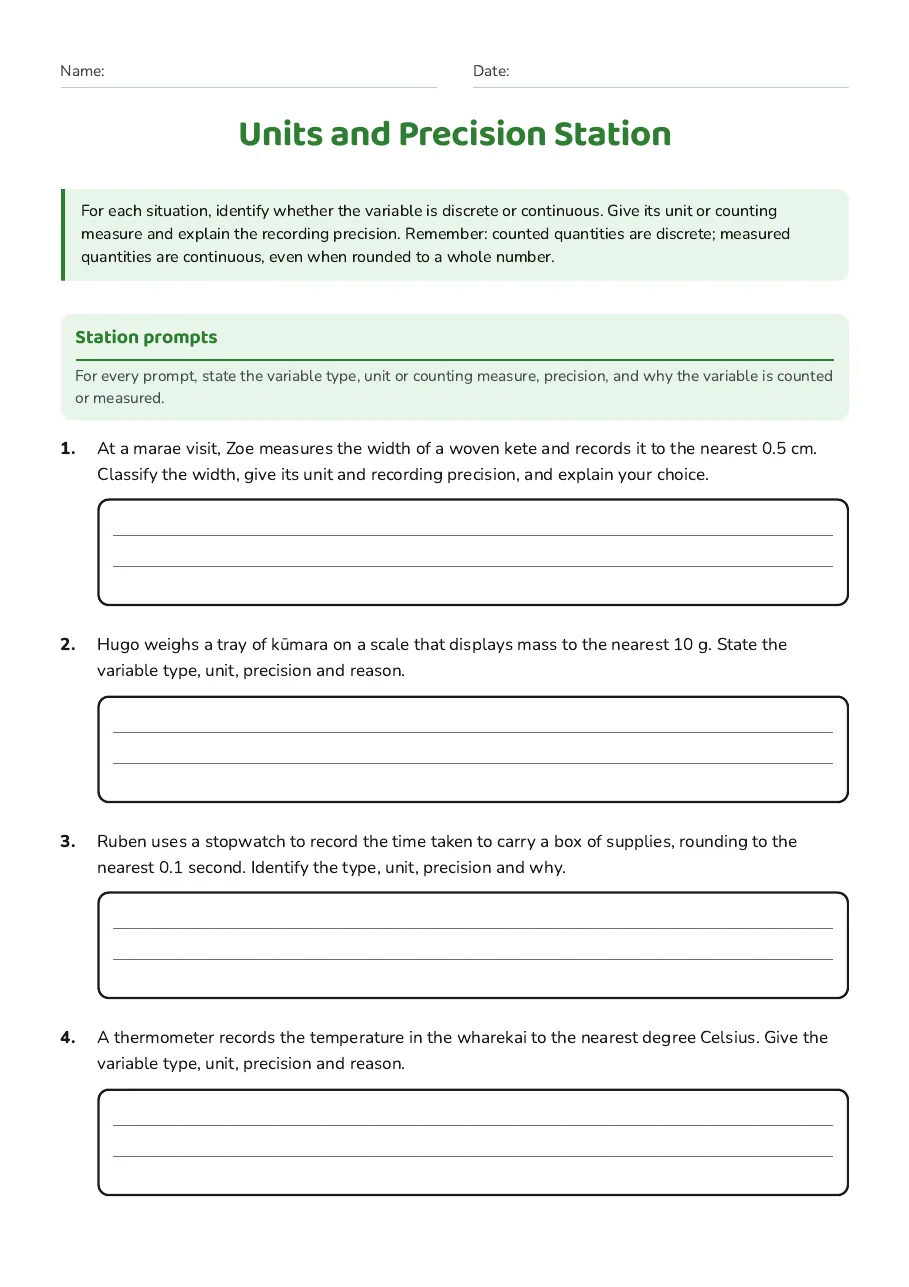
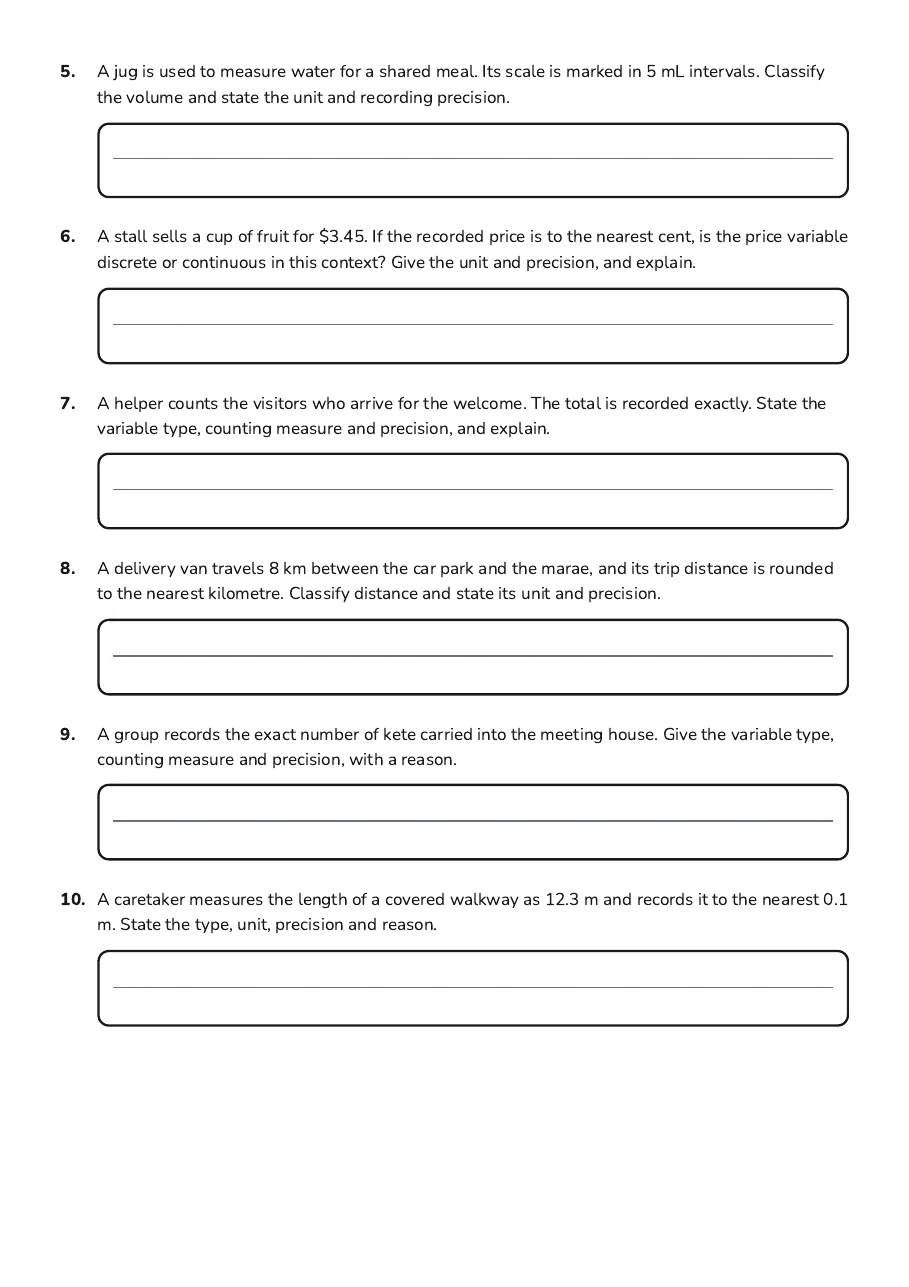
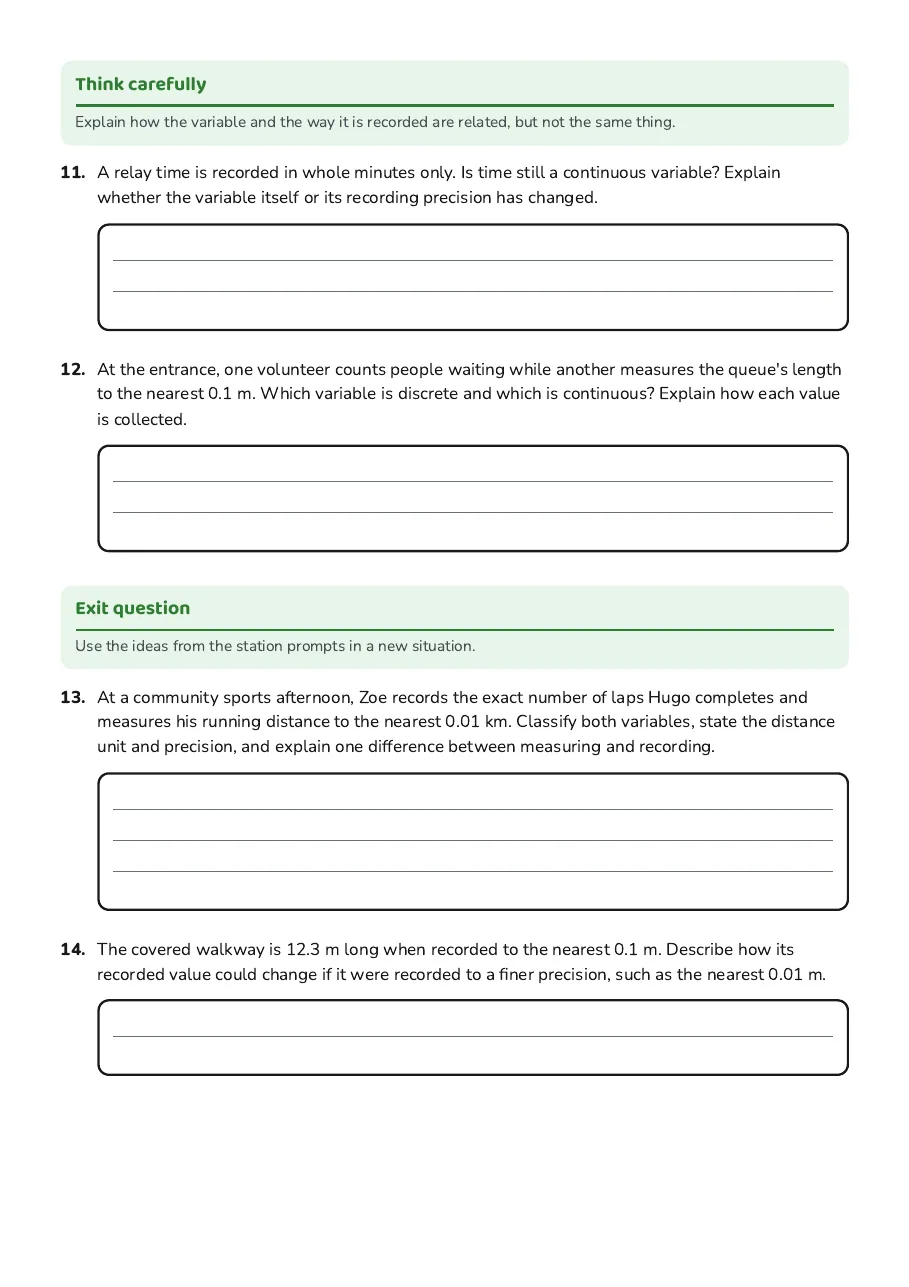
Units and Precision Station

A free maths worksheet ready for your classroom. Open in Kuraplan to grab the print-ready PDF, customize it for your students, or generate a fresh version in seconds.
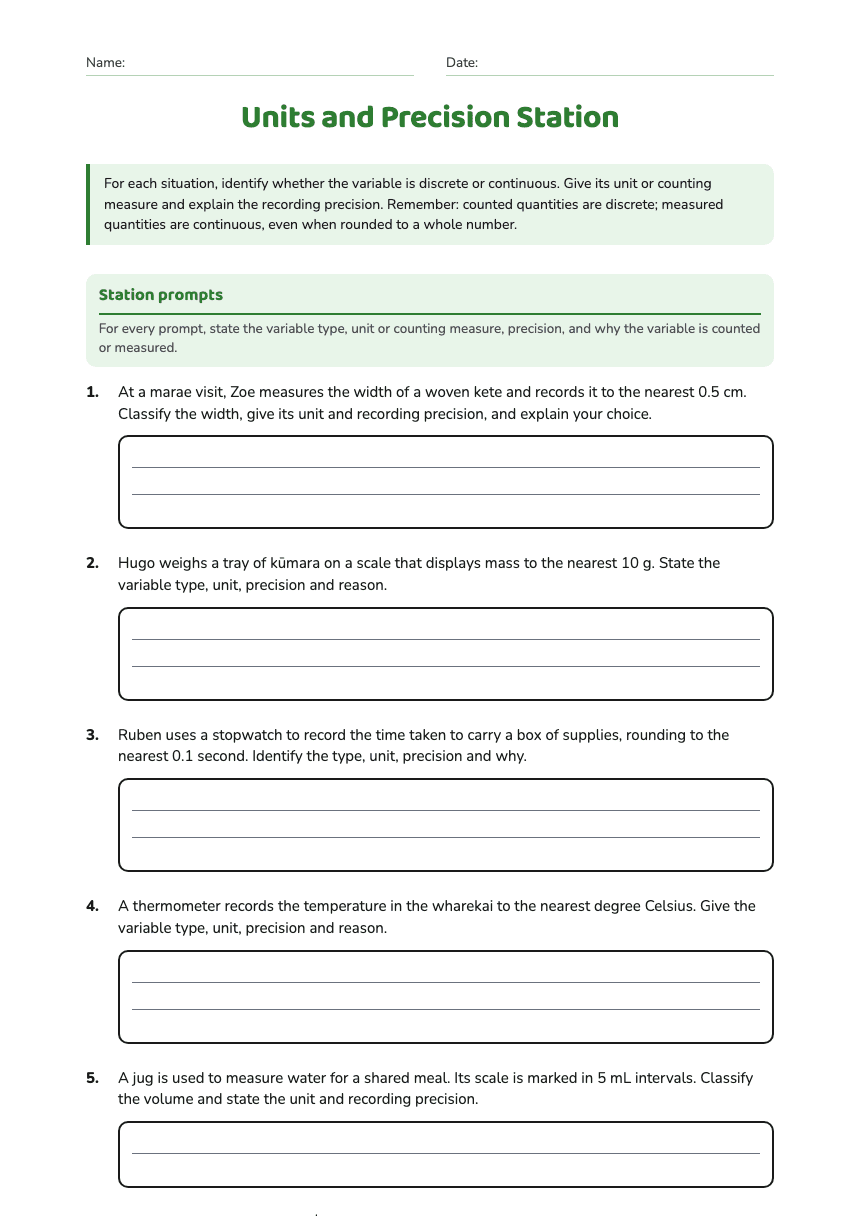
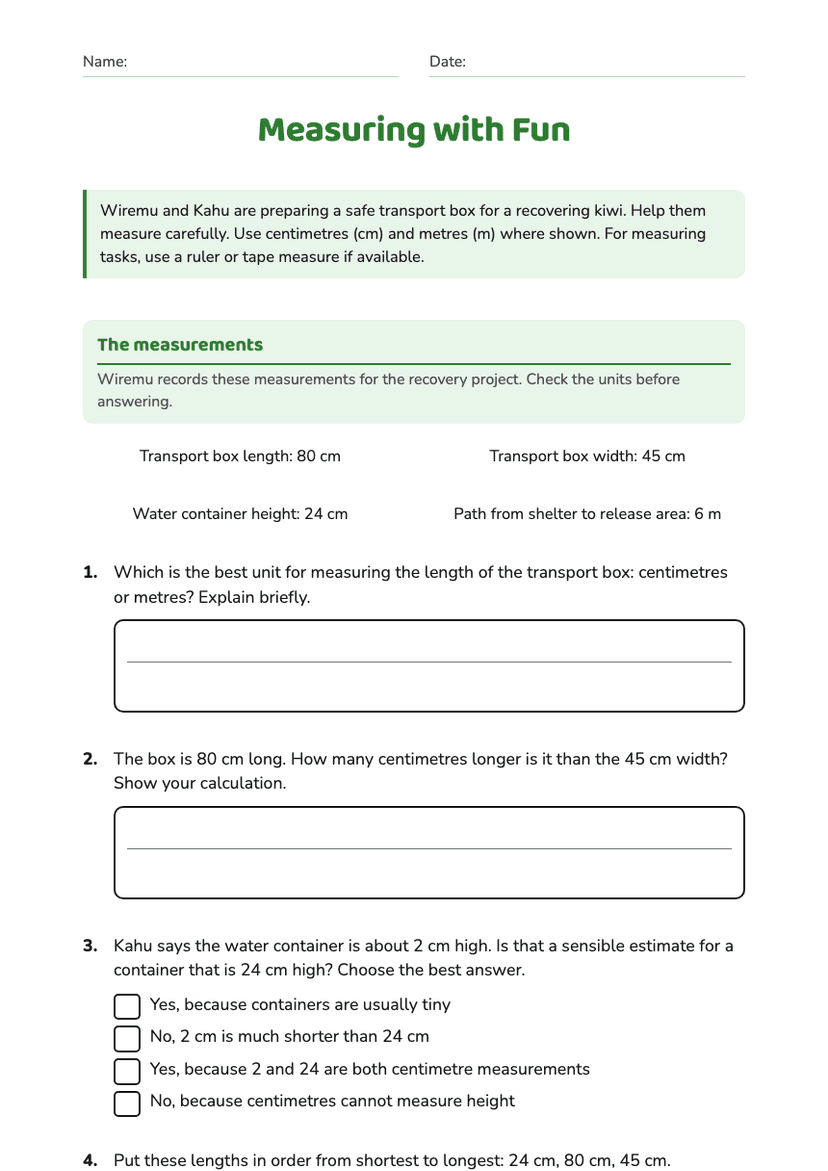
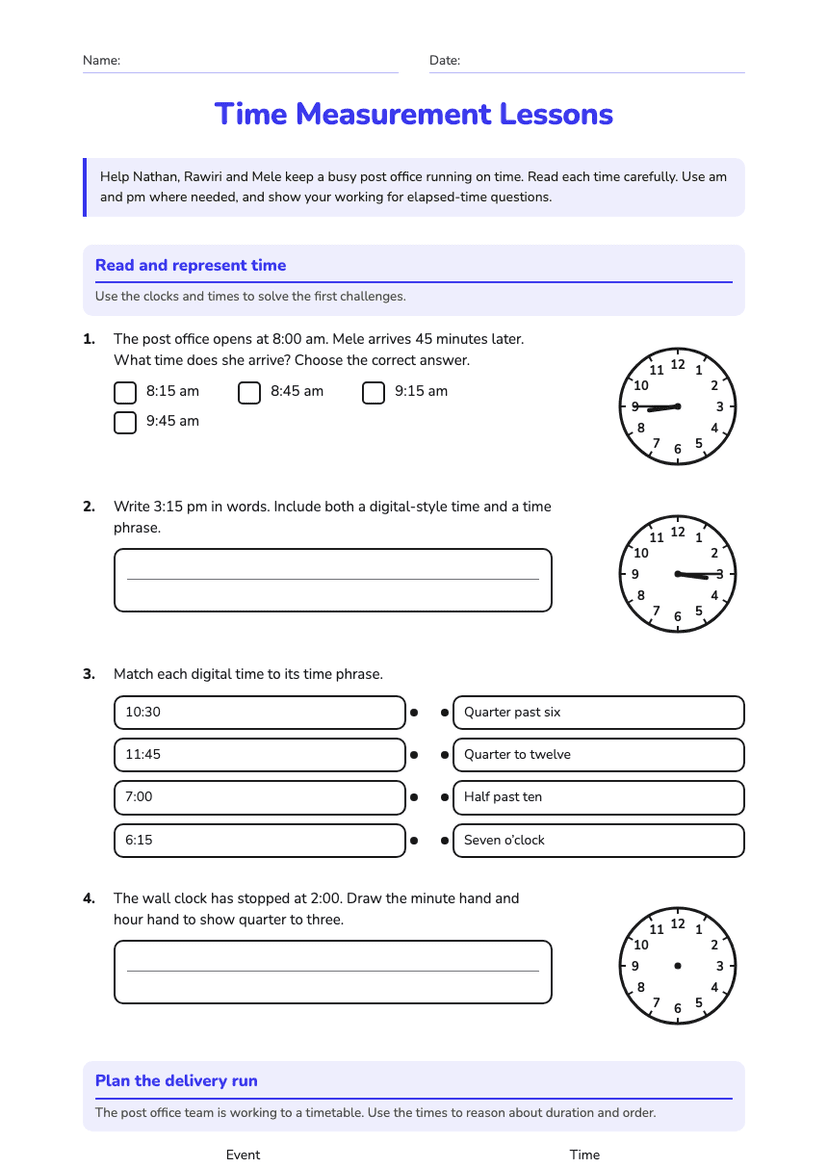
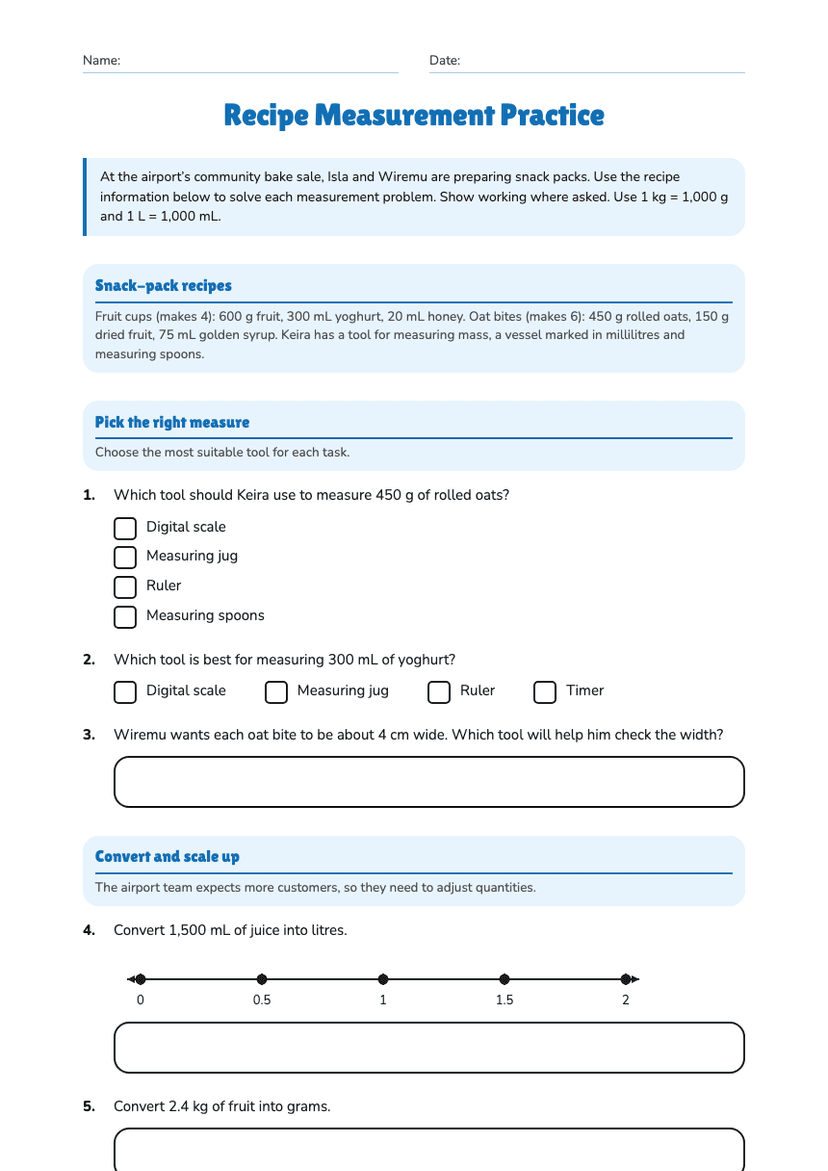
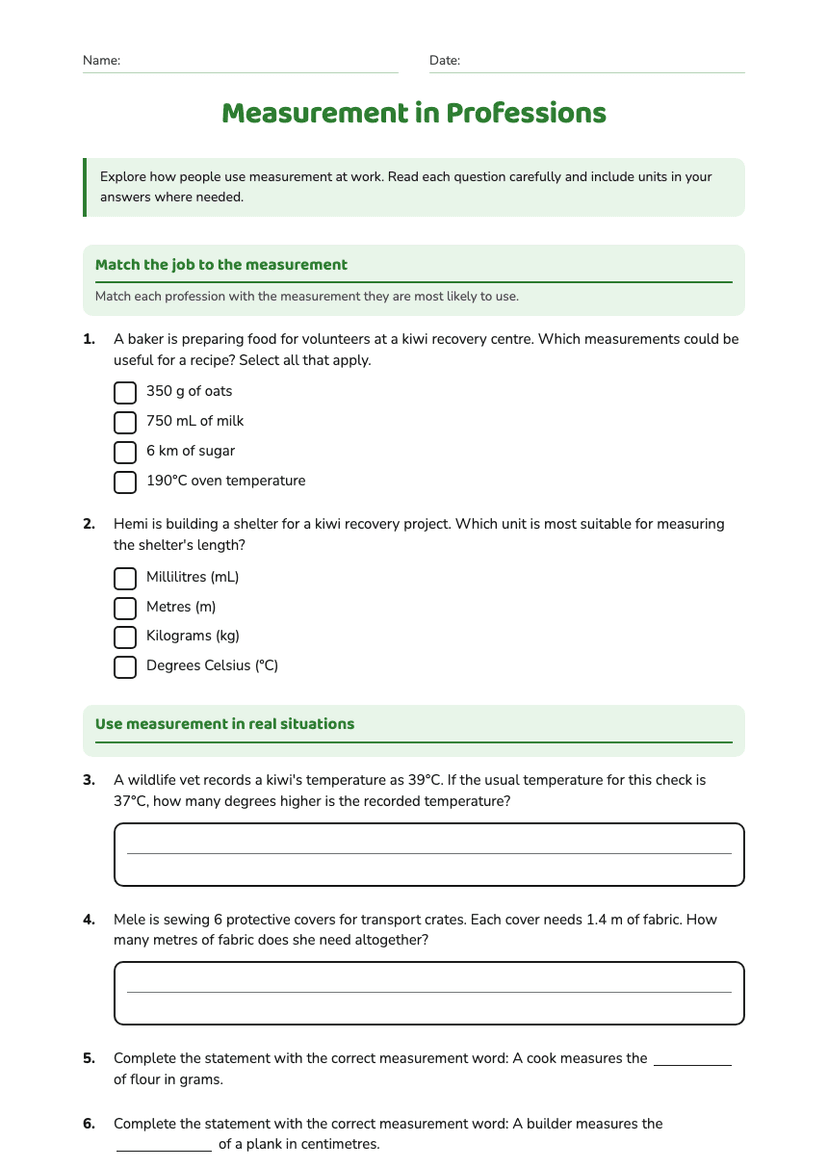
Units and Precision Station worksheet preview

Units and Precision Station

Station C: Units and Precision Prompt Sheet

Learning intention: I can decide whether a variable is discrete or continuous, identify its unit and recording precision, and explain the difference between measuring and recording.

Success criteria: I can use the words counted, measured, unit, precision, whole number and decimal in my reasoning.

Remember: Discrete variables are counted. Continuous variables are measured and can have values between whole numbers. Precision tells us how finely a measurement is recorded.

Word bank: discrete · continuous · counted · measured · unit · precision · nearest · exact

Prompt Cards and Recording Table

For each prompt, record the variable type, the unit or counting measure, the precision, and a reason. You may give your reason orally to a partner or teacher.

1. A ruler records the length of a leaf to the nearest 0.1 cm.

Type: ____________   Unit: ____________   Precision: ____________

Reason: I chose ____________ because ________________________________________________.

2. A kitchen scale records the mass of an apple to the nearest gram.

Type: ____________   Unit: ____________   Precision: ____________

Reason: I chose ____________ because ________________________________________________.

3. A stopwatch records the time for a runner to the nearest second.

Type: ____________   Unit: ____________   Precision: ____________

Reason: I chose ____________ because ________________________________________________.

4. A weather station records the air temperature to the nearest degree Celsius.

Type: ____________   Unit: ____________   Precision: ____________

Reason: I chose ____________ because ________________________________________________.

5. A measuring jug records the volume of water to the nearest millilitre.

Type: ____________   Unit: ____________   Precision: ____________

Reason: I chose ____________ because ________________________________________________.

More Prompt Cards: Think Carefully

6. A café records the price of a drink to the nearest cent.

Type: ____________   Unit: ____________   Precision: ____________

Reason: I chose ____________ because ________________________________________________.

7. A teacher records the exact number of students absent from a class.

Type: ____________   Unit or measure: ____________   Precision: ____________

Reason: I chose ____________ because ________________________________________________.

8. A cyclist records the distance travelled to the nearest kilometre.

Type: ____________   Unit: ____________   Precision: ____________

Reason: I chose ____________ because ________________________________________________.

9. A student records the number of books read this term as an exact count.

Type: ____________   Unit or measure: ____________   Precision: ____________

Reason: I chose ____________ because ________________________________________________.

10. A swimmer records the length of a pool to the nearest metre.

Type: ____________   Unit: ____________   Precision: ____________

Reason: I chose ____________ because ________________________________________________.

Two Tricky Discussion Prompts

A. A race time is recorded in whole minutes only. Is time still a continuous variable? Explain what has changed: the variable, or the recording precision.
B. A shop records the number of people in a queue and the length of the queue in metres. Which variable is discrete and which is continuous? Use the collection method in your explanation.

Teacher Answer Key

1. Continuous; centimetres; nearest 0.1 cm. Length is measured and can have decimal values.

2. Continuous; grams; nearest gram. Mass is measured, even though it is recorded in whole grams.

3. Continuous; seconds; nearest second. Time is measured and can have values between recorded seconds.

4. Continuous; degrees Celsius; nearest degree. Temperature is measured; rounding does not make it a count.

5. Continuous; millilitres; nearest millilitre. Volume is measured and can be recorded more precisely.

6. Usually continuous; dollars; nearest cent. The amount is measured or calculated from value, then rounded to cents.

7. Discrete; students; exact whole-number count. People are counted.

8. Continuous; kilometres; nearest kilometre. Distance is measured, even when rounded to whole kilometres.

9. Discrete; books; exact count. Books are counted and partial books are not meaningful in this context.

10. Continuous; metres; nearest metre. Length is measured and can take values between whole metres.

Tricky A: Time remains continuous. Only the recording precision has changed to whole minutes.

Tricky B: Number of people is discrete because people are counted. Queue length is continuous because length is measured.

Exit Question

At a school sports day, the number of laps completed is recorded as an exact count, and the distance run is recorded to the nearest 0.1 km. Classify both variables and explain one difference between measuring and recording.

Optional oral response: I can explain my answer aloud using: “The variable is ____________ because it is ____________. The unit or precision tells us ____________.”

Support: Read each prompt aloud, highlight the unit words, and discuss the answer with a partner before writing. Use the sentence starter: “I chose ____________ because the value is counted/measured.”

Extension: Choose one continuous variable above. Describe how its data might change if it were recorded to a finer precision.

About This Worksheet

Free in Kuraplan

Sign up free, grab the PDF, and customize it for your class.

Print-Ready

Formatted for standard paper. Clean layout, easy to read.

AI-Generated

Created with Kuraplan's AI, designed for real classroom use.

For Teachers & Parents

Use in classrooms, for homework, tutoring, or homeschool.

Need a custom version of this worksheet?

Kuraplan's AI generates custom worksheets in seconds — differentiated for every learner, aligned to your curriculum.

Generate Custom Worksheets — Free
No credit card Curriculum-aligned Under 60 seconds