MathsFreePrintable

Volume, Capacity, Mass Measurement

A free maths worksheet ready for your classroom. Open in Kuraplan to grab the print-ready PDF, customize it for your students, or generate a fresh version in seconds.
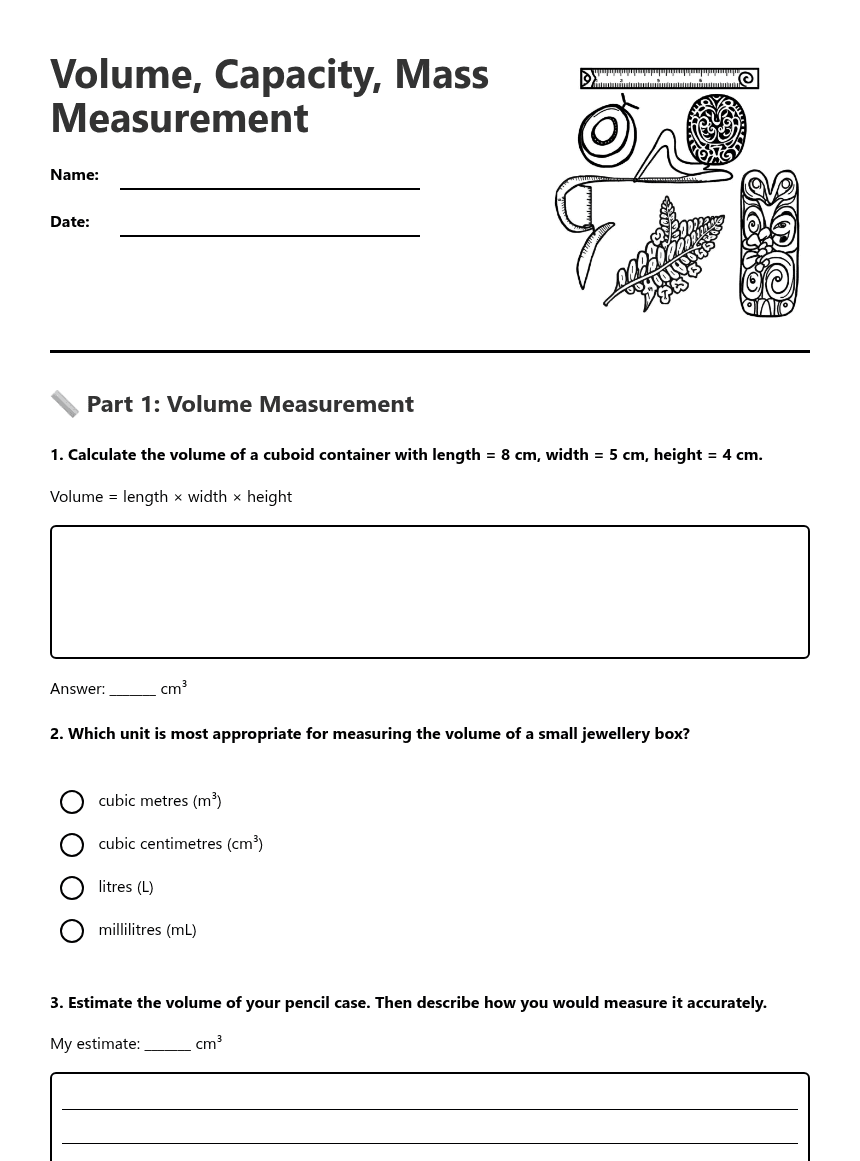
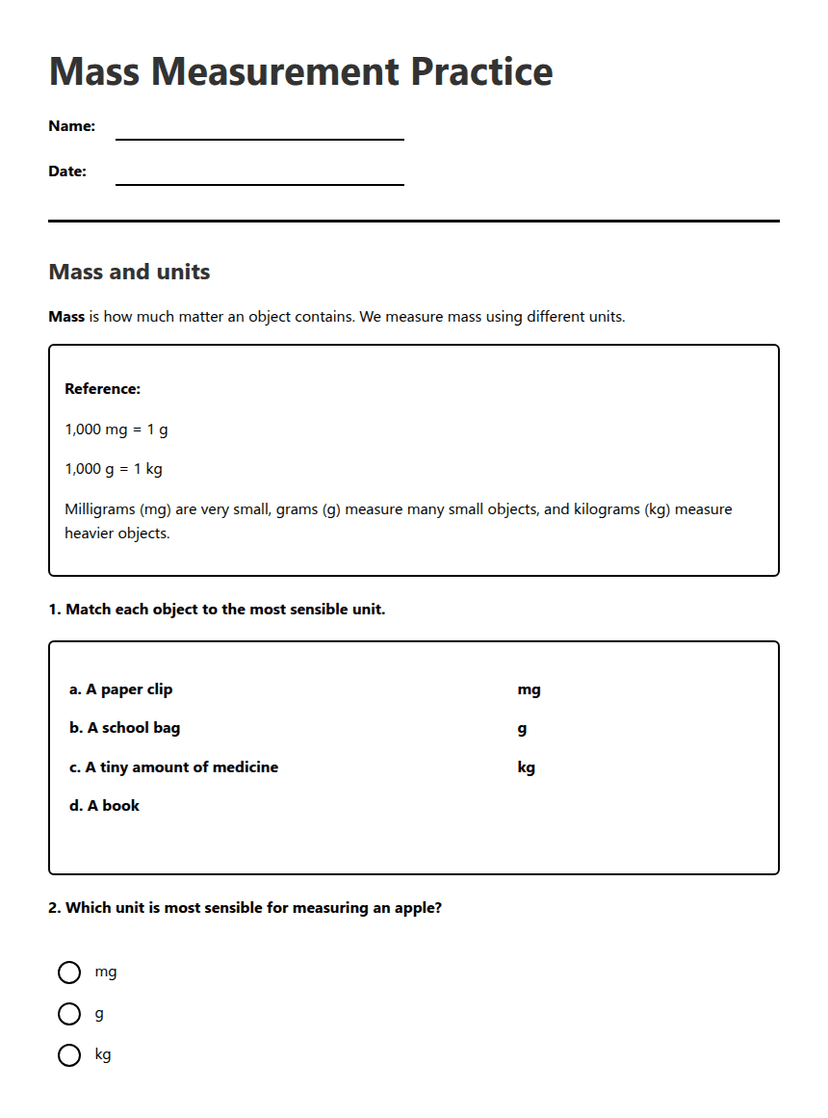
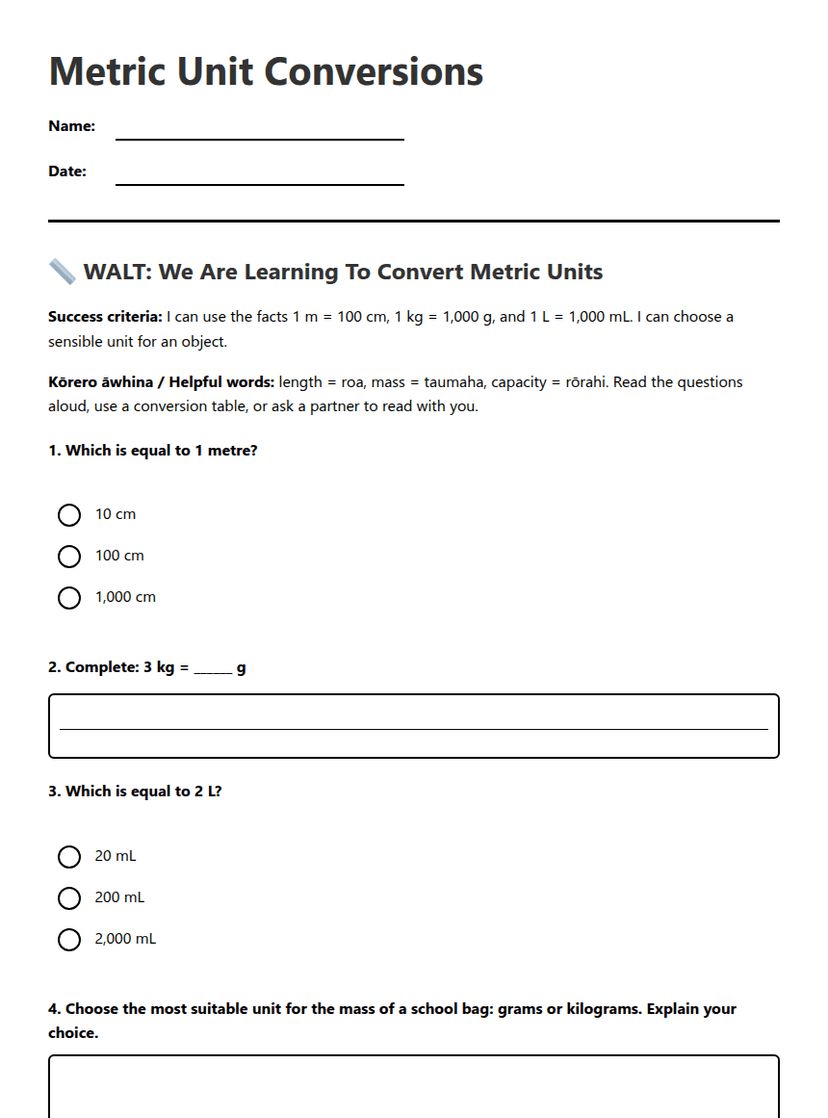
Volume, Capacity, Mass Measurement worksheet preview
Volume, Capacity, Mass Measurement

Volume, Capacity, Mass Measurement

Measuring tools illustration

📏 Part 1: Volume Measurement

1. Calculate the volume of a cuboid container with length = 8 cm, width = 5 cm, height = 4 cm.

Volume = length × width × height

Answer: _______ cm³

2. Which unit is most appropriate for measuring the volume of a small jewellery box?

cubic metres (m³)

cubic centimetres (cm³)

litres (L)

millilitres (mL)

3. Estimate the volume of your pencil case. Then describe how you would measure it accurately.

My estimate: _______ cm³

🥤 Part 2: Capacity and Conversions

4. Convert these capacity measurements:

a) 2.5 litres = _______ millilitres

b) 750 mL = _______ litres

c) 1500 mL = _______ litres

d) 0.25 L = _______ millilitres

5. Circle the most appropriate unit for measuring each container's capacity:

Swimming pool: millilitres (mL) or litres (L)

Medicine spoon: millilitres (mL) or litres (L)

Water bottle: millilitres (mL) or litres (L)

Bathtub: millilitres (mL) or litres (L)

6. A fish tank measures 40 cm × 25 cm × 30 cm. Calculate its capacity in litres.

Hint: 1000 cm³ = 1 litre

Capacity: _______ litres

⚖️ Part 3: Mass Measurement

7. Choose the most appropriate unit for measuring the mass of these objects:

A textbook:

grams (g)
kilograms (kg)

A car:

grams (g)
kilograms (kg)

A paperclip:

grams (g)
kilograms (kg)

A bag of flour:

grams (g)
kilograms (kg)

8. Convert these mass measurements:

a) 3.2 kg = _______ grams

b) 850 g = _______ kilograms

c) 0.75 kg = _______ grams

d) 2500 g = _______ kilograms

9. Estimate the mass of three objects in your classroom, then explain how you would measure them accurately.

🧮 Part 4: Real-World Problem Solving

10. Sarah is making fruit punch for a school event. She needs to fill a container that holds 8 litres. She has bottles containing 750 mL, 1.2 L, and 500 mL of different juices. How much liquid does she have in total? Will it be enough?

Total liquid: _______ litres

Is it enough? _______

11. Match the measurement tools with their best use:
1. Measuring jug
2. Digital scales
3. Ruler
4. Balance scales
A. Measuring dimensions for volume
B. Measuring liquid capacity
C. Comparing masses of objects
D. Finding exact mass in grams
12. A recipe calls for 250 g of flour, 500 mL of milk, and 2 eggs (each egg has a mass of about 60 g). What is the total mass of these ingredients?

Total mass: _______ grams

13. Explain why estimation is important when measuring volume, capacity, and mass. Give one example.

About This Worksheet

Free in Kuraplan

Sign up free, grab the PDF, and customize it for your class.

Print-Ready

Formatted for standard paper. Clean layout, easy to read.

AI-Generated

Created with Kuraplan's AI, designed for real classroom use.

For Teachers & Parents

Use in classrooms, for homework, tutoring, or homeschool.

Need a custom version of this worksheet?

Kuraplan's AI generates custom worksheets in seconds — differentiated for every learner, aligned to your curriculum.

Generate Custom Worksheets — Free
No credit card Curriculum-aligned Under 60 seconds