MathsFreePrintable

Volume Measurement Exploration

A free maths worksheet ready for your classroom. Open in Kuraplan to grab the print-ready PDF, customize it for your students, or generate a fresh version in seconds.
Volume Measurement Exploration worksheet preview
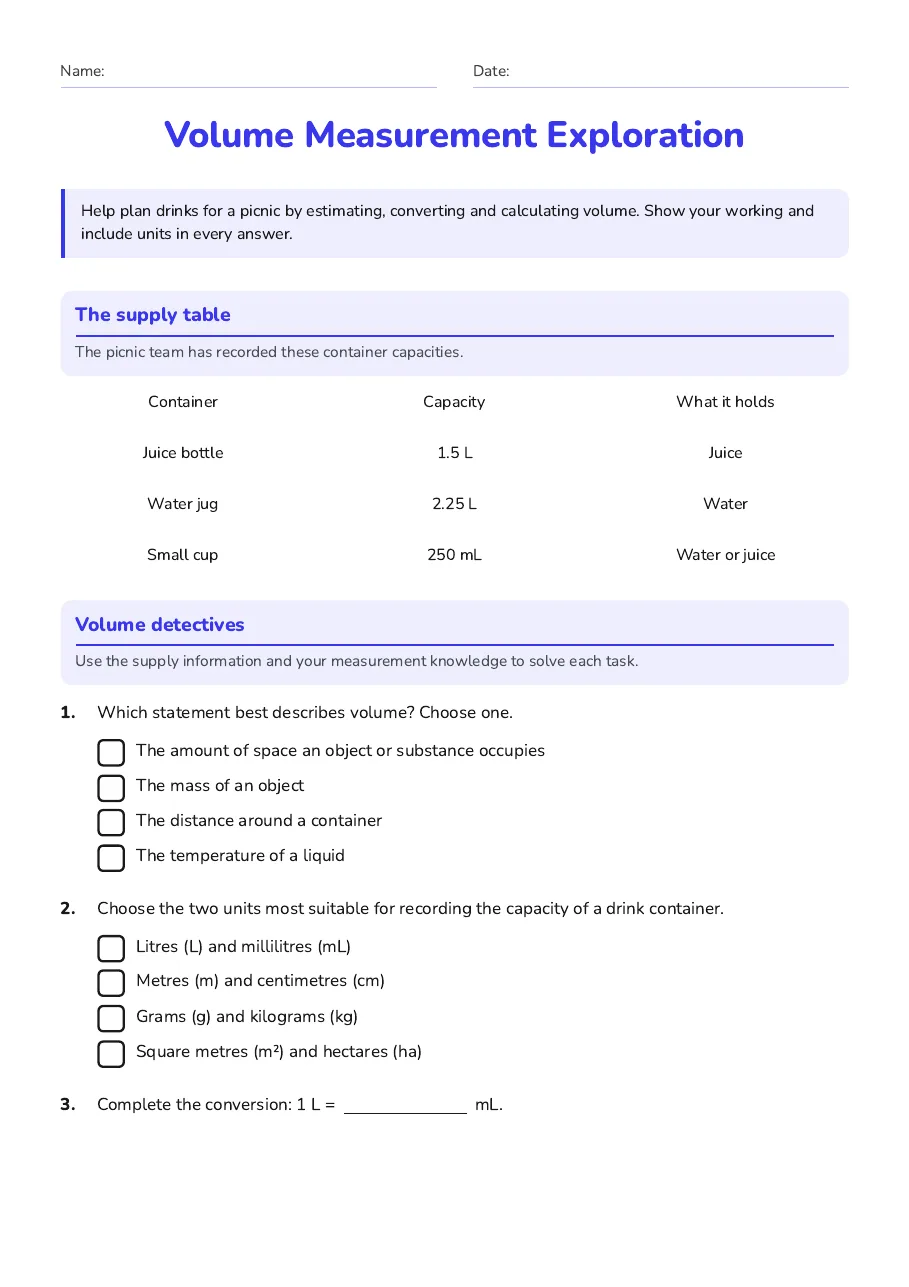
Name:Date:

Volume Measurement Exploration

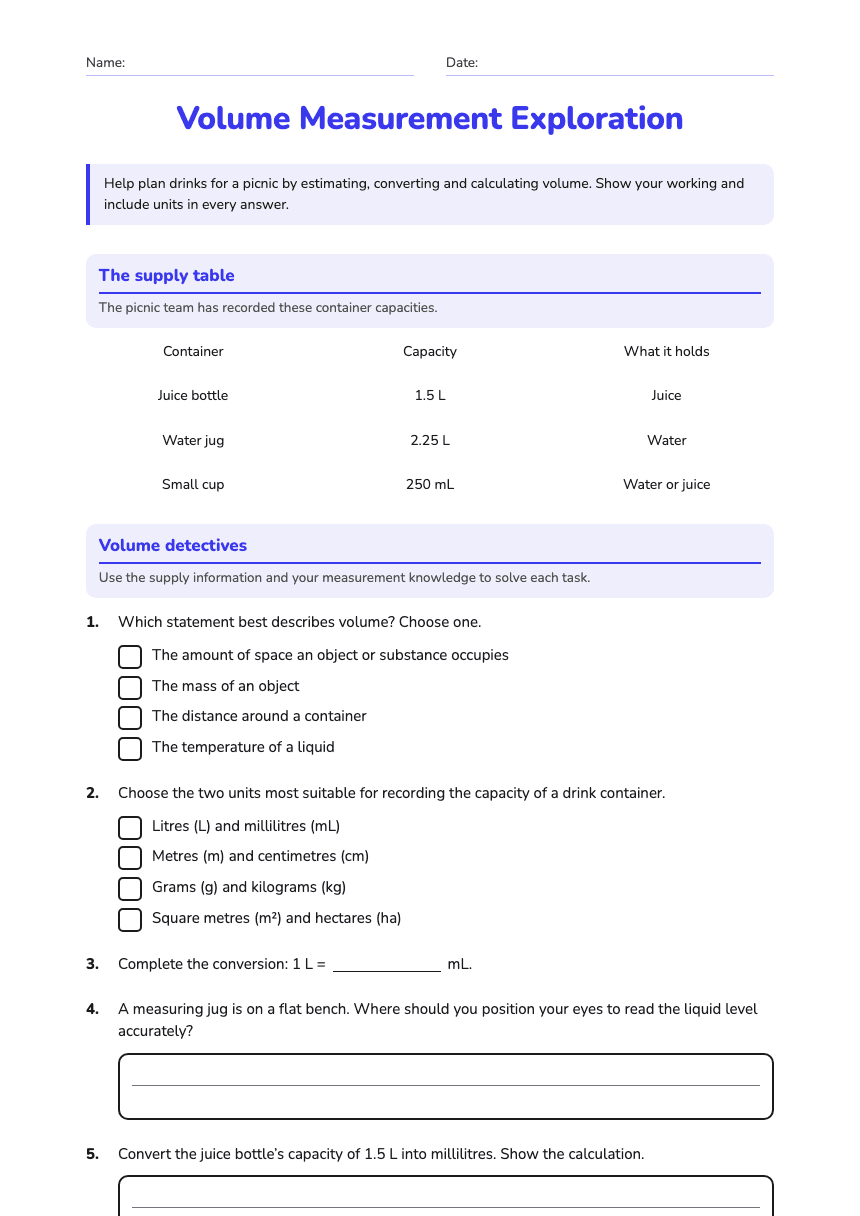
Help plan drinks for a picnic by estimating, converting and calculating volume. Show your working and include units in every answer.

The supply table

The picnic team has recorded these container capacities.

Container

Capacity

What it holds

Juice bottle

1.5 L

Juice

Water jug

2.25 L

Water

Small cup

250 mL

Water or juice

Volume detectives

Use the supply information and your measurement knowledge to solve each task.

1.Which statement best describes volume? Choose one.
  • The amount of space an object or substance occupies
  • The mass of an object
  • The distance around a container
  • The temperature of a liquid
2.Choose the two units most suitable for recording the capacity of a drink container.
  • Litres (L) and millilitres (mL)
  • Metres (m) and centimetres (cm)
  • Grams (g) and kilograms (kg)
  • Square metres (m²) and hectares (ha)
3.Complete the conversion: 1 L = mL.
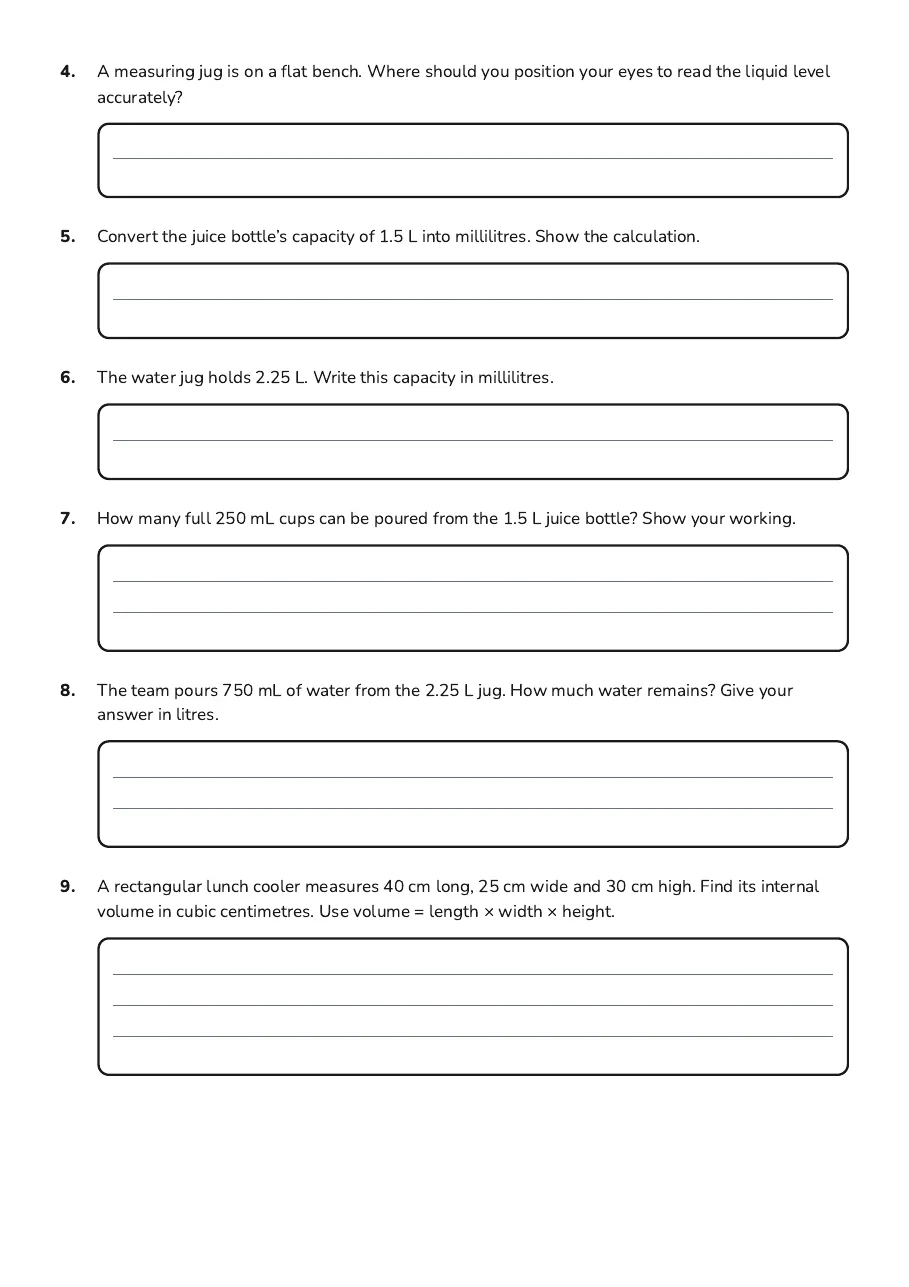
4.A measuring jug is on a flat bench. Where should you position your eyes to read the liquid level accurately?
5.Convert the juice bottle’s capacity of 1.5 L into millilitres. Show the calculation.
6.The water jug holds 2.25 L. Write this capacity in millilitres.
7.How many full 250 mL cups can be poured from the 1.5 L juice bottle? Show your working.
8.The team pours 750 mL of water from the 2.25 L jug. How much water remains? Give your answer in litres.
9.A rectangular lunch cooler measures 40 cm long, 25 cm wide and 30 cm high. Find its internal volume in cubic centimetres. Use volume = length × width × height.
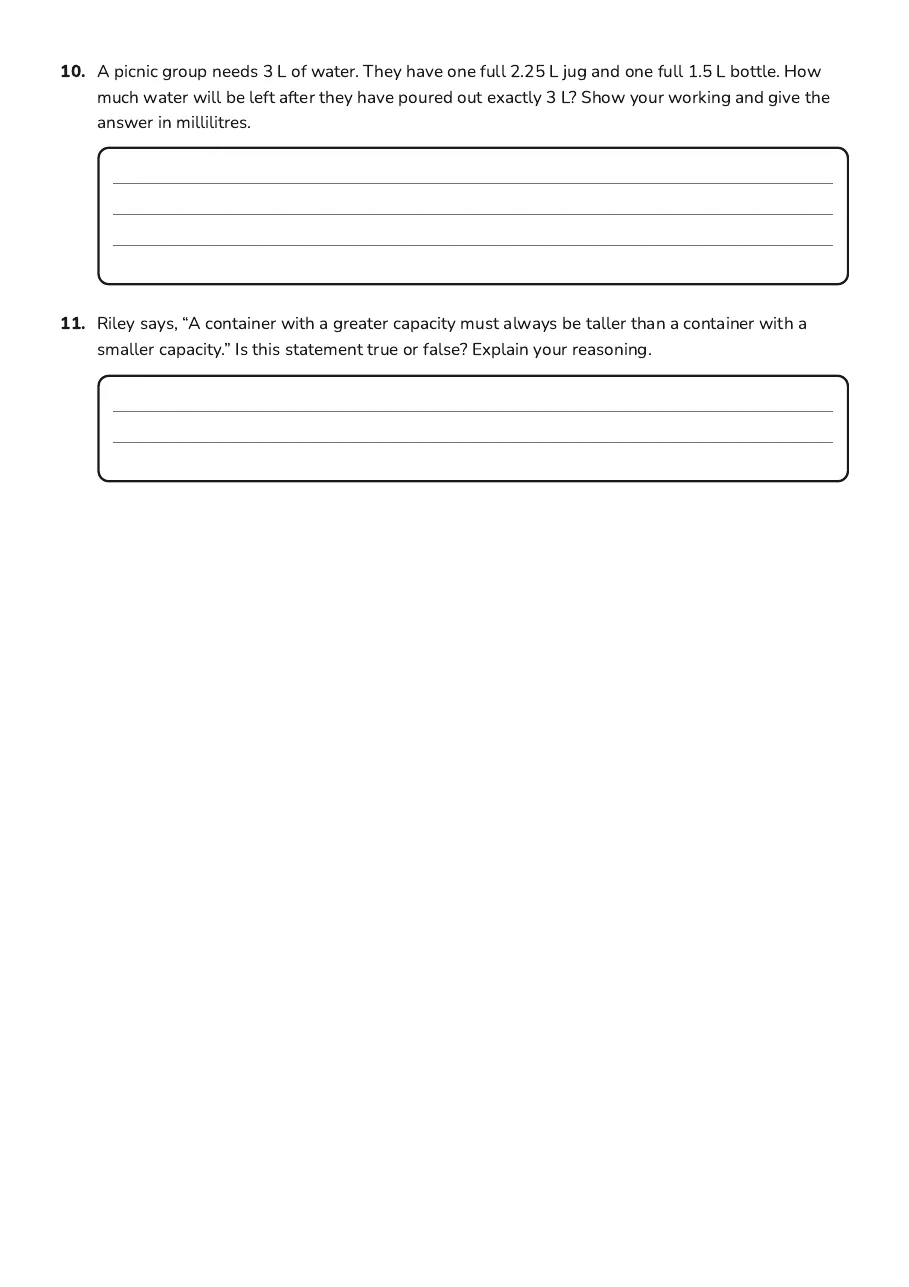
10.A picnic group needs 3 L of water. They have one full 2.25 L jug and one full 1.5 L bottle. How much water will be left after they have poured out exactly 3 L? Show your working and give the answer in millilitres.
11.Riley says, “A container with a greater capacity must always be taller than a container with a smaller capacity.” Is this statement true or false? Explain your reasoning.

3 printable pages

  • Volume Measurement Exploration, page 1 of 3: The supply table, Volume detectives

    Page 1

  • Volume Measurement Exploration, page 2 of 3: 4. A measuring jug is on a flat bench. Where should you position your eyes to read the…

    Page 2

  • Volume Measurement Exploration, page 3 of 3: 10. A picnic group needs 3 L of water. They have one full 2.25 L jug and one full 1.5 L…

    Page 3

About This Worksheet

Free in Kuraplan

Sign up free, grab the PDF, and customize it for your class.

Print-Ready

Formatted for standard paper. Clean layout, easy to read.

AI-Generated

Created with Kuraplan's AI, designed for real classroom use.

For Teachers & Parents

Use in classrooms, for homework, tutoring, or homeschool.

Need a custom version of this worksheet?

Kuraplan's AI generates custom worksheets in seconds — differentiated for every learner, aligned to your curriculum.

Generate Custom Worksheets — Free
No credit card Curriculum-aligned Under 60 seconds