MathsFreePrintable

Volume Measurement Introduction

A free maths worksheet ready for your classroom. Open in Kuraplan to grab the print-ready PDF, customize it for your students, or generate a fresh version in seconds.
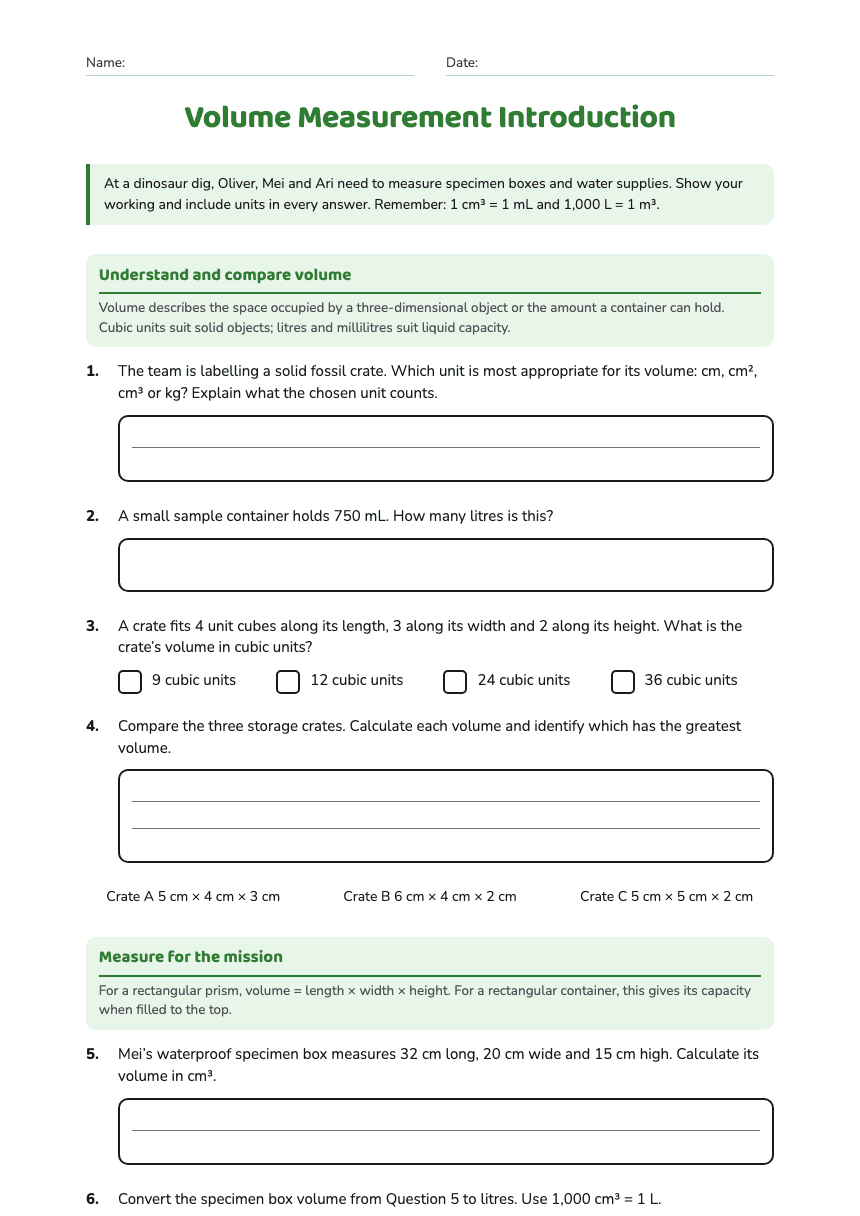
Volume Measurement Introduction worksheet preview
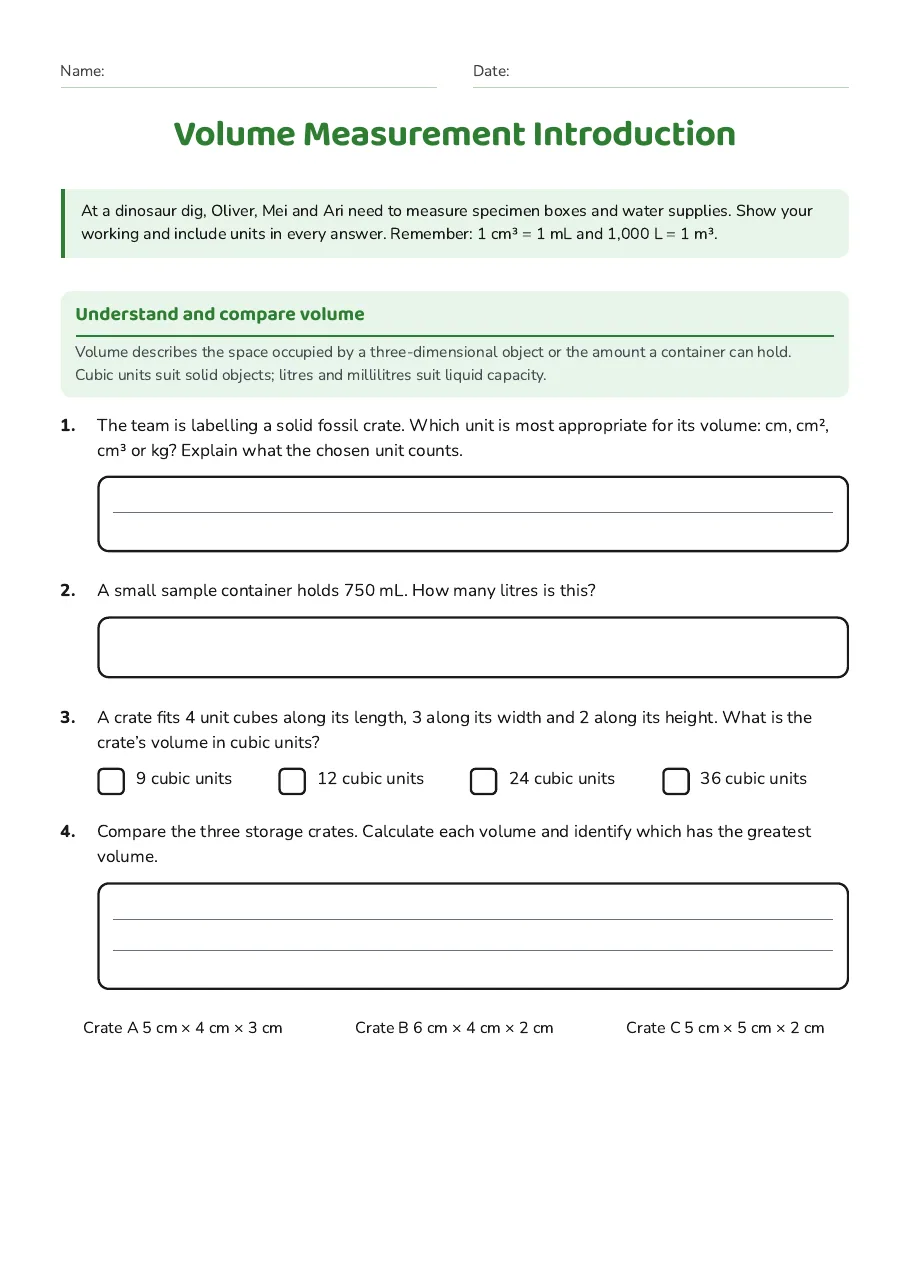
Name:Date:

Volume Measurement Introduction

At a dinosaur dig, Oliver, Mei and Ari need to measure specimen boxes and water supplies. Show your working and include units in every answer. Remember: 1 cm³ = 1 mL and 1,000 L = 1 m³.

Understand and compare volume

Volume describes the space occupied by a three-dimensional object or the amount a container can hold. Cubic units suit solid objects; litres and millilitres suit liquid capacity.

1.The team is labelling a solid fossil crate. Which unit is most appropriate for its volume: cm, cm², cm³ or kg? Explain what the chosen unit counts.
2.A small sample container holds 750 mL. How many litres is this?
3.A crate fits 4 unit cubes along its length, 3 along its width and 2 along its height. What is the crate’s volume in cubic units?
  • 9 cubic units
  • 12 cubic units
  • 24 cubic units
  • 36 cubic units
4.Compare the three storage crates. Calculate each volume and identify which has the greatest volume.

Crate A 5 cm × 4 cm × 3 cm

Crate B 6 cm × 4 cm × 2 cm

Crate C 5 cm × 5 cm × 2 cm

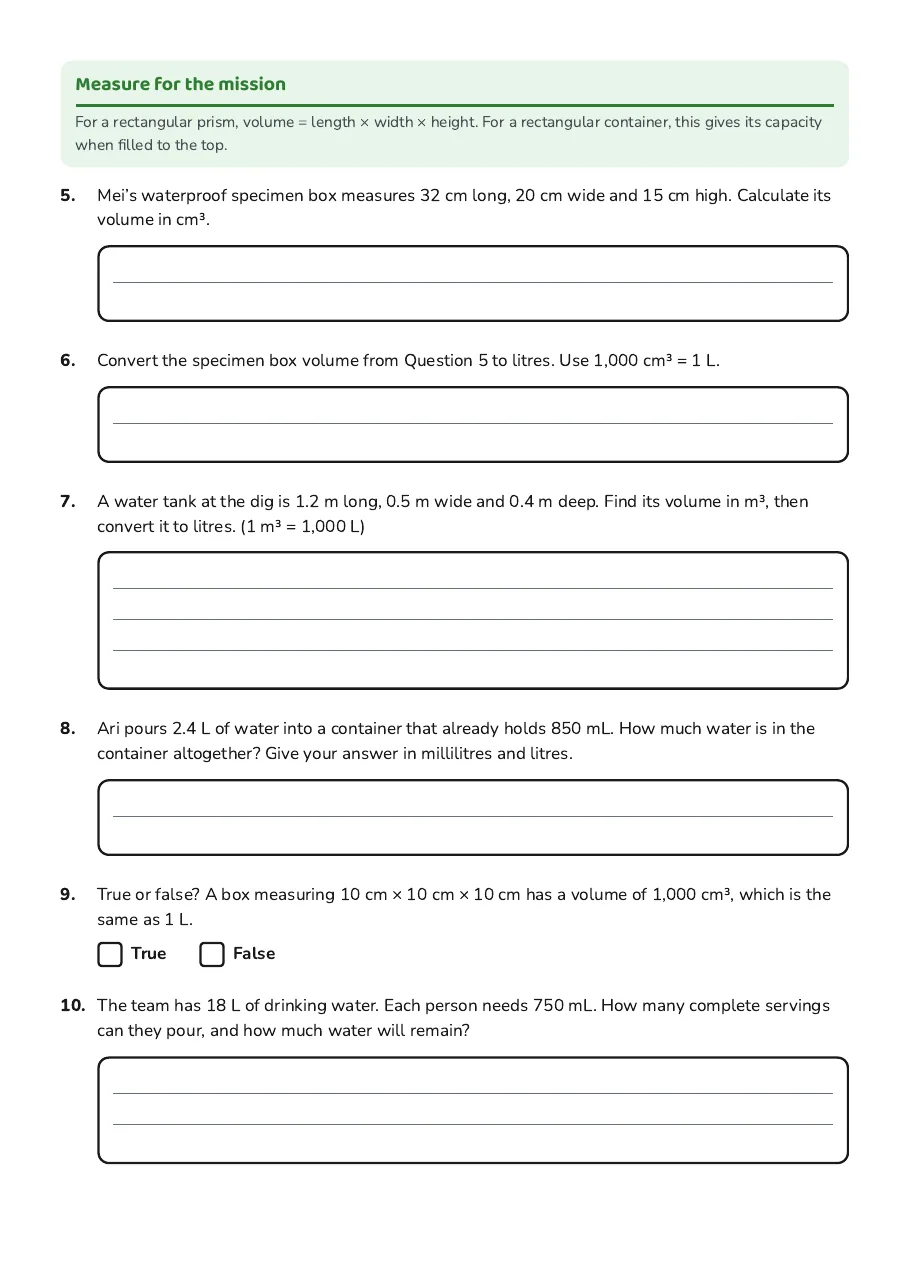
Measure for the mission

For a rectangular prism, volume = length × width × height. For a rectangular container, this gives its capacity when filled to the top.

5.Mei’s waterproof specimen box measures 32 cm long, 20 cm wide and 15 cm high. Calculate its volume in cm³.
6.Convert the specimen box volume from Question 5 to litres. Use 1,000 cm³ = 1 L.
7.A water tank at the dig is 1.2 m long, 0.5 m wide and 0.4 m deep. Find its volume in m³, then convert it to litres. (1 m³ = 1,000 L)
8.Ari pours 2.4 L of water into a container that already holds 850 mL. How much water is in the container altogether? Give your answer in millilitres and litres.
9.True or false? A box measuring 10 cm × 10 cm × 10 cm has a volume of 1,000 cm³, which is the same as 1 L.
TrueFalse
10.The team has 18 L of drinking water. Each person needs 750 mL. How many complete servings can they pour, and how much water will remain?
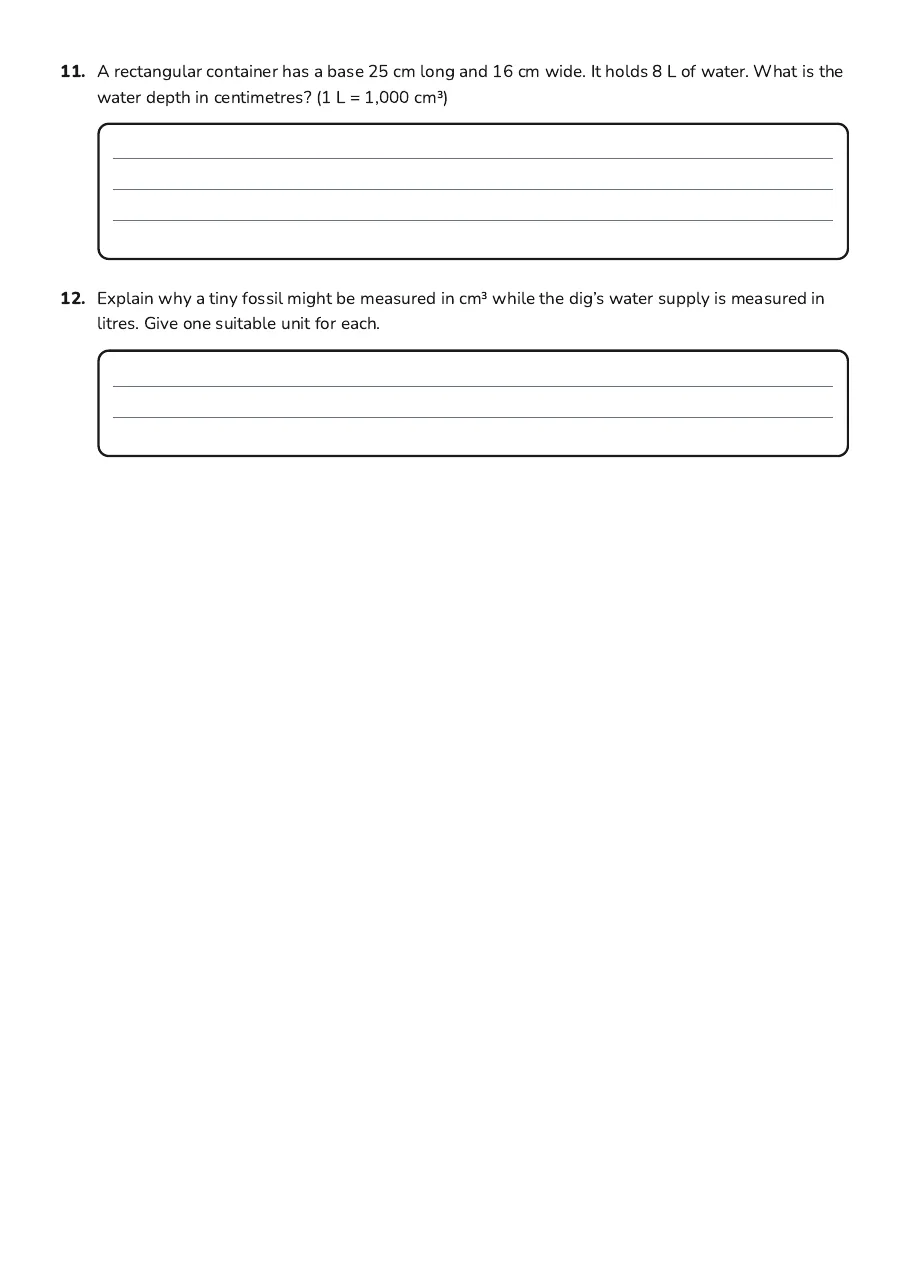
11.A rectangular container has a base 25 cm long and 16 cm wide. It holds 8 L of water. What is the water depth in centimetres? (1 L = 1,000 cm³)
12.Explain why a tiny fossil might be measured in cm³ while the dig’s water supply is measured in litres. Give one suitable unit for each.

3 printable pages

  • Volume Measurement Introduction, page 1 of 3: Understand and compare volume

    Page 1

  • Volume Measurement Introduction, page 2 of 3: Measure for the mission

    Page 2

  • Volume Measurement Introduction, page 3 of 3: 11. A rectangular container has a base 25 cm long and 16 cm wide. It holds 8 L of water.…

    Page 3

About This Worksheet

Free in Kuraplan

Sign up free, grab the PDF, and customize it for your class.

Print-Ready

Formatted for standard paper. Clean layout, easy to read.

AI-Generated

Created with Kuraplan's AI, designed for real classroom use.

For Teachers & Parents

Use in classrooms, for homework, tutoring, or homeschool.

Need a custom version of this worksheet?

Kuraplan's AI generates custom worksheets in seconds — differentiated for every learner, aligned to your curriculum.

Generate Custom Worksheets — Free
No credit card Curriculum-aligned Under 60 seconds