Year 5–6 Geometry Diagnostic Pre-Test
A free maths worksheet ready for your classroom. Open in Kuraplan to grab the print-ready PDF, customize it for your students, or generate a fresh version in seconds.
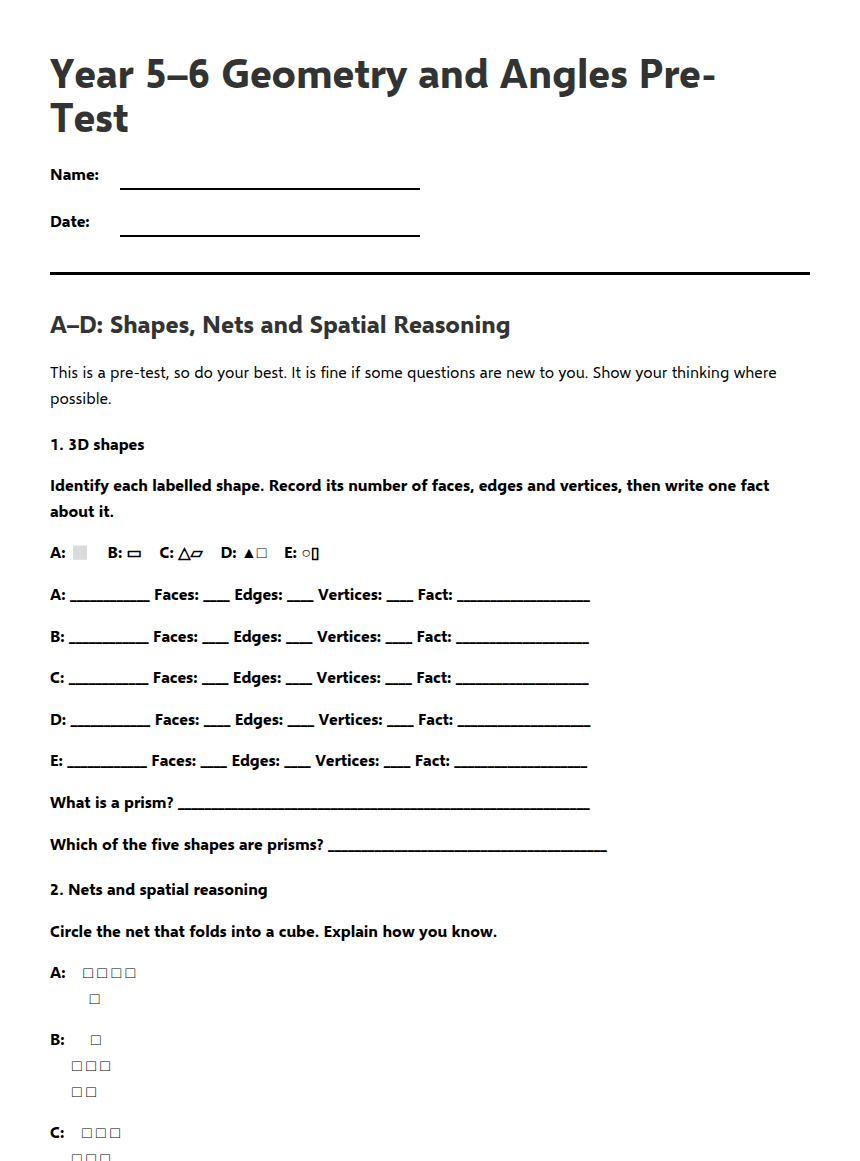
Year 5–6 Geometry and Angles Pre-Test
A–D: Shapes, Nets and Spatial Reasoning
This is a pre-test, so do your best. It is fine if some questions are new to you. Show your thinking where possible.
Identify each labelled shape. Record its number of faces, edges and vertices, then write one fact about it.
A: ◻️ B: ▭ C: △▱ D: ▲□ E: ○▯
A: ____________ Faces: ____ Edges: ____ Vertices: ____ Fact: ____________________
B: ____________ Faces: ____ Edges: ____ Vertices: ____ Fact: ____________________
C: ____________ Faces: ____ Edges: ____ Vertices: ____ Fact: ____________________
D: ____________ Faces: ____ Edges: ____ Vertices: ____ Fact: ____________________
E: ____________ Faces: ____ Edges: ____ Vertices: ____ Fact: ____________________
What is a prism? ______________________________________________________________
Which of the five shapes are prisms? __________________________________________
Circle the net that folds into a cube. Explain how you know.
A: □ □ □ □
□
B: □
□ □ □
□ □
C: □ □ □
□ □ □
Match each shape to a suitable net: triangular prism, square-based pyramid, rectangular prism.
Identify each quadrilateral.
A: ▱ B: ▭ C: □ D: ◇ E: ▱ with all sides equal F: ◈
Use these names: trapezium, parallelogram, rectangle, square, rhombus, kite.
A: __________ B: __________ C: __________ D: __________ E: __________ F: __________
Draw one pair of parallel lines and one pair of perpendicular lines.
Explain what perpendicular lines are. ___________________________________________
How can a square belong to more than one shape group? ___________________________
Classify each triangle using equilateral, isosceles, scalene or right-angled.
A: △ with sides 5 cm, 5 cm, 5 cm: ____________________
B: △ with sides 6 cm, 6 cm, 4 cm: ____________________
C: △ with sides 4 cm, 5 cm, 7 cm: ____________________
D: △ with one 90° angle: ____________________
Write one similarity and one difference between prisms and pyramids.
E–G: Transformations, Tessellations and Angles
Identify each transformation: reflection, translation or rotation.
a) A shape is flipped over a mirror line: ____________________
b) A shape slides 5 squares to the right: ____________________
c) A shape turns around a fixed point: ____________________
On the grid, draw triangle ABC with A(2,2), B(4,2), C(3,4). Reflect it across the vertical mirror line x = 6. Then translate the reflected triangle 4 squares right.
8 · · · · · │ · · · ·
7 · · · · · │ · · · ·
6 · · · · · │ · · · ·
5 · · · · · │ · · · ·
4 · · · · · │ · · · ·
3 · · · · · │ · · · ·
2 · · · · · │ · · · ·
1 · · · · · │ · · · ·
Explain how you would describe a translation 5 squares right. ____________________
What is a tessellation? ________________________________________________________
Tick the shapes that are likely to tessellate without gaps or overlaps.
Explain one of your choices. ___________________________________________________
Complete: A quarter turn = ____°; a half turn = ____°; a full turn = ____°; a right angle = ____°.
Classify each illustrated angle as acute, right, obtuse, straight or reflex.
A: ∠35° ____________________ B: ∠90° ____________________ C: ∠125° ____________________
D: ∠180° ____________________ E: ∠240° ____________________
a) 125° + x = 180°. Find x. x = ______°
b) 90° + 120° + 80° + x = 360°. Find x. x = ______°
c) Vertically opposite angles are equal. If one angle is 65°, the opposite angle is ______°.
d) Find x in a triangle with angles 50°, 60° and x. x = ______°
e) Find x in a quadrilateral with angles 90°, 80°, 100° and x. x = ______°
Tick one statement.
One thing I would like to practise is: __________________________________________
Teacher Answer Key
1. A cube: 6 faces, 12 edges, 8 vertices. B rectangular prism or cuboid: 6 faces, 12 edges, 8 vertices. C triangular prism: 5 faces, 9 edges, 6 vertices. D square-based pyramid: 5 faces, 8 edges, 5 vertices. E cylinder: 3 faces, 2 curved edges, 0 vertices. A prism has two congruent, parallel ends joined by rectangular or parallelogram faces. Prisms: cube, rectangular prism and triangular prism.
2. Net A folds into a cube. Matching: 1–B, 2–A, 3–C.
3. A parallelogram, B rectangle, C square, D rhombus, E rhombus, F kite. Accept equivalent correct labels where the diagram is interpreted accurately. Parallel lines never meet and remain the same distance apart. Perpendicular lines meet at a right angle. A square is both a rectangle and a rhombus, and therefore also a parallelogram.
4. A equilateral, B isosceles, C scalene, D right-angled. Similarity: both have flat faces and edges, or both are 3D solids. Difference: a prism has two matching parallel bases; a pyramid has one base and triangular faces meeting at one vertex.
5. a) Reflection, b) translation, c) rotation. A translation 5 squares right moves every point the same distance and direction: 5 squares to the right.
6. A tessellation covers a surface with repeated shapes without gaps or overlaps. Shapes likely to tessellate: square and equilateral triangle. Circles and regular pentagons do not tessellate by themselves in a regular pattern without gaps.
7. Quarter turn 90°, half turn 180°, full turn 360°, right angle 90°. A acute, B right, C obtuse, D straight, E reflex.
8. a) 55°, b) 70°, c) 65°, d) 70°, e) 90°.
9. Student reflection; no fixed answer.
About This Worksheet
Free in Kuraplan
Sign up free, grab the PDF, and customize it for your class.
Print-Ready
Formatted for standard paper. Clean layout, easy to read.
AI-Generated
Created with Kuraplan's AI, designed for real classroom use.
For Teachers & Parents
Use in classrooms, for homework, tutoring, or homeschool.
Need a custom version of this worksheet?
Kuraplan's AI generates custom worksheets in seconds — differentiated for every learner, aligned to your curriculum.
Generate Custom Worksheets — Free