If you're reading this after a rough morning, you're in good company. A student shut down during writing, another kept calling out through the mini-lesson, and by lunch you were already tired of hearing yourself say, "Please stop." That doesn't mean you're failing. It usually means the classroom system is asking you to be reactive all day, and reactive systems wear teachers out.
The most useful behavior support strategies don't start with punishment charts or perfect scripts. They start with a simple shift. Instead of asking, "How do I stop this behavior?" ask, "What is this behavior doing for the student, and what can I teach instead?" That question changes everything.
Good behavior support isn't magic, and it isn't only for specialists. In a real classroom, it looks like clear routines, fewer surprises, better prompts, stronger relationships, and a plan for the handful of students who need more than universal supports. It also means using simple data so you're not guessing.
Starting with Why Assessing Behavior Before You Act
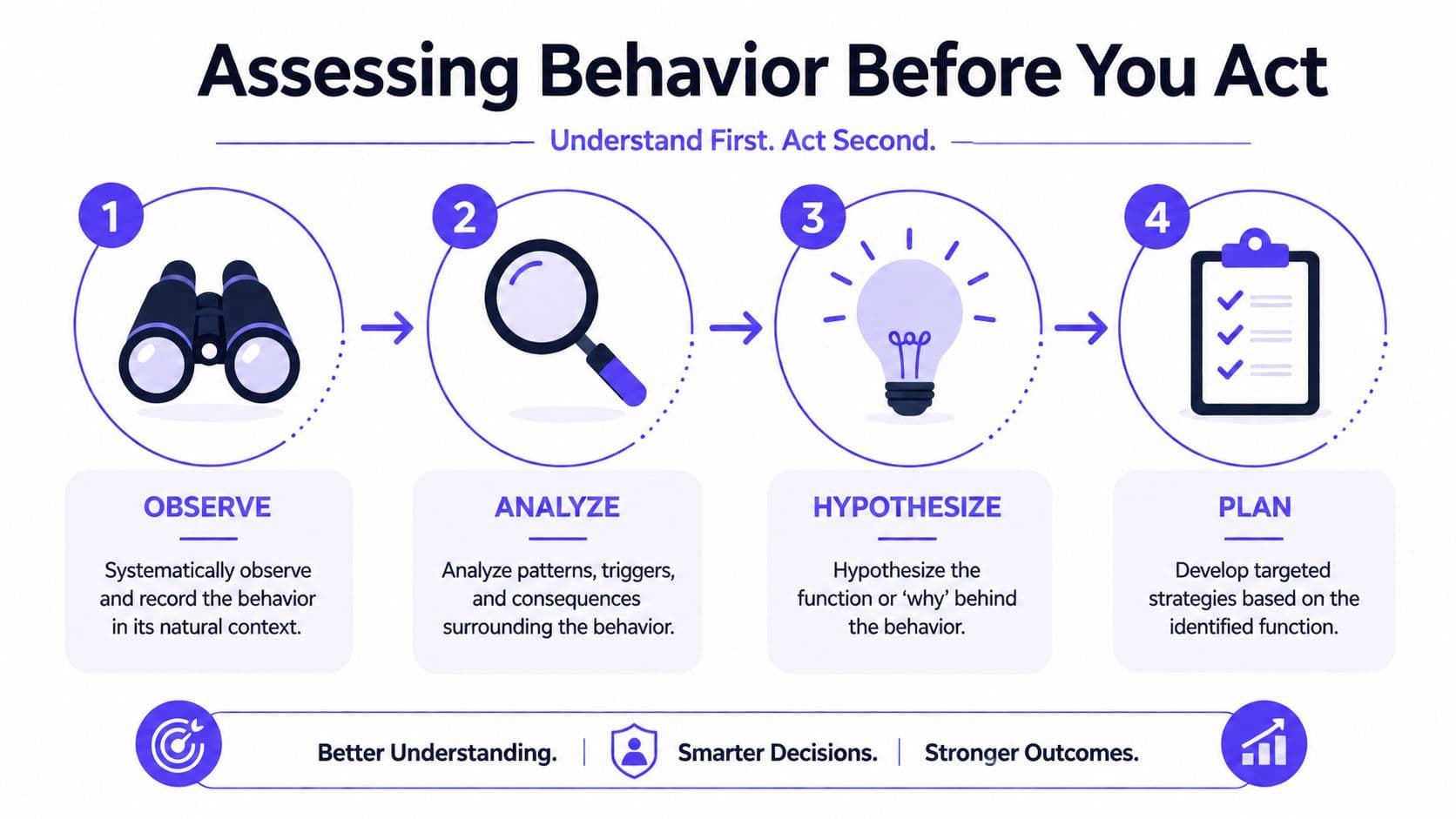
A lot of classroom behavior gets mislabeled because we're naming what it looks like, not what it's doing. "Disruptive" might mean calling out for attention. It might mean avoiding a hard task. It might mean a student is overloaded by noise, confused by directions, or trying to get control back after a stressful transition. If you skip that step, your intervention can make the behavior worse.
Research on functional assessment is clear. Effective behavior support strategies require a functional assessment that includes direct behavioral observations, interviews, record reviews, and behavior rating scales to understand the social and physical context of challenging behavior. This assessment must clearly define the targeted behavior, identify its triggers, and determine the function of the problem behavior in the NIH article on functional assessment.
Define the behavior so another adult could spot it
Don't write "gets disrespectful." Describe what the student does.
A better definition sounds like this:
- Observable action: leaves seat without permission during independent work
- When it happens: within a few minutes of being given written tasks
- What it looks like: walks to peers, taps desks, talks loudly, avoids starting
- What doesn't count: getting up to sharpen a pencil with permission
That kind of wording matters because it gives you something measurable. It also lowers conflict with families and colleagues. You're describing behavior, not judging character.
Use simple classroom detective work
You don't need a giant binder to do this well. Start with four inputs:
- Direct observation: Watch what happens before, during, and after the behavior.
- Interviews: Ask the student, caregivers, and other staff what they notice.
- Record review: Look for patterns across subjects, times of day, and prior notes.
- Rating scales or checklists: Use them when your team has them available.
Practical rule: If you can't say exactly when the behavior starts and what usually follows it, you don't understand it well enough yet.
An A-B-C note is often enough to get moving. Antecedent, Behavior, Consequence. What happened right before? What did the student do? What happened right after?
You might notice that a student calls out most often after multi-step directions. Another may put their head down right before independent reading but not during partner work. Those details point to function.
Form a working hypothesis, not a label
Most classroom behaviors serve a purpose. Common functions include attention, escape, sensory stimulation, or access to something tangible. Your first hypothesis doesn't have to be perfect. It just needs to be testable.
If a student throws a pencil every time writing begins and then gets sent to cool down, escape is worth considering. If a student jokes loudly and peers laugh, attention may be maintaining it. If a student hums or rocks during noisy times, sensory regulation may be part of the picture.
When behavior feels bigger than what school can address alone, families may need broader help for behavioral challenges that explains when behavior concerns may connect to mental health or developmental needs.
Don't rush to consequences before you've answered the why. In classrooms, that single mistake causes a lot of unnecessary power struggles.
Building Your Foundation with Proactive Classroom Routines
Most behavior problems shrink when the room becomes more predictable. Not disappear. Shrink. That's a win.
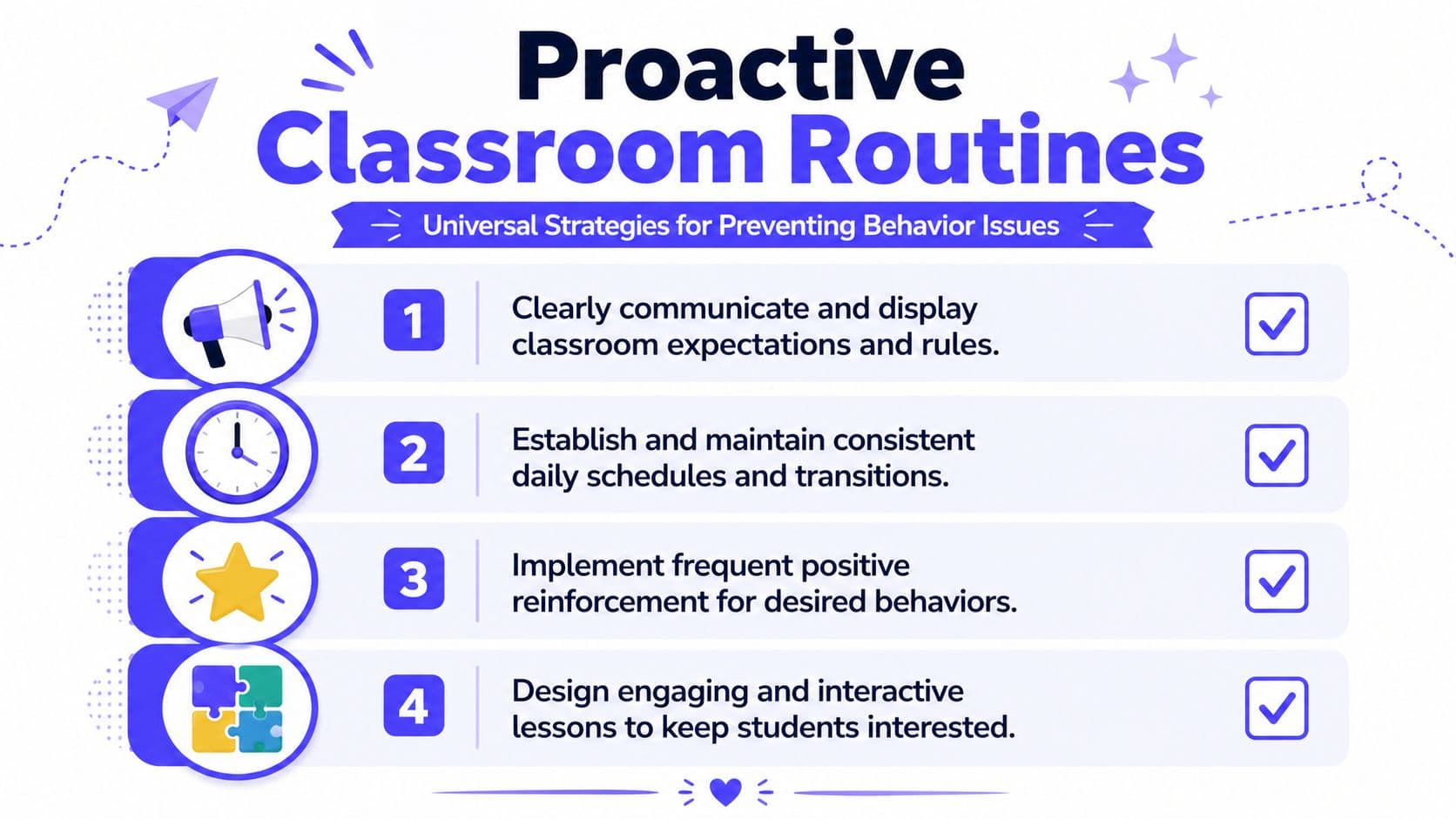
Think of proactive routines as weatherproofing. You can't control every storm, but you can stop a lot of leaks before they start. Students do better when expectations are visible, transitions are rehearsed, and adults respond consistently. That's the boring answer, and it's also the one that works most often.
Teach routines like academic content
A lot of us were trained to explain expectations once and then feel frustrated when students don't follow them. But behavior routines need instruction, modeling, guided practice, and reteaching just like math procedures do.
Three places to tighten first:
- Entry routines: What students do in the first few minutes, without needing you to narrate every step.
- Transition routines: How they move from carpet to desk, group work to independent work, or class to class.
- Help routines: What they do when they're stuck instead of shouting your name across the room.
For younger students, routine and regulation are tightly linked. Even outside school, predictable rhythms matter, which is why family resources like baby sleep schedules by age resonate with so many parents. Kids don't thrive on chaos.
If you need a simple way to make expectations concrete, a printable classroom expectations and agreements worksheet can help you build shared language instead of relying on reminders all day.
Use prompts that move students toward independence
Prompts help, but too much prompting creates dependence. Guidance from Utah's evidence-based behavior support materials stresses using the least intrusive prompt that fits the student's current ability, assessing tolerance for physical prompts, and choosing reinforcers based on actual student preference rather than adult guesswork in the Utah behavior support guidance.
That means:
- Start light: gesture, visual cue, proximity, or a brief verbal reminder
- Pause: give the student time to respond
- Fade support: don't keep helping once they can do the step alone
- Check reinforcers: if the "reward" doesn't matter to the student, it won't teach much
A quick preference check can be simple. "Would you rather earn drawing time, be line leader, or work with a partner?" You'll get better buy-in with that than with a generic prize bin.
Build a regulation routine that doesn't blow up the lesson
One practical structure many teachers can use is Reset-Reflection-Debrief. According to Panorama's description, the strategy involves moving a student to a Reset Space to recalibrate, followed by reflection questions and a debrief to process behaviors. Instructional re-entry happens only once the student shows self-regulation, with target behaviors defined clearly enough to measure success in the Reset-Reflection-Debrief overview.
A reset space isn't a punishment corner. It's a structured place for regulation, reflection, and a clean return to learning.
What matters is the sequence. First calm. Then reflect. Then re-enter. If you try to lecture a dysregulated student in the middle of escalation, you usually get compliance theater at best and a bigger incident at worst.
Creating an Individualized Behavior Support Plan
Sometimes your classroom systems are solid and a student still needs more. That's when an individualized plan helps. Not a vague note in your head. A real plan that names the behavior, teaches a replacement skill, and tells every adult what to do.
Multi-component plans matter because behavior rarely changes from one move alone. According to Links ABA, multi-component behavior support strategies, which combine antecedent modifications, replacement skill teaching, and consequence reinforcement, demonstrate the highest efficacy with success rates reaching up to 85% in clinical and educational settings, and a common pitfall is inconsistent implementation across staff in this behavior intervention planning guide.

What belongs in the plan
A usable behavior support plan should answer a few plain questions.
| Plan element | What it should say |
|---|---|
| Target behavior | Exactly what the student does |
| Triggers | What usually happens before it |
| Replacement skill | What you want the student to do instead |
| Prevention supports | How adults reduce the chance of escalation |
| Response plan | How adults respond if behavior happens |
| Re-entry | How the student returns to learning |
The replacement skill is where many plans fall apart. If the behavior gets a student out of work, "make good choices" isn't a replacement skill. "Ask for a break with a card" is. "Request help using a sentence stem" is. "Use headphones during independent work" can be, if sensory load is part of the pattern.
Write the plan for the adults, not just the file
A plan fails when only one person understands it. The classroom teacher, support staff, specials teachers, and anyone covering the room need the same short version.
Include things like:
- Antecedent supports: shortened directions, visual checklist, front-loaded warning before transitions
- Replacement teaching: role-play the help request, rehearse how to ask for a break, model waiting language
- Adult response: neutral tone, brief redirection, reinforce replacement behavior fast
- Recovery steps: where the student goes, how long the pause lasts, what successful return looks like
What works in practice: Short plans get used. Overbuilt plans get filed.
If you need help building the instructional pieces, tools can save time. For example, differentiation teaching strategies can support the lesson side of a behavior plan by helping you adjust task difficulty, format, and access points so the student can practice the replacement skill during class. Kuraplan can also help create worksheets, visuals, or social-story-style materials that fit into daily instruction instead of living in a separate behavior binder.
A quick visual explanation can also help teams align on what makes a support plan usable in a real classroom.
Keep the plan alive
The best plan is provisional. If the behavior shifts, the support should shift. If one adult is following the plan and another is accidentally reinforcing the old behavior, the student gets mixed signals.
That's why staff consistency matters so much. The student doesn't need perfect adults. The student needs adults who react in a predictable way.
Knowing If It Works Monitoring, Data, and Adjustments
A behavior plan without data turns into opinion fast. One adult says things are improving. Another says nothing has changed. The student has a rough day, and everyone wants to scrap the whole plan. Data keeps the conversation grounded.
The good news is that classroom data doesn't have to be complicated. Skillbuilders ABA notes that effective behavior support plans depend on continuous progress monitoring using metrics like frequency, duration, and latency, and includes a useful benchmark: the 5:1 ratio, where five confirmations or praise are delivered for every one criticism, in their guide to developing a behavior support plan.

Use the three numbers that tell you the most
You don't need to track everything. Start with the measure that matches the problem.
- Frequency asks how often the behavior happens.
- Duration asks how long it lasts.
- Latency asks how long it takes the student to begin after a prompt or demand.
Here's the simplest way to think about it:
| If the problem is... | Track... | Example |
|---|---|---|
| Repeated call-outs | Frequency | Number of times per lesson |
| Long shutdowns | Duration | Minutes with head down |
| Slow task initiation | Latency | Time from direction to first step |
A-B-C charts are still useful when patterns are unclear. Frequency counts work when behavior is brief and obvious. Interval recording can help when behavior is constant enough that every instance is hard to catch.
Let the data answer a practical question
Teachers don't need data for data's sake. They need it to answer, "Should I keep this strategy, tweak it, or drop it?"
Look for patterns like:
- Timing: behavior spikes before transitions or certain subjects
- Task demands: behavior rises when work is too long, too vague, or too hard
- Adult response: behavior changes depending on who is in the room
- Replacement success: the student starts using the new skill in some settings but not others
Data from reinforcement systems should also connect the consequence directly to the target behavior. Wyoming's autism best-practice guidance emphasizes that data collection is a mechanical part of reinforcement, and for approaches such as a specific response training, teams should track changes in communication, language, play, and social behavior in the Wyoming evidence-based practices document.
Track your own feedback too
The 5:1 ratio is one of the few teacher habits worth counting for a week. If most of your language is corrective, the room starts to feel tense, even when your intentions are good.
Try a self-audit during one class period:
- Positive feedback: "You started right away." "Thanks for fixing that quickly."
- Corrections: "Stop talking." "No, not like that."
If your ratio is off, don't fake praise. Make it more specific and more frequent. Catch transitions done well. Catch effort. Catch approximation. Students who hear only correction often stop listening long before they stop misbehaving.
Navigating Common Challenges and Special Considerations
Behavior support gets messier when the classroom isn't the only variable. Culture matters. Language matters. Home stress matters. Access to devices and internet matters. Any plan that ignores those realities ends up punishing students for barriers they didn't choose.
A 2023 study highlighted that sociocultural factors and technology barriers significantly hinder participation in telehealth behavior models, yet few resources offer practical strategies to overcome these disparities for underserved communities in the NIH telehealth study. Even if you aren't running telehealth services, the lesson carries over to school. Supports that look clean on paper may be impossible for a family to use at home.
Equity changes the questions you ask
Instead of asking, "Why didn't the family follow through?" ask better questions:
- Access: Does the student have reliable internet, a device, and quiet space?
- Language: Are directions understandable without specialist jargon?
- Fit: Does the strategy match the family's routines, values, and capacity?
- Student voice: Has anyone asked the student what helps and what makes things worse?
That doesn't mean lowering expectations. It means removing friction that adults often overlook.
A regulation tool only helps if students understand it and teachers use it consistently. Something like a Zones of Regulation introduction worksheet can give a shared starting point, especially for students who need visual language for internal states.
If a support plan only works under ideal conditions, it isn't a strong plan yet.
Be honest about crisis and last-resort responses
Schools sometimes avoid talking plainly about restrictive interventions because it's uncomfortable. It is uncomfortable. It should be. But pretending those decisions never arise doesn't help staff respond ethically when safety is at risk.
The principle is simple. Restrictive responses are not behavior teaching. They are safety measures for specific high-risk situations, and they belong only as a last resort, under school policy, legal guidance, and trained supervision. They should never become the routine response to noncompliance, frustration, or inconvenience.
What teachers need most is clarity:
- Know the threshold: what counts as a safety risk in your setting
- Know your role: what you may do, what you may not do, and who must respond
- Know the follow-up: documentation, family communication, debrief, and plan revision
A classroom behavior system should reduce the chance of crisis. It shouldn't depend on crisis.
Bringing It All Together for a Calmer Classroom
The strongest behavior support strategies aren't flashy. They're steady. You study the behavior before reacting. You build routines that prevent half the problems from starting. You make individualized plans when a student needs more than the universal system. Then you look at the data and adjust without ego.
That approach changes the emotional tone of teaching. You stop feeling like the class is happening to you. You start seeing patterns, levers, and teachable skills. Students notice that difference too. They can tell when an adult is trying to control them and when an adult is trying to help them succeed.
A calmer classroom doesn't mean silent compliance. It means students know what's expected, what support looks like, and how to recover after a rough moment. It means teachers don't spend the whole day in correction mode. It means a child who struggles with transitions, task avoidance, or sensory overload isn't treated like a problem to remove.
Some students also benefit from simple regulation supports outside formal behavior plans. Families and teachers looking for hands-on tips for sensory regulation in children may find useful ideas there for calming routines, movement, and sensory activities.
Good behavior support teaches skills. It doesn't just suppress symptoms long enough to get through the lesson.
If your classroom has felt reactive lately, don't overhaul everything at once. Tighten one routine. Define one target behavior more clearly. Track one piece of data. Teach one replacement skill. Small changes, used consistently, usually beat complicated systems that nobody has time to sustain.
Kuraplan can help when you need classroom-ready materials that support this work, such as lesson-aligned visuals, worksheets, and planning tools for differentiated instruction. If you want a practical way to fold behavior supports into everyday teaching instead of managing them separately, take a look at Kuraplan.