You need a usable English worksheet before tomorrow's lesson, but “usable” means more than finding a page with the right topic. It has to fit the grade level, match students' reading ability, support the lesson objective, and leave you with a manageable way to check understanding. A phonics page for early readers, a comprehension passage for an intervention group, and a grammar review for middle school students all require different decisions.
This list compares ten printable English worksheet resources across phonics, comprehension, grammar, writing, intervention, and standards-based planning. Each entry considers grade span, printable format, differentiation, answer support, customization, classroom fit, and limitations. Downloadable materials still need a quick teacher review for local standards, accessibility, vocabulary load, cultural fit, and student readiness. A worksheet can be well designed and still be wrong for the particular class in front of you.
1. Kuraplan
A teacher preparing a main-idea lesson may need more than one handout. The class might require a short reading passage, guided questions, vocabulary support, and an exit ticket, while a smaller group needs simpler language and fewer items. Kuraplan helps build those connected materials from a stated English objective instead of making the teacher assemble separate PDFs.
The platform is designed for K–12 planning and can produce printable worksheets, slides, visuals, differentiated activities, and assessment rubrics within the same planning workflow. For a phonics lesson, a teacher can request age-appropriate prompts and images, then create a reduced-item version for students who need less writing or more guided practice. For comprehension, the same objective can support a passage, questions, vocabulary work, and a short assessment.
Kuraplan also includes broader planning tools, such as unit sequencing, a weekly planner that can extract a timetable from a photo, and an AI teaching assistant for lesson ideas and classroom-management support.
Best classroom fit
Choose Kuraplan when the available worksheet covers the topic but misses the grade level, reading load, skill progression, or support needs of your class. Its worksheet-generation feature is useful when one lesson needs several printable versions, such as a standard page, a scaffolded page with sentence starters, and an extension task for early finishers.
The platform offers free printable resources alongside its generation tools. Kuraplan reports 1,000+ school customers. Treat that as vendor data, then judge the platform by the worksheets it produces for your actual objective, students, and curriculum.
Use AI for drafting and formatting. Keep teacher review in charge of content, difficulty, and assessment decisions.
Trade-offs to check
- Strength: Kuraplan connects worksheet creation with lesson planning, differentiation, visuals, and assessment rather than producing an isolated handout.
- Preparation need: It can reduce drafting time, but the teacher still needs to enter a precise objective, specify the grade and reading level, and review the generated page before printing.
- Differentiation: Request fewer questions, sentence frames, word banks, larger print, or an extension section. Check that each version still measures the same skill.
- Standards check: Match the activity to the exact local standard, not just a broad label such as “reading comprehension” or “grammar.”
- Content review: Check factual accuracy, vocabulary load, cultural suitability, accessibility, question difficulty, answer keys, and whether the passage gives students enough evidence to answer.
Website: Kuraplan
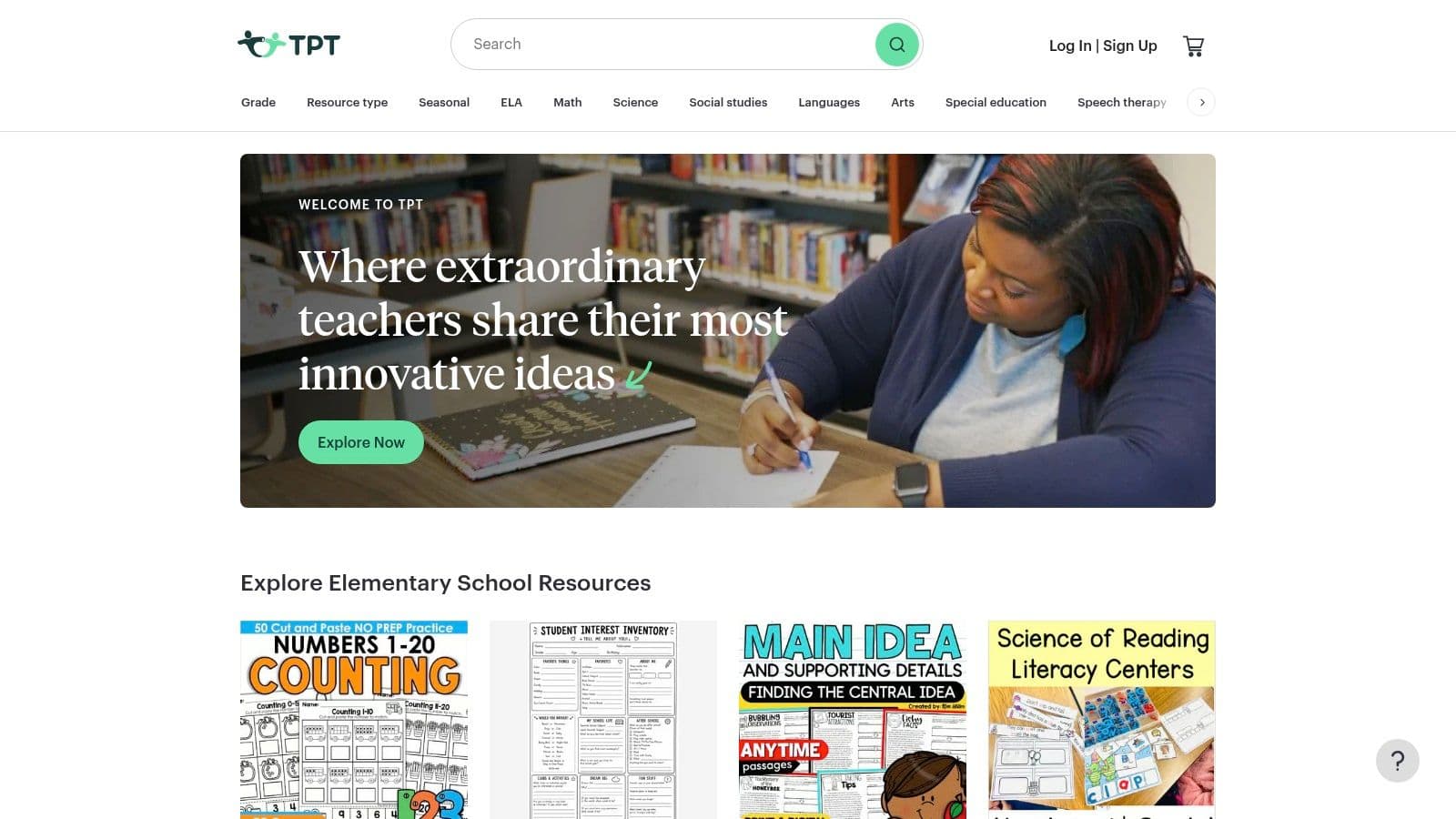
2. Teachers Pay Teachers
Teachers Pay Teachers, usually called TPT, is the best place to look when your need is unusually specific. You can find printable English resources for phonics, grammar, vocabulary, reading comprehension, writing, test preparation, and classroom intervention, often created by practicing teachers who understand a particular grade or teaching situation. A niche request such as figurative-language practice, a particular writing organizer, or a themed grammar review is more likely to appear here than in a general worksheet library.
Print the preview before downloading the full resource. Look for a clear student page, an answer key, editable files, and instructions that explain how the activity is meant to work. Reviews and ratings can help narrow the search, but they don't replace checking the actual page for dense text, confusing directions, small print, or examples that don't match your curriculum.
Best classroom fit
TPT works well when you need a ready-made activity for tomorrow's lesson and have enough time to vet the seller. It's also useful for building a small bank of repeatable resources, such as writing prompts, reading-response pages, or grammar centers.
- Differentiation: Search for leveled, scaffolded, editable, or intervention versions, then inspect whether the differences are meaningful rather than cosmetic.
- Answer support: Many downloads include answer keys, but confirm that before assigning the work independently.
- Standards check: Seller labels aren't a substitute for comparing the skill to your local standards and success criteria.
- Cost control: The marketplace is free to browse and includes free materials, but paid resources are generally purchased individually unless a school uses the TPT School Access program.
TPT has 7M+ resources across K–12, according to its official marketplace. That scale creates variety, but it also creates uneven quality. A useful third-party option is this AI tool for Teachers Pay Teachers, particularly if you're trying to organize or develop marketplace materials.
3. Education.com
Education.com is a practical choice for PreK through elementary and lower middle-school preparation, especially when students need repeated practice across a carefully sequenced skill. Its English library includes phonics, spelling, reading comprehension, grammar, and writing, along with games and lesson plans. The materials are easy to print, and the collections make it simpler to move from a basic skill page to a more demanding application task.
For a phonics lesson, print the page that introduces the sound pattern and pair it with a short application activity. For comprehension, preview the passage and confirm that the vocabulary doesn't turn a reading lesson into an unintended decoding test. The platform is also suitable for home-school communication because families can use the same kind of practice pages outside class.
What works and what doesn't
The clearest advantage is the progression. Students can practise a subskill repeatedly without the teacher assembling disconnected pages from several websites. Materials are described as standards-informed, and the site supports printable PDFs, curated collections, Google Classroom sharing, and progress tools through Premium access. Check the current access level before planning a whole unit because the basic free tier has limited downloads, while unlimited downloading and printing require Premium.
Differentiation is easiest when you assign the same objective with different page difficulty, not when you give faster students more problems. Remove unnecessary decorative elements for students who need a less distracting page, preteach vocabulary from the passage, and provide oral directions where appropriate.
Print one page first. A worksheet that looks clear on a screen can feel crowded when several students are working with pencils, highlighters, or accessibility supports.
Education.com is strongest in elementary English. Teachers planning substantial secondary ELA work may find the middle-school depth thinner than the early-literacy and elementary coverage. Visit the Education.com worksheet and lesson library to check the exact grade and skill before assigning it.
4. Super Teacher Worksheets
For a teacher who needs a usable page before the next lesson, Super Teacher Worksheets offers copy-ready materials with little preparation. Its strongest fit is K–5 English: reading passages with questions, grammar practice, vocabulary review, handwriting, writing prompts, phonics, mini-books, and spelling activities. The plain design photocopies clearly and keeps attention on the task, although students seeking richer visuals or more authentic texts may find it less engaging.
Use the site by objective rather than by topic alone. A short passage and question set can serve as morning work, while a grammar or spelling page can reinforce the same skill later in the week. Answer keys support quick checking during independent work or a small-group conference. Before printing, read the entire student page and check passage length, sentence structure, vocabulary, and the expected response. In comprehension and writing, review whether the key allows reasonable alternative answers.
A practical choice guide:
- Best classroom objective: Elementary reading, phonics, grammar, vocabulary, handwriting, spelling, and writing practice.
- Preparation level: Low. Print a page and its answer key, then decide whether students need directions or a worked example.
- Differentiation: Reduce the number of items, add a word bank, provide oral reading support, or complete the first example with a small group. Pairing the core page with a customized Kuraplan companion worksheet can provide sentence frames, extra vocabulary practice, or a shorter passage for students who need another entry point.
- Standards check: Confirm that the selected task matches the precise skill and grade expectation. The worksheet topic alone does not establish standards alignment.
- Trade-off: The elementary focus makes the collection practical for younger learners, but it offers limited depth for middle and high school English.
Print one page first. Check spacing for pencils, highlighters, and accessibility supports before making a class set. Explore Super Teacher Worksheets to inspect the exact format and decide whether it suits the group.
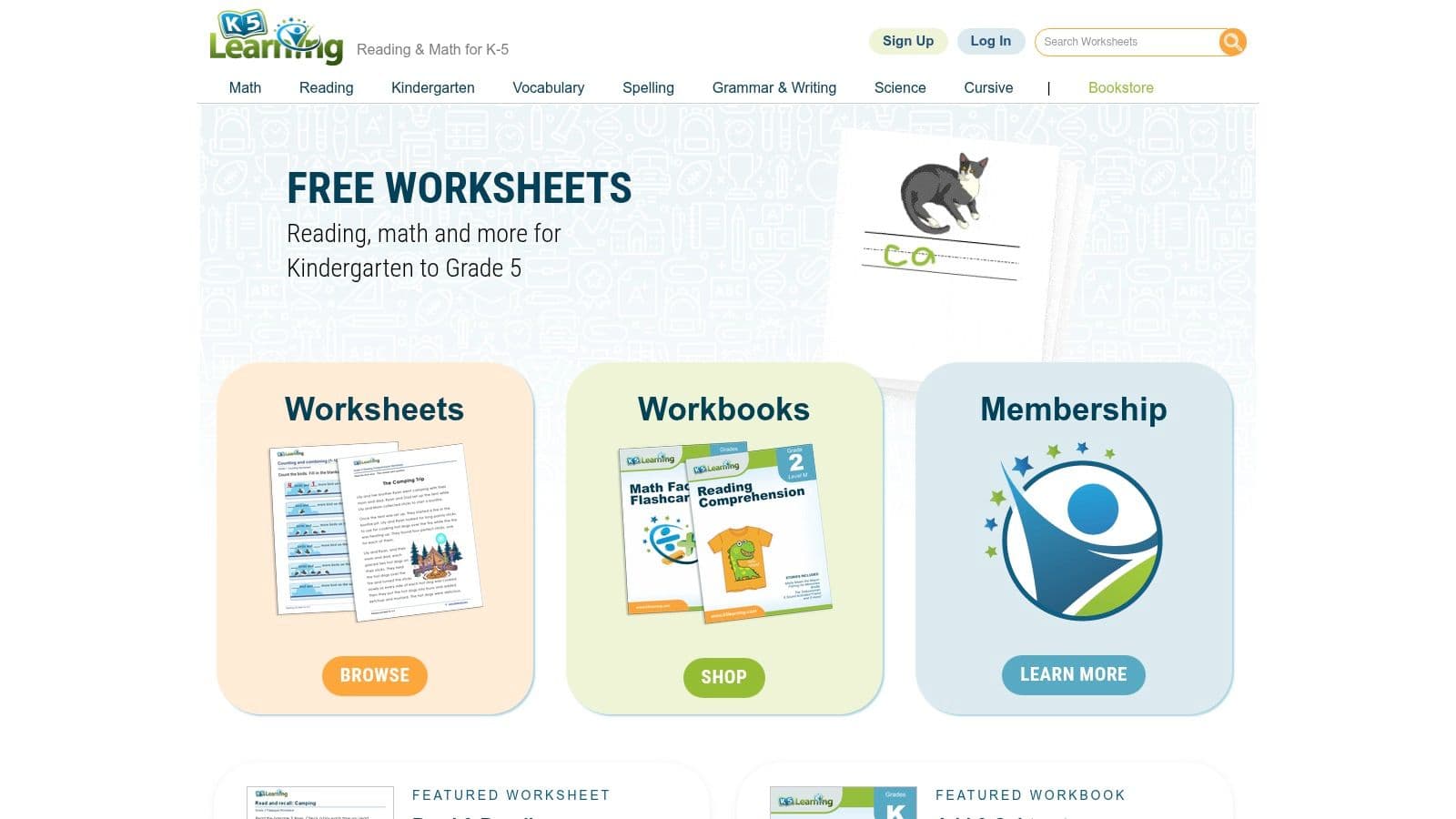
5. K5 Learning
K5 Learning is a strong fit when differentiation means assigning the same English subskill at different levels. Its K–5 materials cover phonics, vocabulary, reading comprehension, grammar, writing, and leveled passages. The organization makes it easier to assemble a focused packet rather than handing students a random collection of pages that happen to share a topic.
Use K5 Learning for targeted practice after a quick formative assessment. If one group needs decoding and another is ready for vocabulary in context, select related materials with different demands. Member tools allow teachers to preview worksheets, download full sets, remove grade labels, and share PDFs to Google Classroom. Removing grade labels can be helpful when students are working at different instructional levels, although it also makes teacher review more important.
A practical differentiation routine
Choose one objective, such as identifying supporting details. Print a simpler passage for students who need shorter sentences and stronger vocabulary support, then use a more demanding passage for students ready to justify answers with evidence. Keep the discussion objective shared across groups so differentiation changes access and complexity without splitting the class into unrelated lessons.
K5 Learning is elementary-only, so it isn't a sensible main library for secondary English. Its design is functional rather than modern, but that can help students focus on the task and makes the PDFs easy to use in packets, folders, or intervention sessions.
For mixed groups: Different pages can still lead to one shared discussion. Plan the conversation before you select the PDFs.
Check every passage for cultural relevance, vocabulary load, and the kind of response expected. A page may be labelled for a grade but still demand background knowledge your students haven't developed. Visit K5 Learning to inspect the available levels and topic organization.
6. ReadWorks
Use ReadWorks when the lesson objective is reading comprehension, especially for intervention, guided reading, or paper-based work. The nonprofit provides passages, question sets, vocabulary supports, audio, step-reads, graphic organizers, and teacher materials. Many assignments offer student and teacher PDFs, so teachers can prepare printed lessons for limited-device classrooms, substitute plans, or small-group instruction.
Start with the skill, then choose the text. For a main-idea lesson, print a passage, its questions, and an organizer that directs students to key details. Students at different reading levels can work on related texts before comparing how each author develops a central idea. Decide whether students will read independently, listen first, or use both audio and print.
A useful selection check:
- Intervention: Begin with a shorter or more accessible passage, then increase text complexity as students gain control.
- Vocabulary: Preselect unfamiliar terms so word work supports comprehension rather than taking over the lesson.
- Assessment: Print the question set and keep the teacher version for reviewing text evidence.
- Differentiation: Use leveled texts, audio, and step-reads while keeping the same comprehension target visible.
ReadWorks suits reading instruction more than grammar, mechanics, or sentence-construction drills. Its large article library also needs teacher curation. Check the district scope and sequence, topic relevance, vocabulary load, response demands, and available lesson time before printing. Grade labels alone do not confirm standards alignment.
The platform's free reading comprehension worksheets can provide a customized companion page for the same objective, such as citing evidence or sequencing events. Review the passage first, then match the companion worksheet to its vocabulary and expected response.
Website: ReadWorks. For older elementary and secondary practice, compare these KS2 to GCSE reading practice materials.
7. CommonLit
Use CommonLit when the reading text needs to anchor a full ELA lesson for grades 3–12. Its library and CommonLit 360 curriculum can combine student texts, lesson materials, assessments, discussion prompts, and scaffolds. That setup supports a sequence from first reading to annotation, discussion, written response, and assessment without requiring teachers to assemble every part separately.
For a paper-based lesson, print the student text, selected prompts, and any annotation or vocabulary support students will need. This works well when devices are limited, students benefit from marking a physical page, or the class needs a consistent assessment setting. Full 360 units generally include printable teacher and student materials, while reports or data exports can assist with progress tracking. Check the individual text before printing, because some titles have rights restrictions and are not downloadable as PDFs.
Choose the materials according to the lesson objective:
- Grade fit: The strongest coverage is upper elementary through high school, with text complexity and response demands that still require teacher review.
- Differentiation: Use available scaffolds, audio, or accessible supports. Reduce the number of written prompts, provide sentence frames, or let students respond orally while preserving the lesson's central question.
- Standards check: Compare the stated objective with district standards and the actual task. Platform labels alone do not confirm alignment.
- Answer support: Teacher materials and assessments offer more structure than a standalone worksheet. Open-ended answers still need a rubric or agreed evidence criteria.
CommonLit is better suited to close reading, discussion, and evidence-based writing than to a quick grammar or spelling drill. Preview vocabulary, passage length, annotation demands, and lesson time before committing to a complete unit.
Standards labels also need verification. Learning Yay describes searchable standard matches and Common Core icons for its printables, but teachers should check whether the activity measures the intended skill. If students need a targeted companion page, Kuraplan can help create one for citing evidence, organizing notes, or drafting a response.
Explore CommonLit when you need a reading and writing sequence that can operate on paper.
8. Scholastic Teachables
Scholastic Teachables is designed for teachers who want a publisher-curated library for PreK through elementary grades. Its printable English resources include phonics, decodables, vocabulary, mini-books, guided reading materials, writing practice, and seasonal packs. The editorial presentation is more consistent than what you'll find in an open marketplace, which matters when you're building a classroom folder that students can use independently.
For early literacy, print a decodable or mini-book alongside a phonics page and a short response task. For vocabulary or writing, select a resource that gives students enough modeling before expecting independent work. The library's search and file-cabinet organization can reduce the time spent hunting through downloaded files, especially when several teachers share a grade-level resource bank.
The main trade-off
The platform advertises 30,000+ resources and 2,000+ customizable mini-books on its Teachables library. Those figures describe the catalog, not a guarantee that every item will fit your classroom. Preview pages for font size, sentence complexity, cultural representation, handwriting demand, and the amount of adult support required.
Its biggest strengths are early literacy, phonics, and consistent classroom presentation. Its limitations are equally clear: middle-school depth is limited, and unlimited access requires a subscription. Differentiation usually comes from choosing a different resource, adding a word bank, changing the response mode, or pairing print with teacher modeling rather than editing every page directly.
A polished worksheet still needs a purpose. Decide whether students are decoding, practising fluency, demonstrating comprehension, or producing language before you print it.
Check whether the activity aligns with your local progression and whether the mini-book or worksheet supports the exact sound, spelling pattern, or writing outcome students are learning. Scholastic Teachables is a dependable elementary source, but it works best as part of a broader toolkit rather than as a complete secondary English solution.
9. Twinkl USA
Twinkl USA fits classrooms that need materials for several objectives, from phonics intervention to comprehension and writing practice. Its K–8+ English collection includes differentiated activities, intervention packs, display materials, and resources that can be filtered for US standards such as Common Core, TEKS, and Florida B.E.S.T. Personalization tools allow teachers to adjust selected pages, although reviewing the finished worksheet remains necessary.
Start with the classroom job, not the catalogue. For a phonics group, print a page that matches the sound pattern students are learning, then check that practice includes reading and spelling rather than recognition alone. For comprehension, preview the passage and questions because a grade label does not guarantee the right reading demand. For writing, choose prompts with planning support when students need help generating or organizing ideas.
A small saved collection works better than a crowded download folder. Organize resources by unit and objective, using labels such as “Grade 4 inferencing, independent practice.” This makes substitute plans and team sharing easier, and it reduces repeated searching before a lesson.
Use the platform selectively:
- Best fit: Core lessons, intervention groups, early finishers, and short-notice planning across elementary and middle grades.
- Preparation need: Low to moderate. Filtering is quick, but preview each page for readability, directions, response space, and cultural fit.
- Differentiation: Choose a different level, add teacher modeling, or pair the printout with a word bank and oral rehearsal. Personalization helps, but it does not replace instructional judgment.
- Standards check: Confirm that the task measures the specific skill in your local progression. A standards filter is a starting point, not evidence of alignment.
- Limitation: The large catalogue can encourage unnecessary downloading, and pricing details vary by offer, so check the current terms before committing.
Twinkl reports 1,000,000+ resources in its US library. Treat that as a catalogue description. If the available page is close but misses your objective, Kuraplan can help create a customized companion worksheet for the same vocabulary, text skill, or writing outcome.
10. WorksheetWorks.com
A reteach group has mixed gaps: some students need spelling practice, while others need sentence-level grammar work. WorksheetWorks.com lets you set the skill, content, and difficulty, then generate a printable page instead of searching through finished PDFs. Its tools cover grammar, vocabulary, handwriting, and other K–8 language skills.
Use the generator for a short warm-up, intervention station, or follow-up practice after a recurring error appears. Create one vocabulary page with a word bank for students who need support, then remove that scaffold for independent practice. You can also produce parallel versions by changing the vocabulary, item count, or difficulty while keeping the learning objective stable. This makes the site useful when a class needs repeated practice without receiving identical questions.
Match the generator to the instructional job
WorksheetWorks.com suits sentence skills, spelling patterns, handwriting, and targeted grammar. It is less suitable for a literature unit, sustained writing, or a complex comprehension sequence because the pages focus on isolated practice. The simple interface saves preparation time, though teachers still need to supply context, modeling, and application.
Before printing, check that examples sound natural, directions are clear, and the difficulty fits the group. Limit the item count to what students can complete carefully. Add a brief reading or writing task afterward so they apply the target skill beyond the worksheet.
For a packet that may become a small classroom resource business, teachers can learn how to sell digital products from your link in a practical guide, while checking that shared materials follow school and copyright policies. For matching diagrams, Kuraplan's worksheet illustration generator can supply companion visuals. Review WorksheetWorks.com to see whether its generator options fit your regular K–8 practice needs.
Top 10 Printable English Worksheet Resources
| Product | Core features | UX / Quality ★ | Value & Price 💰 | Target 👥 | Unique ✨ |
|---|---|---|---|---|---|
| Kuraplan 🏆 | AI-driven lesson & unit planning, auto-aligned standards, worksheet/slide/image generation | ★★★★★ | 💰 Free trial; paid plans & school licensing | 👥 K–12 teachers, schools & districts | ✨ Auto standards mapping, 24/7 AI teaching assistant, multi-format outputs |
| Teachers Pay Teachers (TPT) | Marketplace of teacher-created printables & bundles, previews & reviews | ★★★★☆ (varies by author) | 💰 Mix of free & per-item purchases; school access available | 👥 K–12 teachers seeking niche resources | ✨ Huge variety of teacher-authored niche resources |
| Education.com | Thousands of scaffolded PreK–8 worksheets, games, printable PDFs | ★★★★☆ | 💰 Free tier; Premium for unlimited downloads | 👥 Elementary teachers & families (PreK–8) | ✨ Skill progressions & family-friendly printables |
| Super Teacher Worksheets | Extensive K–5 PDFs, answer keys, mini-books; copy-ready formatting | ★★★★☆ | 💰 Affordable individual membership | 👥 Elementary classroom teachers (K–5) | ✨ Reliable, classroom-tested, copy-ready worksheets |
| K5 Learning | Leveled K–5 worksheets & passages, member tools, Google Classroom sharing | ★★★★☆ | 💰 Member plans for sets & ad-free access | 👥 K–5 teachers needing leveled packets | ✨ Easy assembly of leveled/downloadable practice sets |
| ReadWorks | 6,000+ research-backed passages, audio, vocab supports, printable PDFs | ★★★★★ | 💰 Always free for teachers & schools | 👥 K–12 teachers focused on reading comprehension | ✨ Free, research-aligned texts with scaffolds & audio |
| CommonLit | Free library + CommonLit 360 units, printable lesson & assessment PDFs | ★★★★☆ | 💰 Free core library; some rights-restricted texts | 👥 Grades 3–12 ELA teachers | ✨ Standards-aligned units with assessment tracking |
| Scholastic Teachables | 30k+ vetted printables, mini-books, early-literacy focus | ★★★★☆ | 💰 Subscription with free trial | 👥 PreK–6 teachers & early-literacy specialists | ✨ Publisher-vetted early-literacy resources |
| Twinkl USA | Massive library (standards filters), intervention packs, US standards mapping | ★★★★☆ | 💰 Paid plans with unlimited downloads (varies) | 👥 K–8+ teachers needing standards alignment | ✨ Extensive catalog + US standards filters |
| WorksheetWorks.com | On-the-fly customizable worksheet generators for many ELA subskills | ★★★★☆ | 💰 Very low-cost annual membership | 👥 K–8 teachers needing quick skill drills | ✨ Fast, customizable worksheet generation for differentiation |
Build a Worksheet Shortlist You Will Reuse
The fastest way to choose a printable English worksheet is to start with the skill, not the website. Write the objective in student-friendly language, such as “identify two details that support the main idea” or “use commas in a series,” then filter for grade, reading level, and task type. A page that addresses the right topic but asks students to perform a different skill will create extra explanation and correction later.
Preview the actual student page before printing. Check the directions, font size, contrast, vocabulary, sentence length, writing space, and whether students can complete the work with the support available in your room. Then verify the answer key, because an incorrect or overly narrow key can turn a useful discussion into a marking problem. If the resource claims standards alignment, compare the task with your local standard and lesson success criteria. Standards labels are helpful, but they don't remove the need for professional review.
Print a small test batch before assigning the worksheet widely. Watch where students hesitate, which directions require oral clarification, and whether the page takes the planned amount of time. If students finish without demonstrating the objective, the worksheet needs replacing or adapting. If they struggle because of vocabulary, layout, or reading load rather than the target skill, change the access support before deciding that students haven't learned the content.
Copyright also belongs in this routine. In the United States, fair use for classroom copying is evaluated through the four statutory factors in Section 107, not through a blanket classroom exception, as explained in this education-focused copyright guide. WestEd's educational copying guidance specifically identifies worksheets, tests, and answer sheets as consumable materials that shouldn't be copied without permission. A worksheet is protected when its creator fixes it in tangible form, so online availability doesn't automatically grant reuse rights, as explained in this teaching copyright resource.
Keep a small, dependable toolkit rather than chasing every new PDF:
- Free reading source: ReadWorks or CommonLit for passages, questions, and comprehension support.
- Foundational skills source: Education.com, Super Teacher Worksheets, K5 Learning, or Scholastic Teachables for phonics, grammar, spelling, and elementary practice.
- Niche resource source: Teachers Pay Teachers when the lesson requires a very specific topic, genre, intervention, or classroom format.
- Customizable generator or planning platform: WorksheetWorks.com for targeted drills, or Kuraplan when the worksheet needs to connect to a specific objective, differentiated activity, visual, assessment, or broader unit.
Kuraplan is most useful when a ready-made page is close but not close enough. You can create a worksheet around the exact objective, adjust the level and question types for your class, and connect it to a larger lesson or unit. Review every AI-generated page before use, especially its factual accuracy, standards fit, accessibility, vocabulary, and cultural appropriateness.
The best printable resource isn't the one with the largest library or the most attractive page. It's the one that matches tomorrow's objective, gives students a fair route to demonstrate learning, and doesn't create extra correction or adaptation work for you.
Kuraplan helps K–12 teachers turn English objectives into standards-aligned lesson plans, differentiated printable worksheets, slides, visuals, and assessment materials in minutes. Visit Kuraplan to explore its free teacher resources and create a worksheet that fits your next class instead of forcing your class to fit a generic page.