You've just finished grading a multi-step problem. One student has the correct answer but barely shows a strategy. Another has a clear diagram, a sensible equation, and an explanation that makes the thinking easy to follow, but a small arithmetic error changes the final result. If your scoring system only counts right answers, the second student may appear to understand less than the first.
A well-designed rubric for math helps you see the difference. It makes mathematical reasoning, representations, communication, and accuracy visible instead of reducing every response to correct or incorrect. More than that, a rubric gives teachers a shared language for judging work, which matters when several classrooms, grade levels, or schools assess similar tasks.
Why Math Rubrics Matter Beyond the Final Answer
A student solving a word problem reveals much more than a final number. They might identify the relevant information, choose a representation, write an equation, explain a pattern, and check whether the result makes sense. A final-answer score hides those decisions.
Consider two solutions to the same problem. Student A writes a correct answer after several unexplained steps and uses an operation that doesn't match the context. Student B models the situation accurately, explains each step, and makes a minor calculation mistake near the end. A teacher using only point counting may reward Student A more heavily. A rubric can show that Student B has stronger evidence of conceptual understanding and problem-solving structure.
Practical rule: Score the evidence of mathematical thinking, not just the number at the bottom of the page.
Rubrics are scoring guides with pre-established performance criteria for evaluating student work on performance assessments. In mathematics, that structure supports more consistent judgments about complex work, especially when students must reason, justify, represent, or communicate rather than select an answer. The history of rubric use reflects this concern about subjectivity. Rubrics became more formalized during the twentieth century, including a 1912 proposal by Noyes to standardize composition evaluation, while standards-based reform helped spread them widely in the 1990s. This history of rubrics and mathematics assessment also notes that Harvard used a 100-point scale for mathematics examinations in the nineteenth century.
A math rubric also improves feedback. Instead of writing “show more work,” you can identify the missing evidence: “Your equation represents the quantities, but explain why the operation matches the situation.” Students can then revise a specific part of the solution, and teachers can spot patterns across a class.
Rubrics won't remove professional judgment. They make that judgment more transparent, discussable, and easier to apply consistently.
Core Components of an Effective Math Rubric
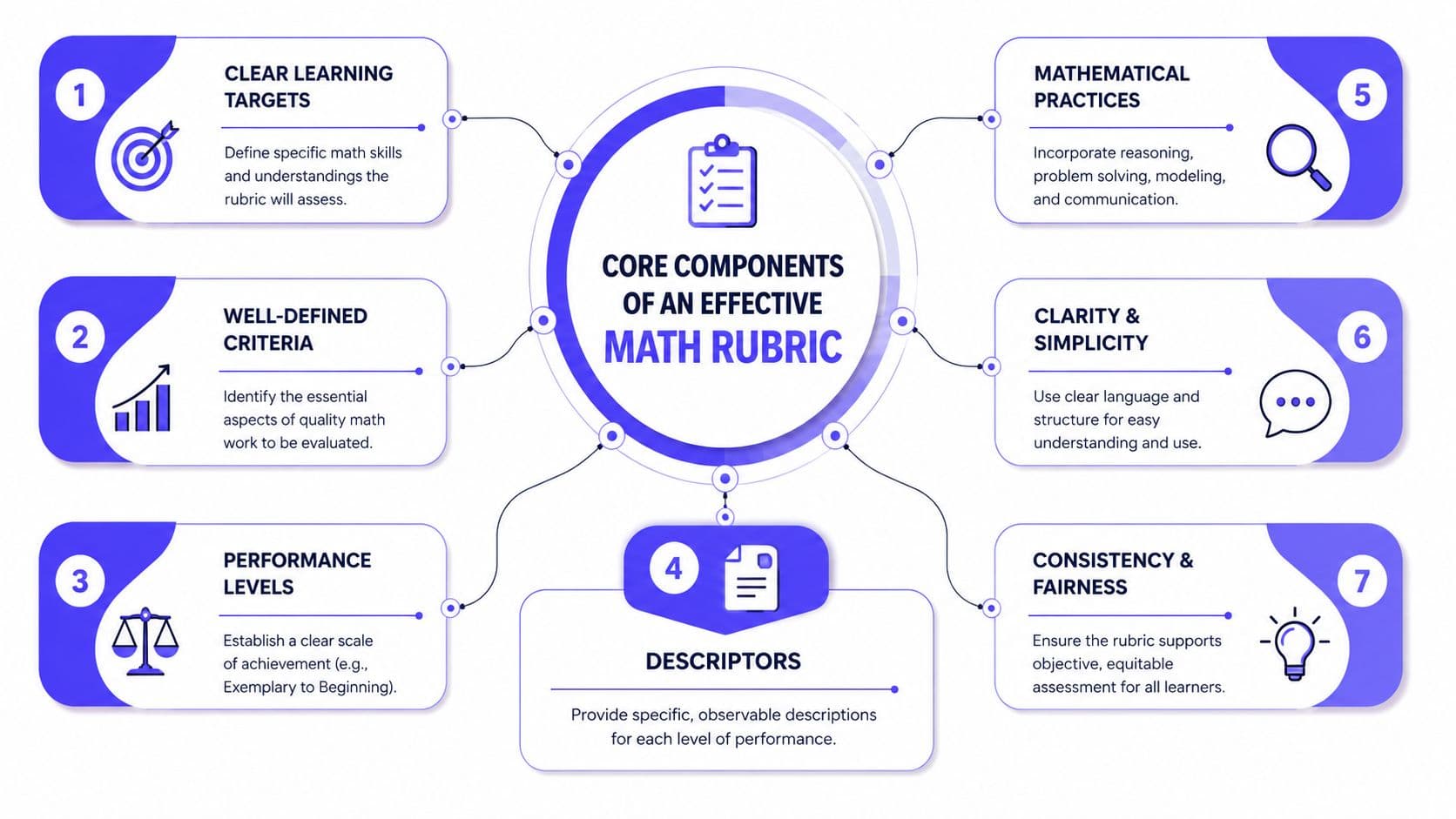
A practical rubric for math needs four working parts: criteria, performance levels, descriptors, and scoring guidance. Together, they define what matters, show how quality develops, describe observable evidence, and explain how to treat partial or unusual responses.
Start with criteria
Criteria name the dimensions you'll assess. For a multi-step problem, you might use:
- Understanding: Identifies the quantities, relationships, and question.
- Strategy: Chooses and applies a suitable method.
- Accuracy: Performs calculations and uses notation correctly.
- Communication: Explains reasoning with words, symbols, diagrams, or tables.
Don't add a criterion because it sounds academic. If students aren't expected to use a representation, don't score representation separately.
Define performance levels
Levels describe progression, not personality. Labels such as Beginning, Developing, Proficient, and Advanced can work, but the label matters less than the evidence beneath it. Exemplars' standards-based math rubric uses Novice, Apprentice, Practitioner, and Expert, with Practitioner representing meeting the standard, and evaluates Problem Solving, Reasoning and Proof, Communication, Connections, and Representation. The Exemplars math rubric demonstrates how a rubric can separate conceptual reasoning from presentation quality.
Write observable descriptors
Replace “shows good understanding” with language a second teacher could recognize. For example, “represents the comparison with a labeled diagram and explains how the diagram supports the equation” gives students and graders something concrete to look for.
Add scoring rules
State how you'll handle a correct strategy with an arithmetic error, an incomplete explanation, or a valid method that differs from the one taught. A rubric should guide judgment in these cases, not pretend they won't occur.
For help connecting criteria to classroom goals, teachers can use this guide to align learning intentions and success criteria.
Overall vs Analytic Rubrics for Math Assessment
A rubric can produce one overall judgment, while an analytic rubric scores separate dimensions. Neither format is automatically better. The practical choice depends on whether you need quick scoring, diagnostic feedback, or a shared record of several kinds of evidence.
An overall rubric fits a quick exit ticket or informal check. For example, you might mark a response Proficient when it uses an appropriate strategy, reaches a defensible conclusion, and communicates enough reasoning, without assigning separate points to each element. This keeps marking manageable, but gives students less guidance about what to improve.
An analytic rubric takes longer because the teacher evaluates each criterion independently. That detail is useful for performance tasks, portfolios, and assessments that require reasoning and communication alongside accuracy. It also supports grade-team calibration. Teachers can compare evidence criterion by criterion, much like checking each instrument in an orchestra, rather than trying to reconcile different overall impressions.
| Feature | Overall Rubric | Analytic Rubric |
|---|---|---|
| Main judgment | One overall performance level | Separate levels for each criterion |
| Best use | Quick formative checks and short responses | Complex tasks and targeted feedback |
| Feedback | Broad and efficient | Specific and diagnostic |
| Scoring process | Faster | More deliberate |
| Main risk | Hides the source of difficulty | Can become overloaded or time-consuming |
A single-point rubric provides another option. It names the expected standard and leaves space for evidence that exceeds or falls short of it. This structure works well when the purpose is coaching rather than producing a detailed grade.
Use the simplest structure that answers your assessment question. If you need to determine whether students can justify a method, an analytic rubric is worth the extra scoring time. If you only need to decide whether a response is ready for the next lesson, an overall quality judgment may be enough. For consistent results across classrooms, agree on a few sample responses and discuss how each format handles partial reasoning, errors, and unusually strong solutions.
Ready-to-Use Math Rubric Templates by Grade Band
Grade level should shape the evidence you expect. A young learner may demonstrate understanding through counters, drawings, and oral language. An older student may need symbolic work, algebraic structure, and a written justification. Broad K–12 templates are useful starting points, but grade-band calibration makes them more usable across real classrooms.
| Grade Band | Primary Focus Areas | Scoring Criteria | Performance Levels |
|---|---|---|---|
| K–2 | Concrete models, representation, verbal explanation | Model, strategy, explanation, answer | Emerging, Developing, Proficient, Advanced |
| 3–5 | Fluency, multi-step strategy, estimation, written reasoning | Understanding, procedure, accuracy, communication | Emerging, Developing, Proficient, Advanced |
| 6–8 | Algebraic reasoning, representation, justification, precision | Model, reasoning, symbolic work, conclusion | Emerging, Developing, Proficient, Advanced |
K–2 template
Use descriptors that allow students to show thinking without requiring extended writing.
- Emerging: Uses materials or drawings with substantial prompting. The representation may not match the problem.
- Developing: Represents some quantities correctly and describes part of the strategy orally or in writing.
- Proficient: Chooses a matching model, solves with an appropriate strategy, and explains the answer using words, numbers, or a labeled drawing.
- Advanced: Uses an efficient representation, explains why the strategy works, and checks the result in another way.
For a student who counts correctly but writes the wrong numeral, record the conceptual evidence separately from the recording error. That distinction gives families and support teams more useful information.
Grades 3–5 template
Focus on the relationship between procedures and meaning.
- Emerging: Begins a strategy but misreads important information or abandons the process.
- Developing: Selects a partly suitable procedure, with gaps in place value, operation choice, or intermediate steps.
- Proficient: Solves accurately or shows a clearly correct method with only a minor computational slip, explains the steps, and checks reasonableness.
- Advanced: Compares methods, uses an efficient strategy, and justifies why the solution fits the context.
Grades 6–8 template
Make algebraic relationships and justification explicit.
- Emerging: Writes an expression or equation that doesn't represent the situation.
- Developing: Represents the relationship partly correctly but includes unsupported transformations or incomplete reasoning.
- Proficient: Builds a valid model, performs appropriate transformations, and justifies the conclusion with mathematical evidence.
- Advanced: Connects representations, identifies constraints or patterns, and evaluates the efficiency or limitations of the method.
Give students a comment box for “evidence I showed” and “my next improvement.” A rubric generator for teachers can help create an editable starting draft, but your team still needs to adjust descriptors to the actual task and grade band.
Aligning Your Rubric with Math Standards
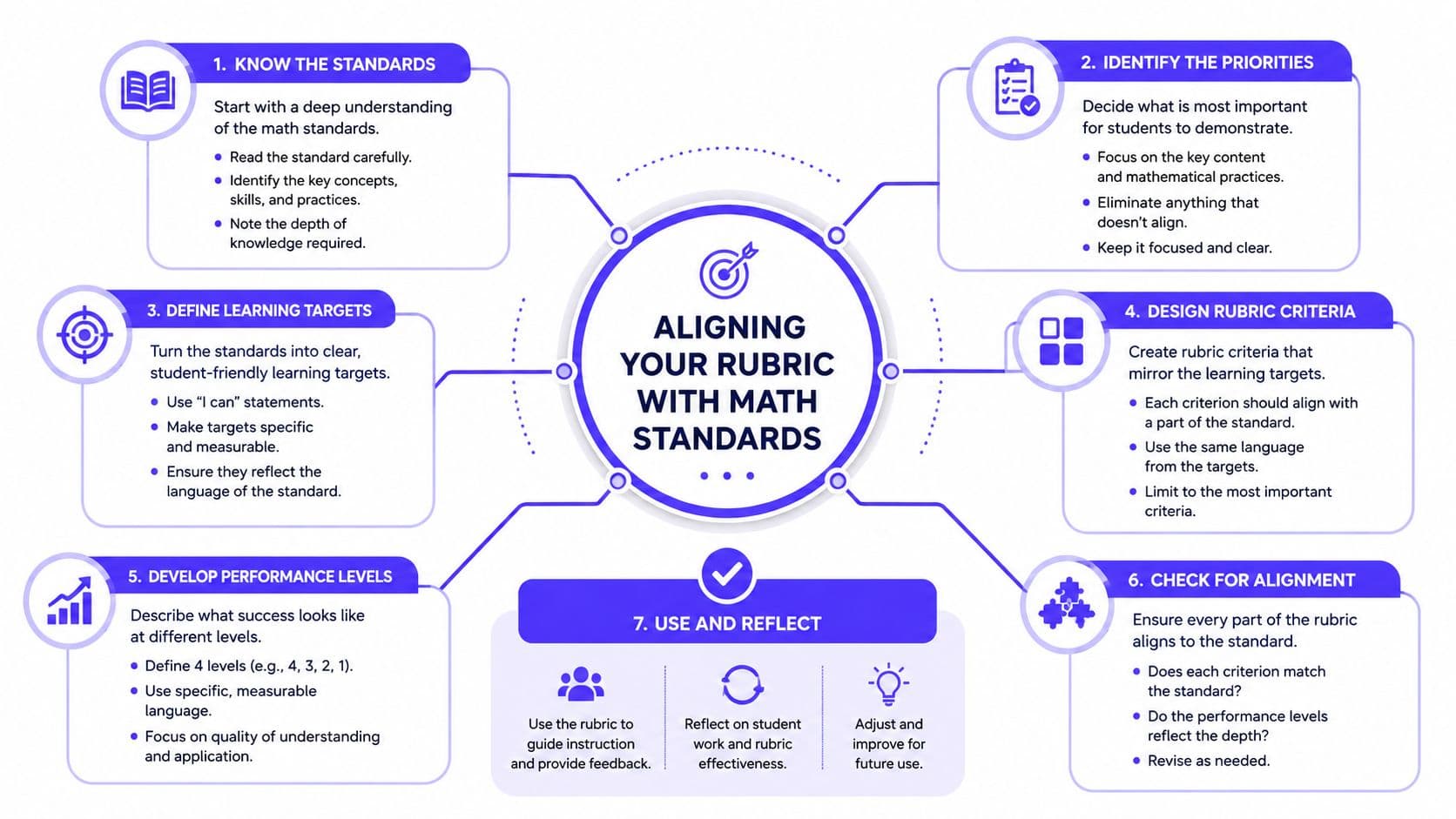
A standards-aligned rubric starts with the learning target. Define what students should understand, do, and show, then connect each criterion to a mathematical practice or process standard. This order prevents a familiar template from driving the assessment.
The Common Core State Standards for Mathematical Practice include making sense of problems, persevering, constructing arguments, critiquing reasoning, modeling, using tools strategically, attending to precision, looking for structure, and expressing regularity in repeated reasoning. NCTM Process Standards emphasize problem solving, reasoning and proof, communication, connections, and representation. The Exemplars standards-based rubric shows how these dimensions can fit within one assessment framework.
Grade-band calibration matters here. A primary rubric might look for a labeled model and an explanation in everyday language, while a middle-grade rubric may require symbolic representation, constraints, and evidence. The standard sets the demand, but descriptors must show what that demand looks like in student work. Test them with colleagues so two teachers would assign similar scores to the same sample.
A task comparing two linear models may assess representation, reasoning, precision, and communication. If the target is interpreting slope in context, a polished graph should not offset a misunderstanding of the relationship.
Use this alignment check:
- Name the target: Write the student-facing learning intention.
- Identify evidence: Decide what students must produce or explain.
- Match the practice: Link the evidence to a mathematical practice or process.
- Remove distractions: Do not score handwriting or vocabulary unless it is part of the target.
- Review descriptors: Ensure the highest level reflects the standard's cognitive demand.
Scoring only computational accuracy creates misalignment. Students may calculate correctly without explaining why a method works, interpreting a result, or recognizing an invalid model. Record procedural skill alongside conceptual understanding and application so scoring remains useful across classrooms.
Customizing Rubrics for Your Classroom Needs
Generic templates become useful only after you adapt them to your students, task, and instructional purpose. Start with the exact performance you want to see. Then revise the language until another teacher could apply it without needing your personal explanation.
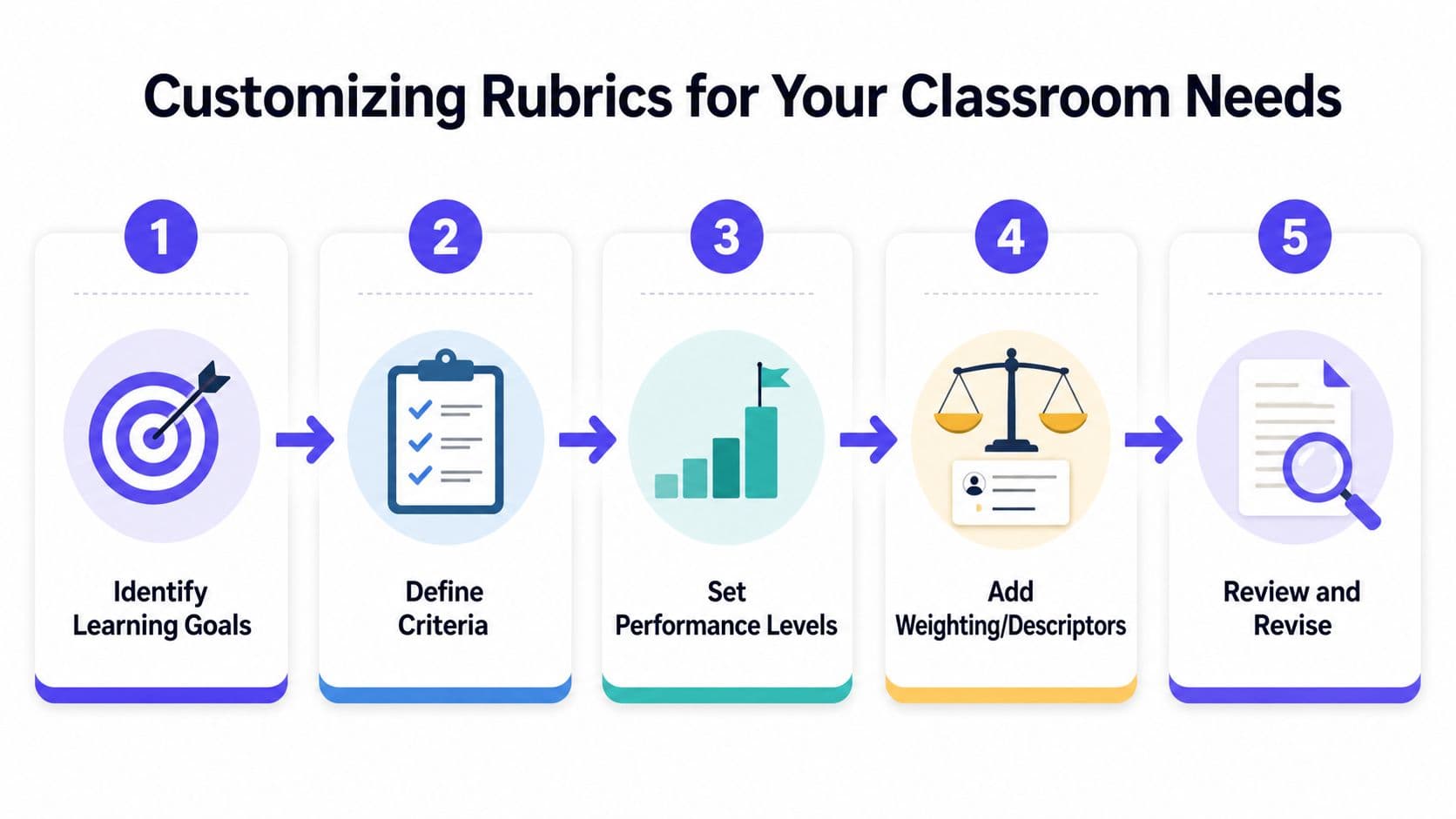
A practical customization sequence
First, preserve the target. Simplify sentence structure for younger readers or multilingual learners, but don't lower the mathematical expectation. “I can explain why my equation matches the story” is clearer than “demonstrates contextualized symbolic reasoning,” while the underlying demand remains intact.
Next, separate access from evidence. A student with an IEP may use a calculator, speech-to-text, manipulatives, or a scribe according to the support plan. Decide whether the accommodation changes the target being assessed. If it doesn't, score the same mathematical evidence.
Then, test the descriptors. Apply the draft to several anonymous samples. Mark the sentence that caused hesitation. That sentence needs a clearer example, a boundary, or a definition of partial credit.
Finally, ask a colleague to score the same samples independently. Discuss differences by criterion, not by student. This exposes vague wording before it affects a larger grading cycle.
Keep a short version for daily use and a fuller version for major tasks. Teachers exploring digital planning and classroom technology can also browse AI tools for education for ideas, then evaluate each tool against privacy, accessibility, and curriculum needs.
Achieving Scoring Consistency Across Graders
A rubric doesn't create consistency by itself. Teachers create consistency by agreeing on what the descriptors mean and testing those interpretations against actual student work.
Begin with a norming session. Each grader independently scores the same anchor papers, including a strong response, a middle response, and a response with substantial gaps. Compare criterion-level decisions and ask, “What evidence led you to this level?” Avoid debating whether a paper feels like a three. Point to the equation, diagram, explanation, or error.
Build a shared scoring protocol
Write concrete definitions for recurring issues:
- Minor computational error: The student selects and applies a mathematically appropriate strategy, but a calculation mistake changes the result.
- Conceptual misunderstanding: The student's model, operation, or transformation shows that the underlying relationship is not understood.
- Valid unconventional method: The method differs from instruction but is logically sound, complete, and connected to the problem.
For borderline work, use double scoring. Record the original decisions, compare them, and document the final rationale. Teams can calculate an inter-rater agreement percentage by dividing matching ratings by the total ratings and multiplying by one hundred. The formula matters less than examining disagreements closely, because disagreement often reveals a descriptor that needs revision.
A short meeting agenda might include:
- Revisit the target and criteria.
- Score an anchor response independently.
- Compare evidence and resolve terminology.
- Score an edge case.
- Record a rule for future papers.
Score without student names when possible. Fatigue and prior knowledge can influence judgment even when teachers are working carefully.
If scores begin drifting mid-cycle, pause rather than changing standards. Re-score an anchor, check whether a new error pattern has appeared, and note whether teachers are applying a criterion differently. The Exemplars standards-based rubric materials are useful context for this calibration challenge because many available models remain broad by grade band rather than providing a universal grade-specific reliability system.
Using AI Tools to Streamline Rubric Creation
AI can reduce the blank-page problem, but it cannot replace teacher judgment about mathematical expectations. Give the tool the information a colleague would need:
- grade level and course
- learning intention
- assessment type
- standards or mathematical practices
- required representations or explanations
- preferred performance levels
- accommodations or language considerations
Ask for criteria and descriptors, then inspect each line. Can students produce the evidence named in the Proficient descriptor? Does Advanced require deeper reasoning rather than longer writing? Does the rubric separate a computational slip from an invalid strategy? Grade-band calibration matters here. A descriptor suitable for early elementary work may be too broad for secondary algebra, so compare the draft with actual student samples from the intended grade.
Kuraplan can generate editable assessment rubrics with criteria, performance levels, and descriptors through its AI-supported planning tools. Teachers can use Kuraplan's AI tools to create a starting draft, connect planning with assessment, and revise it for a particular math task.
A teacher review workflow
- Draft: Enter the target, grade band, task, and standards.
- Inspect: Remove criteria unrelated to the learning goal.
- Calibrate: Apply the rubric to anonymous student samples and compare ratings with colleagues.
- Differentiate: Adjust reading load or allowed supports without changing the target.
- Publish: Share the student-friendly version before students begin.
AI wording can sound polished while remaining too vague to score consistently. Replace “demonstrates strong reasoning” with observable evidence, such as “explains why the two expressions are equivalent and supports the claim with a valid transformation.” Revise descriptors until different teachers can identify the same evidence and assign the same level.
Quick Reference Guide for Choosing the Right Rubric
Choose the rubric format by starting with the purpose of the assessment. Are you deciding what to reteach tomorrow, documenting mastery, or evaluating a sustained investigation? Then consider how much time graders have and how much feedback students need.
| Assessment Type | Recommended Format | Scoring Levels | Priority Criteria |
|---|---|---|---|
| Daily exit tickets | Holistic or single-point | A few broad levels or one target | Conceptual understanding and next step |
| Weekly problem sets | Analytic, kept compact | Several clear levels | Strategy, accuracy, and explanation |
| Unit performance tasks | Analytic | Multiple evidence-based levels | Modeling, reasoning, representation, communication |
| End-of-term portfolios | Analytic with student reflection | Levels plus narrative comments | Growth, transfer, precision, and justification |
For collaborative problem solving, separate group evidence from individual evidence. A group may produce a strong model while one student contributes reasoning that isn't visible in the final product. Open investigations also need a criterion for making and testing connections, but creativity shouldn't become a vague substitute for mathematical quality.
Use a simple decision path:
- If speed is the priority, start with overall scoring.
- If diagnosis is the priority, use analytic criteria.
- If students need revision guidance, use a single-point or compact analytic rubric.
- If several teachers will score, add anchors and shared rules.
- If the rubric won't be used consistently, remove unnecessary criteria.
A short rubric applied reliably is more useful than an impressive document that teachers avoid.
Common Rubric Mistakes and How to Avoid Them
A teacher can spend hours building a rubric that students can't use and colleagues can't score consistently. The usual problems are predictable: too many criteria, vague descriptors, and an emphasis on procedural accuracy that leaves reasoning invisible.
One teacher may write “good explanation” at every level. Another may interpret that phrase as several sentences, while a colleague looks for a labeled diagram. Replace the phrase with observable evidence. Also introduce the rubric before the task, use it during instruction, and invite students to examine sample work against the criteria.
Rubric design should evolve. Standards-based math rubrics have changed alongside expectations for mathematical practice, including an updated example from 2014 and a classic three-criteria version used from 1993 to 2001. The ERIC overview of math rubrics shows why teachers should revisit descriptors rather than treating a template as permanent.
Start with one task. Score it with a colleague, record the disagreements, revise two or three unclear descriptors, and ask students whether the language helps them understand quality. That small cycle builds a rubric for math that supports instruction instead of adding paperwork.
Kuraplan helps teachers create standards-aligned lesson plans, worksheets, educational visuals, and editable assessment rubrics, including resources for math skills and grade-level tasks. Visit Kuraplan to turn a learning target into a usable rubric and plan the lesson around the evidence students need to show.