You're probably staring at a blank planning document, a stack of standards, and a class roster that includes students at very different stages of English development. You want the unit to be rigorous. You also want it to be teachable on a real Tuesday when the copier jams and half the class needs more modeling than you expected.
That's where a solid SIOP unit plan template helps. Not because it makes planning magically easy, but because it gives you a structure that keeps content, language, scaffolds, and assessment connected. When teachers struggle with SIOP, it usually isn't because the framework is flawed. It's because the template looks bigger on paper than it feels in a live classroom.
The Ultimate SIOP Unit Plan Template for Your Classroom
The hardest part of building your first SIOP unit is often getting started. A daily lesson plan already asks you to think about objectives, materials, pacing, and assessment. A SIOP unit plan template adds another layer. Now you're planning across several days, with language development woven into every lesson instead of tacked on at the end.
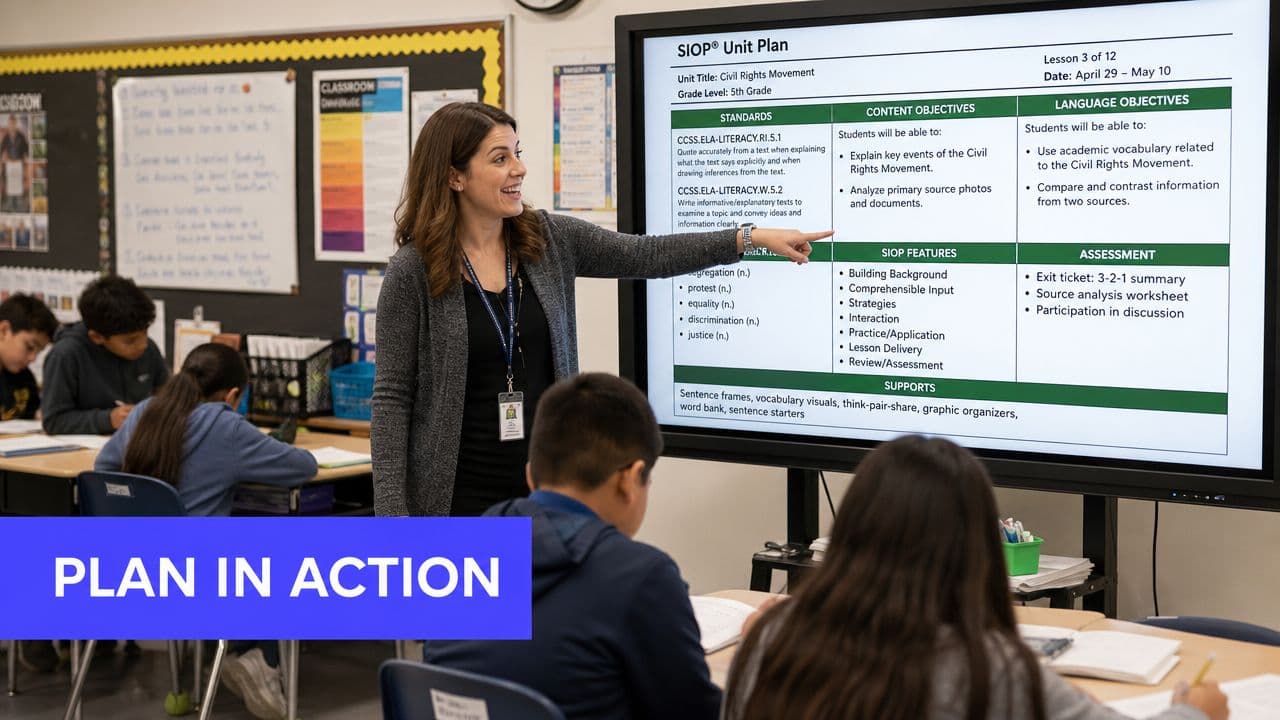
If you want a simple place to start, use a template that includes these fields: unit standards, content objectives, language objectives, key vocabulary, scaffolds by proficiency level, lesson sequence, interaction tasks, and daily review or assessment. If your current planning form doesn't make room for those pieces, it will fight you the whole way.
The reason SIOP has lasted is that it was built on more than preference. The SIOP model was empirically validated in the mid-1990s by researchers Echevarría, Vogt, and Short. Their work showed that students in SIOP classrooms scored, on average, 10–20 percentage points higher on standardized reading and language assessments than their peers in non-SIOP classrooms, as summarized in this overview of the SIOP lesson plan model.
What your template needs to hold
A useful unit template should help you track more than topics.
- Standards alignment: Daily lessons should connect clearly to broader unit goals.
- Two kinds of objectives: Content and language both need to be visible.
- Scaffolds across days: Supports should build, not appear randomly.
- Checks for understanding: Each lesson needs a way to tell you what students understood.
Some teachers like a printable Word document. Others prefer planning digitally so they can move pieces around more quickly. If you're building units online, a unit plan generation tool for connected lesson sequences can help with the first draft, especially when you need standards and lesson flow in one place.
Practical rule: If your unit plan only tells you what students will learn, but not how they'll use language to show it, it isn't finished.
A simple starting structure
Before you fill in every lesson, sketch the unit with four anchors:
- What students must know by the end
- What language they'll need to discuss, read, write, or explain it
- What support each proficiency band will need
- How you'll know each day whether they're ready to move on
That's the difference between a binder-friendly plan and a classroom-ready one.
Deconstructing the SIOP Template Component by Component
A blank SIOP form can feel like too many boxes. It helps to think of the eight components as planning moves rather than compliance categories. Each one answers a practical classroom question.
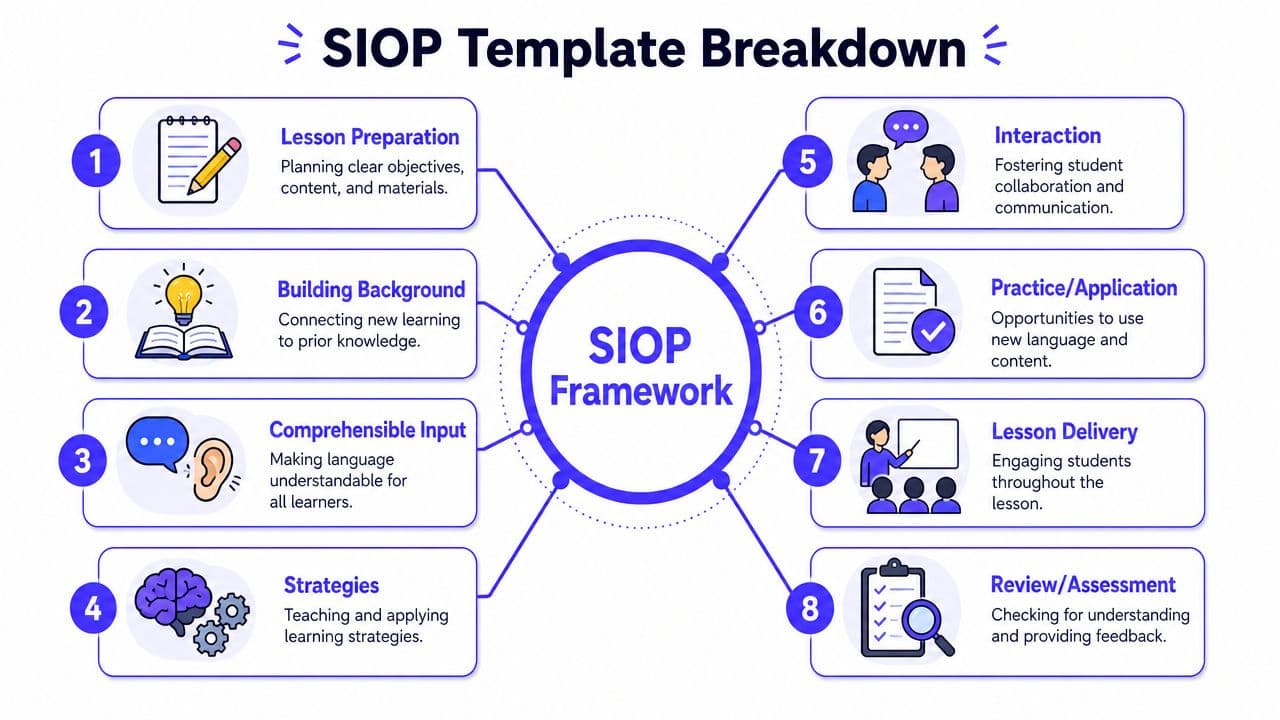
One key point matters here. Research on SIOP implementation shows that units systematically embedding all eight components across at least 80% of instructional days yield 17–23% higher achievement gains for English Learners on content assessments, based on this summary of the SIOP approach. So the eight parts aren't decorative. They work best when they show up consistently.
Lesson Preparation
The ultimate success or failure of the unit largely depends on this section. In the template, write the content objective, language objective, standards, materials, and key vocabulary.
Don't write broad goals that sound nice but can't guide instruction. “Students will understand ecosystems” is too loose. A stronger content objective tells you what students will do with that understanding. A stronger language objective tells you what kind of speaking, writing, reading, or listening task will make the learning visible.
A quick test helps. If you can't imagine what student work would look like from the objective alone, revise it.
Building Background
Students need a bridge into the unit. This section is where you note prior knowledge, cultural connections, and vocabulary links.
That doesn't mean adding a random warm-up. It means identifying what students already know that can support new learning. In a history unit, they may already understand fairness, conflict, or leadership even if they don't yet know the academic language of revolution, taxation, or resistance.
- Prior experiences: What real-life knowledge can students connect to the topic?
- Academic links: What earlier lesson, text, or concept can you reactivate?
- Vocabulary prep: Which words must be introduced before students can access the lesson?
Comprehensible Input
This part asks a blunt question. How will students understand you, the text, and the task?
You're planning for visuals, modeling, chunked directions, sentence stems, gestures, examples, and teacher language that is clear without being watered down. Many new SIOP plans often become vague in these aspects. “Use visuals” isn't enough. Name the visual. Diagram, anchor chart, labeled image, timeline, map, or slide sequence.
Students don't need easier ideas. They need clearer access to the ideas.
Strategies
This section is about what students will do mentally to process the learning. Think summarizing, predicting, comparing, annotating, asking clarifying questions, or using graphic organizers.
The strongest plans don't just assign a strategy. They teach it. If students are comparing two texts, show them how to use the comparison frame first. If they're summarizing, model what counts as a summary and what doesn't.
Interaction
SIOP expects students to use language with other people, not just listen passively. In your template, note who talks to whom, when, and with what support.
A common mistake is writing “turn and talk” and moving on. Better planning spells out the interaction structure.
| Interaction move | What to write in the template |
|---|---|
| Partner talk | Prompt, timing, sentence stem, grouping choice |
| Small-group task | Role for each student, language support, expected product |
| Whole-class share | How students rehearse before speaking publicly |
Practice and Application
Students use the content and language together. If the unit includes new vocabulary, students should use it in speaking and writing. If the lesson includes a concept, students should apply it in a task that goes beyond copying notes.
Hands-on work helps here, but “hands-on” doesn't always mean science materials. It can be sorting claims and evidence, labeling a diagram, sequencing events, completing a cause-and-effect chart, or rehearsing an explanation with a partner before writing.
Lesson Delivery
This is the reality check section. Did the lesson stay aligned to the objectives? Were students engaged in the actual work of the lesson? Was pacing reasonable?
You don't need a perfect script. You do need a sequence that is realistic. If one lesson includes direct instruction, partner practice, vocabulary review, a close read, independent writing, and a gallery walk, it probably needs trimming.
Review and Assessment
Teachers often rush through this final component. Don't. It's the stage for planning how students revisit key ideas and for checking both content understanding and language use.
Use the template to record what gets reviewed and how. Vocabulary review should be intentional. So should the assessment method. Exit ticket, quick oral retell, short write, labeled diagram, checklist during discussion. Match the check to the objective.
A Filled-In SIOP Unit Plan Example in Action
A completed example makes the template feel much less abstract. Here's a simple model for a 5th grade science unit on the water cycle. It's not the only way to build it, but it shows how the pieces fit together across several lessons.
The unit at a glance
Unit topic: The Water Cycle
Content objective: Students will be able to describe the stages of the water cycle and explain how water moves through the environment.
Language objective: Students will use sequencing words such as first, next, then, and finally to explain the process orally and in writing.
Key vocabulary: evaporation, condensation, precipitation, collection, vapor, droplets
The opening lesson builds background by connecting to what students already know about rain, clouds, puddles drying, and steam. Instead of starting with definitions, the teacher uses photos, a short demonstration with warm water and a lid, and a word bank with visuals. That lowers the language barrier without lowering the science.
What the sequence looks like
Lesson 1 focuses on vocabulary and observation. Students sort images, label a basic diagram, and rehearse oral explanations with sentence frames.
Lesson 2 moves into process. Students sequence the stages and explain changes using a partner routine. Emerging learners use a diagram with pre-labeled stages and sentence starters. More advanced students explain the cycle in complete sentences with transition words.
Lesson 3 asks students to apply the concept to weather examples. They read a short passage, highlight evidence of each stage, and complete a cause-and-effect organizer.
Lesson 4 ends with a written and oral explanation. Students use the vocabulary and sequencing language to explain the full cycle.
Here's a useful walkthrough of SIOP instruction in practice:
What makes this unit actually SIOP
The difference isn't just the presence of vocabulary. It's the alignment.
- Content and language stay paired: Students don't merely learn the stages. They explain them using academic language.
- Scaffolds change by proficiency: One student may use picture support and a sentence frame. Another may write a fuller explanation from notes.
- Interaction is planned: Students rehearse explanations before independent writing.
- Assessment is ongoing: The teacher checks diagrams, listens to oral practice, and reviews written explanations.
A filled-in template should let another teacher see the flow of the unit without needing you in the room to narrate it.
A sample daily entry
A single lesson in that unit might include these pieces:
- Content objective: Describe evaporation and condensation.
- Language objective: Use “first” and “next” to explain two stages.
- Building background: Connect steam from cooking to water vapor.
- Comprehensible input: Diagram, gestures, teacher think-aloud, labeled visuals.
- Interaction: Partner retell using sentence frames.
- Practice: Students sequence images and explain the order.
- Assessment: Exit slip with one labeled diagram and one sentence explanation.
That's the kind of clarity you want from your SIOP unit plan template.
Aligning Standards and Differentiating Instruction Seamlessly
Standards alignment and differentiation are where many unit plans get messy. Teachers often do one well and rush the other. In a SIOP unit, they have to work together.
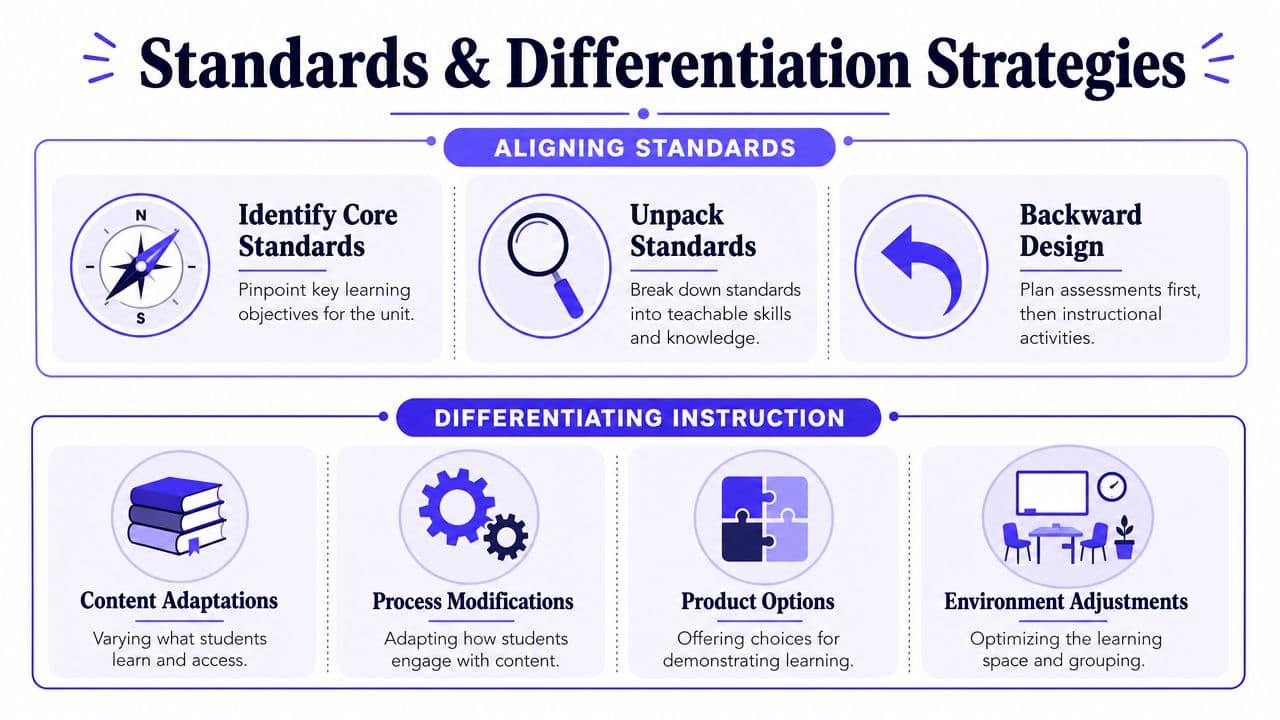
A strong SIOP unit plan template starts with the standards and then breaks them into teachable daily targets. The content standard tells you what students need to learn. The language demand tells you how they'll need to process and communicate that learning.
Start with the standard, not the activity
Teachers sometimes fall in love with an activity first. That's understandable. We all have favorite labs, discussions, and graphic organizers. But if the standard isn't clear, the lesson sequence gets fuzzy fast.
Try this order instead:
- Identify the unit standard
- Unpack the knowledge and skill inside it
- Write daily content objectives
- Add language objectives that match the task
That last move matters. If students need to compare, justify, summarize, or explain, your language objective should reflect that function.
Differentiate without watering things down
The planning template should show what changes for different learners and what stays the same. The essential concept should stay the same. Access points should change.
A SIOP unit plan must articulate how the teacher will scaffold techniques for each proficiency band across lessons. Effective plans specify distinct modeling, guided practice, and independent practice for at least five proficiency levels, from Newcomer/Entering to Bridging, as shown in MSU Denver's SIOP lesson plan templates.
A quick planning table helps:
| Proficiency band | What may change | What should stay rigorous |
|---|---|---|
| Newcomer or Entering | Visuals, gestures, first-language support, shorter output | Core concept |
| Emerging or Developing | Sentence frames, guided discussion, modeled writing | Grade-level thinking |
| Expanding or Bridging | More independent reading, fuller responses, less linguistic support | Same essential understanding |
Coach's note: If the only differentiation move in your unit is “simplify the text,” you probably haven't differentiated enough.
Useful differentiation usually shows up in three places. Materials, interaction, and product. A student may read a supported version of a text, discuss it with sentence frames, and show understanding through an annotated diagram before moving into fuller writing.
Weaving in Meaningful Assessment and Feedback
Assessment in a SIOP unit shouldn't wait until the end. If you only discover misunderstandings on the final task, you've waited too long. A good SIOP unit plan template builds in checks that tell you what students understand now, not what you hope they understood yesterday.
One important finding is worth keeping in mind here. Studies show that SIOP units with at least one formative assessment per lesson and explicitly adapted materials for three proficiency levels see roughly 25-30% higher rates of on-time standard mastery for English Learners, according to this SIOP lesson plan template resource. That's why the assessment box in the template can't be an afterthought.
What to plan into each lesson
You don't need a formal quiz every day. You do need evidence.
Some of the most useful checks are quick:
- Exit slips: One sentence, one label, one comparison, or one response to a prompt
- Oral rehearsal checks: Listen during partner talk with a short checklist
- Visual demonstrations: Students sequence cards, sort vocabulary, or label a diagram
- Quick writes: A short explanation using the target language structure
What matters is alignment. If the language objective asks students to explain cause and effect, then a thumbs-up signal won't tell you enough.
A simple dual-focus rubric
SIOP planning gets stronger when you assess both content and language. You don't need a giant rubric. A short one works.
| Criterion | Look for |
|---|---|
| Content understanding | Accurate explanation of the concept or process |
| Vocabulary use | Correct use of target academic terms |
| Language function | Evidence of comparing, explaining, sequencing, or arguing |
| Clarity | Response is understandable with appropriate support level |
This kind of rubric keeps you from praising a polished sentence that contains weak science, or strong content knowledge that never gets expressed clearly enough to assess.
Feedback that changes tomorrow's lesson
The most valuable feedback is usable right away. If students can identify the stages of the water cycle but can't explain them in sequence, tomorrow's lesson needs more oral rehearsal and sentence support. If they can speak the explanation but not write it, the gap may be in transfer from talk to written language.
A practical routine helps:
- Collect one small piece of evidence daily
- Sort student responses by what support they still need
- Adjust grouping, modeling, or practice for the next lesson
If you want a clearer breakdown of the role each assessment type plays, this guide to formative vs summative assessment in lesson planning is worth reading.
The best SIOP assessment question is often small enough to fit on a sticky note and sharp enough to change your next move.
Bringing Your SIOP Unit Plan to Life in the Classroom
A polished template doesn't teach the unit. You do. That's why implementation matters as much as planning.
One thing I've seen repeatedly is this. Teachers write thoughtful SIOP units, then try to deliver every part exactly as written even when the room is telling them otherwise. That usually leads to rushed pacing, shallow discussion, or skipped review. The plan should guide you, not trap you.
Keep the daily lesson tied to the unit
An effective SIOP unit plan template requires teachers to connect daily lesson objectives to broader unit standards and include a review section for each lesson that checks both content and language outcomes, as shown in this SIOP unit lesson plan template in Word. That kind of vertical alignment helps students feel the continuity from day to day.
If a lesson goes sideways, return to the day's content objective and language objective. Those two lines tell you what's essential. A game, worksheet, or extension can be cut. The objective can't.
Expect to adjust in real time
Some trade-offs are just part of teaching.
- Pacing versus depth: If students need more oral practice, shorten the independent task.
- Coverage versus clarity: It's better to teach fewer ideas well than push through a confusing lesson sequence.
- Structure versus responsiveness: Keep the routine predictable, but shift support when students need it.
A SIOP classroom works best when students know they're expected to talk, listen, read, and write every day, but also know they'll be supported in doing it.
Build routines that lower the language risk
Students are more willing to take academic risks when the routine feels familiar. Partner protocols, sentence frames, visual word banks, modeled examples, and predictable review formats all reduce the stress of participation.
That doesn't make the work easier. It makes the work accessible.
If you're refining your day-to-day planning habits alongside your unit planning, this guide on how to write a lesson plan can help tighten the daily flow inside a larger unit.
Your first SIOP unit probably won't be elegant. That's normal. What matters is that the plan gives English learners real access to grade-level learning, and gives you a clear way to teach with purpose instead of improvising every support on the fly.
Kuraplan helps teachers turn a rough idea into a standards-aligned unit without spending the whole evening formatting documents. If you want support building lesson sequences, differentiation, worksheets, visuals, and assessment pieces in one place, Kuraplan is worth exploring.