
Mastering Complex Sentences
English • Year 9 • 60 • 12 students • Created with AI following Aligned with National Curriculum for England
Free PDF · we'll email you a copy
Teaching Instructions
use the following information to create the lesson plan - Adding Information Using Complex Sentences
- Sentence Structures
When we talk about sentence structure, we refer to the various elements that make up a sentence and how these elements are organised in a text to create an effect.
The three basic types of sentences are:
Simple sentences Compound sentences Complex sentences. A skillful writer will use a variety of sentence types to create specific effects in their writing. Achieving this will take practice but a good grasp of each sentence type and how it works will imbue your writing with style and flair.2. Simple and Complex Sentences In English grammar, sentences can be classified into different types based on their structure and the number of independent and dependent clauses they contain. Two common types of sentences are simple sentences and complex sentences. A simple sentence is a type of sentence that consists of a single independent clause. It contains a subject and a verb and expresses a complete thought. In addition to the subject and verb, a simple sentence may also include phrases, which are groups of words that function together but do not contain both a subject and a verb.A complex sentence is a type of sentence that contains both an independent clause and at least one dependent clause. The independent clause can stand alone as a sentence, while the dependent clause relies on the independent clause for meaning. Similar to simple sentences, complex sentences can also incorporate phrases to add descriptive or modifying elements.What is a phrase?
A phrase is a group of words that works together in a sentence but does not contain a subject or a verb. They play a significant role in both simple and complex sentences by enhancing the meaning, adding description, or providing context.Clauses
A clause is a group of words that includes a subject and a verb. We use clauses to form sentences or parts of sentences. There are a number of different types of clauses including main clauses, subordinate clauses, coordinate clauses and adjective (or relative) clauses.
Learning about clauses is crucial for improving your writing.
Clauses are the building blocks of sentences. Understanding how clauses work and how to use them effectively allows you to construct well-structured, grammatically correct, and coherent sentences. What is a clause? A clause is a fundamental component of written English. In simple terms, it is a group of words that contains a subject and a verb. Clauses are the building blocks of sentences. They come in different types, such as main clauses, coordinate clauses, and subordinate clauses. To better understand what a clause is, let's consider an example: The fast, red squirrel darted up a tree. In this sentence, the squirrel is the subject of the clause, and "darted" is the verb. This particular clause can also be referred to as a simple sentence. What is an independent clause?
An independent clause, also known as a main clause, functions on its own to make a meaningful sentence and looks much like a regular sentence.
In a sentence two independent clauses can be connected by the coordinators: and, but, so, or, nor, for*, yet*.
Examples
She is a wise woman.
I like chocolate.
Can you do it?
Do it please. (Subject you is hidden)
I read the whole story.
I want to buy a laptop, but I don’t have enough money. (Two independent clauses)
He went to Paris and visited the Eiffel Tower. (Subject of the second clause is ‘he,' so “he visited the Eiffel Tower” is an independent clause.)
Tana smiles whenever she sees her. (One independent clause)
What is a dependent clause? It cannot function on its own because it leaves an idea or thought unfinished. It is also called a subordinate clause. These help the independent clauses complete the sentence. Alone, it cannot form a complete sentence.
The subordinators do the work of connecting the dependent clause to another clause to complete the sentence. In each of the dependent clauses, the first word is a subordinator. Subordinators include relative pronouns, subordinating conjunctions, and noun clause markers.
Examples:
When I was dating Khan, I had an accident.
I know the man who stole the luxury car.
He bought a house which was too expensive.
I know that they cannot do it.
He does not know where he was born.
If you don’t play, I won’t go.
He is a very talented player though he is out of form.
Examples of marker words: because, after, before, since, to, although, though, whenever, wherever, whether, while, even though, even if, etc.Dependent Clauses are divided into three types:
(i) Coordinate clauses
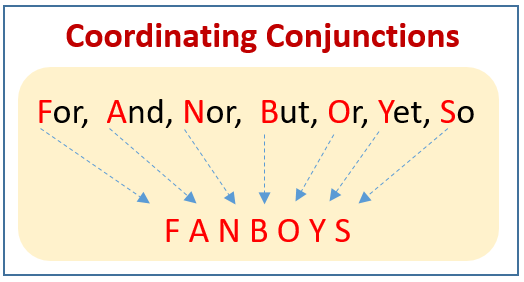
Two or more similarly important Independent Clauses joined by Coordinating Conjunctions (and, or, but etc.) in terms of Compound Sentences are called Coordinate Clauses.
https://www.onlinemathlearning.com/image-files/fanboys.png
Examples:
I like taking photos and she loves posing for them.
You prefer Oreos but she always wants shortbread.
We are going to visit Sam or he is coming over.
(ii) Adjectival clauses
It is a Dependent Clause that modifies a Noun. Basically, Adjective Clauses have similar qualities as Adjectives that are of modifying Nouns and hence the name, Adjective Clause. These are also called Relative Clauses and they usually sit right after the Nouns they modify.
A good tip for remembering how to spot an adjective clause is to watch out for certain words. The only words that can be used to introduce an adjective clause are relative pronouns (who, whose, whom, which or that) and subordinating conjunctions (when and where).
Examples of adjective clauses include:
The girl who has short hair is laughing.
The book which has the dragon on the cover is my favourite.
The stray cat that I pet sometimes is friendly.
Those people whose names are on the list will go to camp.
https://7esl.com/adjective-clause/
(iii) Adverbial clauses
By definition, these are Dependent Clauses acting as Adverbs. It means that these clauses have the power to modify Verbs, Adjectives and other Adverbs.
https://7esl.com/?s=adverbial+clause
Examples of adverb clauses include:
She walked slowly.
She walked like an old lady.
She walked as if she were heading to the gallows.
Noun clauses
Dependent Clauses acting as Nouns in sentences are called Noun Clauses or Nominal Clauses. These often start with “how,” “that,” and other WH-words (What, Who, Where, When, Why, Which, Whose and Whom), if, whether etc.
Examples:
I like what I hear.
You need to express that it’s crossing a line for you.
He knows how things work around here.
Overview
This 60-minute lesson is designed for Year 9 students (ages 13-14) to deeply understand and apply complex sentence structures, particularly focusing on adding information using dependent clauses according to the National Curriculum for England – Key Stage 3 English (Years 7-9). The session emphasises sentence construction, clause types, and integrating subordinate clauses meaningfully to enhance writing skills.
National Curriculum Links
- Spoken language: Articulate and justify answers, arguments and opinions (Years 7-9).
- Writing – Composition: Use a wide range of clause structures, sometimes varying their position within the sentence (Year 9 writing programme of study).
- Grammar and Vocabulary: Use knowledge of grammar and vocabulary to adapt speech and writing for a range of contexts and purposes, including using complex sentences (Year 9).
- Reading: Develop understanding of vocabulary through morphology and etymology (Year 9).
Learning Objectives
By the end of this lesson, students will:
- Identify and distinguish between simple, compound, and complex sentences with accuracy.
- Analyse how independent and dependent clauses function in complex sentence construction.
- Construct complex sentences using a variety of dependent clauses (adjective, adverbial, and noun clauses).
- Use subordinators and relative pronouns confidently to add detailed information and complexity to their writing.
- Assess and improve sentence variety in their own written work.
Resources
- Whiteboard or interactive whiteboard
- Printed worksheet with sentence and clause activities (dyslexia-friendly font, sans-serif, 14pt minimum)
- Colour-coded cards for sentence types and clause functions
- Example excerpts from age-appropriate novels and texts (dyslexia-friendly: highlighted key phrases, audio recording optional)
- Lined paper or digital document for writing practice
Lesson Breakdown
1. Starter – Sentence Type Sorting (10 mins)
Objective: Activate prior knowledge of sentence structures.
- Distribute colour-coded cards with sentences (simple, compound, and complex) to pairs.
- Task: Sort the sentences into the correct categories on a chart displayed using the whiteboard.
- Discuss answers with the class, highlighting why each sentence fits the category.
- Include some sentences with embedded dependent clauses to foreshadow complex sentences.
- Differentiation: Provide scaffolding cards for students who need extra support, with definitions and example clauses.
2. Teaching Input – Clause Exploration (15 mins)
Objective: Deepen understanding of independent vs dependent clauses and types of dependent clauses.
- Explain key terminology orally and in writing with examples, writing on the board:
- Independent clause: can stand alone
- Dependent (subordinate) clauses: cannot stand alone, types: adjectival (relative), adverbial, noun clauses
- Use clear colour-coding and symbols to visually differentiate clauses within sentences.
- Share examples with varied subordinators and relative pronouns: because, although, who, which, that, if, when, where, etc.
- Dyslexia-friendly tip: Present examples in spaced, large fonts with bullet points to reduce visual clutter.
- Interactive Q&A: Students identify clause types from sentences read aloud, using hand signals (e.g., fist for independent clause, open palm for dependent clause).
3. Guided Practice – Sentence Construction Task (15 mins)
Objective: Apply learning by constructing complex sentences using dependent clauses.
- Give students worksheet with simple sentences and a bank of subordinators/relative pronouns.
- Task: Transform simple sentences into complex sentences by adding appropriate dependent clauses.
- Examples to scaffold:
- Simple: The girl laughed.
- Complex: The girl, who has short hair, laughed loudly.
- Monitor and support students needing help.
- Extension: Challenge advanced learners to vary clause position (front- or end-placed clauses) and combine multiple dependent clauses for flair.
4. Independent Application – Creative Writing (15 mins)
Objective: Consolidate skills through creative descriptive writing.
- Prompt: Write a short descriptive paragraph (5-7 sentences) about a memorable event or character, incorporating at least three complex sentences with different types of dependent clauses.
- Encourage use of varied subordinators and relative pronouns from earlier activities.
- Dyslexia-friendly support: Provide sentence starters and visual thesaurus suggestions (printed or digital) for assistive vocabulary.
- Peer review: Students exchange paragraphs and highlight complex sentences in each other's work. Offer positive and constructive feedback using a checklist focusing on clause use and sentence variety.
5. Plenary – Reflect and Share (5 mins)
- Invite volunteers to share one complex sentence they wrote that they are proud of; explain the clause structure.
- Recap key learning points on clause types and their roles in sentence complexity.
- Quick quiz: Teacher says a subordinating word, students give a quick example sentence aloud or written on mini-whiteboards.
Assessment & Feedback
- Ongoing formative assessment through pair and group dialogue, teacher observation during tasks.
- Peer feedback during writing section using explicit criteria.
- Collect written paragraphs for marking against success criteria aligned with the National Curriculum expectations for KS3 writing complexity (variety of sentences and grammatical accuracy).
- Provide targeted verbal or written feedback highlighting the use of dependent clauses and sentence variety.
Differentiation Strategies
- For students with SEND or EAL: Use clear, dyslexia-friendly fonts in worksheets; break down tasks into smaller, manageable chunks; provide bilingual glossaries or visual supports.
- For dyslexic learners: Offer audio recordings of examples, written tasks comfortably spaced, use coloured overlays if preferred.
- For advanced learners: Encourage use of more complex subordinators (e.g., “even though,” “whereas”), embedding multiple dependent clauses, challenging syntactical variety.
Extension Activities
- Create a "Sentence Workshop" challenge where students transform dull or repetitive writing from a provided text by adding layered dependent clauses and stylistic features.
- Explore how sentence variety affects reader engagement and tone by comparing rewritten extracts.
- Analyse complex sentence use in prose or poetry extracts; create presentations on how sentence structures influence meaning or mood.
Additional Notes for Teachers
- Prior knowledge check early helps identify learners who need extra support or challenge.
- Encourage students to read out their complex sentences, supporting their spoken language development alongside writing.
- Create a classroom display of subordinators and clause examples for ongoing reference.
- Use formative assessment evidence to inform future lessons on punctuation for complex sentences (e.g., commas with relative clauses).
This highly structured yet engaging lesson plan will equip Year 9 pupils with confident use of complex sentences, enriching their written and spoken English while fully aligning with the National Curriculum performance descriptors for Key Stage 3.
Create Your Own AI Lesson Plan
Join thousands of teachers using Kuraplan AI to create personalized lesson plans that align with Aligned with National Curriculum for England in minutes, not hours.
Created with Kuraplan AI
Generated using gpt-4.1-mini-2025-04-14
🌟 Trusted by 1000+ Schools
Join educators across United Kingdom