Coastal Deposition Landforms
A free geography worksheet ready for your classroom. Open in Kuraplan to grab the print-ready PDF, customize it for your students, or generate a fresh version in seconds.
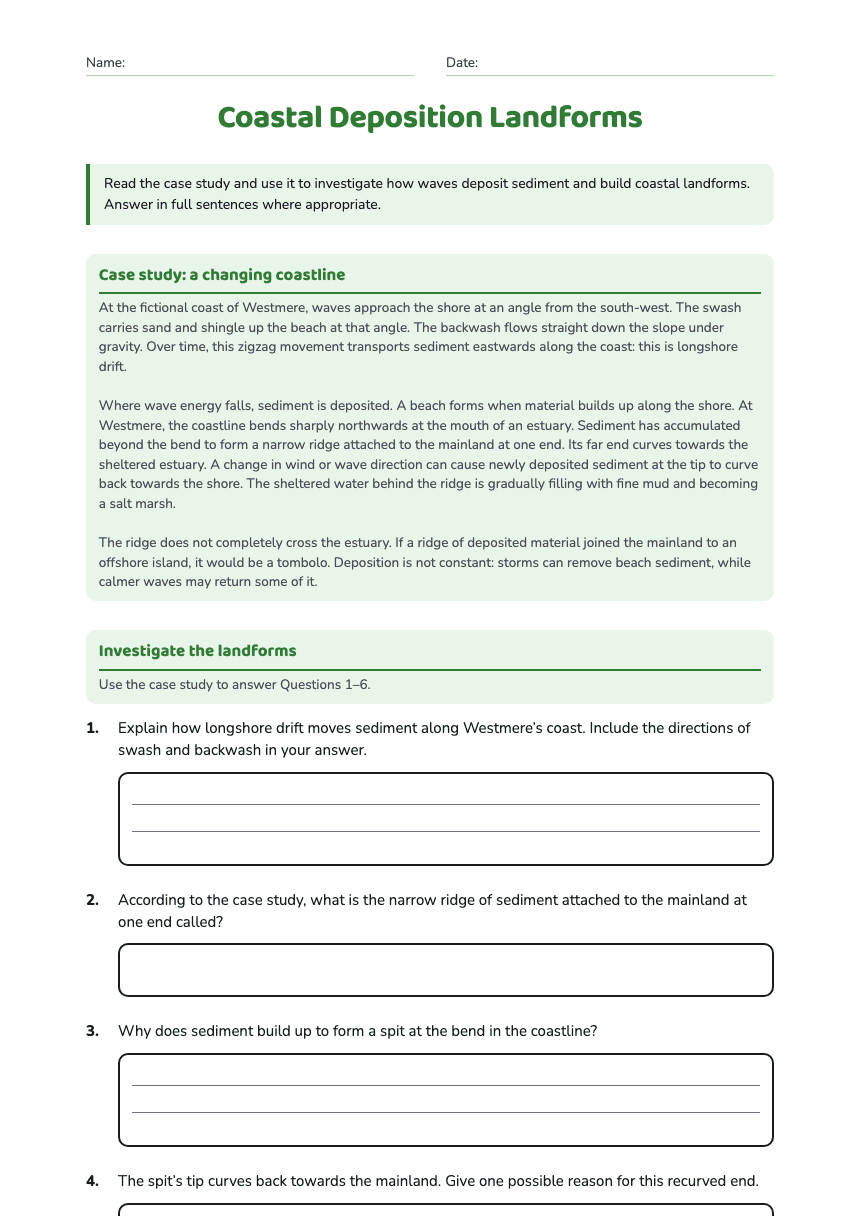
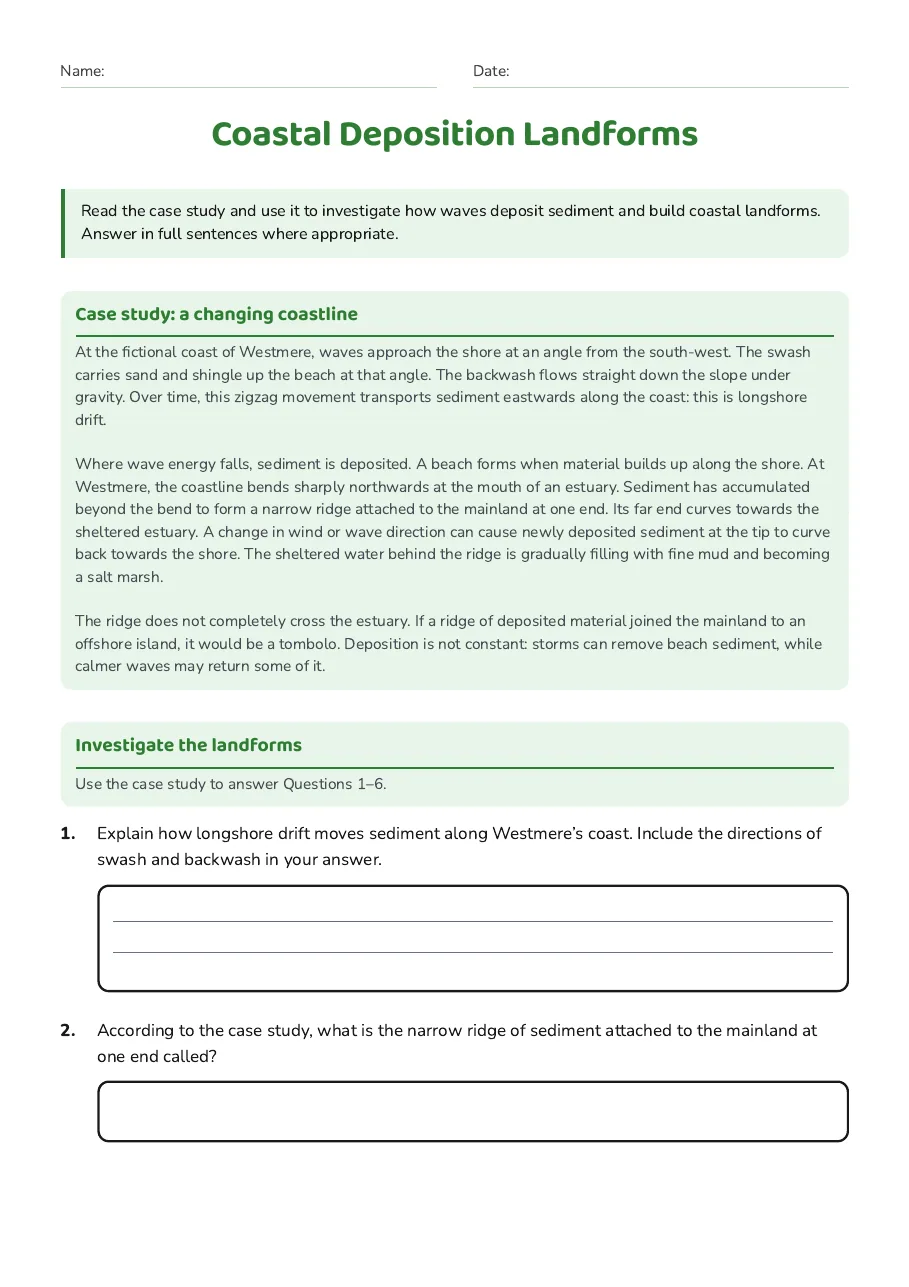
Coastal Deposition Landforms
Case study: a changing coastline
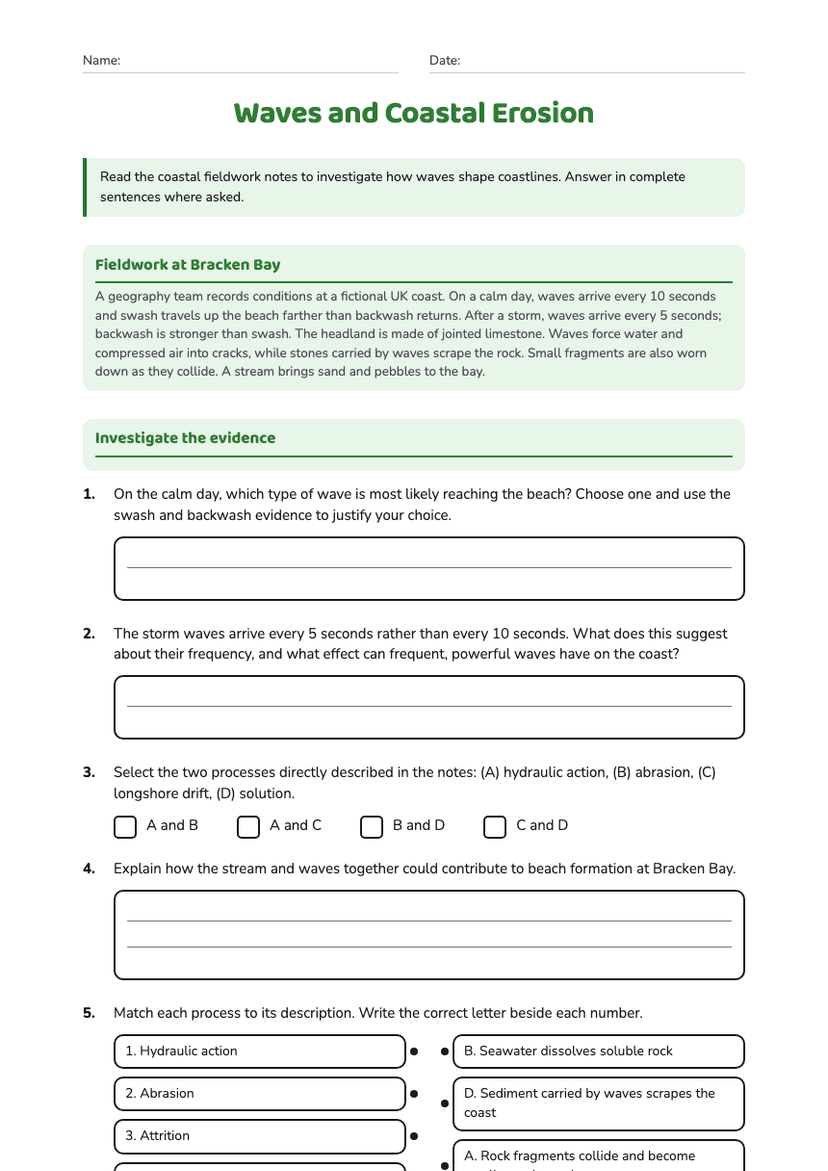
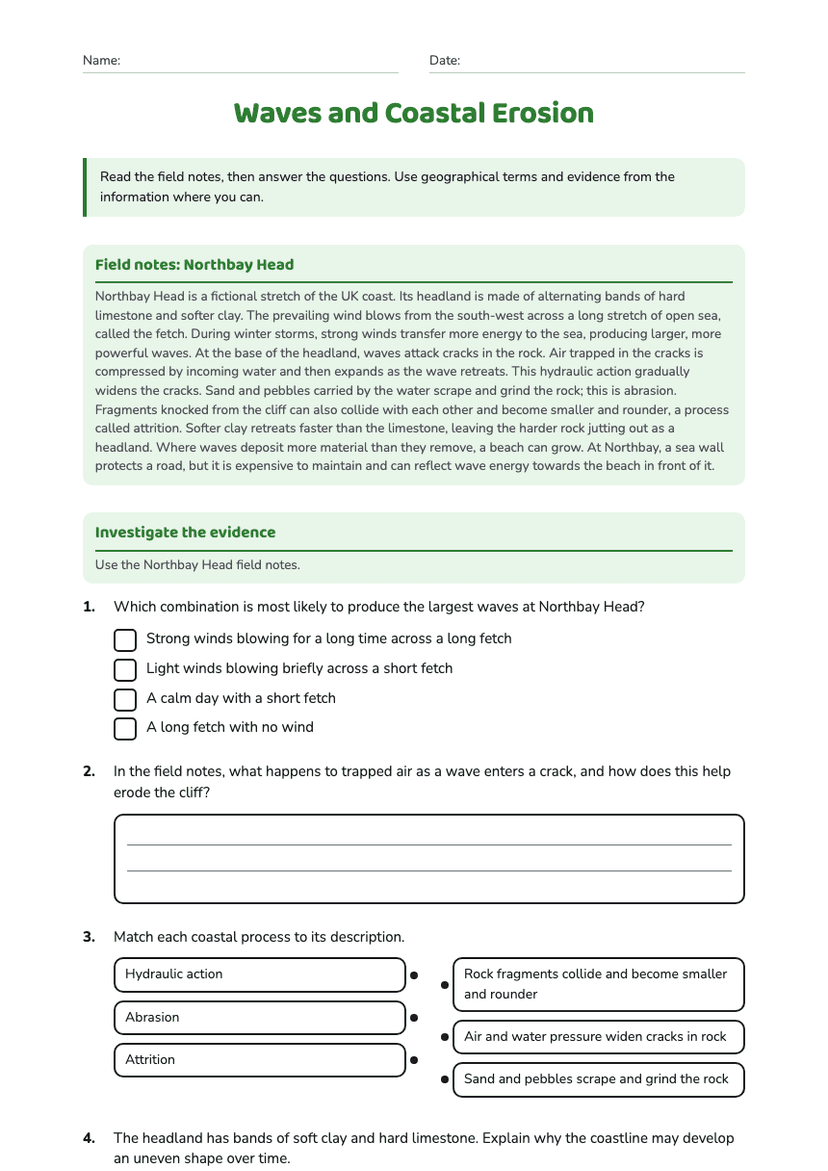
At the fictional coast of Westmere, waves approach the shore at an angle from the south-west. The swash carries sand and shingle up the beach at that angle. The backwash flows straight down the slope under gravity. Over time, this zigzag movement transports sediment eastwards along the coast: this is longshore drift. Where wave energy falls, sediment is deposited. A beach forms when material builds up along the shore. At Westmere, the coastline bends sharply northwards at the mouth of an estuary. Sediment has accumulated beyond the bend to form a narrow ridge attached to the mainland at one end. Its far end curves towards the sheltered estuary. A change in wind or wave direction can cause newly deposited sediment at the tip to curve back towards the shore. The sheltered water behind the ridge is gradually filling with fine mud and becoming a salt marsh. The ridge does not completely cross the estuary. If a ridge of deposited material joined the mainland to an offshore island, it would be a tombolo. Deposition is not constant: storms can remove beach sediment, while calmer waves may return some of it.
Investigate the landforms
Use the case study to answer Questions 1–6.
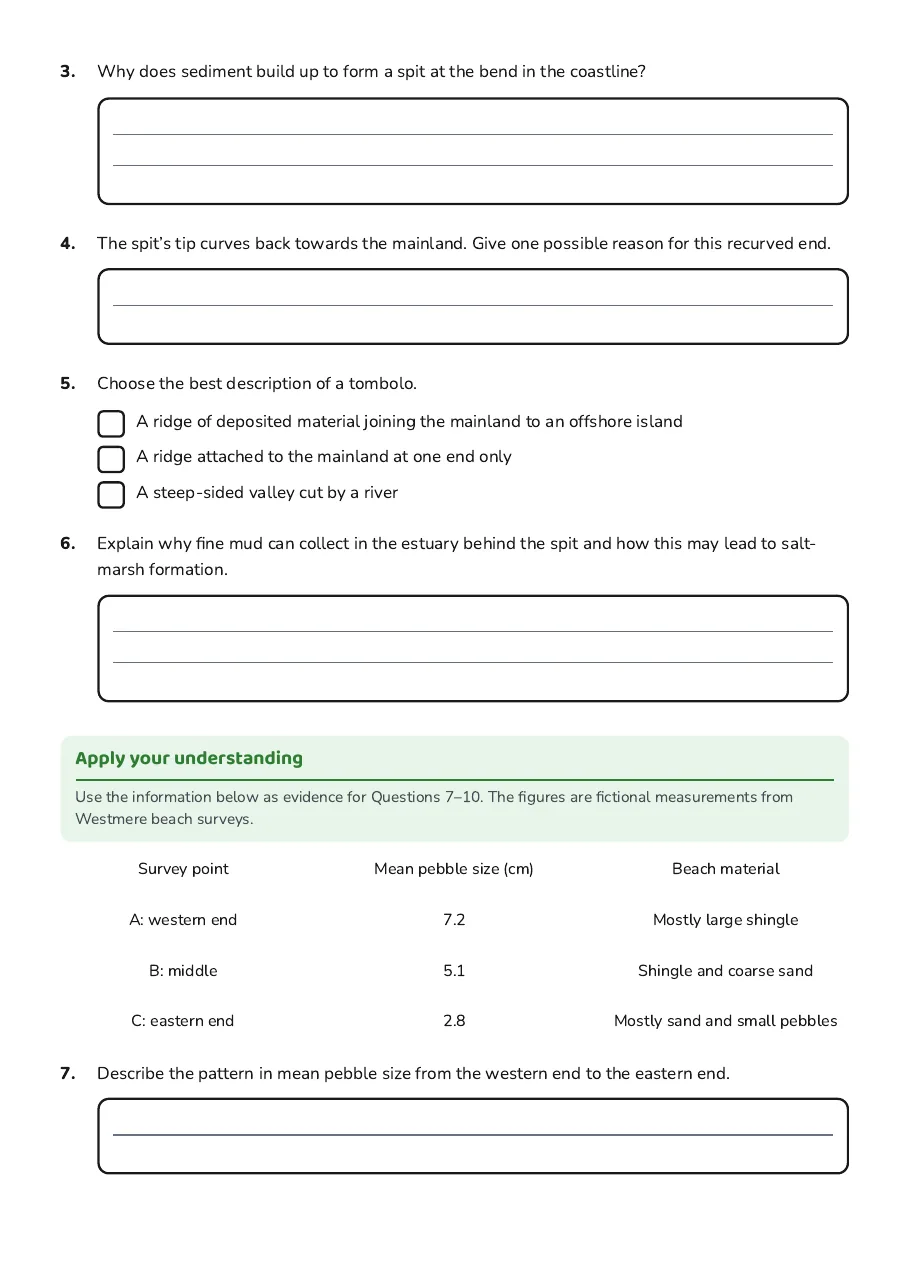
- A ridge of deposited material joining the mainland to an offshore island
- A ridge attached to the mainland at one end only
- A steep-sided valley cut by a river
Apply your understanding
Use the information below as evidence for Questions 7–10. The figures are fictional measurements from Westmere beach surveys.
Survey point
Mean pebble size (cm)
Beach material
A: western end
7.2
Mostly large shingle
B: middle
5.1
Shingle and coarse sand
C: eastern end
2.8
Mostly sand and small pebbles
3 printable pages
Page 1
Page 2
Page 3
About This Worksheet
Free in Kuraplan
Sign up free, grab the PDF, and customize it for your class.
Print-Ready
Formatted for standard paper. Clean layout, easy to read.
AI-Generated
Created with Kuraplan's AI, designed for real classroom use.
For Teachers & Parents
Use in classrooms, for homework, tutoring, or homeschool.
Need a custom version of this worksheet?
Kuraplan's AI generates custom worksheets in seconds — differentiated for every learner, aligned to your curriculum.
Generate Custom Worksheets — Free