GeographyFreePrintable

Coastal Deposits Worksheet

A free geography worksheet ready for your classroom. Open in Kuraplan to grab the print-ready PDF, customize it for your students, or generate a fresh version in seconds.
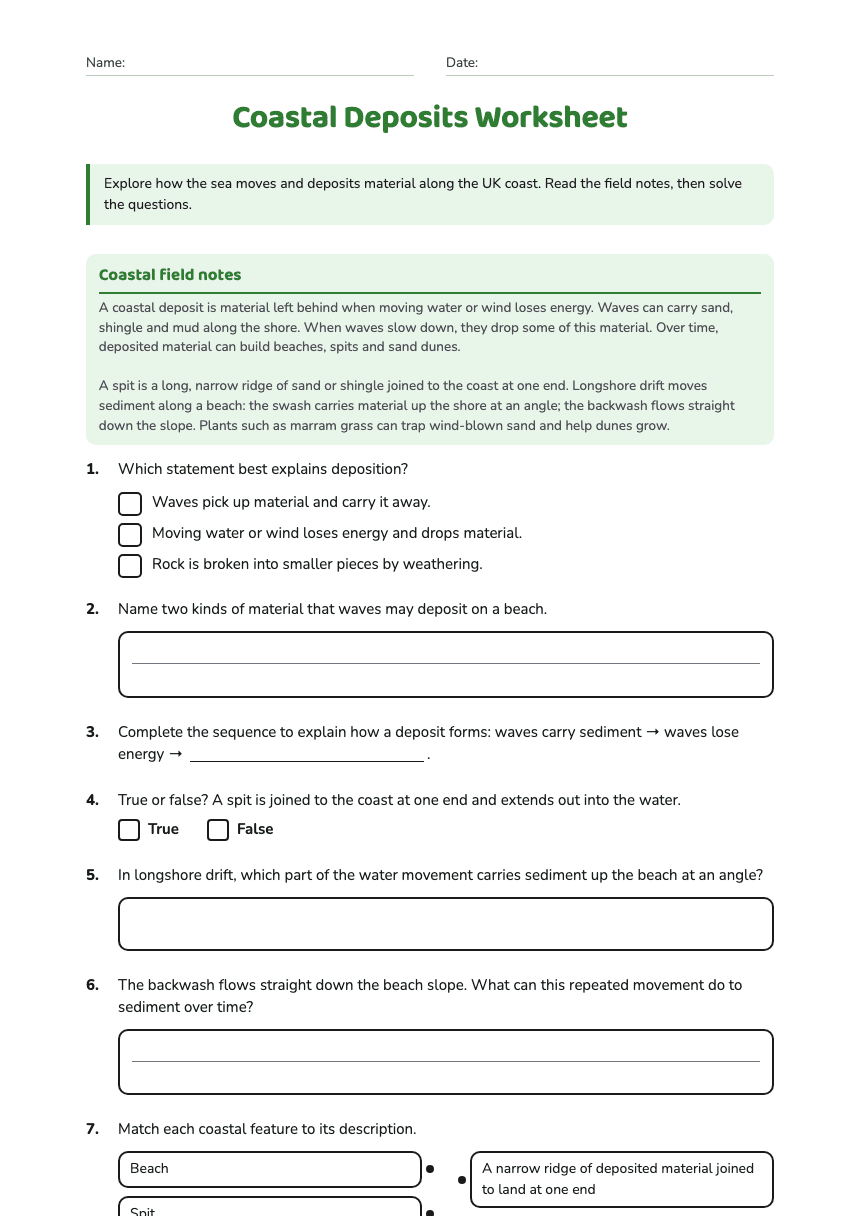
Coastal Deposits Worksheet worksheet preview
Name:Date:

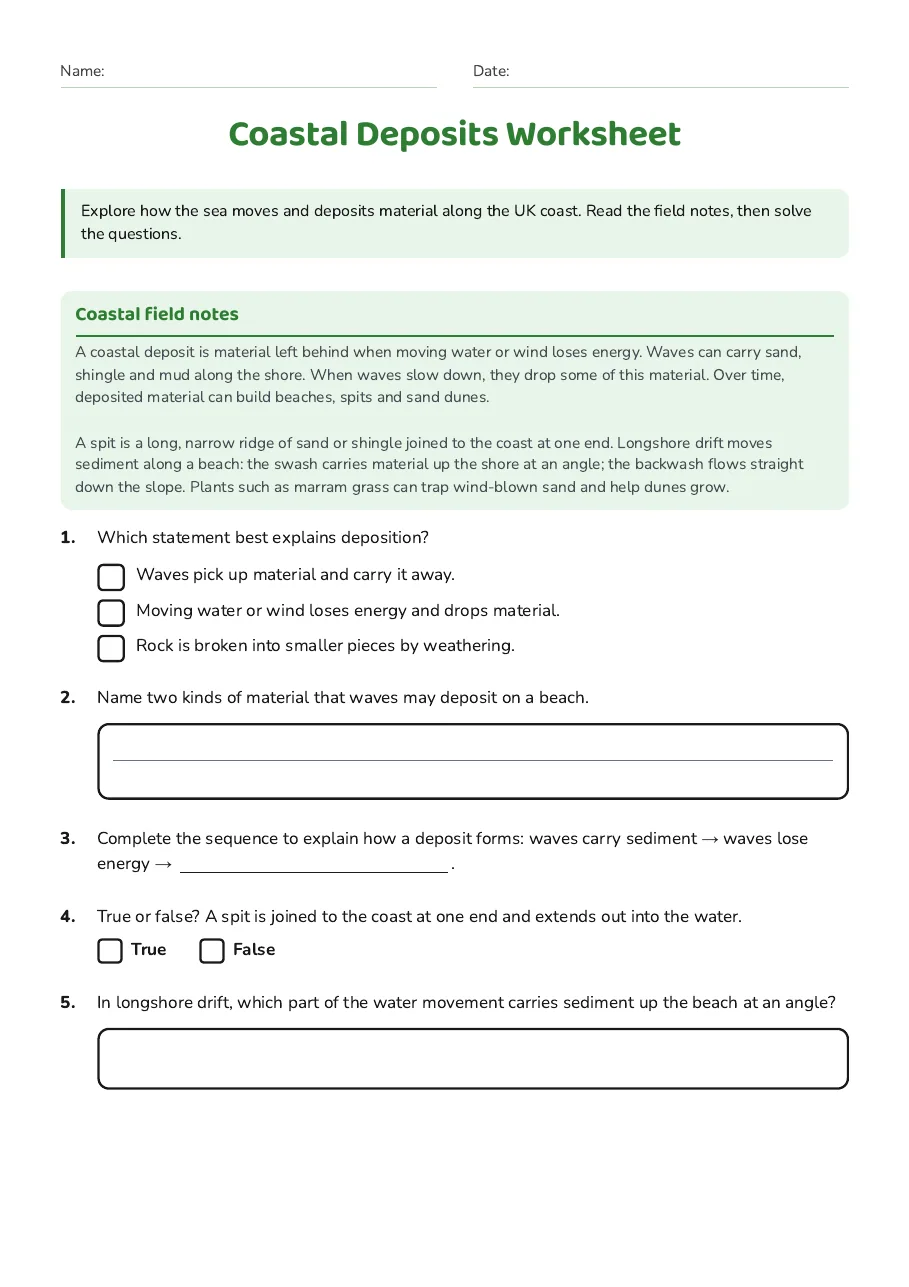
Coastal Deposits Worksheet

Explore how the sea moves and deposits material along the UK coast. Read the field notes, then solve the questions.

Coastal field notes

A coastal deposit is material left behind when moving water or wind loses energy. Waves can carry sand, shingle and mud along the shore. When waves slow down, they drop some of this material. Over time, deposited material can build beaches, spits and sand dunes. A spit is a long, narrow ridge of sand or shingle joined to the coast at one end. Longshore drift moves sediment along a beach: the swash carries material up the shore at an angle; the backwash flows straight down the slope. Plants such as marram grass can trap wind-blown sand and help dunes grow.

1.Which statement best explains deposition?
  • Waves pick up material and carry it away.
  • Moving water or wind loses energy and drops material.
  • Rock is broken into smaller pieces by weathering.
2.Name two kinds of material that waves may deposit on a beach.
3.Complete the sequence to explain how a deposit forms: waves carry sediment → waves lose energy → .
4.True or false? A spit is joined to the coast at one end and extends out into the water.
TrueFalse
5.In longshore drift, which part of the water movement carries sediment up the beach at an angle?
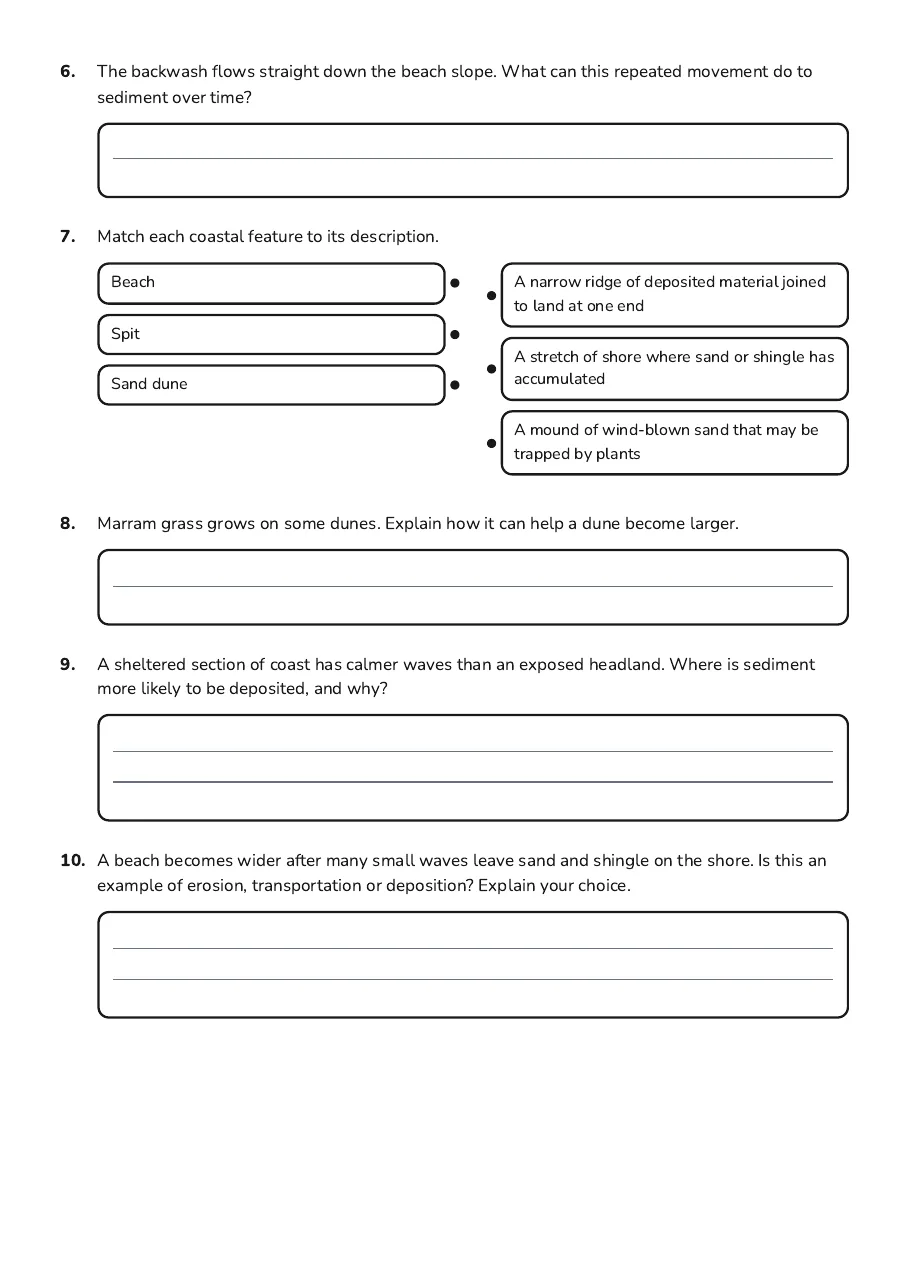
6.The backwash flows straight down the beach slope. What can this repeated movement do to sediment over time?
7.Match each coastal feature to its description.
  • Beach
  • Spit
  • Sand dune
  • A narrow ridge of deposited material joined to land at one end
  • A stretch of shore where sand or shingle has accumulated
  • A mound of wind-blown sand that may be trapped by plants
8.Marram grass grows on some dunes. Explain how it can help a dune become larger.
9.A sheltered section of coast has calmer waves than an exposed headland. Where is sediment more likely to be deposited, and why?
10.A beach becomes wider after many small waves leave sand and shingle on the shore. Is this an example of erosion, transportation or deposition? Explain your choice.
11.Create a labelled field sketch of a depositional coastline. Include a beach, a spit joined to land at one end, and an arrow showing the direction sediment is moving. Add one sentence explaining how the spit could grow.

3 printable pages

  • Coastal Deposits Worksheet, page 1 of 3: Coastal field notes

    Page 1

  • Coastal Deposits Worksheet, page 2 of 3: 6. The backwash flows straight down the beach slope. What can this repeated movement do to

    Page 2

  • Coastal Deposits Worksheet, page 3 of 3: 11. Create a labelled field sketch of a depositional coastline. Include a beach, a spit…

    Page 3

About This Worksheet

Free in Kuraplan

Sign up free, grab the PDF, and customize it for your class.

Print-Ready

Formatted for standard paper. Clean layout, easy to read.

AI-Generated

Created with Kuraplan's AI, designed for real classroom use.

For Teachers & Parents

Use in classrooms, for homework, tutoring, or homeschool.

Need a custom version of this worksheet?

Kuraplan's AI generates custom worksheets in seconds — differentiated for every learner, aligned to your curriculum.

Generate Custom Worksheets — Free
No credit card Curriculum-aligned Under 60 seconds