Constructive Plate Margins
A free geography worksheet ready for your classroom. Open in Kuraplan to grab the print-ready PDF, customize it for your students, or generate a fresh version in seconds.
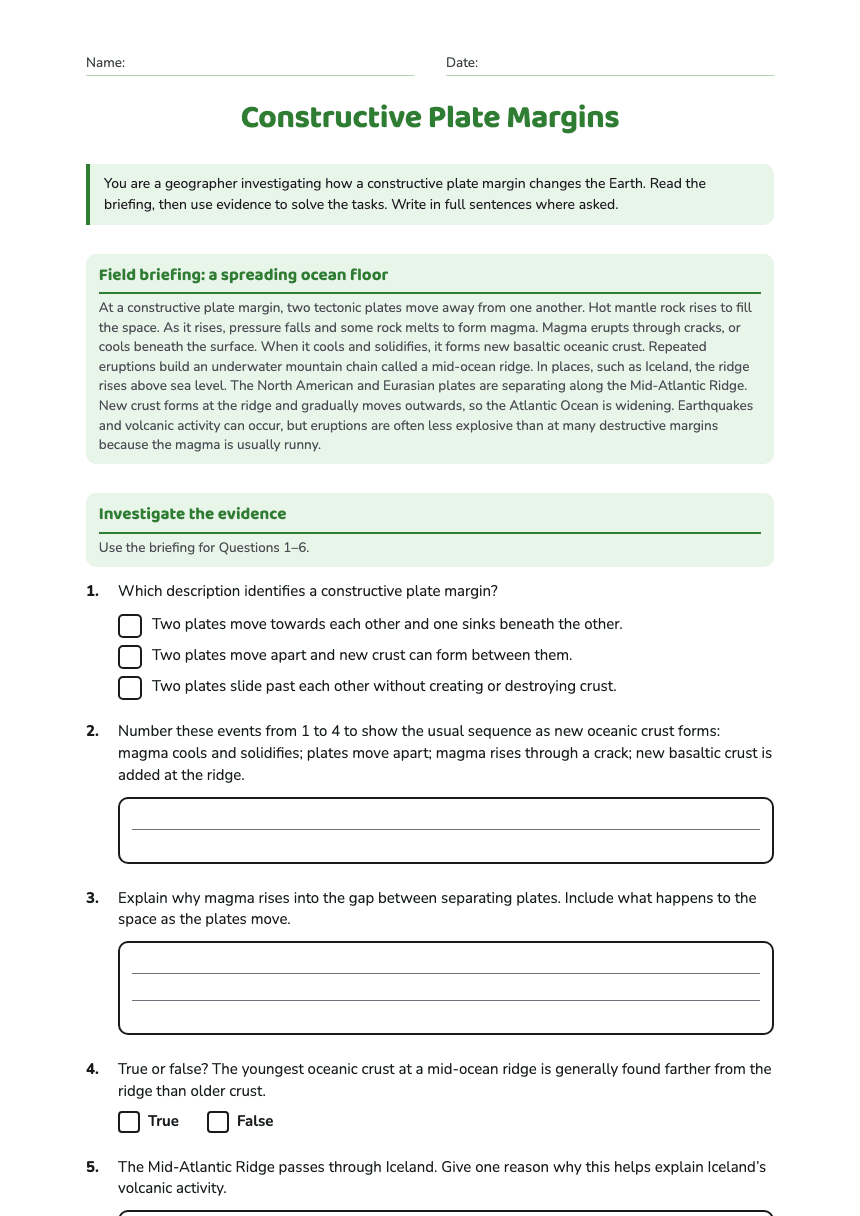
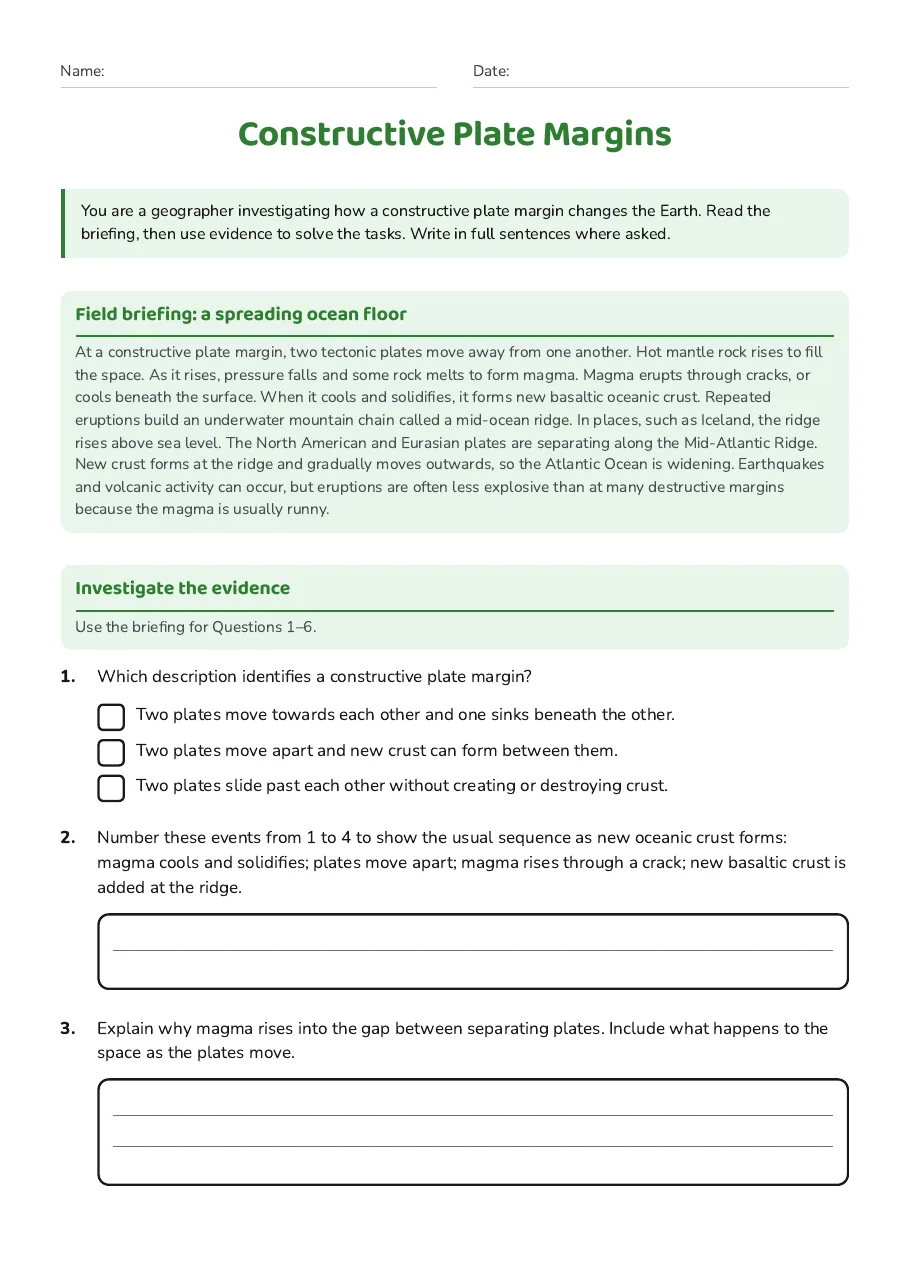
Constructive Plate Margins
Field briefing: a spreading ocean floor
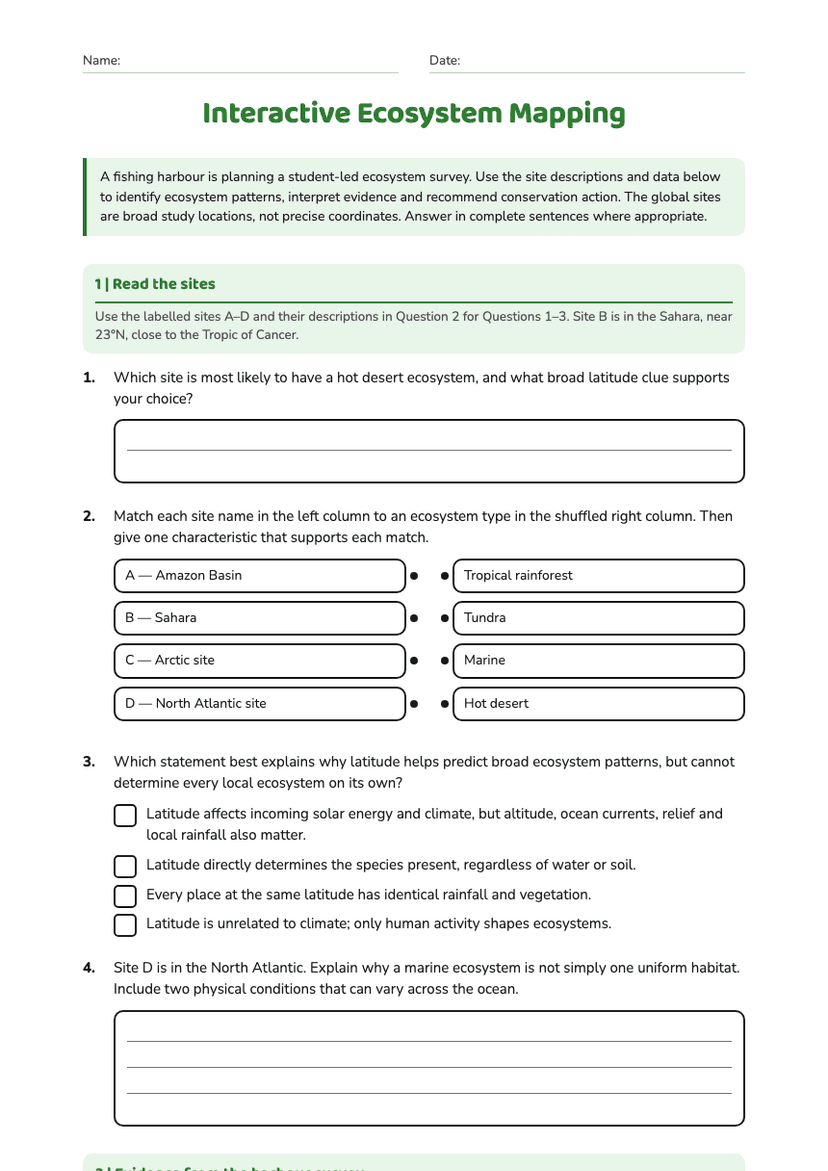
At a constructive plate margin, two tectonic plates move away from one another. Hot mantle rock rises to fill the space. As it rises, pressure falls and some rock melts to form magma. Magma erupts through cracks, or cools beneath the surface. When it cools and solidifies, it forms new basaltic oceanic crust. Repeated eruptions build an underwater mountain chain called a mid-ocean ridge. In places, such as Iceland, the ridge rises above sea level. The North American and Eurasian plates are separating along the Mid-Atlantic Ridge. New crust forms at the ridge and gradually moves outwards, so the Atlantic Ocean is widening. Earthquakes and volcanic activity can occur, but eruptions are often less explosive than at many destructive margins because the magma is usually runny.
Investigate the evidence
Use the briefing for Questions 1–6.
- Two plates move towards each other and one sinks beneath the other.
- Two plates move apart and new crust can form between them.
- Two plates slide past each other without creating or destroying crust.
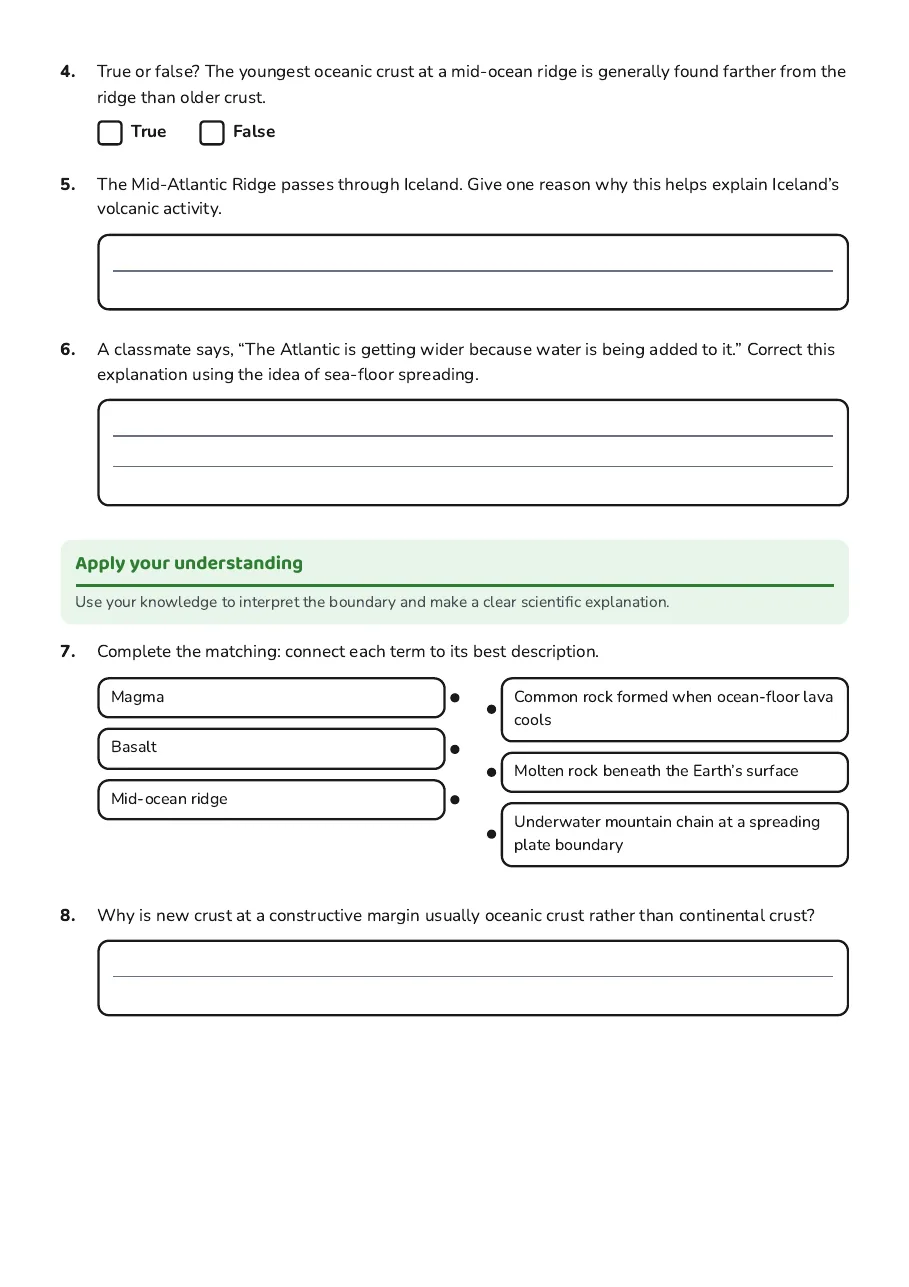
Apply your understanding
Use your knowledge to interpret the boundary and make a clear scientific explanation.
- Magma
- Basalt
- Mid-ocean ridge
- Common rock formed when ocean-floor lava cools
- Molten rock beneath the Earth’s surface
- Underwater mountain chain at a spreading plate boundary
3 printable pages
Page 1
Page 2
Page 3
About This Worksheet
Free in Kuraplan
Sign up free, grab the PDF, and customize it for your class.
Print-Ready
Formatted for standard paper. Clean layout, easy to read.
AI-Generated
Created with Kuraplan's AI, designed for real classroom use.
For Teachers & Parents
Use in classrooms, for homework, tutoring, or homeschool.
Need a custom version of this worksheet?
Kuraplan's AI generates custom worksheets in seconds — differentiated for every learner, aligned to your curriculum.
Generate Custom Worksheets — Free