Democracy and Nazism Worksheet
A free history worksheet ready for your classroom. Open in Kuraplan to grab the print-ready PDF, customize it for your students, or generate a fresh version in seconds.
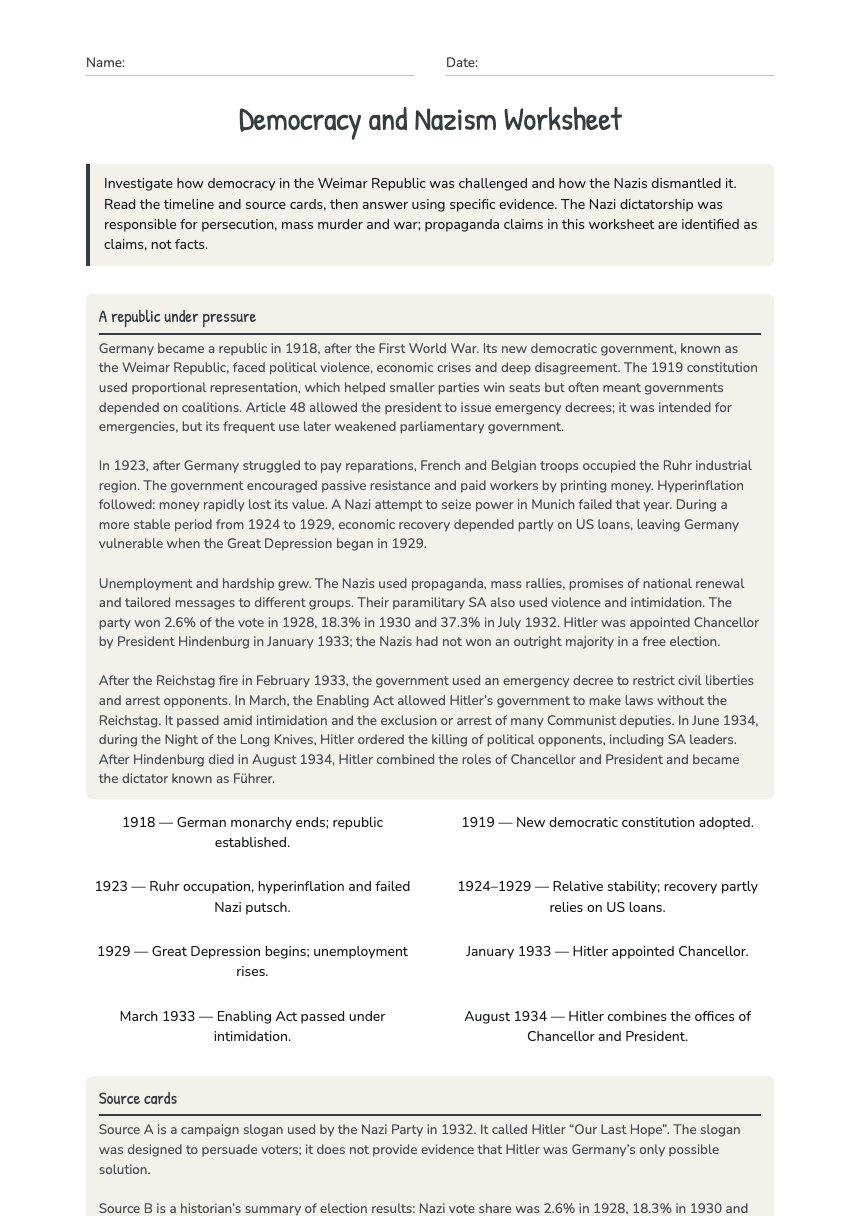
Democracy and Nazism Worksheet
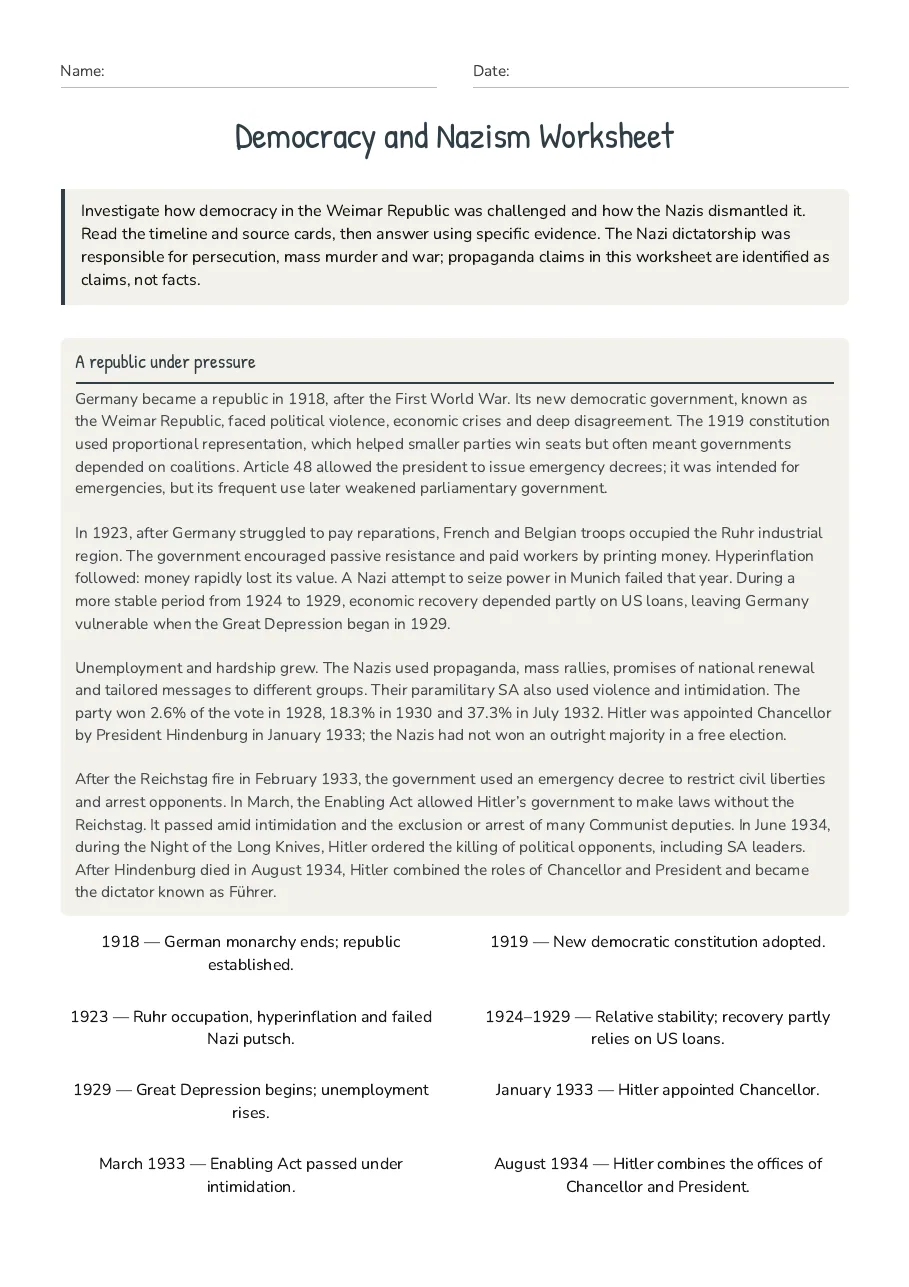
A republic under pressure
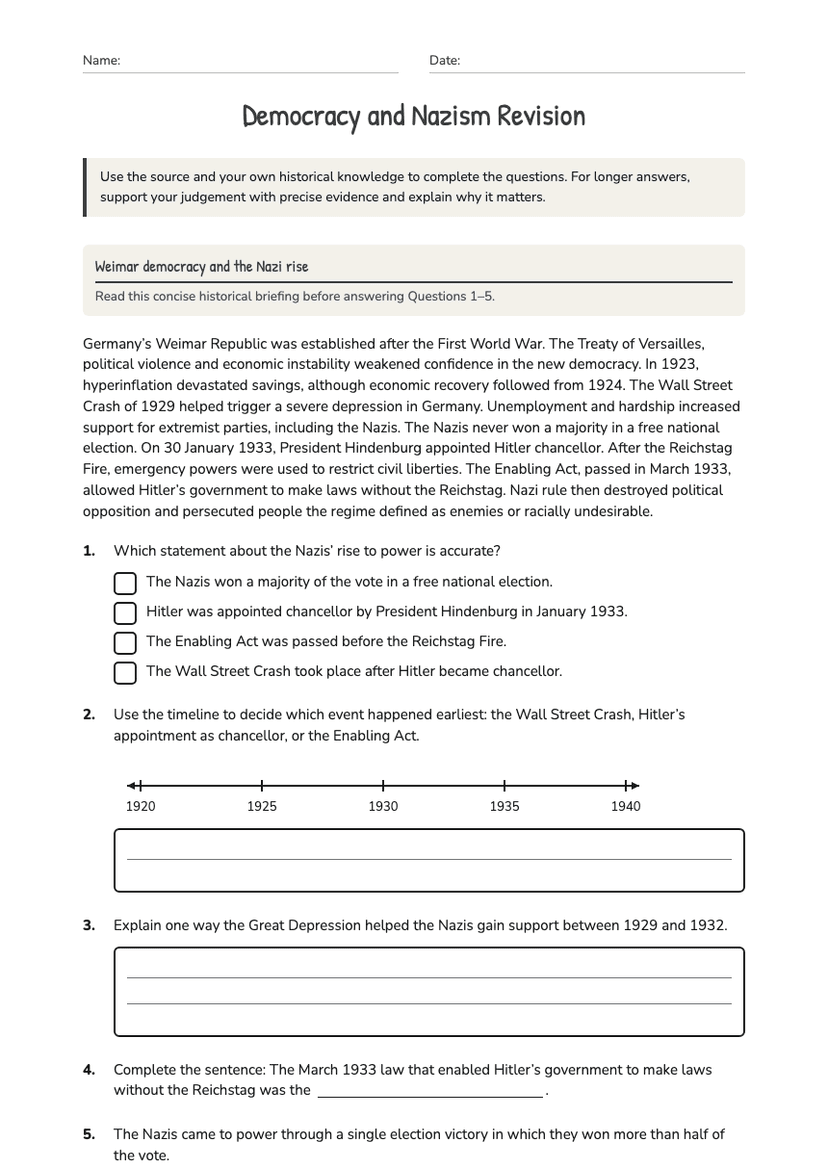
Germany became a republic in 1918, after the First World War. Its new democratic government, known as the Weimar Republic, faced political violence, economic crises and deep disagreement. The 1919 constitution used proportional representation, which helped smaller parties win seats but often meant governments depended on coalitions. Article 48 allowed the president to issue emergency decrees; it was intended for emergencies, but its frequent use later weakened parliamentary government. In 1923, after Germany struggled to pay reparations, French and Belgian troops occupied the Ruhr industrial region. The government encouraged passive resistance and paid workers by printing money. Hyperinflation followed: money rapidly lost its value. A Nazi attempt to seize power in Munich failed that year. During a more stable period from 1924 to 1929, economic recovery depended partly on US loans, leaving Germany vulnerable when the Great Depression began in 1929. Unemployment and hardship grew. The Nazis used propaganda, mass rallies, promises of national renewal and tailored messages to different groups. Their paramilitary SA also used violence and intimidation. The party won 2.6% of the vote in 1928, 18.3% in 1930 and 37.3% in July 1932. Hitler was appointed Chancellor by President Hindenburg in January 1933; the Nazis had not won an outright majority in a free election. After the Reichstag fire in February 1933, the government used an emergency decree to restrict civil liberties and arrest opponents. In March, the Enabling Act allowed Hitler’s government to make laws without the Reichstag. It passed amid intimidation and the exclusion or arrest of many Communist deputies. In June 1934, during the Night of the Long Knives, Hitler ordered the killing of political opponents, including SA leaders. After Hindenburg died in August 1934, Hitler combined the roles of Chancellor and President and became the dictator known as Führer.
1918 — German monarchy ends; republic established.
1919 — New democratic constitution adopted.
1923 — Ruhr occupation, hyperinflation and failed Nazi putsch.
1924–1929 — Relative stability; recovery partly relies on US loans.
1929 — Great Depression begins; unemployment rises.
January 1933 — Hitler appointed Chancellor.
March 1933 — Enabling Act passed under intimidation.
August 1934 — Hitler combines the offices of Chancellor and President.
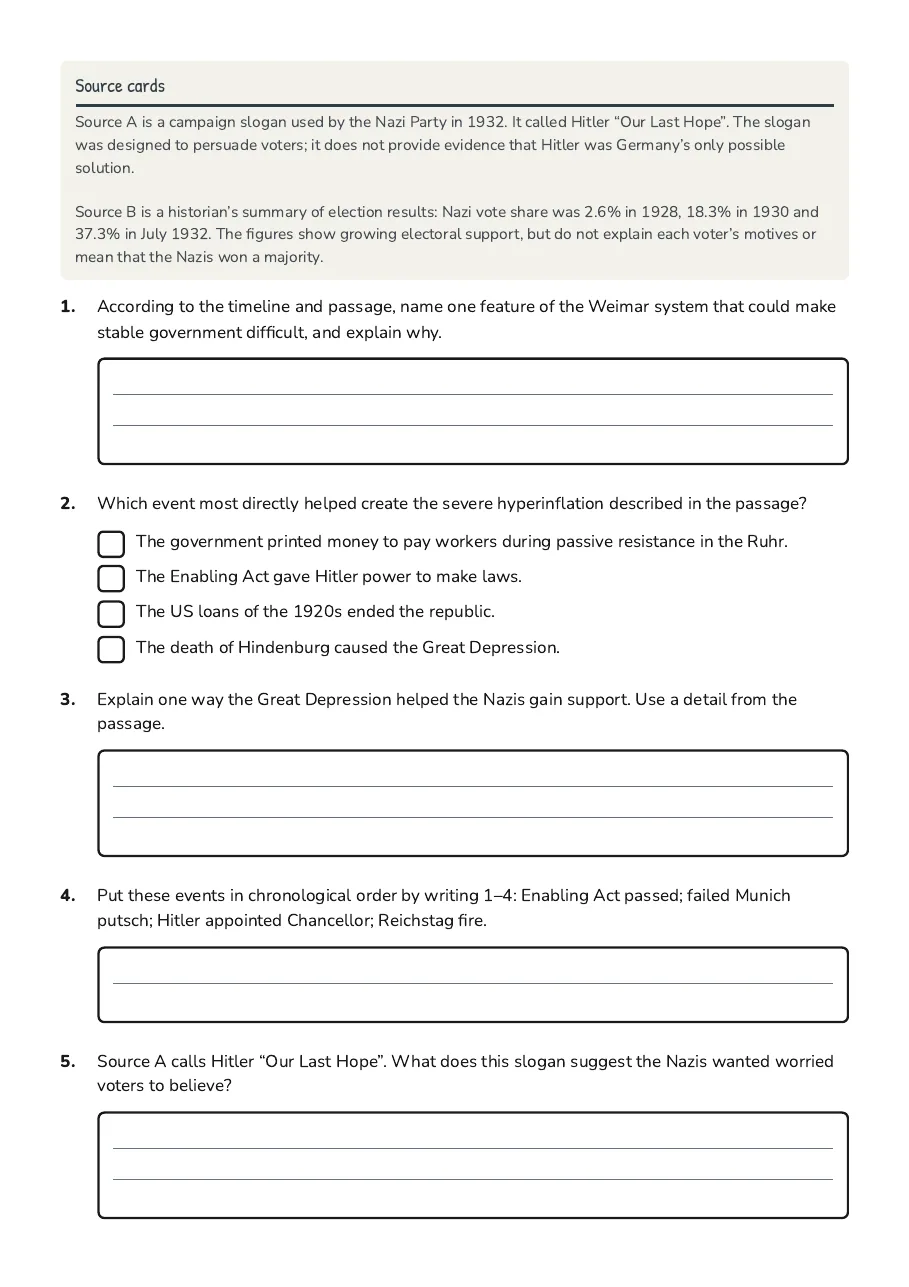
Source cards
Source A is a campaign slogan used by the Nazi Party in 1932. It called Hitler “Our Last Hope”. The slogan was designed to persuade voters; it does not provide evidence that Hitler was Germany’s only possible solution. Source B is a historian’s summary of election results: Nazi vote share was 2.6% in 1928, 18.3% in 1930 and 37.3% in July 1932. The figures show growing electoral support, but do not explain each voter’s motives or mean that the Nazis won a majority.
- The government printed money to pay workers during passive resistance in the Ruhr.
- The Enabling Act gave Hitler power to make laws.
- The US loans of the 1920s ended the republic.
- The death of Hindenburg caused the Great Depression.
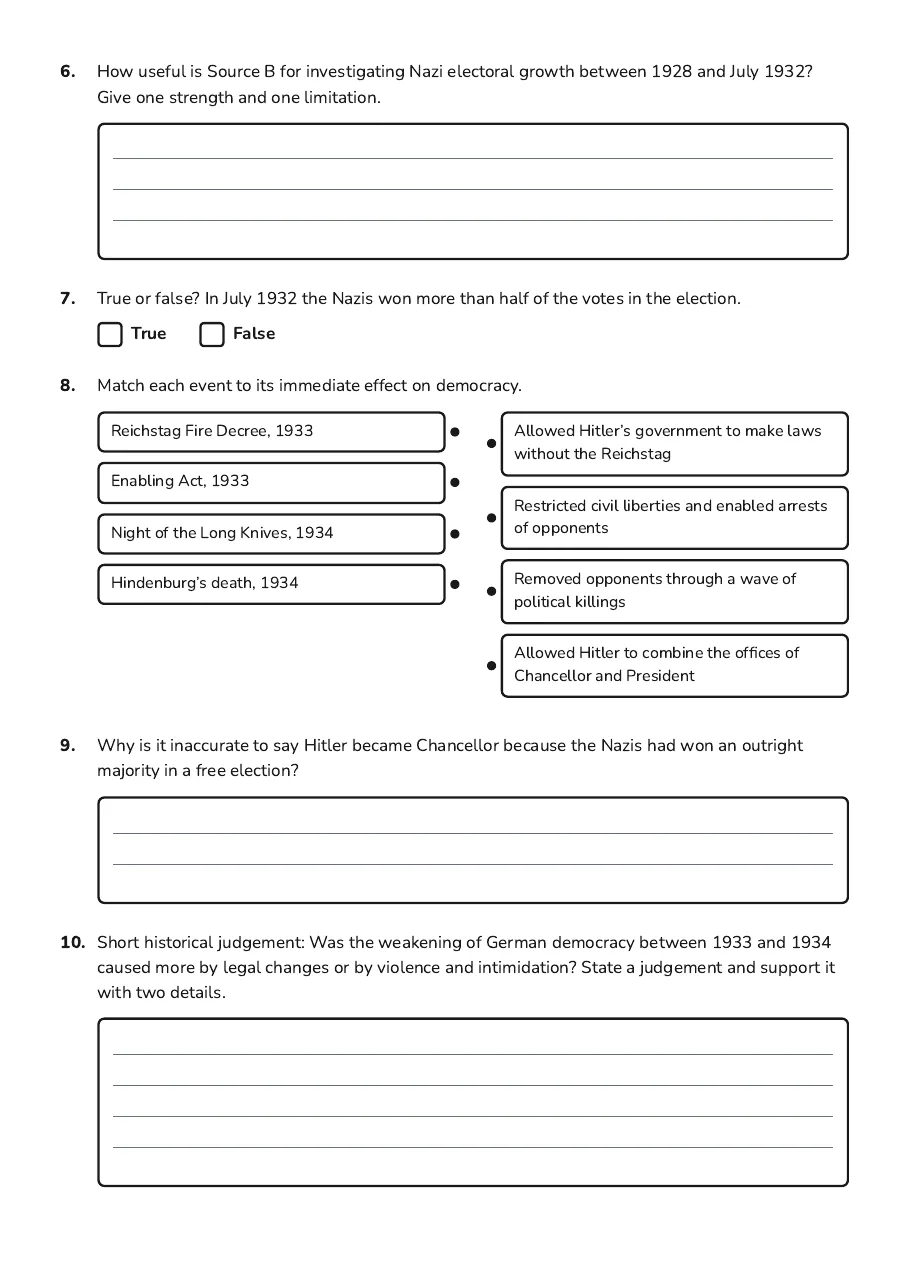
- Reichstag Fire Decree, 1933
- Enabling Act, 1933
- Night of the Long Knives, 1934
- Hindenburg’s death, 1934
- Allowed Hitler’s government to make laws without the Reichstag
- Restricted civil liberties and enabled arrests of opponents
- Removed opponents through a wave of political killings
- Allowed Hitler to combine the offices of Chancellor and President
3 printable pages
Page 1
Page 2
Page 3
About This Worksheet
Free in Kuraplan
Sign up free, grab the PDF, and customize it for your class.
Print-Ready
Formatted for standard paper. Clean layout, easy to read.
AI-Generated
Created with Kuraplan's AI, designed for real classroom use.
For Teachers & Parents
Use in classrooms, for homework, tutoring, or homeschool.
Need a custom version of this worksheet?
Kuraplan's AI generates custom worksheets in seconds — differentiated for every learner, aligned to your curriculum.
Generate Custom Worksheets — Free