Religious EducationFreePrintable

God's Existence Arguments

A free religious education worksheet ready for your classroom. Open in Kuraplan to grab the print-ready PDF, customize it for your students, or generate a fresh version in seconds.
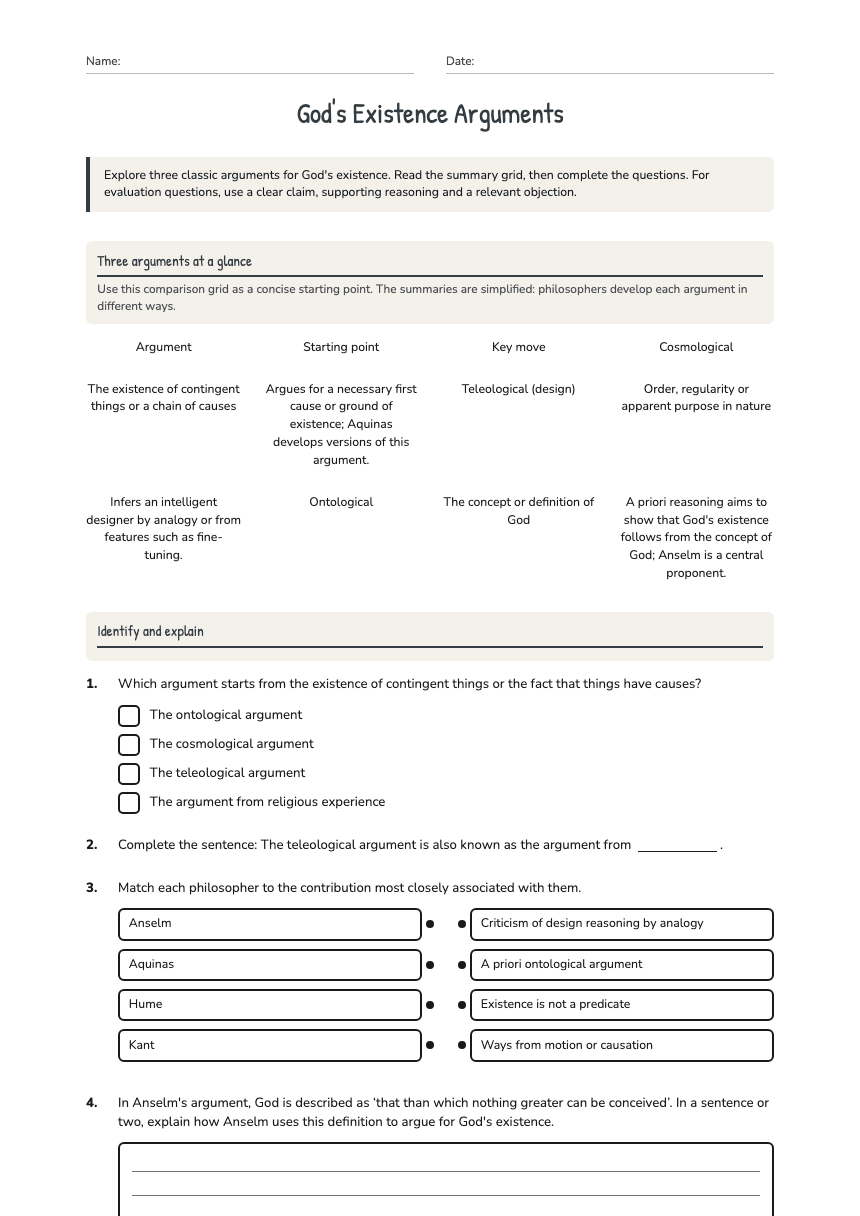
God's Existence Arguments worksheet preview
Name:Date:

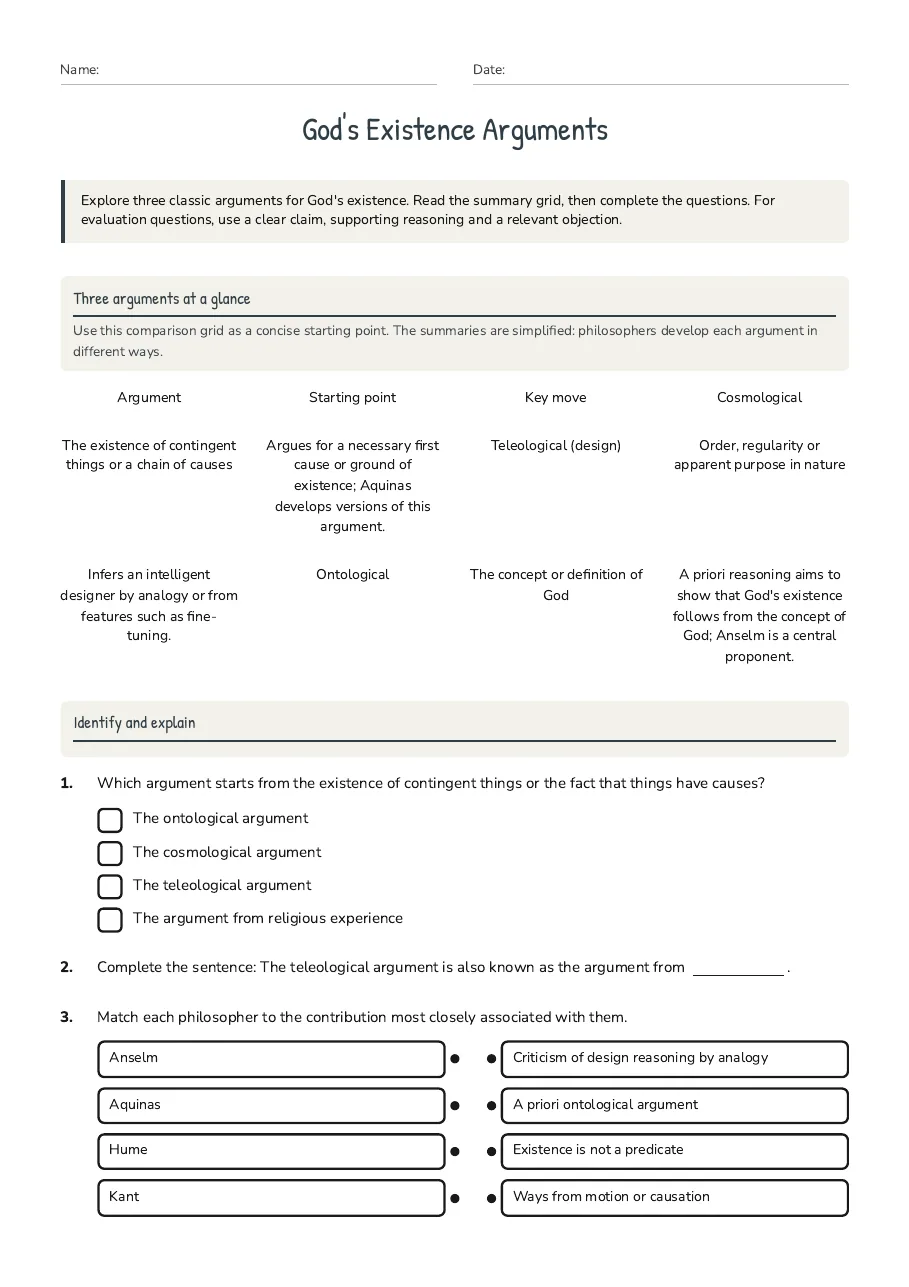
God's Existence Arguments

Explore three classic arguments for God's existence. Read the summary grid, then complete the questions. For evaluation questions, use a clear claim, supporting reasoning and a relevant objection.

Three arguments at a glance

Use this comparison grid as a concise starting point. The summaries are simplified: philosophers develop each argument in different ways.

Argument

Starting point

Key move

Cosmological

The existence of contingent things or a chain of causes

Argues for a necessary first cause or ground of existence; Aquinas develops versions of this argument.

Teleological (design)

Order, regularity or apparent purpose in nature

Infers an intelligent designer by analogy or from features such as fine-tuning.

Ontological

The concept or definition of God

A priori reasoning aims to show that God's existence follows from the concept of God; Anselm is a central proponent.

Identify and explain

1.Which argument starts from the existence of contingent things or the fact that things have causes?
  • The ontological argument
  • The cosmological argument
  • The teleological argument
  • The argument from religious experience
2.Complete the sentence: The teleological argument is also known as the argument from .
3.Match each philosopher to the contribution most closely associated with them.
  • Anselm
  • Aquinas
  • Hume
  • Kant
  • Criticism of design reasoning by analogy
  • A priori ontological argument
  • Existence is not a predicate
  • Ways from motion or causation
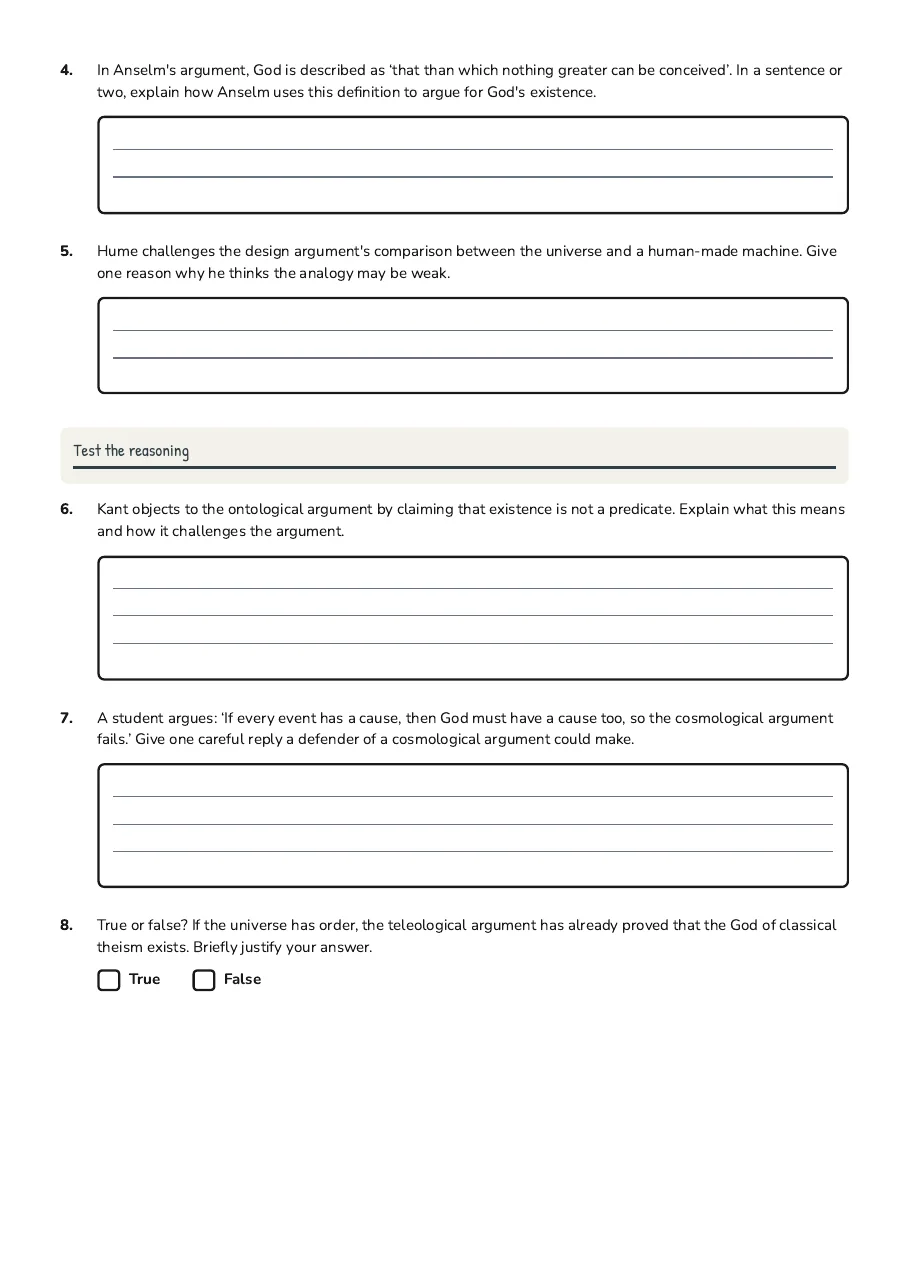
4.In Anselm's argument, God is described as ‘that than which nothing greater can be conceived’. In a sentence or two, explain how Anselm uses this definition to argue for God's existence.
5.Hume challenges the design argument's comparison between the universe and a human-made machine. Give one reason why he thinks the analogy may be weak.

Test the reasoning

6.Kant objects to the ontological argument by claiming that existence is not a predicate. Explain what this means and how it challenges the argument.
7.A student argues: ‘If every event has a cause, then God must have a cause too, so the cosmological argument fails.’ Give one careful reply a defender of a cosmological argument could make.
8.True or false? If the universe has order, the teleological argument has already proved that the God of classical theism exists. Briefly justify your answer.
TrueFalse
9.Evaluation challenge: Which of the cosmological, teleological or ontological arguments gives the strongest reason to believe in God? Make a reasoned judgement that explains one strength, considers one objection and reaches a conclusion. Use specific philosophical ideas.

3 printable pages

  • God's Existence Arguments, page 1 of 3: Three arguments at a glance, Identify and explain

    Page 1

  • God's Existence Arguments, page 2 of 3: Test the reasoning

    Page 2

  • God's Existence Arguments, page 3 of 3: 9. Evaluation challenge: Which of the cosmological, teleological or ontological arguments…

    Page 3

About This Worksheet

Free in Kuraplan

Sign up free, grab the PDF, and customize it for your class.

Print-Ready

Formatted for standard paper. Clean layout, easy to read.

AI-Generated

Created with Kuraplan's AI, designed for real classroom use.

For Teachers & Parents

Use in classrooms, for homework, tutoring, or homeschool.

Need a custom version of this worksheet?

Kuraplan's AI generates custom worksheets in seconds — differentiated for every learner, aligned to your curriculum.

Generate Custom Worksheets — Free
No credit card Curriculum-aligned Under 60 seconds