Hitler's Foreign Policy Escalation
A free history worksheet ready for your classroom. Open in Kuraplan to grab the print-ready PDF, customize it for your students, or generate a fresh version in seconds.
Hitler's Foreign Policy Escalation
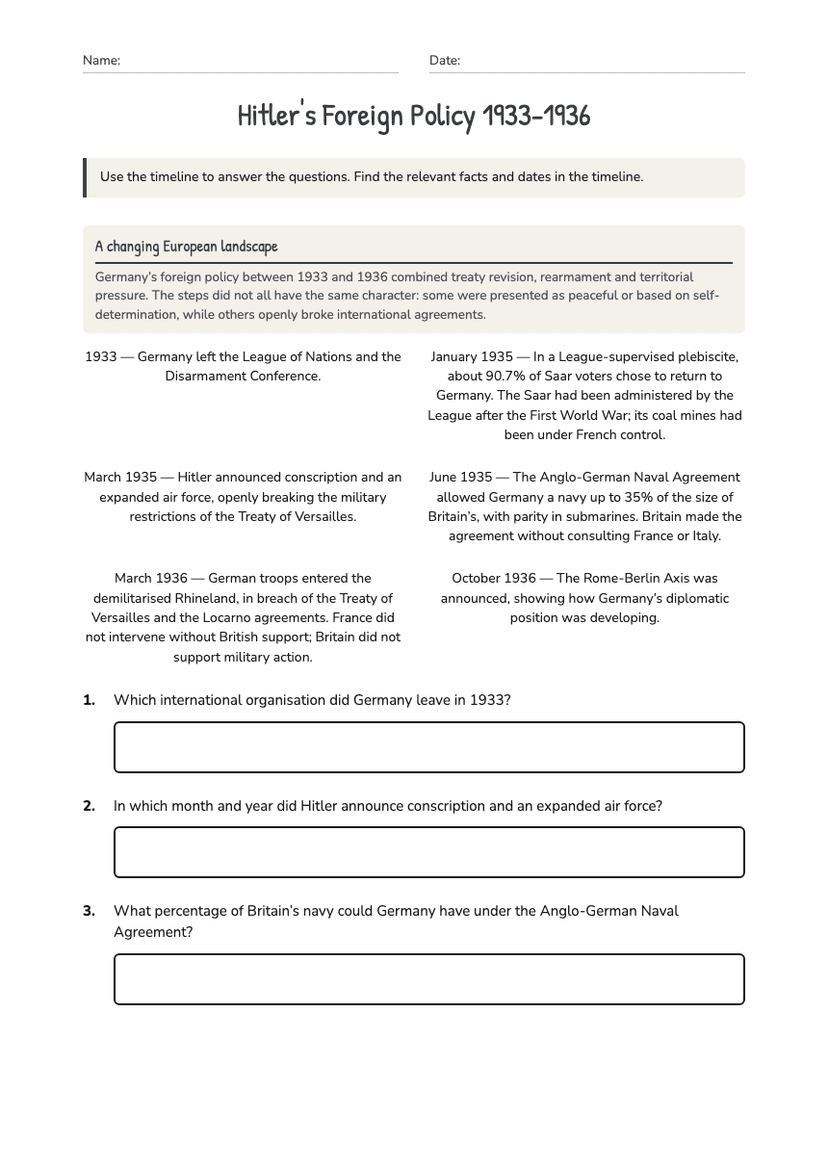
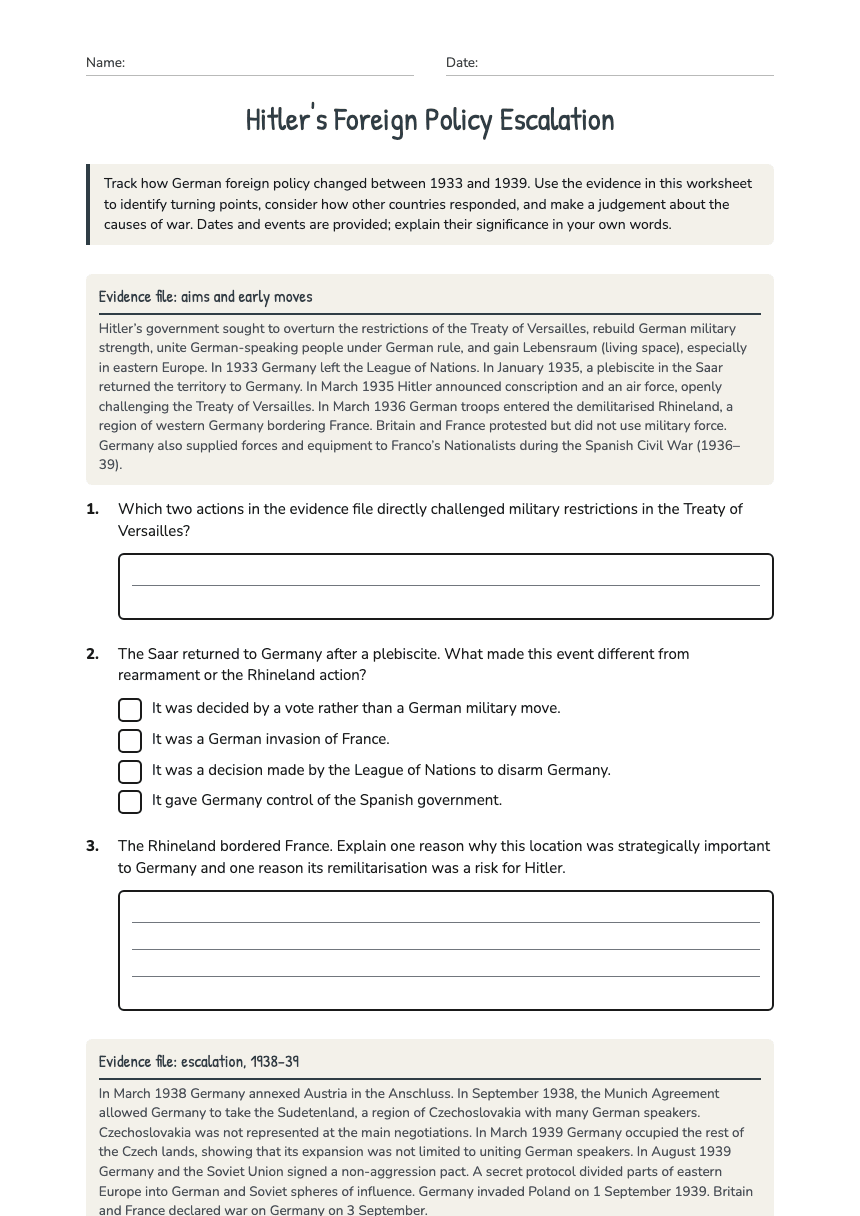
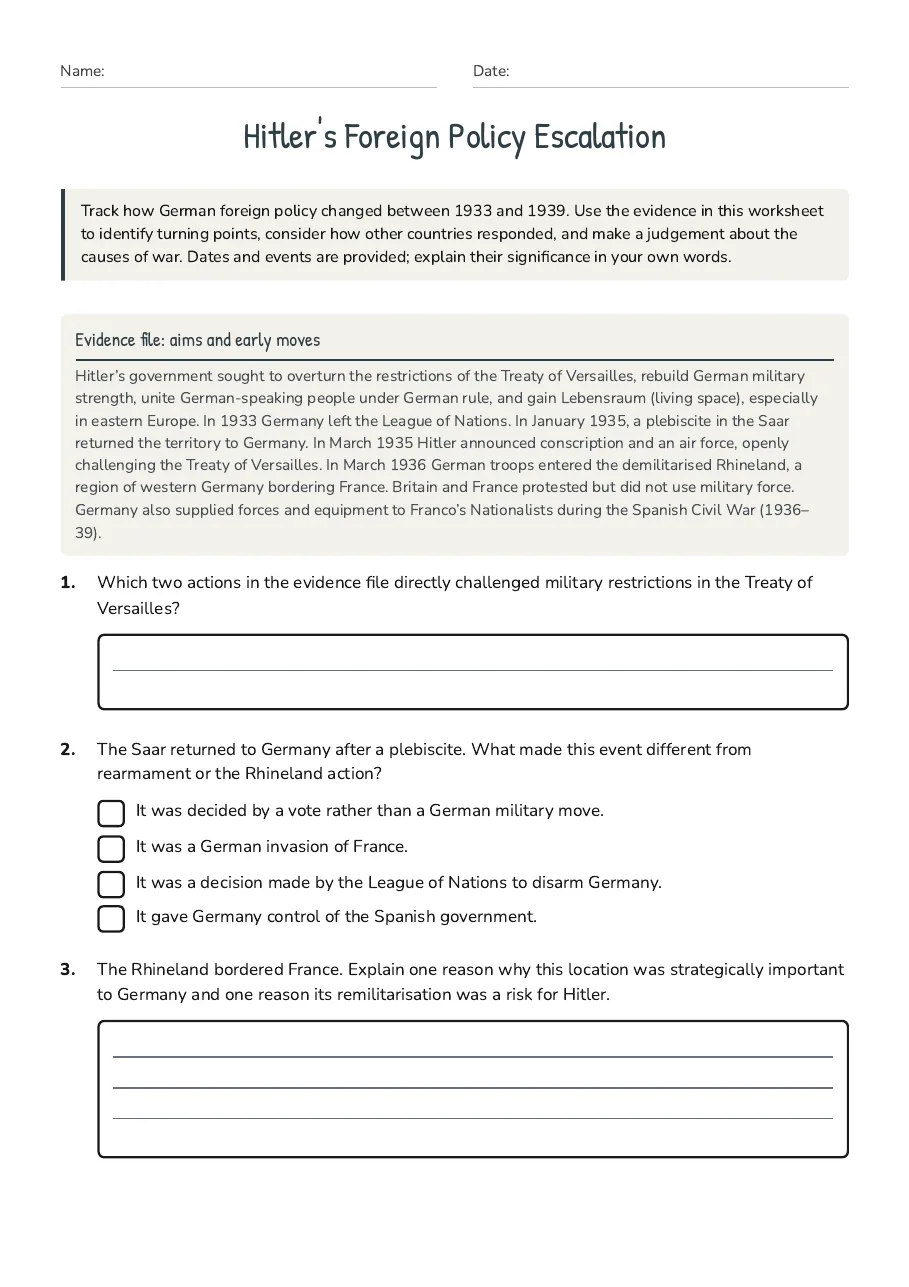
Evidence file: aims and early moves
Hitler’s government sought to overturn the restrictions of the Treaty of Versailles, rebuild German military strength, unite German-speaking people under German rule, and gain Lebensraum (living space), especially in eastern Europe. In 1933 Germany left the League of Nations. In January 1935, a plebiscite in the Saar returned the territory to Germany. In March 1935 Hitler announced conscription and an air force, openly challenging the Treaty of Versailles. In March 1936 German troops entered the demilitarised Rhineland, a region of western Germany bordering France. Britain and France protested but did not use military force. Germany also supplied forces and equipment to Franco’s Nationalists during the Spanish Civil War (1936–39).
- It was decided by a vote rather than a German military move.
- It was a German invasion of France.
- It was a decision made by the League of Nations to disarm Germany.
- It gave Germany control of the Spanish government.
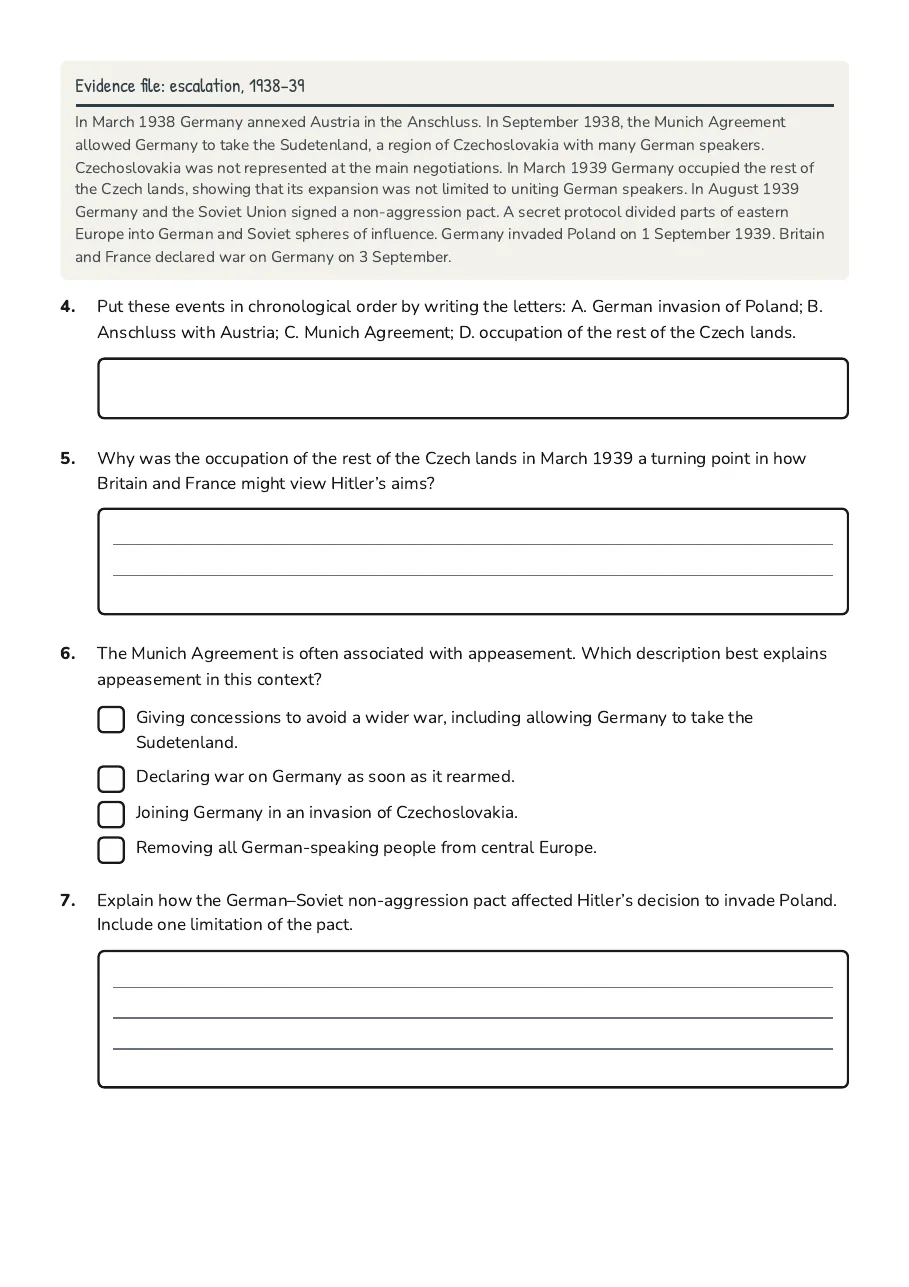
Evidence file: escalation, 1938–39
In March 1938 Germany annexed Austria in the Anschluss. In September 1938, the Munich Agreement allowed Germany to take the Sudetenland, a region of Czechoslovakia with many German speakers. Czechoslovakia was not represented at the main negotiations. In March 1939 Germany occupied the rest of the Czech lands, showing that its expansion was not limited to uniting German speakers. In August 1939 Germany and the Soviet Union signed a non-aggression pact. A secret protocol divided parts of eastern Europe into German and Soviet spheres of influence. Germany invaded Poland on 1 September 1939. Britain and France declared war on Germany on 3 September.
- Giving concessions to avoid a wider war, including allowing Germany to take the Sudetenland.
- Declaring war on Germany as soon as it rearmed.
- Joining Germany in an invasion of Czechoslovakia.
- Removing all German-speaking people from central Europe.
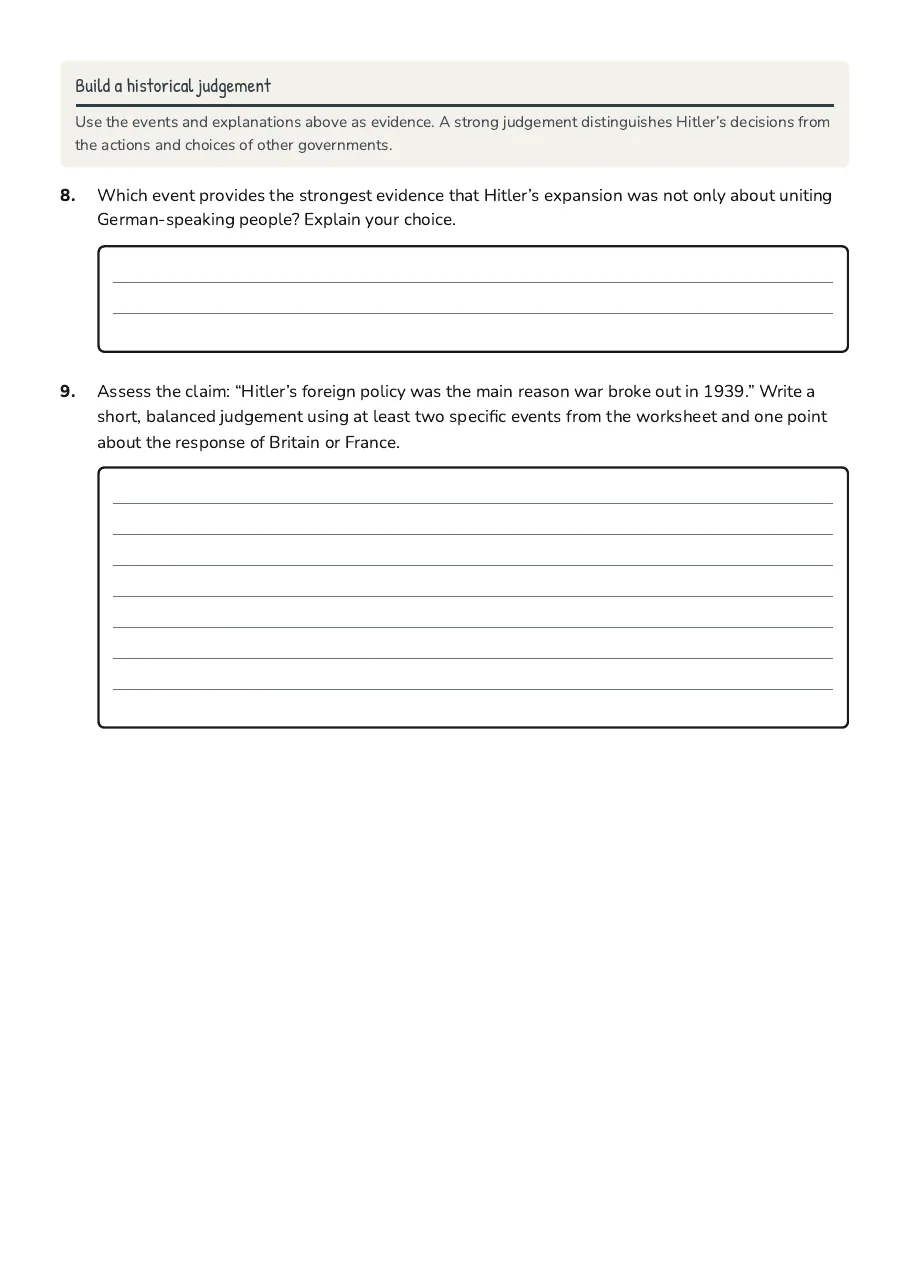
Build a historical judgement
Use the events and explanations above as evidence. A strong judgement distinguishes Hitler’s decisions from the actions and choices of other governments.
3 printable pages
Page 1
Page 2
Page 3
About This Worksheet
Free in Kuraplan
Sign up free, grab the PDF, and customize it for your class.
Print-Ready
Formatted for standard paper. Clean layout, easy to read.
AI-Generated
Created with Kuraplan's AI, designed for real classroom use.
For Teachers & Parents
Use in classrooms, for homework, tutoring, or homeschool.
Need a custom version of this worksheet?
Kuraplan's AI generates custom worksheets in seconds — differentiated for every learner, aligned to your curriculum.
Generate Custom Worksheets — FreeMore History Worksheets
League of Nations Weaknesses
Free
Ancient vs Modern Benin
Free
Year 7 History Exploration: Britain Through Time
Free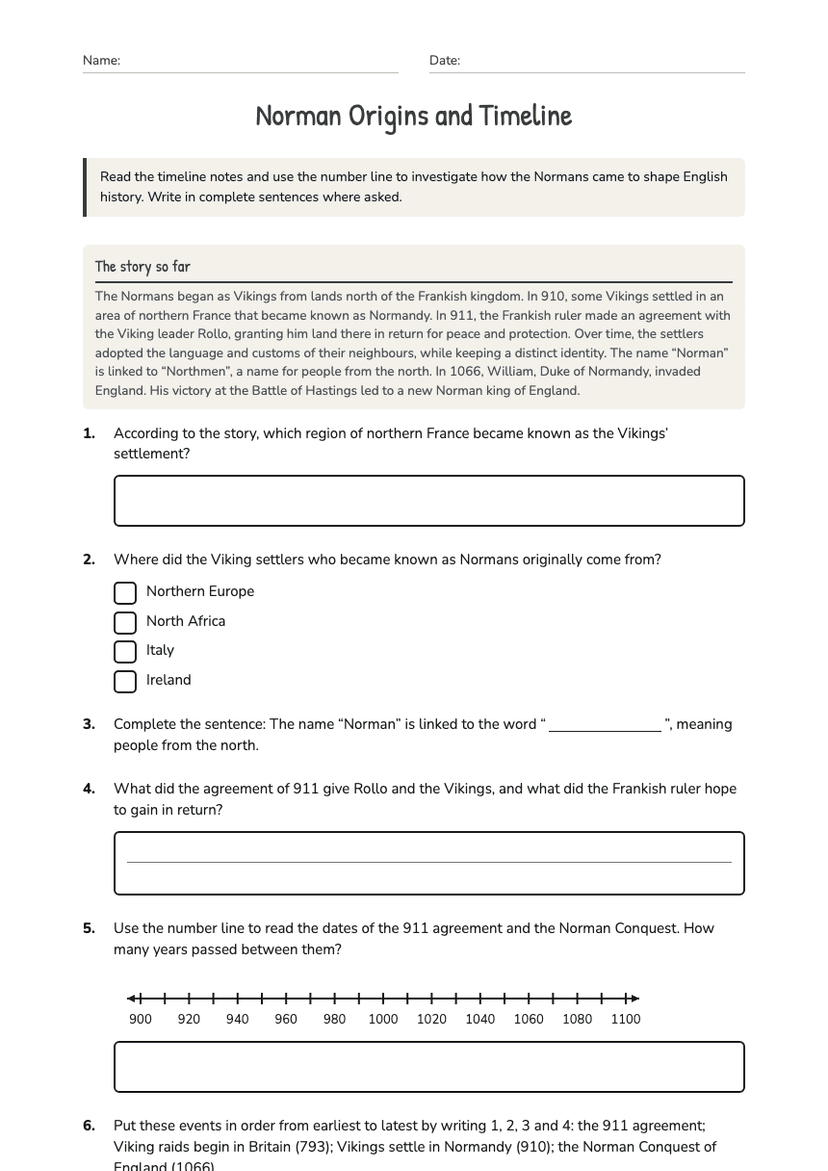
Norman Origins and Timeline
Free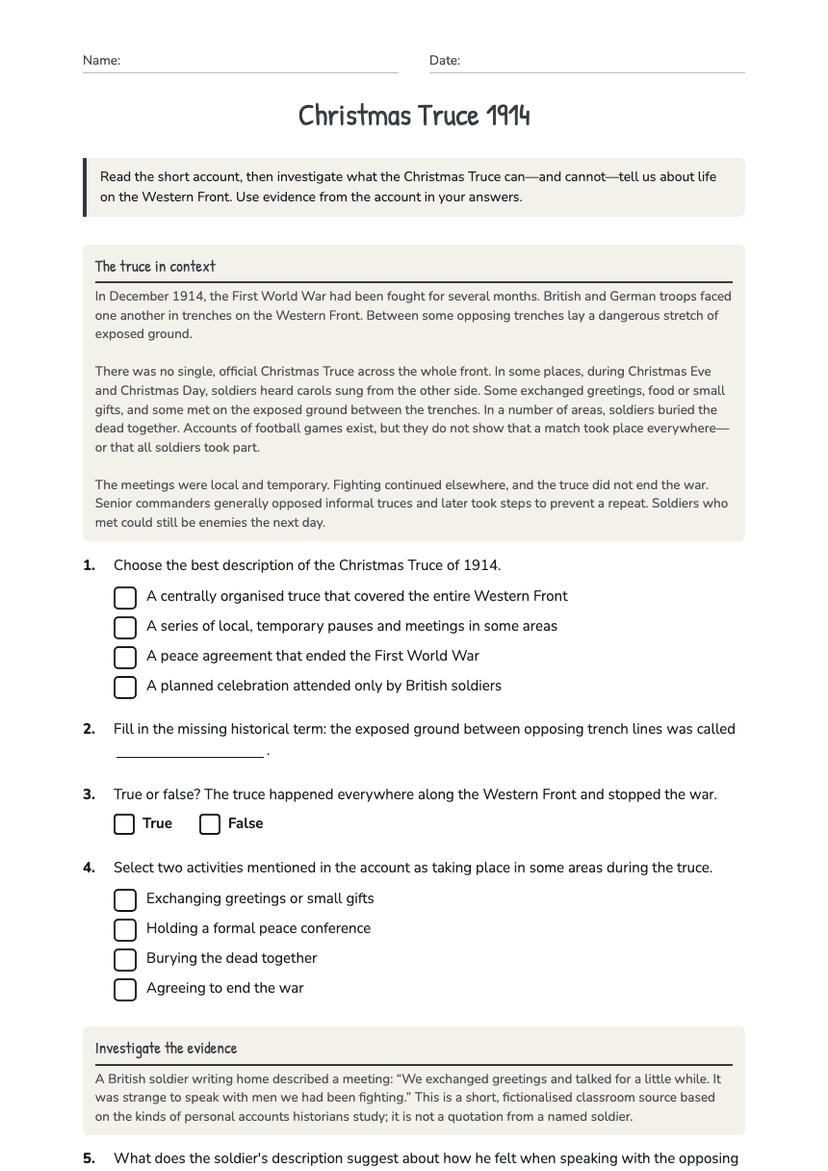
Christmas Truce 1914
Free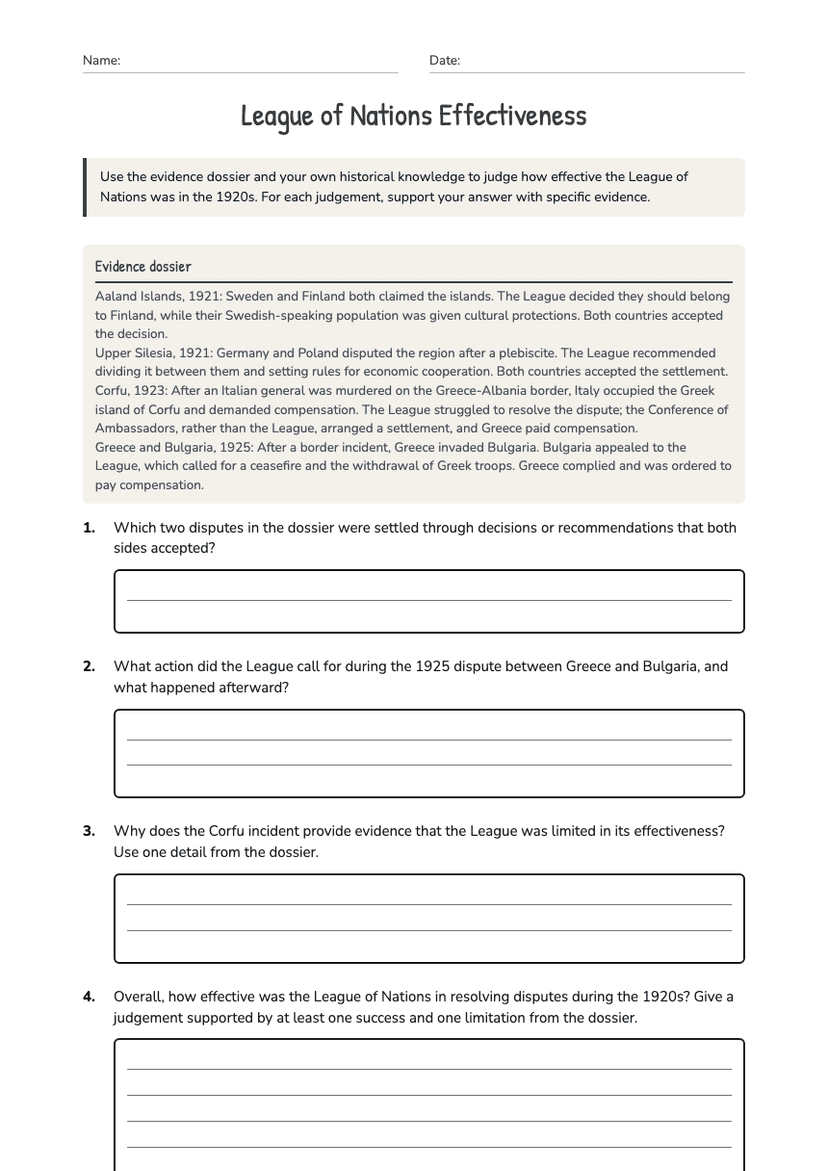
League of Nations Effectiveness
Free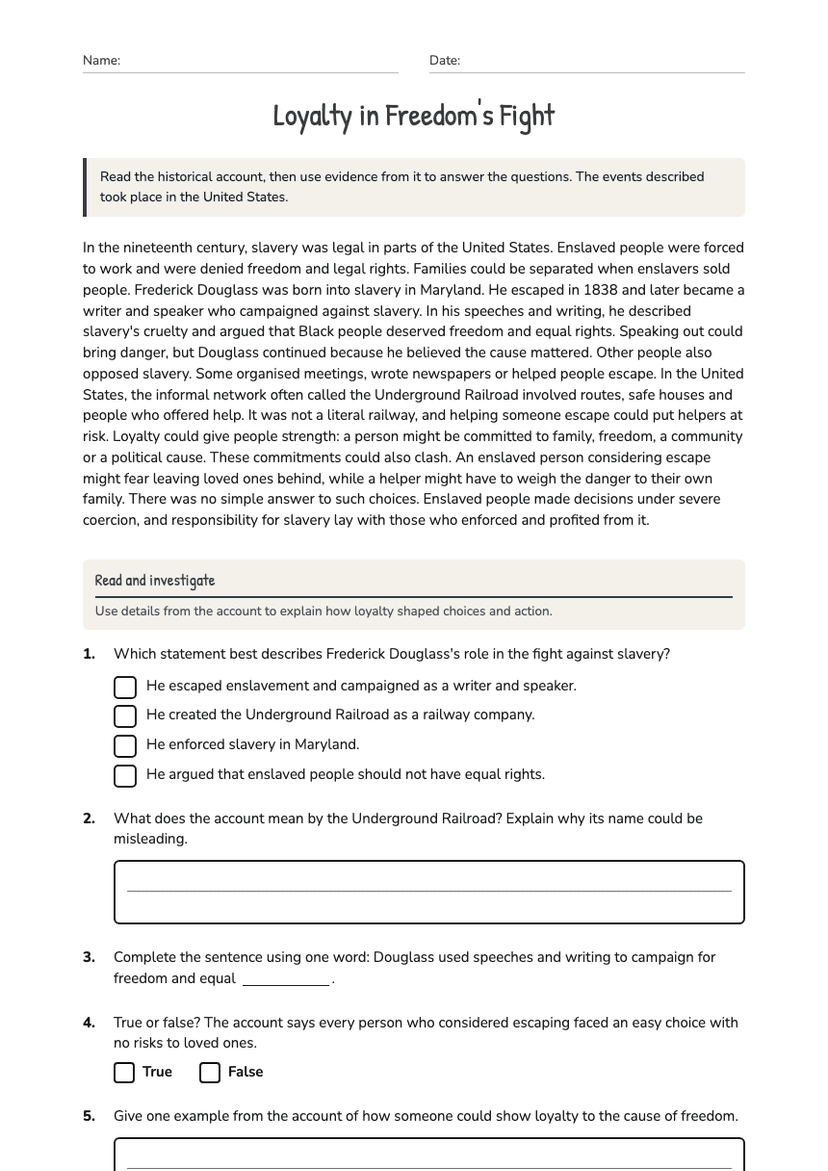
Loyalty in Freedom's Fight
Free