League Failures and Appeasement
A free history worksheet ready for your classroom. Open in Kuraplan to grab the print-ready PDF, customize it for your students, or generate a fresh version in seconds.
League Failures and Appeasement
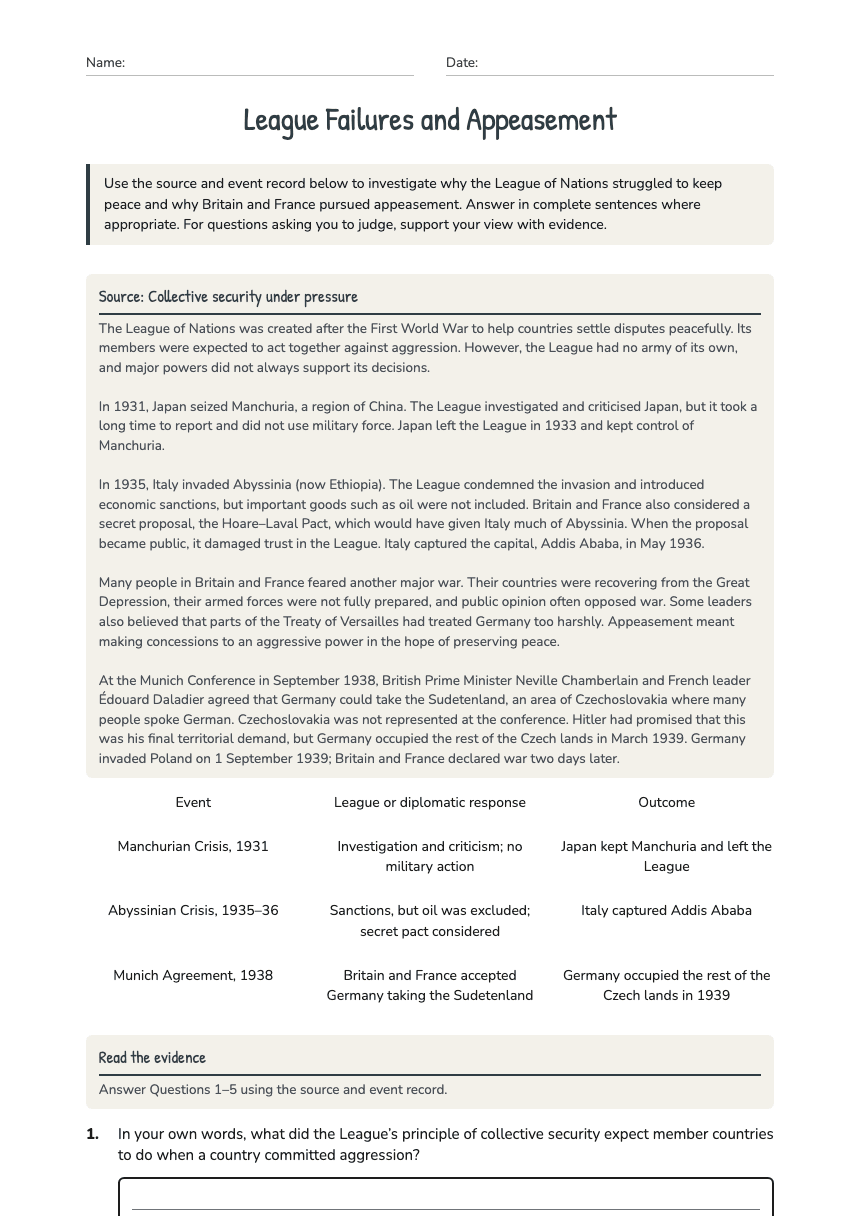
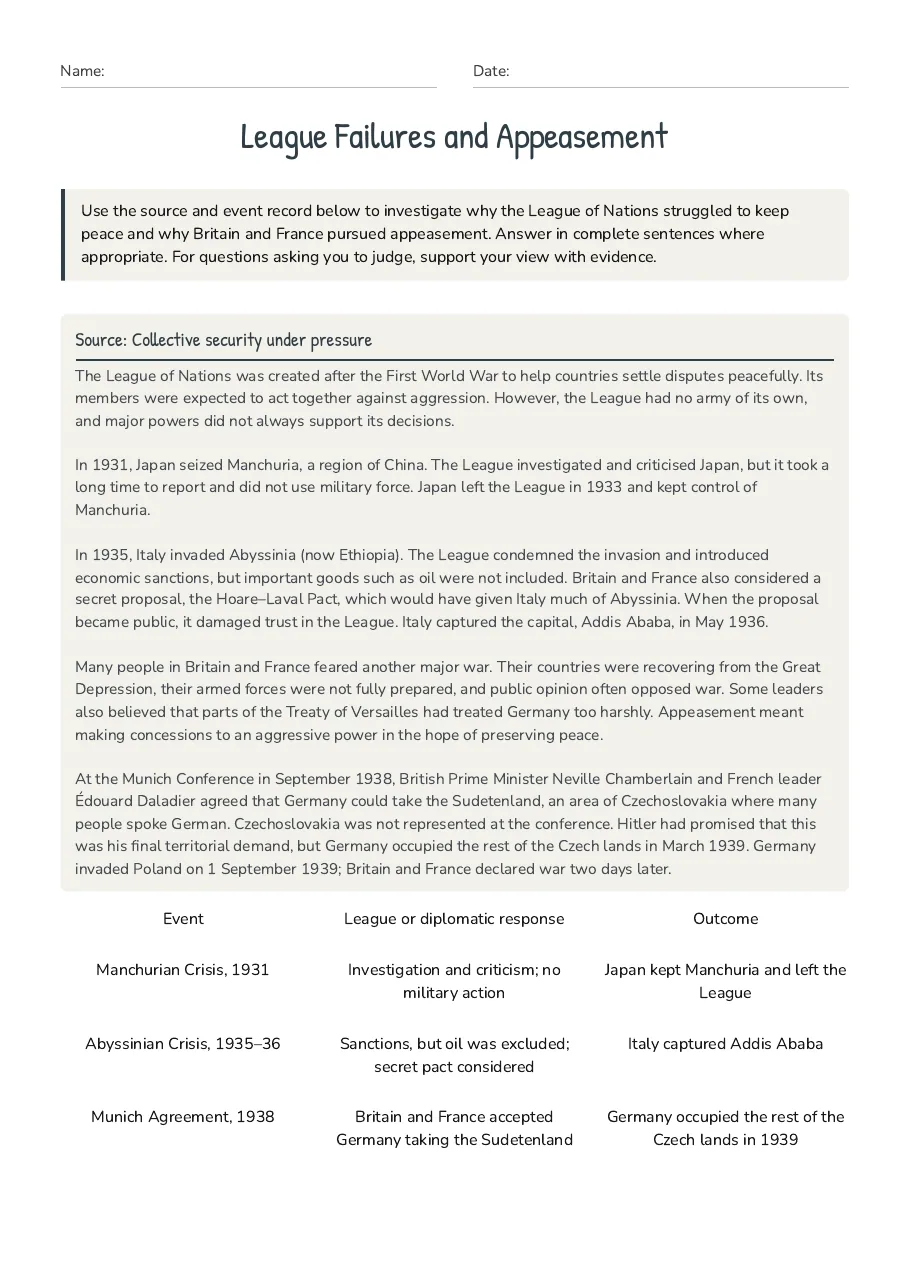
Source: Collective security under pressure
The League of Nations was created after the First World War to help countries settle disputes peacefully. Its members were expected to act together against aggression. However, the League had no army of its own, and major powers did not always support its decisions. In 1931, Japan seized Manchuria, a region of China. The League investigated and criticised Japan, but it took a long time to report and did not use military force. Japan left the League in 1933 and kept control of Manchuria. In 1935, Italy invaded Abyssinia (now Ethiopia). The League condemned the invasion and introduced economic sanctions, but important goods such as oil were not included. Britain and France also considered a secret proposal, the Hoare–Laval Pact, which would have given Italy much of Abyssinia. When the proposal became public, it damaged trust in the League. Italy captured the capital, Addis Ababa, in May 1936. Many people in Britain and France feared another major war. Their countries were recovering from the Great Depression, their armed forces were not fully prepared, and public opinion often opposed war. Some leaders also believed that parts of the Treaty of Versailles had treated Germany too harshly. Appeasement meant making concessions to an aggressive power in the hope of preserving peace. At the Munich Conference in September 1938, British Prime Minister Neville Chamberlain and French leader Édouard Daladier agreed that Germany could take the Sudetenland, an area of Czechoslovakia where many people spoke German. Czechoslovakia was not represented at the conference. Hitler had promised that this was his final territorial demand, but Germany occupied the rest of the Czech lands in March 1939. Germany invaded Poland on 1 September 1939; Britain and France declared war two days later.
Event
League or diplomatic response
Outcome
Manchurian Crisis, 1931
Investigation and criticism; no military action
Japan kept Manchuria and left the League
Abyssinian Crisis, 1935–36
Sanctions, but oil was excluded; secret pact considered
Italy captured Addis Ababa
Munich Agreement, 1938
Britain and France accepted Germany taking the Sudetenland
Germany occupied the rest of the Czech lands in 1939
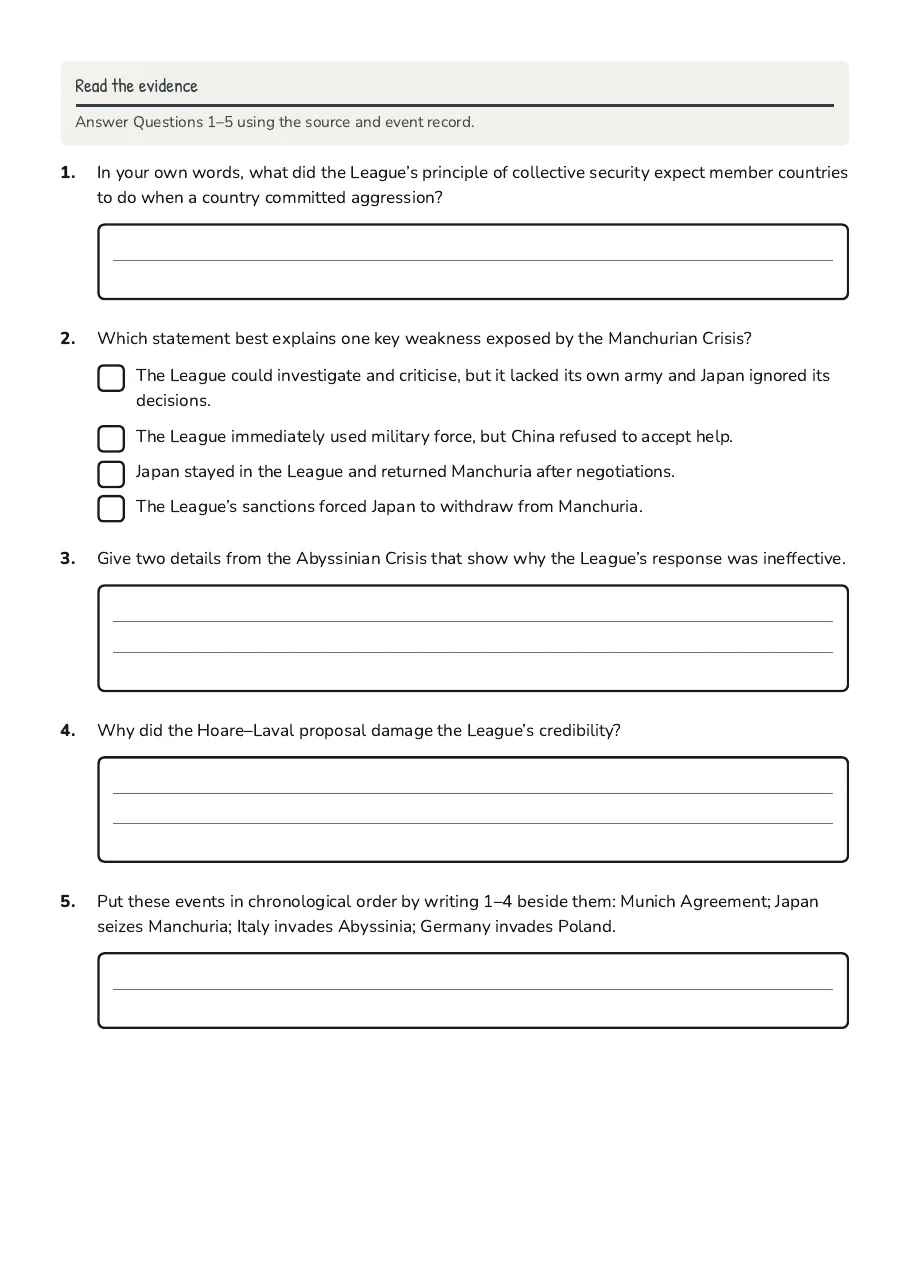
Read the evidence
Answer Questions 1–5 using the source and event record.
- The League could investigate and criticise, but it lacked its own army and Japan ignored its decisions.
- The League immediately used military force, but China refused to accept help.
- Japan stayed in the League and returned Manchuria after negotiations.
- The League’s sanctions forced Japan to withdraw from Manchuria.
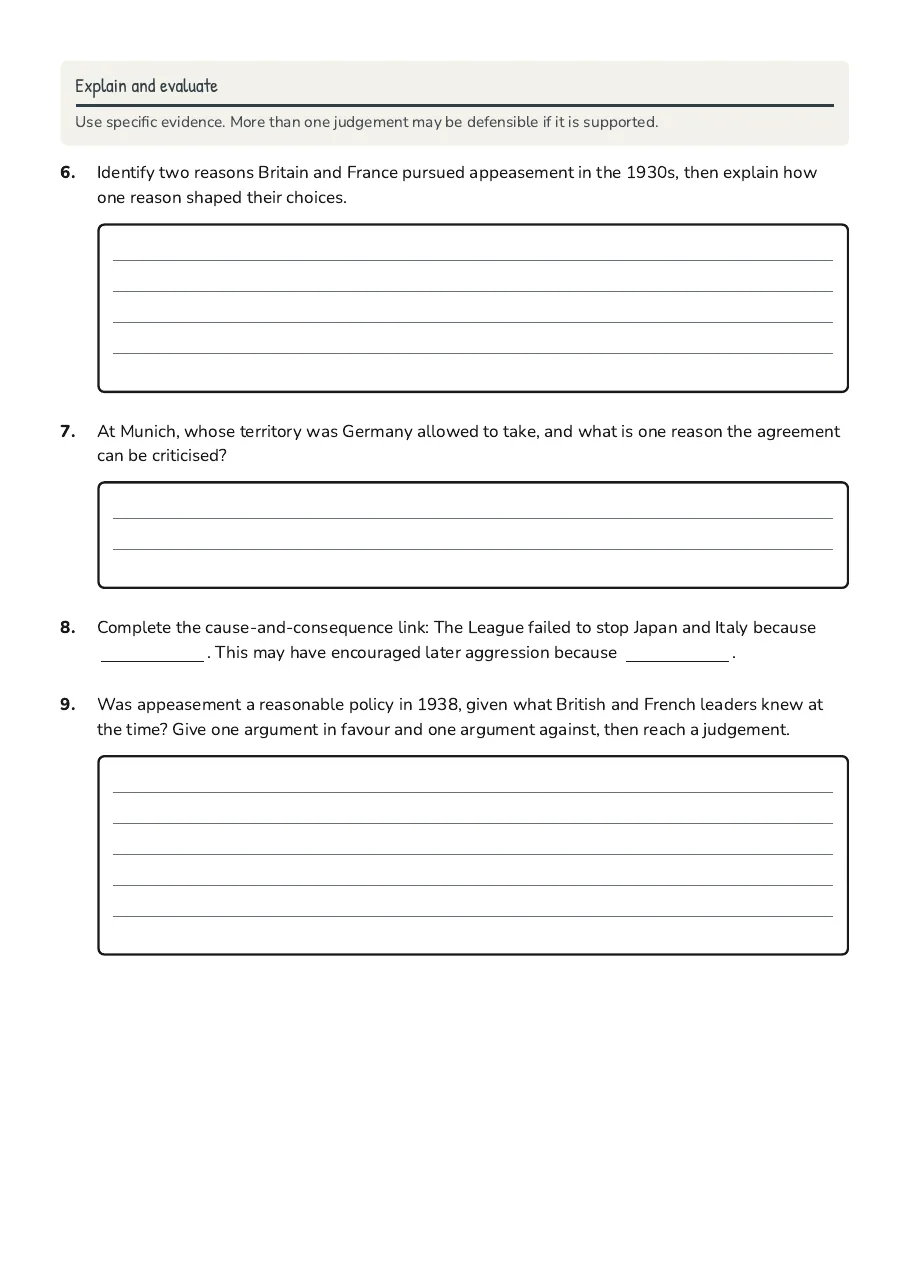
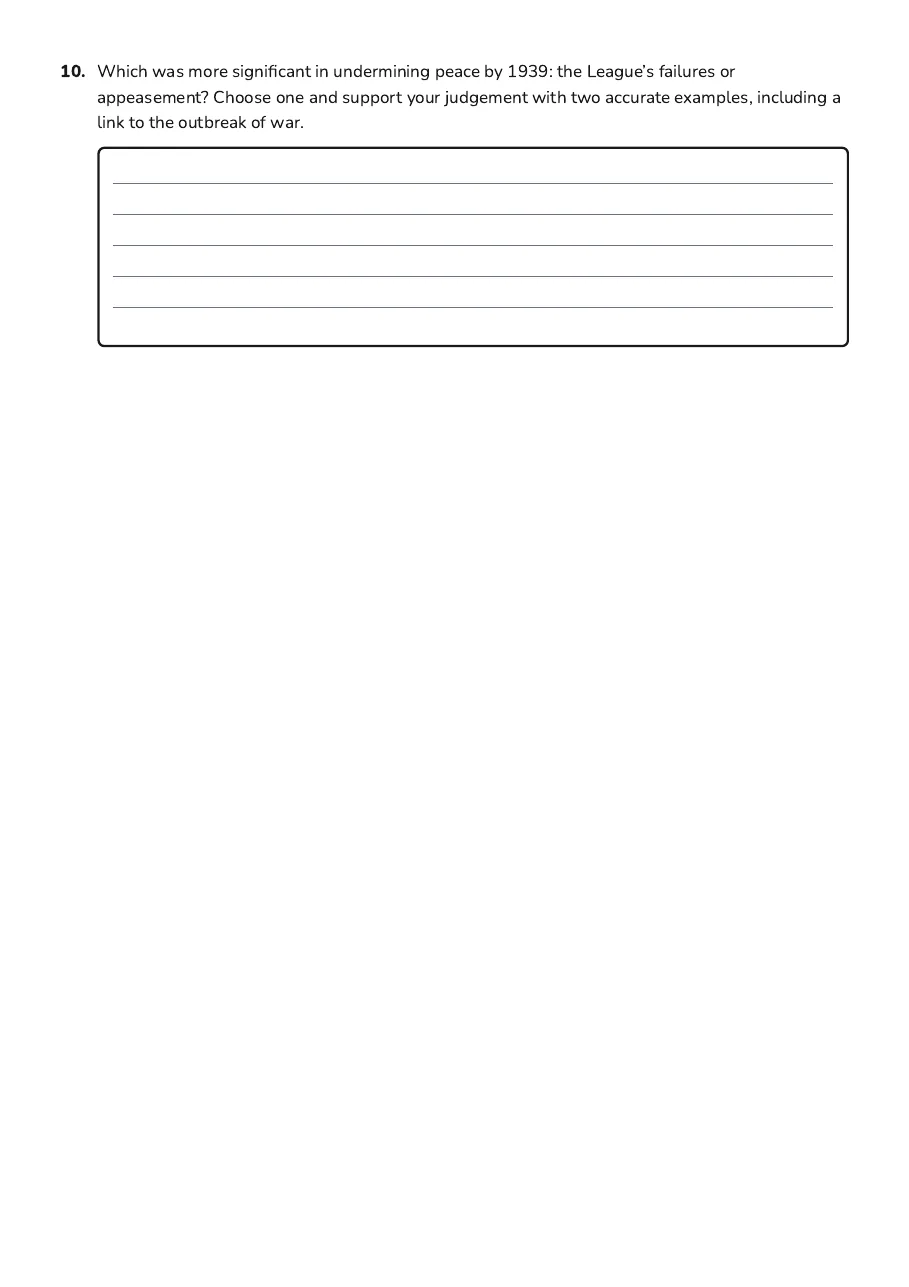
Explain and evaluate
Use specific evidence. More than one judgement may be defensible if it is supported.
4 printable pages
Page 1
Page 2
Page 3
Page 4
About This Worksheet
Free in Kuraplan
Sign up free, grab the PDF, and customize it for your class.
Print-Ready
Formatted for standard paper. Clean layout, easy to read.
AI-Generated
Created with Kuraplan's AI, designed for real classroom use.
For Teachers & Parents
Use in classrooms, for homework, tutoring, or homeschool.
Need a custom version of this worksheet?
Kuraplan's AI generates custom worksheets in seconds — differentiated for every learner, aligned to your curriculum.
Generate Custom Worksheets — FreeMore History Worksheets
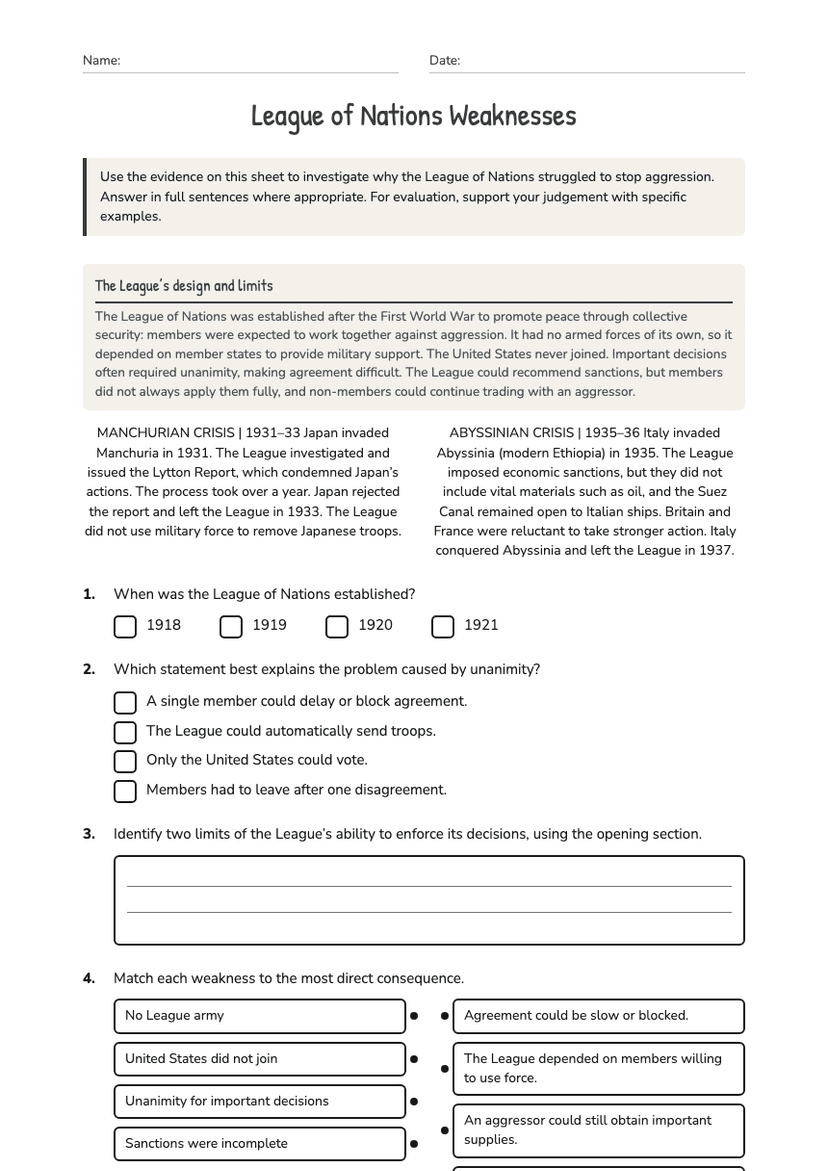
League of Nations Weaknesses
Free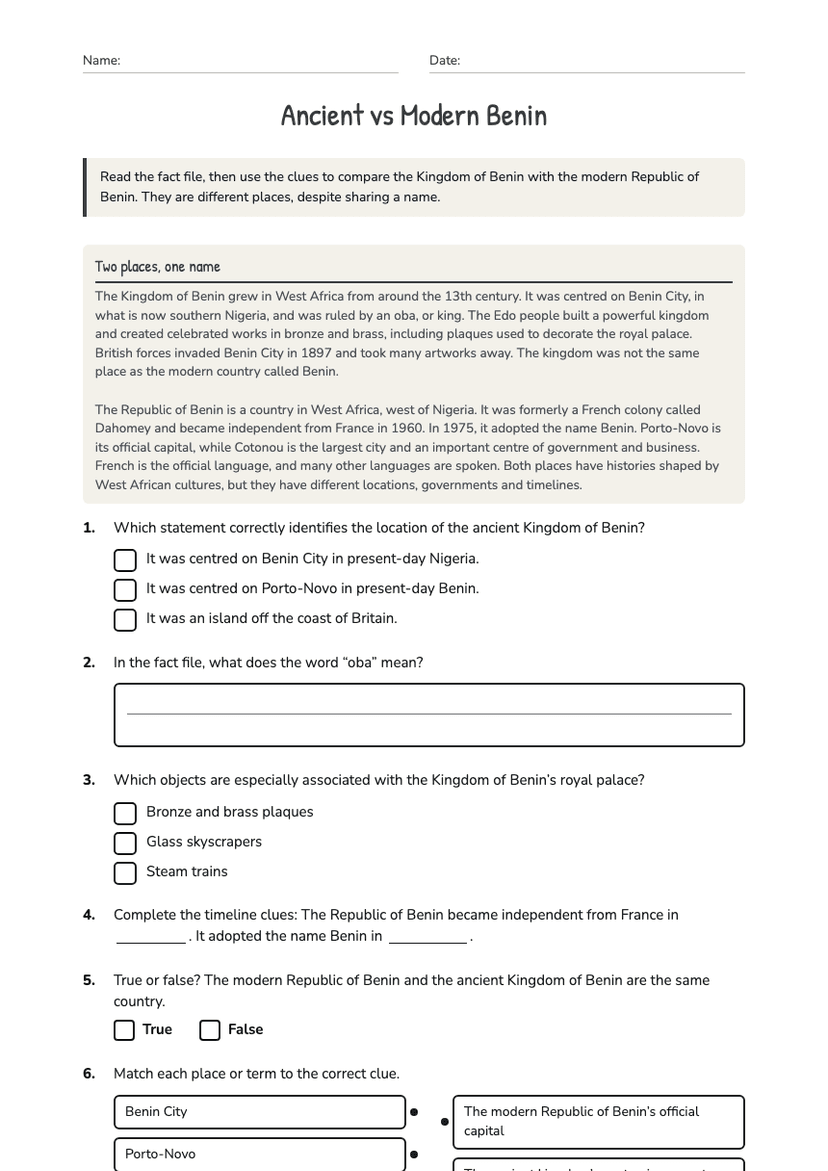
Ancient vs Modern Benin
Free
Year 7 History Exploration: Britain Through Time
Free
Norman Origins and Timeline
Free
Christmas Truce 1914
Free
League of Nations Effectiveness
Free
Loyalty in Freedom's Fight
Free