Atomic Structure and Bonding Revision
A free science worksheet ready for your classroom. Open in Kuraplan to grab the print-ready PDF, customize it for your students, or generate a fresh version in seconds.
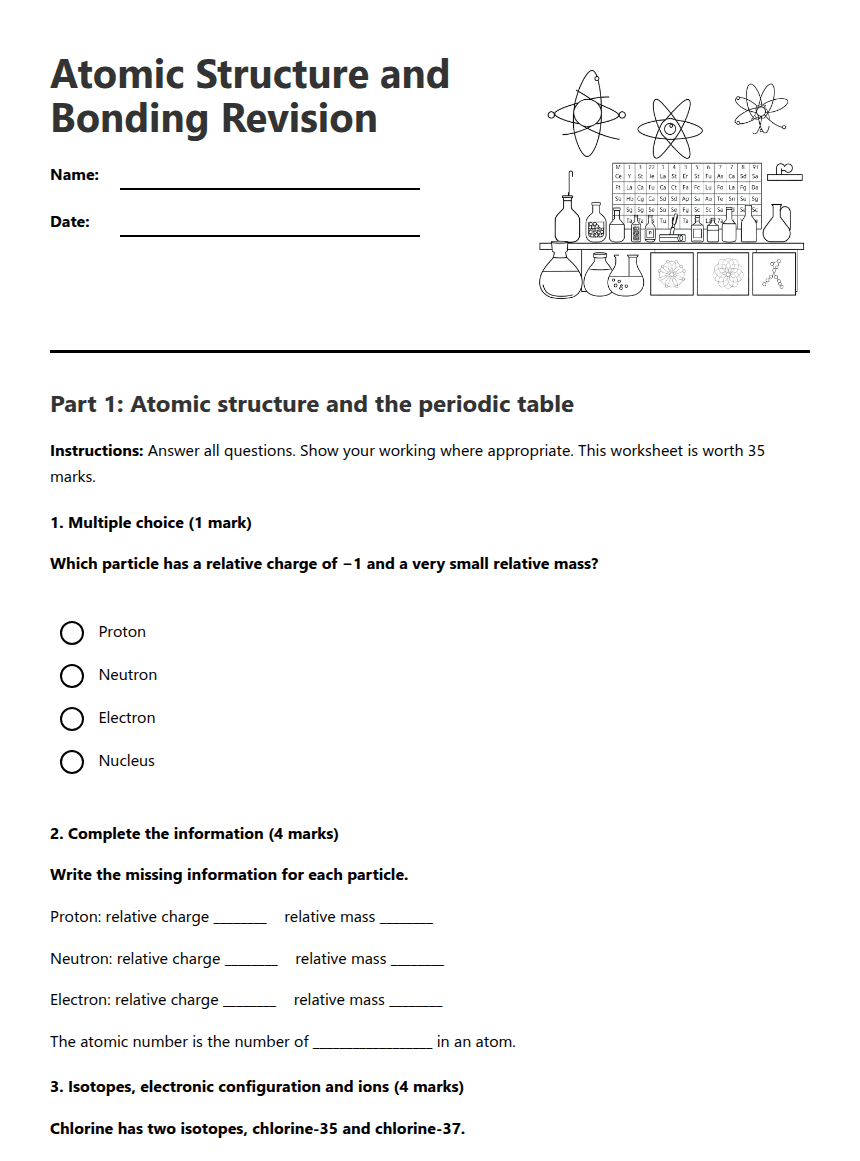
Atomic Structure and Bonding Revision
Part 1: Atomic structure and the periodic table
Instructions: Answer all 20 questions. Show your working where appropriate. Use the periodic table provided by your teacher if needed.
Complete the table.
Proton: relative charge ________ relative mass ________
Neutron: relative charge ________ relative mass ________
Electron: relative charge ________ relative mass ________
Where are protons, neutrons and electrons found? Name the central part of the atom.
An atom contains 17 protons, 18 neutrons and 17 electrons. State its atomic number and mass number. Explain why it has no overall charge.
Explain what is meant by the term isotopes.
Chlorine has atomic number 17. Calculate the number of neutrons in one atom of chlorine-35 and one atom of chlorine-37. Show your working.
Write the electronic structure of each atom using numbers of electrons in each shell.
a) Magnesium, atomic number 12: ______________________________
b) Oxygen, atomic number 8: _________________________________
c) Potassium, atomic number 19: ______________________________
Explain how a magnesium atom forms a Mg2+ ion. Include the number of electrons lost and the electronic structures of the atom and ion.
Choose one answer for each statement.
a) The atomic number of an element is the number of:
Neutrons Protons Electron shellsb) Elements in the same group have the same number of:
Protons Outer-shell electrons Neutronsc) The number of occupied electron shells shows the element's:
Group Period Relative atomic massDescribe how the reactivity of Group 1 metals changes down the group. State how the reactivity of Group 7 elements changes down the group.
Element X has the electronic structure 2,8,1. Identify its group and period, state whether it is a metal or non-metal, and predict the charge of its ion.
Part 2: Bonding, structure and properties
Use a dot-and-cross diagram to show the formation of magnesium oxide, MgO. Show the transfer of two electrons and the charges on both ions.
Explain why solid sodium chloride has a high melting point and does not conduct electricity, whereas molten sodium chloride does conduct electricity.
Draw the displayed formula for a molecule of water, H2O. Show the covalent bonds and state what a covalent bond is.
Explain why simple molecular substances usually have low melting points and boiling points.
Compare the structure and properties of diamond and graphite. Include one reason why their properties are different.
Describe metallic bonding and explain why metals conduct electricity.
Explain why an alloy is usually harder than a pure metal.
Part 3: The particle model and properties of matter
Describe the arrangement and movement of particles in a gas. Use the particle model to explain why gases can be compressed.
Explain what happens to the particles when a solid melts. State whether energy is absorbed or released and describe what happens to the forces between particles.
A metal block has a mass of 270 g and a volume of 100 cm3. Calculate its density in g/cm3. Show your working and include the unit.
Answer key and mark scheme
1. (3) Proton: relative charge +1, relative mass 1. Neutron: relative charge 0, relative mass 1. Electron: relative charge −1, relative mass approximately 1/2000 or negligible.
2. (2) Protons and neutrons are found in the nucleus (1). Electrons are found in shells around the nucleus (1).
3. (3) Atomic number = 17 (1). Mass number = 17 + 18 = 35 (1). It has equal numbers of protons and electrons, so the positive and negative charges cancel and there is no overall charge (1).
4. (2) Isotopes are atoms of the same element, so they have the same number of protons (1), but they have different numbers of neutrons (1).
5. (3) Chlorine-35: 35 − 17 = 18 neutrons (1). Chlorine-37: 37 − 17 = 20 neutrons (1). Correct use of mass number − atomic number and clear working (1).
6. (3) a) Magnesium: 2,8,2 (1). b) Oxygen: 2,6 (1). c) Potassium: 2,8,8,1 (1).
7. (3) A magnesium atom loses two electrons (1). The atom has the electronic structure 2,8,2 (1). The Mg2+ ion has the electronic structure 2,8 (1).
8. (3) a) Protons (1). b) Outer-shell electrons (1). c) Period (1).
9. (3) Group 1 reactivity increases down the group (1). Group 7 reactivity decreases down the group (1). A suitable explanation may refer to the increasing distance from the nucleus and increased shielding for Group 1, or the greater difficulty attracting an electron for Group 7 (1).
10. (3) Group 1 (1). Period 3 (1). It is a metal and forms a 1+ ion (1).
11. (3) Magnesium loses two outer-shell electrons (1). Oxygen gains two electrons (1). The diagram shows Mg2+ and O2−, both with full outer shells, with the transferred electrons identifiable (1).
12. (3) There are strong electrostatic attractions between oppositely charged ions, requiring lots of energy to overcome (1). In solid sodium chloride the ions cannot move, so it does not conduct electricity (1). When molten, the ions can move and carry electrical charge (1).
13. (3) Correct displayed formula H–O–H with two covalent bonds (1). The bonds are shown as shared pairs of electrons (1). A covalent bond is a shared pair of electrons between two atoms (1).
14. (2) The forces between simple molecules are weak (1), so only a small amount of energy is needed to overcome these forces (1).
15. (3) Diamond has a giant covalent structure in which each carbon atom forms four strong covalent bonds; it is hard and does not conduct electricity (1). Graphite has layers in which each carbon atom forms three covalent bonds; it has delocalised electrons and conducts electricity (1). Weak forces between graphite layers allow the layers to slide, explaining why graphite is soft or slippery (1).
16. (3) Metals consist of positive metal ions in a lattice (1), surrounded by delocalised electrons (1). The electrons are free to move and carry electrical charge through the metal (1).
17. (2) Alloys contain atoms of different sizes (1). These distort the regular layers and make it more difficult for the layers to slide over one another (1).
18. (3) Gas particles are far apart (1), move randomly and rapidly in all directions (1), and have large gaps between them so they can be pushed closer together (1).
19. (3) Particles gain energy and vibrate more until they leave their fixed positions (1). They can then move past one another (1). Energy is absorbed and the forces holding the particles in fixed positions are weakened or overcome (1).
20. (3) Correct equation: density = mass ÷ volume (1). Correct calculation: 270 ÷ 100 = 2.7 (1). Correct unit: 2.7 g/cm3 (1).
Total: 56 marks
About This Worksheet
Free in Kuraplan
Sign up free, grab the PDF, and customize it for your class.
Print-Ready
Formatted for standard paper. Clean layout, easy to read.
AI-Generated
Created with Kuraplan's AI, designed for real classroom use.
For Teachers & Parents
Use in classrooms, for homework, tutoring, or homeschool.
Need a custom version of this worksheet?
Kuraplan's AI generates custom worksheets in seconds — differentiated for every learner, aligned to your curriculum.
Generate Custom Worksheets — FreeMore Science Worksheets
Danforth: Authority and Conscience
Free
Natural Resources Science
Free
Natural Resources Science
Free
Vitamins, Minerals, and Protein Science
Free
Exploring Science Materials
Free
Waka Buoyancy Science Worksheet
Free
Science Skills Made Simple
Free