FreePrintable

Badminton Rules Introduction

A free, printable general worksheet ready for your classroom. Download instantly, print, and hand out to your students — no account needed.

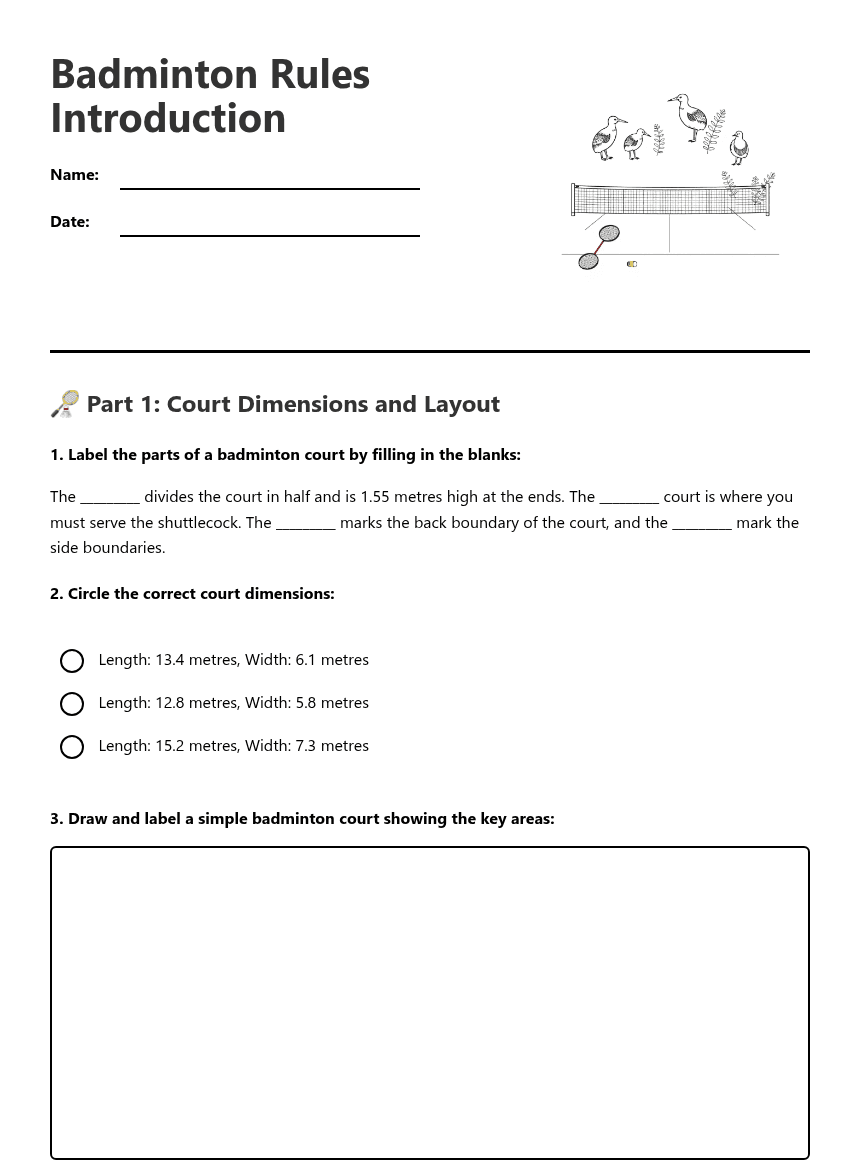
Badminton Rules Introduction worksheet preview
Badminton Rules Introduction

Badminton Rules Introduction

Badminton court and racket illustration

🏸 Part 1: Court Dimensions and Layout

1. Label the parts of a badminton court by filling in the blanks:

The _________ divides the court in half and is 1.55 metres high at the ends. The _________ court is where you must serve the shuttlecock. The _________ marks the back boundary of the court, and the _________ mark the side boundaries.

2. Circle the correct court dimensions:

Length: 13.4 metres, Width: 6.1 metres

Length: 12.8 metres, Width: 5.8 metres

Length: 15.2 metres, Width: 7.3 metres

3. Draw and label a simple badminton court showing the key areas:

⚖️ Part 2: Basic Rules and Faults

4. Check all the actions that would result in a fault (multiple selection):

The shuttlecock lands outside the court boundaries

A player hits the shuttlecock twice in succession

The shuttlecock touches the net during play

A player serves from the correct service court

A player's racket touches the net

5. Match the serving rules with their descriptions:
1. Underarm serve
2. Service court
3. Service fault
A. Diagonal area where serve must land
B. Required serving technique in badminton
C. When serve doesn't follow the rules
6. Explain what happens when a shuttlecock hits the net during a rally:

🏆 Part 3: Scoring System

7. Circle the correct scoring format used in badminton:

First to 15 points, win by 1

First to 21 points, win by 2

First to 25 points, win by 3

8. Complete the scoring scenario:

Player A has 20 points and Player B has 19 points. Player A wins the next rally. The score is now _____ to _____. Does Player A win the game? _______ Why? _________________________________

9. Fill in the missing information about match structure:

A badminton match is played as the best of _____ games. This means a player must win _____ games to win the match. If the score reaches 20-20, play continues until one player leads by _____ points or reaches _____ points.

10. Calculate the final match result:

Game 1: Player A wins 21-18
Game 2: Player B wins 21-16
Game 3: Player A wins 21-19

Match winner: _____________ Final score: _____ games to _____ games

🤝 Part 4: Sportsmanship and Fair Play

11. List three ways players can show good sportsmanship in badminton:
12. Check all the behaviours that demonstrate respect for opponents:

Shaking hands before and after the match

Arguing with the opponent about line calls

Acknowledging good shots by the opponent

Following the rules even when no referee is present

Celebrating excessively after every point

13. Describe a situation where you might need to make a fair decision during a badminton game:

🎯 Part 5: Reflection and Goal Setting

14. What was the most surprising or new rule you learned about badminton today?
15. Set a personal learning goal for your next badminton lesson:
16. Rate your understanding of badminton rules (circle one):

Excellent - I understand all the rules clearly

Good - I understand most rules with some questions

Fair - I understand basic rules but need more practice

Needs improvement - I need to review most rules

About This Worksheet

Free Download

No sign-up, no email, no paywall. Just download and print.

Print-Ready

Formatted for standard paper. Clean layout, easy to read.

AI-Generated

Created with Kuraplan's AI, designed for real classroom use.

For Teachers & Parents

Use in classrooms, for homework, tutoring, or homeschool.

Need a custom version of this worksheet?

Kuraplan's AI generates custom worksheets in seconds — differentiated for every learner, aligned to your curriculum.

Generate Custom Worksheets — Free
No credit card Curriculum-aligned Under 60 seconds