ScienceFreePrintable

Climate Shapes Ecosystems

A free science worksheet ready for your classroom. Open in Kuraplan to grab the print-ready PDF, customize it for your students, or generate a fresh version in seconds.

Climate Shapes Ecosystems worksheet preview
Name:Date:

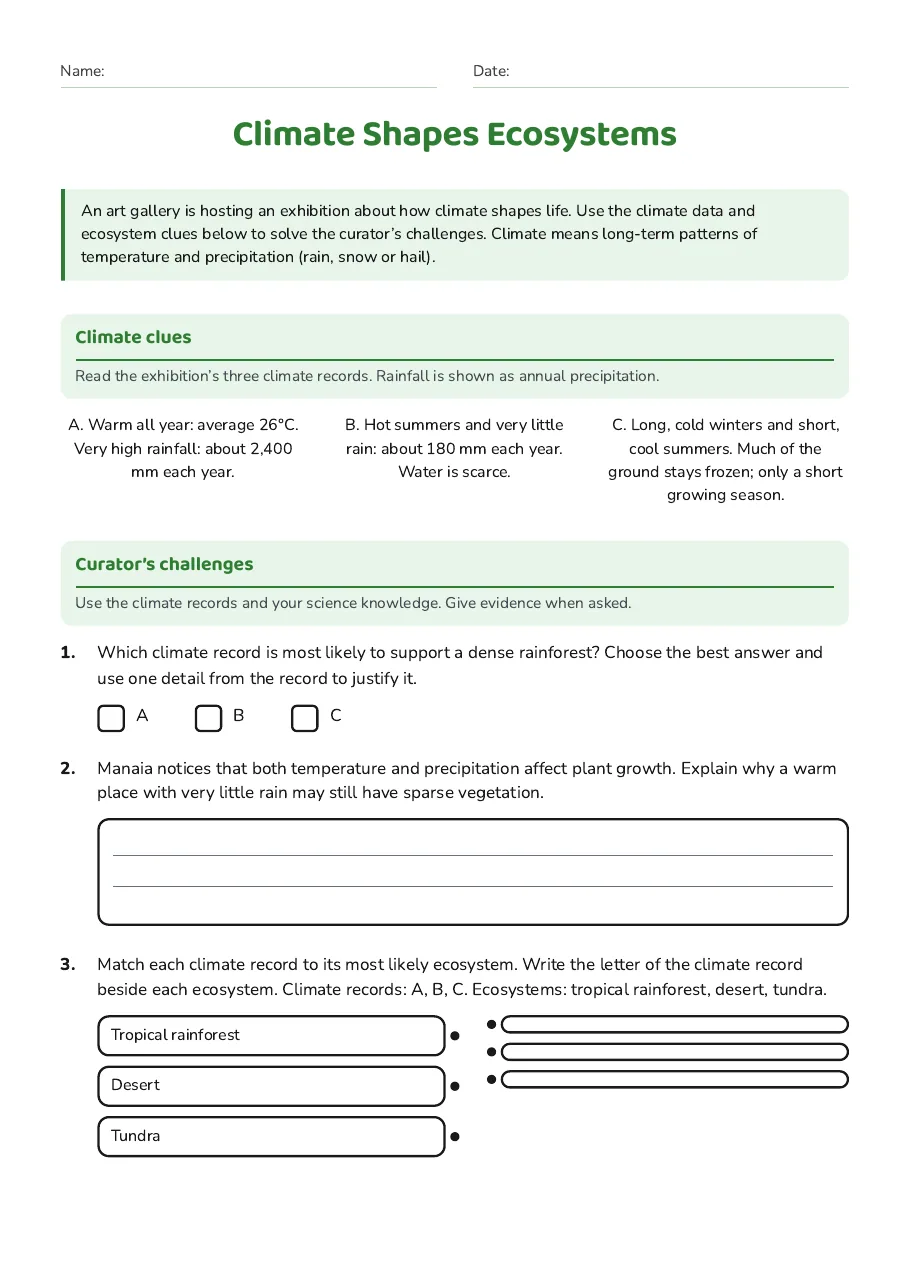
Climate Shapes Ecosystems

An art gallery is hosting an exhibition about how climate shapes life. Use the climate data and ecosystem clues below to solve the curator’s challenges. Climate means long-term patterns of temperature and precipitation (rain, snow or hail).

Climate clues

Read the exhibition’s three climate records. Rainfall is shown as annual precipitation.

A. Warm all year: average 26°C. Very high rainfall: about 2,400 mm each year.

B. Hot summers and very little rain: about 180 mm each year. Water is scarce.

C. Long, cold winters and short, cool summers. Much of the ground stays frozen; only a short growing season.

Curator’s challenges

Use the climate records and your science knowledge. Give evidence when asked.

1.Which climate record is most likely to support a dense rainforest? Choose the best answer and use one detail from the record to justify it.
  • A
  • B
  • C
2.Manaia notices that both temperature and precipitation affect plant growth. Explain why a warm place with very little rain may still have sparse vegetation.
3.Match each climate record to its most likely ecosystem. Write the letter of the climate record beside each ecosystem. Climate records: A, B, C. Ecosystems: tropical rainforest, desert, tundra.
  • Tropical rainforest
  • Desert
  • Tundra
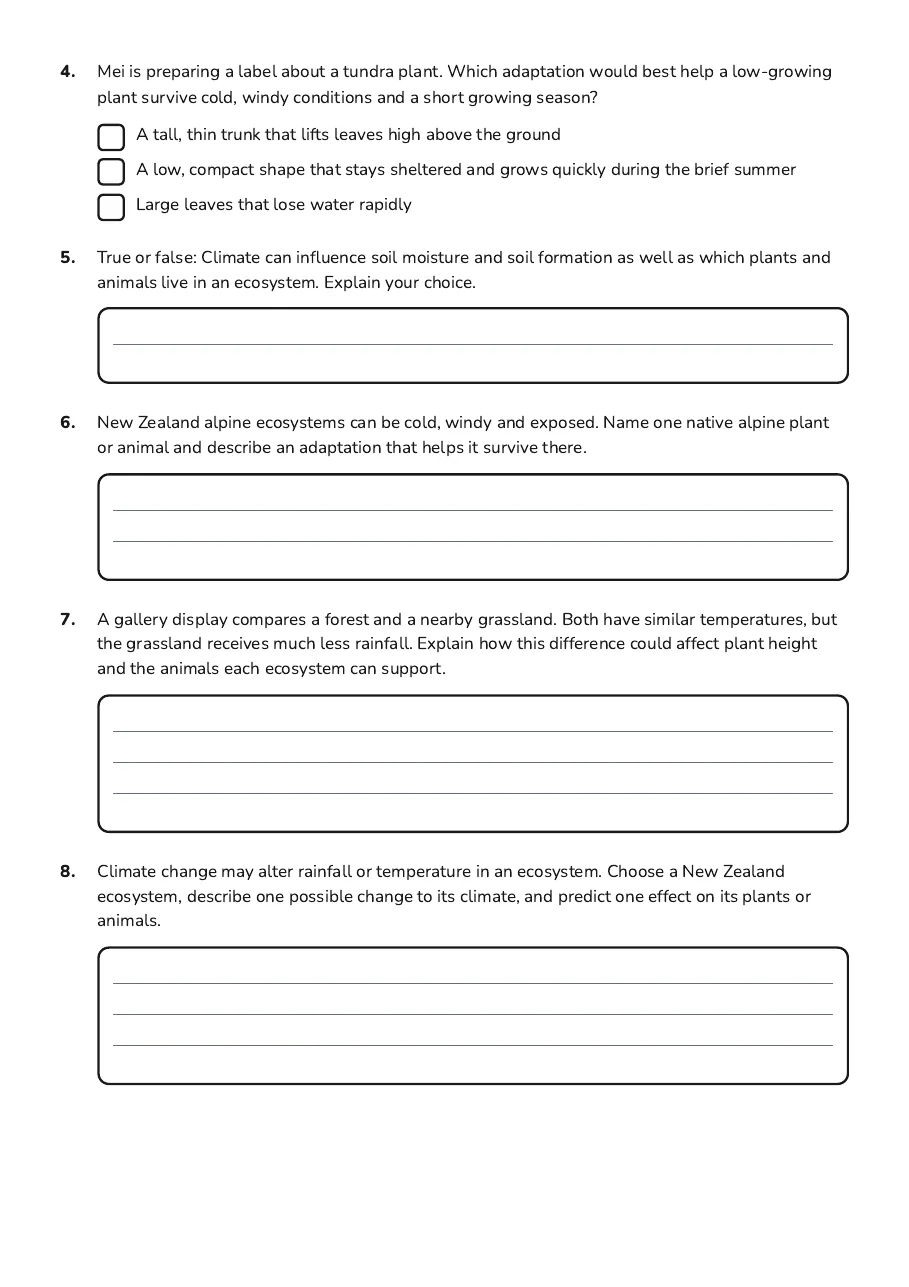
4.Mei is preparing a label about a tundra plant. Which adaptation would best help a low-growing plant survive cold, windy conditions and a short growing season?
  • A tall, thin trunk that lifts leaves high above the ground
  • A low, compact shape that stays sheltered and grows quickly during the brief summer
  • Large leaves that lose water rapidly
5.True or false: Climate can influence soil moisture and soil formation as well as which plants and animals live in an ecosystem. Explain your choice.
6.New Zealand alpine ecosystems can be cold, windy and exposed. Name one native alpine plant or animal and describe an adaptation that helps it survive there.
7.A gallery display compares a forest and a nearby grassland. Both have similar temperatures, but the grassland receives much less rainfall. Explain how this difference could affect plant height and the animals each ecosystem can support.
8.Climate change may alter rainfall or temperature in an ecosystem. Choose a New Zealand ecosystem, describe one possible change to its climate, and predict one effect on its plants or animals.
9.Mere claims, “Climate decides exactly which species live in every ecosystem.” Is this claim accurate? Improve it by explaining climate’s role and naming one other factor that can affect an ecosystem.

3 printable pages

  • Climate Shapes Ecosystems, page 1 of 3: Climate clues, Curator’s challenges

    Page 1

  • Climate Shapes Ecosystems, page 2 of 3: 4. Mei is preparing a label about a tundra plant. Which adaptation would best help a…

    Page 2

  • Climate Shapes Ecosystems, page 3 of 3: 9. Mere claims, “Climate decides exactly which species live in every ecosystem.” Is this…

    Page 3

About This Worksheet

Free in Kuraplan

Sign up free, grab the PDF, and customize it for your class.

Print-Ready

Formatted for standard paper. Clean layout, easy to read.

AI-Generated

Created with Kuraplan's AI, designed for real classroom use.

For Teachers & Parents

Use in classrooms, for homework, tutoring, or homeschool.

Need a custom version of this worksheet?

Kuraplan's AI generates custom worksheets in seconds — differentiated for every learner, aligned to your curriculum.

Generate Custom Worksheets — Free
No credit card Curriculum-aligned Under 60 seconds