MathsFreePrintable

Compound Pool Design

A free maths worksheet ready for your classroom. Open in Kuraplan to grab the print-ready PDF, customize it for your students, or generate a fresh version in seconds.
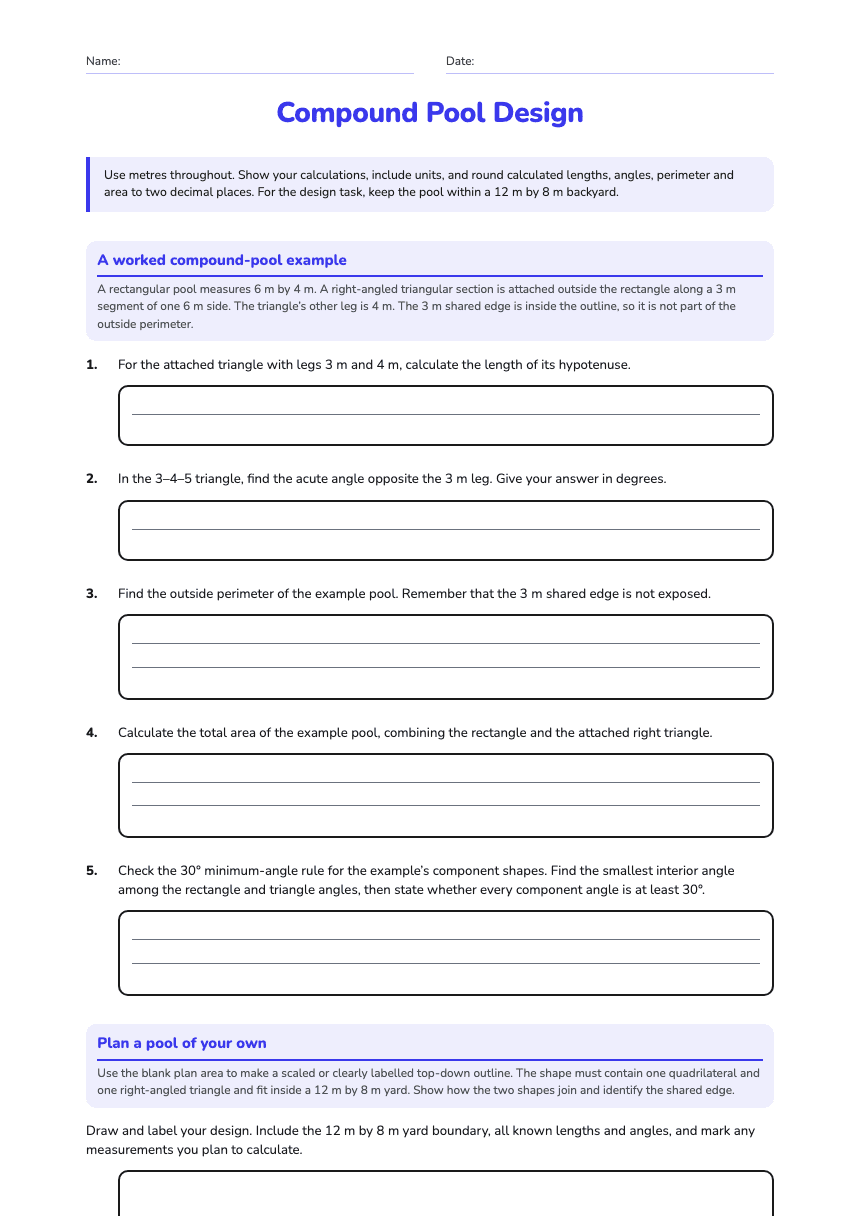
Compound Pool Design worksheet preview
Name:Date:

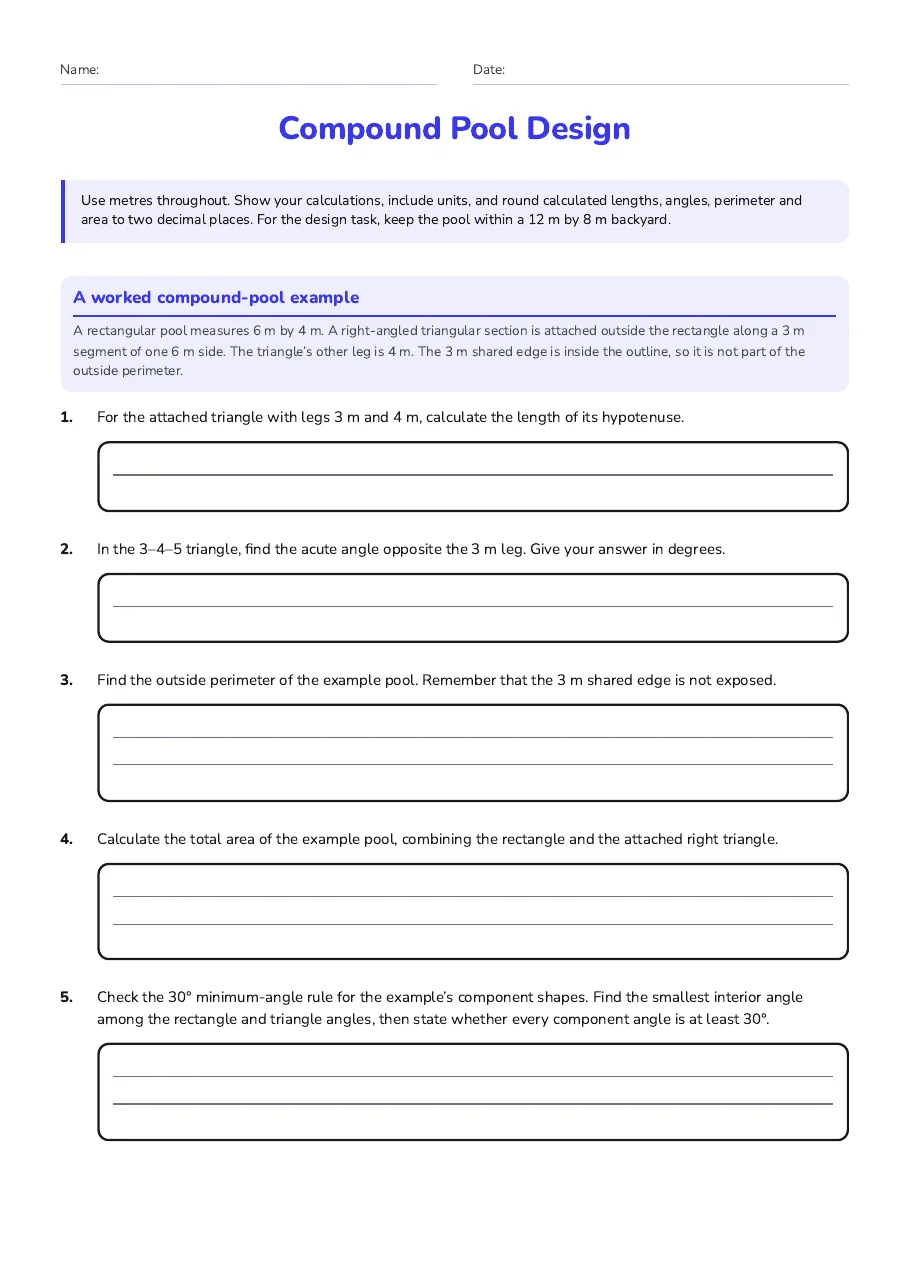
Compound Pool Design

Use metres throughout. Show your calculations, include units, and round calculated lengths, angles, perimeter and area to two decimal places. For the design task, keep the pool within a 12 m by 8 m backyard.

A worked compound-pool example

A rectangular pool measures 6 m by 4 m. A right-angled triangular section is attached outside the rectangle along a 3 m segment of one 6 m side. The triangle’s other leg is 4 m. The 3 m shared edge is inside the outline, so it is not part of the outside perimeter.

1.For the attached triangle with legs 3 m and 4 m, calculate the length of its hypotenuse.
2.In the 3–4–5 triangle, find the acute angle opposite the 3 m leg. Give your answer in degrees.
3.Find the outside perimeter of the example pool. Remember that the 3 m shared edge is not exposed.
4.Calculate the total area of the example pool, combining the rectangle and the attached right triangle.
5.Check the 30° minimum-angle rule for the example’s component shapes. Find the smallest interior angle among the rectangle and triangle angles, then state whether every component angle is at least 30°.

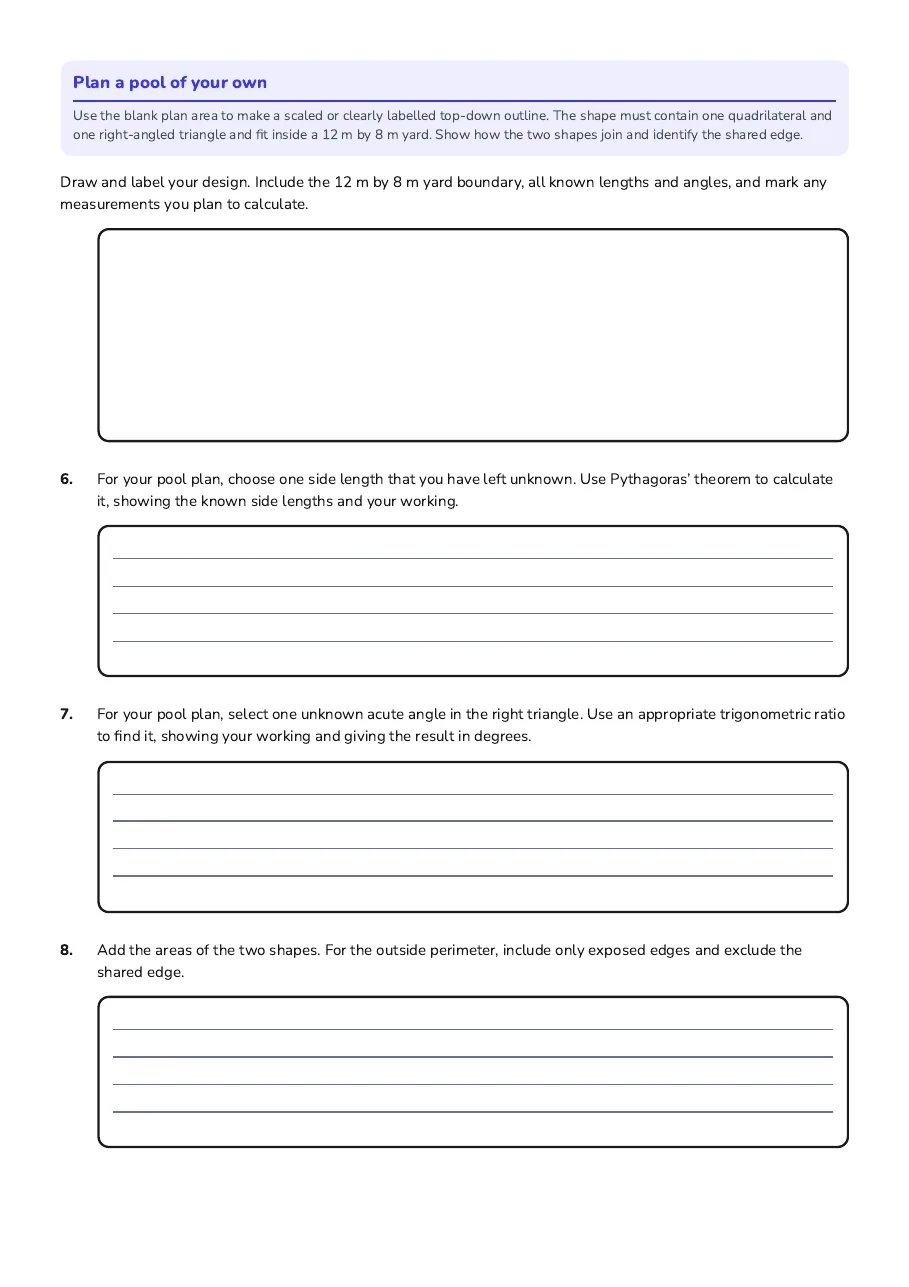
Plan a pool of your own

Use the blank plan area to make a scaled or clearly labelled top-down outline. The shape must contain one quadrilateral and one right-angled triangle and fit inside a 12 m by 8 m yard. Show how the two shapes join and identify the shared edge.

Draw and label your design. Include the 12 m by 8 m yard boundary, all known lengths and angles, and mark any measurements you plan to calculate.
6.For your pool plan, choose one side length that you have left unknown. Use Pythagoras’ theorem to calculate it, showing the known side lengths and your working.
7.For your pool plan, select one unknown acute angle in the right triangle. Use an appropriate trigonometric ratio to find it, showing your working and giving the result in degrees.
8.Add the areas of the two shapes. For the outside perimeter, include only exposed edges and exclude the shared edge.
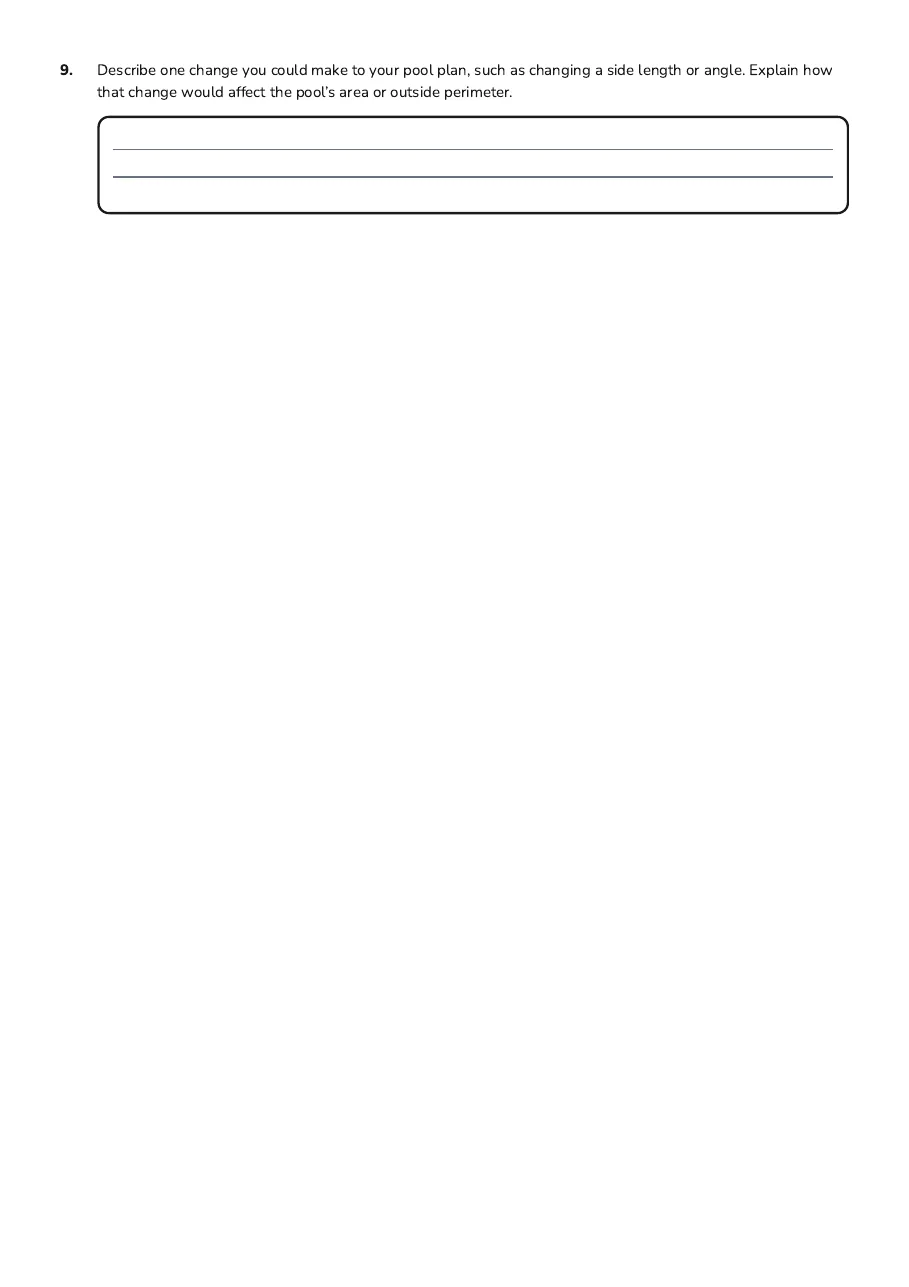
9.Describe one change you could make to your pool plan, such as changing a side length or angle. Explain how that change would affect the pool’s area or outside perimeter.

3 printable pages

  • Compound Pool Design, page 1 of 3: A worked compound-pool example

    Page 1

  • Compound Pool Design, page 2 of 3: Plan a pool of your own

    Page 2

  • Compound Pool Design, page 3 of 3: 9. Describe one change you could make to your pool plan, such as changing a side length…

    Page 3

About This Worksheet

Free in Kuraplan

Sign up free, grab the PDF, and customize it for your class.

Print-Ready

Formatted for standard paper. Clean layout, easy to read.

AI-Generated

Created with Kuraplan's AI, designed for real classroom use.

For Teachers & Parents

Use in classrooms, for homework, tutoring, or homeschool.

Need a custom version of this worksheet?

Kuraplan's AI generates custom worksheets in seconds — differentiated for every learner, aligned to your curriculum.

Generate Custom Worksheets — Free
No credit card Curriculum-aligned Under 60 seconds