FreePrintable

Critical Reading Fundamentals

A free, printable general worksheet ready for your classroom. Download instantly, print, and hand out to your students — no account needed.
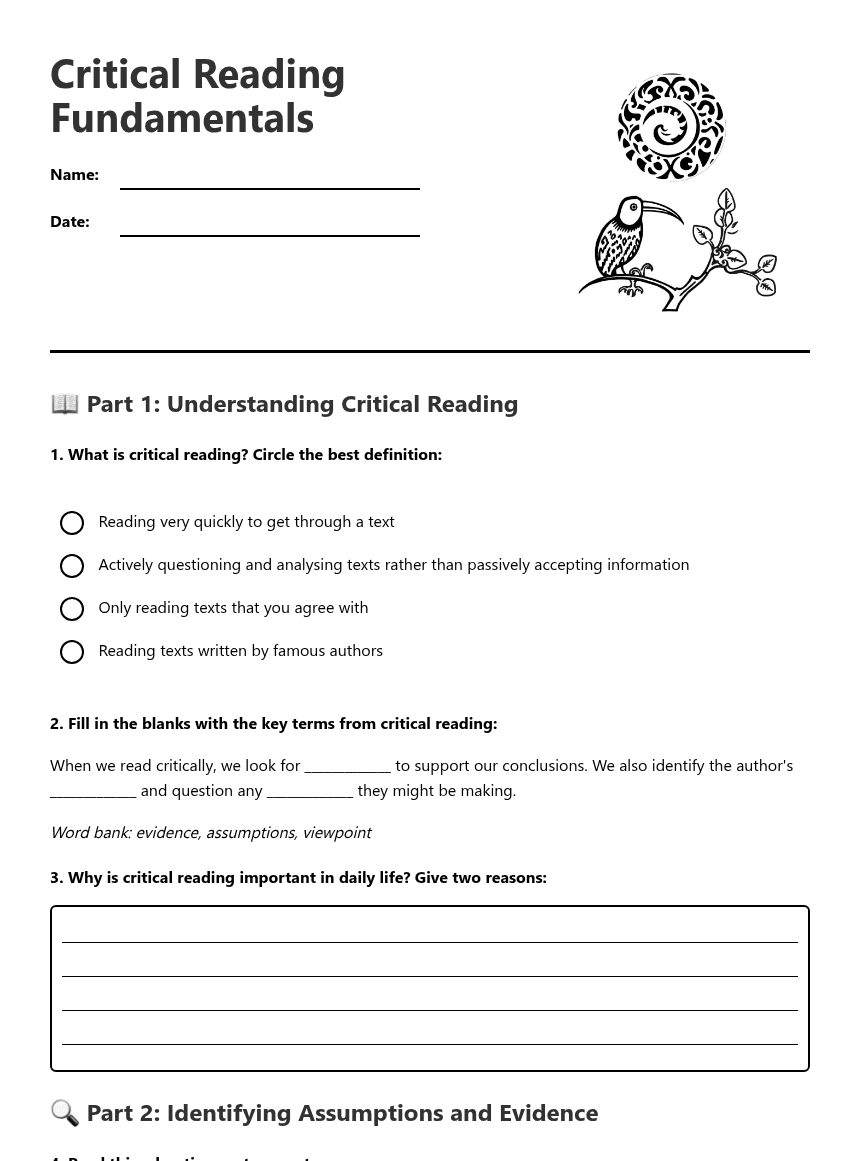
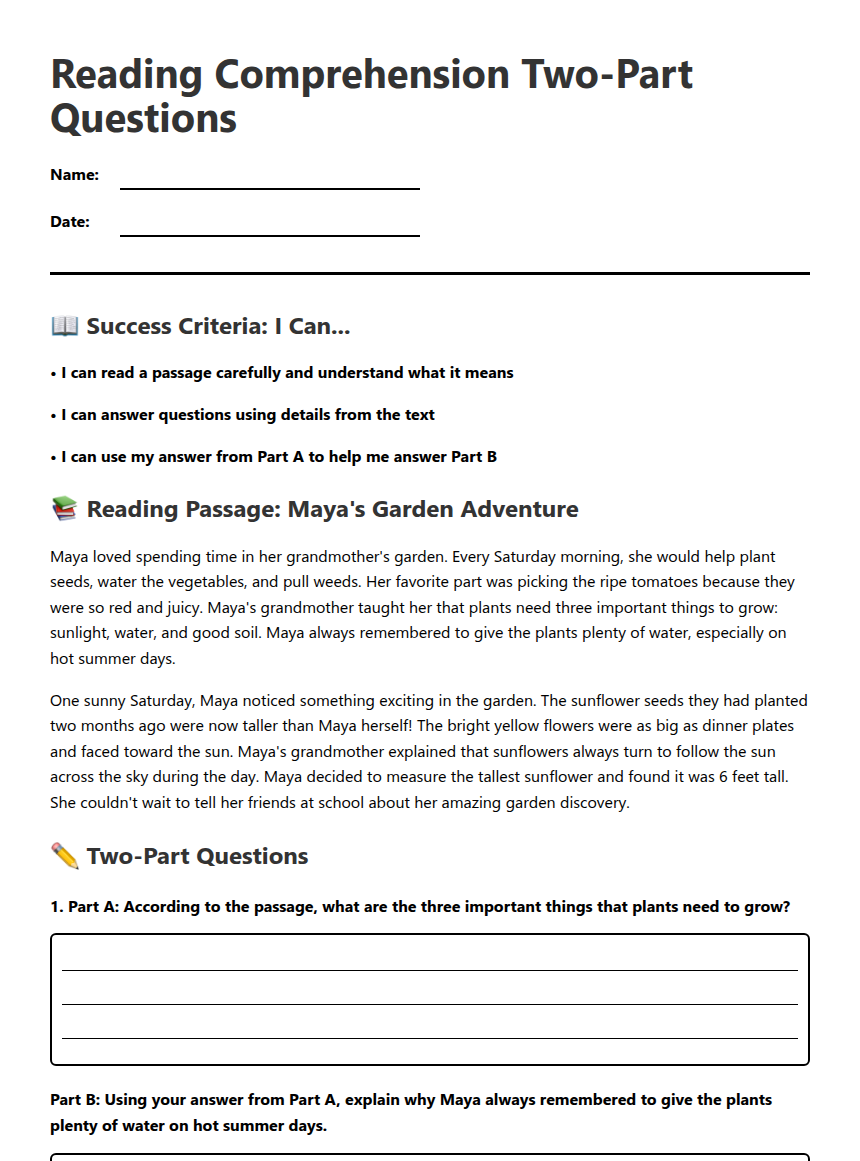
Critical Reading Fundamentals worksheet preview

Critical Reading Fundamentals

Critical Reading Fundamentals

Critical reading illustration

📖 Part 1: Understanding Critical Reading

1. What is critical reading? Circle the best definition:

Reading very quickly to get through a text

Actively questioning and analysing texts rather than passively accepting information

Only reading texts that you agree with

Reading texts written by famous authors

2. Fill in the blanks with the key terms from critical reading:

When we read critically, we look for _____________ to support our conclusions. We also identify the author's _____________ and question any _____________ they might be making.

Word bank: evidence, assumptions, viewpoint

3. Why is critical reading important in daily life? Give two reasons:

🔍 Part 2: Identifying Assumptions and Evidence

4. Read this advertisement excerpt:

"SuperClean washing powder gets your clothes 50% cleaner than ordinary brands! Thousands of satisfied customers can't be wrong. Make the smart choice for your family today."

a) What assumptions does this advertisement make? Check all that apply:

All customers want the cleanest possible clothes

Other brands are inferior

Being "smart" means choosing this product

Thousands of customers proves the product works

b) What evidence does the advertisement provide to support its claims?
c) What questions might a critical reader ask about this advertisement?

📰 Part 3: Analysing a Text Extract

5. Read this opinion piece excerpt:

"Social media is destroying young people's ability to communicate face-to-face. I've observed teenagers at cafés, all staring at their phones instead of talking to each other. This generation has lost the art of real conversation, and it's only getting worse."

a) What is the author's main conclusion?
b) What evidence does the author provide?
c) What assumptions is the author making? List at least two:
d) How strong is this argument? Explain your reasoning:

🎯 Part 4: Critical Reading in Practice

6. Match each critical reading skill with its definition:
1. Identifying bias
2. Finding evidence
3. Questioning assumptions
4. Considering viewpoints
A. Looking for facts that support claims
B. Recognising unfair prejudice in writing
C. Challenging ideas taken for granted
D. Understanding different perspectives
7. Think of a time when you accepted information without questioning it. What happened, and how could critical reading have helped?
8. Complete this statement: "A critical reader always..."

Disagrees with everything they read

Looks for evidence and questions assumptions

Only reads academic texts

Reads very slowly

💭 Part 5: Reflection and Application

9. List three questions you can ask yourself while reading to be more critical:
10. How can critical reading skills help you in subjects other than English? Give specific examples:
11. Exit Ticket: Write one thing you learned about critical reading and one question you still have:

What I learned: _________________________________________________

My question: ____________________________________________________

About This Worksheet

Free Download

No sign-up, no email, no paywall. Just download and print.

Print-Ready

Formatted for standard paper. Clean layout, easy to read.

AI-Generated

Created with Kuraplan's AI, designed for real classroom use.

For Teachers & Parents

Use in classrooms, for homework, tutoring, or homeschool.

Need a custom version of this worksheet?

Kuraplan's AI generates custom worksheets in seconds — differentiated for every learner, aligned to your curriculum.

Generate Custom Worksheets — Free
No credit card Curriculum-aligned Under 60 seconds