Europe at War Worksheet
A free au history worksheet ready for your classroom. Open in Kuraplan to grab the print-ready PDF, customize it for your students, or generate a fresh version in seconds.
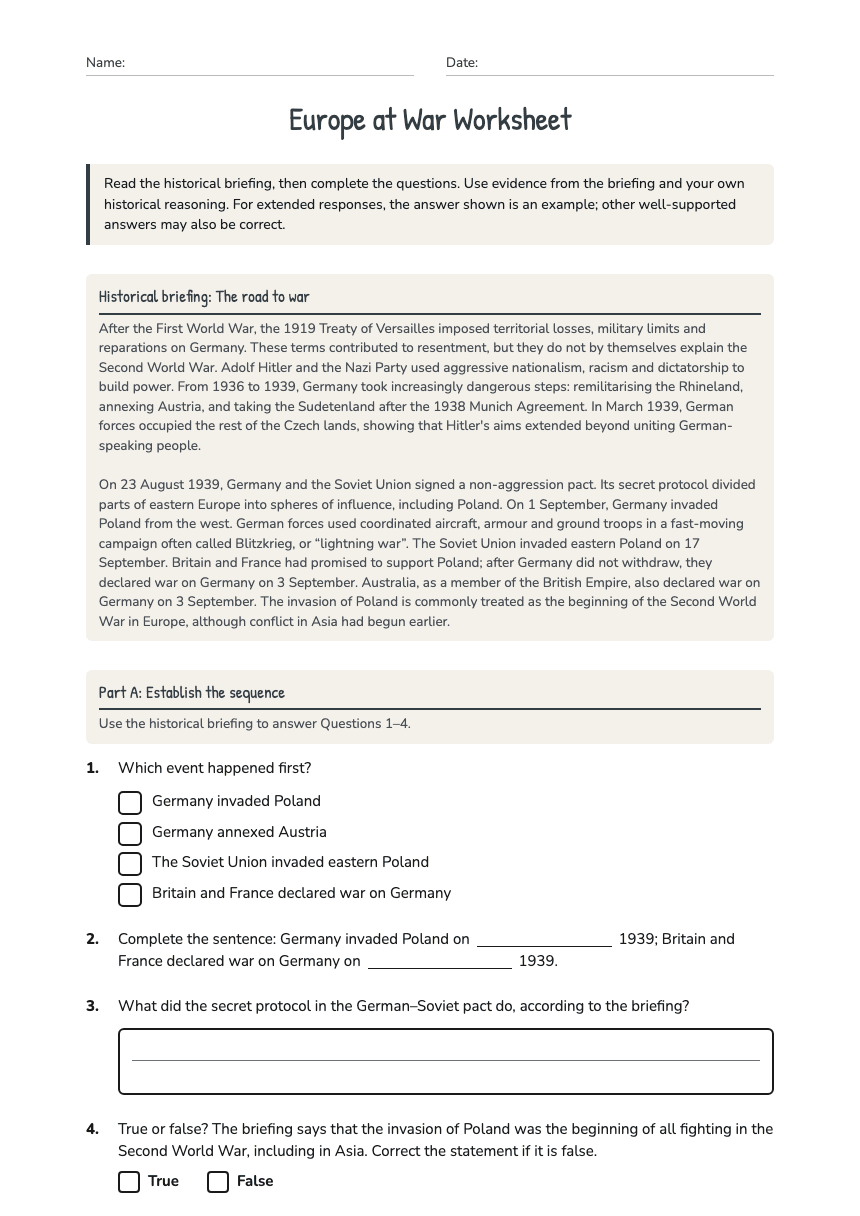
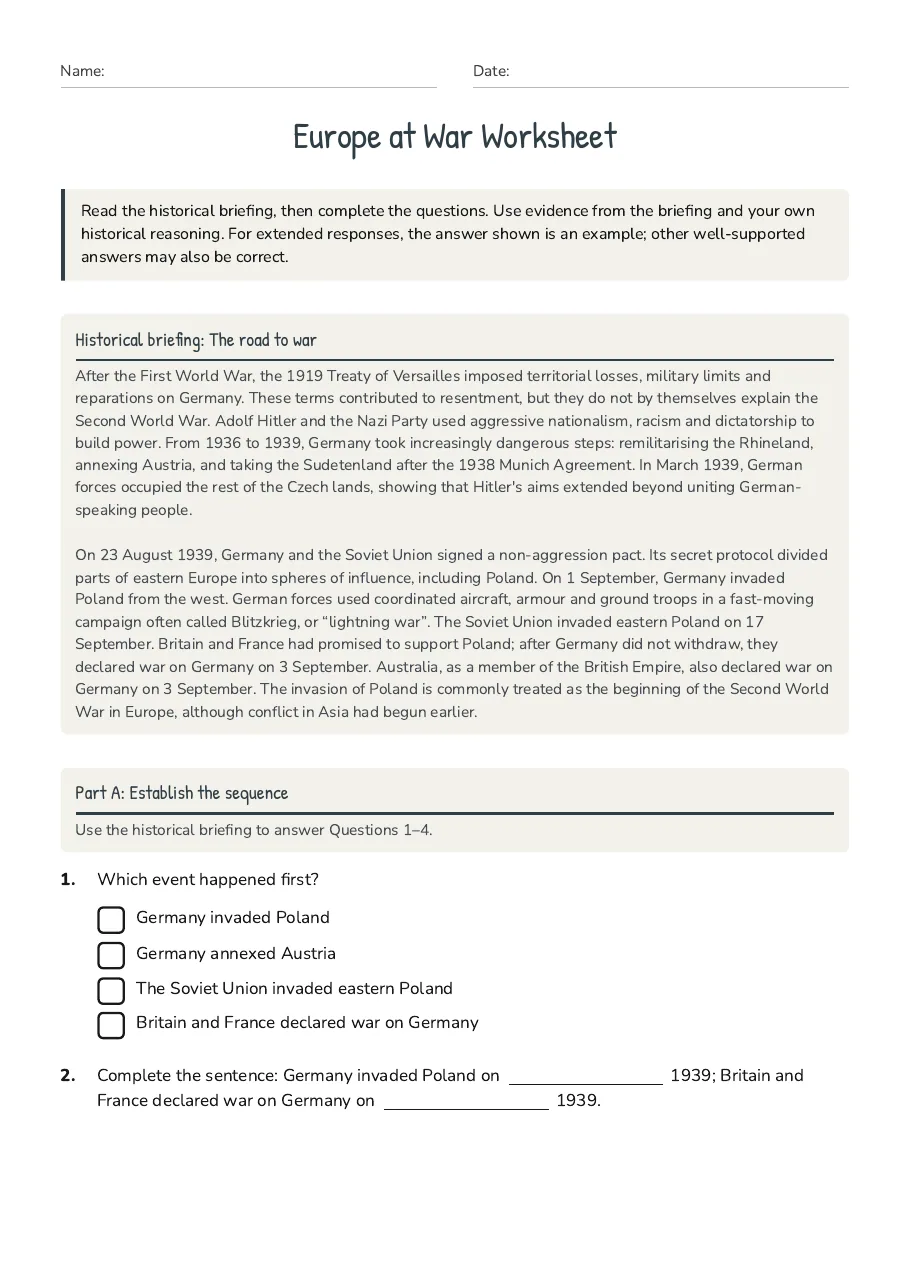
Europe at War Worksheet
Historical briefing: The road to war
After the First World War, the 1919 Treaty of Versailles imposed territorial losses, military limits and reparations on Germany. These terms contributed to resentment, but they do not by themselves explain the Second World War. Adolf Hitler and the Nazi Party used aggressive nationalism, racism and dictatorship to build power. From 1936 to 1939, Germany took increasingly dangerous steps: remilitarising the Rhineland, annexing Austria, and taking the Sudetenland after the 1938 Munich Agreement. In March 1939, German forces occupied the rest of the Czech lands, showing that Hitler's aims extended beyond uniting German-speaking people. On 23 August 1939, Germany and the Soviet Union signed a non-aggression pact. Its secret protocol divided parts of eastern Europe into spheres of influence, including Poland. On 1 September, Germany invaded Poland from the west. German forces used coordinated aircraft, armour and ground troops in a fast-moving campaign often called Blitzkrieg, or “lightning war”. The Soviet Union invaded eastern Poland on 17 September. Britain and France had promised to support Poland; after Germany did not withdraw, they declared war on Germany on 3 September. Australia, as a member of the British Empire, also declared war on Germany on 3 September. The invasion of Poland is commonly treated as the beginning of the Second World War in Europe, although conflict in Asia had begun earlier.
Part A: Establish the sequence
Use the historical briefing to answer Questions 1–4.
- Germany invaded Poland
- Germany annexed Austria
- The Soviet Union invaded eastern Poland
- Britain and France declared war on Germany
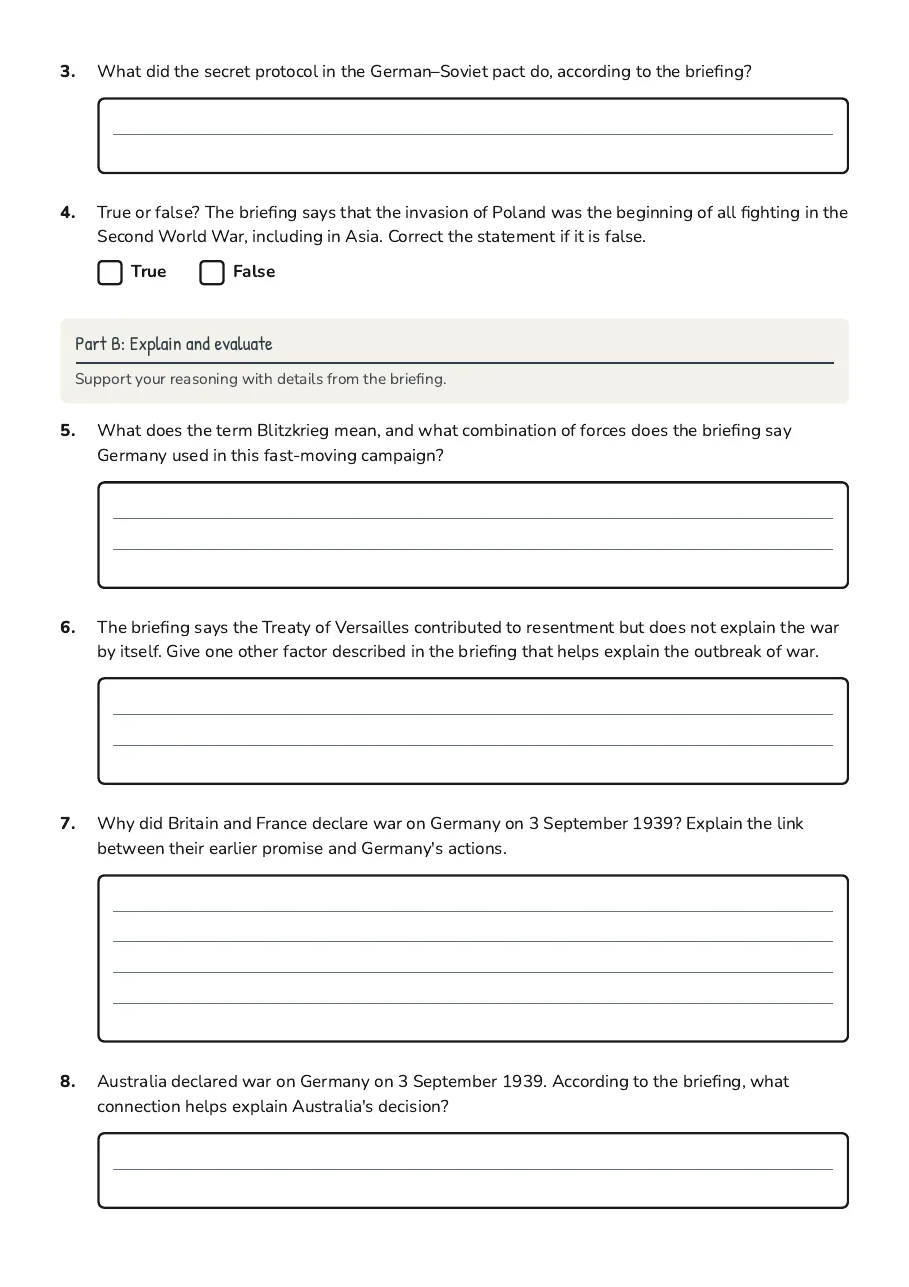
Part B: Explain and evaluate
Support your reasoning with details from the briefing.
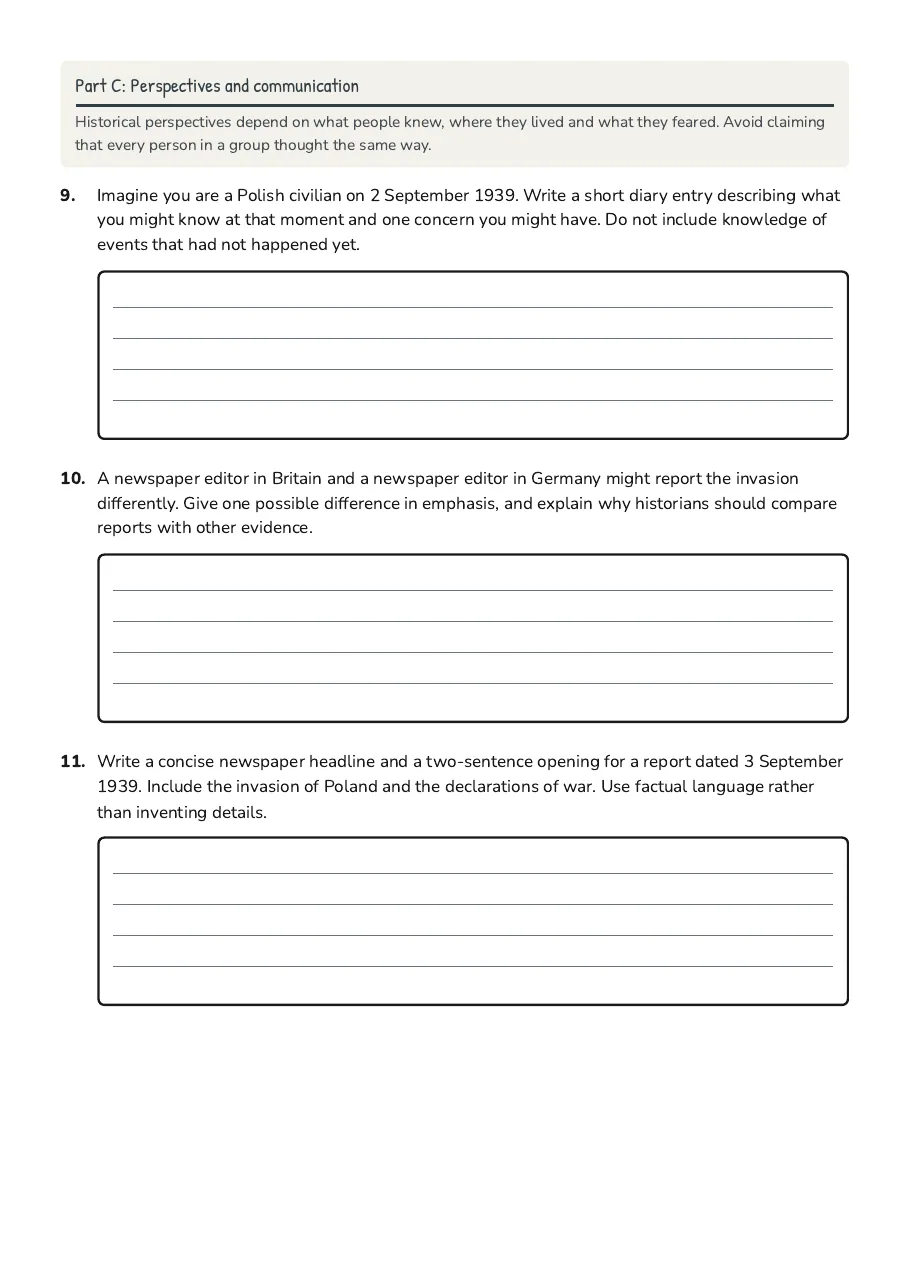
Part C: Perspectives and communication
Historical perspectives depend on what people knew, where they lived and what they feared. Avoid claiming that every person in a group thought the same way.
3 printable pages
Page 1
Page 2
Page 3
About This Worksheet
Free in Kuraplan
Sign up free, grab the PDF, and customize it for your class.
Print-Ready
Formatted for standard paper. Clean layout, easy to read.
AI-Generated
Created with Kuraplan's AI, designed for real classroom use.
For Teachers & Parents
Use in classrooms, for homework, tutoring, or homeschool.
Need a custom version of this worksheet?
Kuraplan's AI generates custom worksheets in seconds — differentiated for every learner, aligned to your curriculum.
Generate Custom Worksheets — Free