Formation of the Bible
A free religious education worksheet ready for your classroom. Open in Kuraplan to grab the print-ready PDF, customize it for your students, or generate a fresh version in seconds.
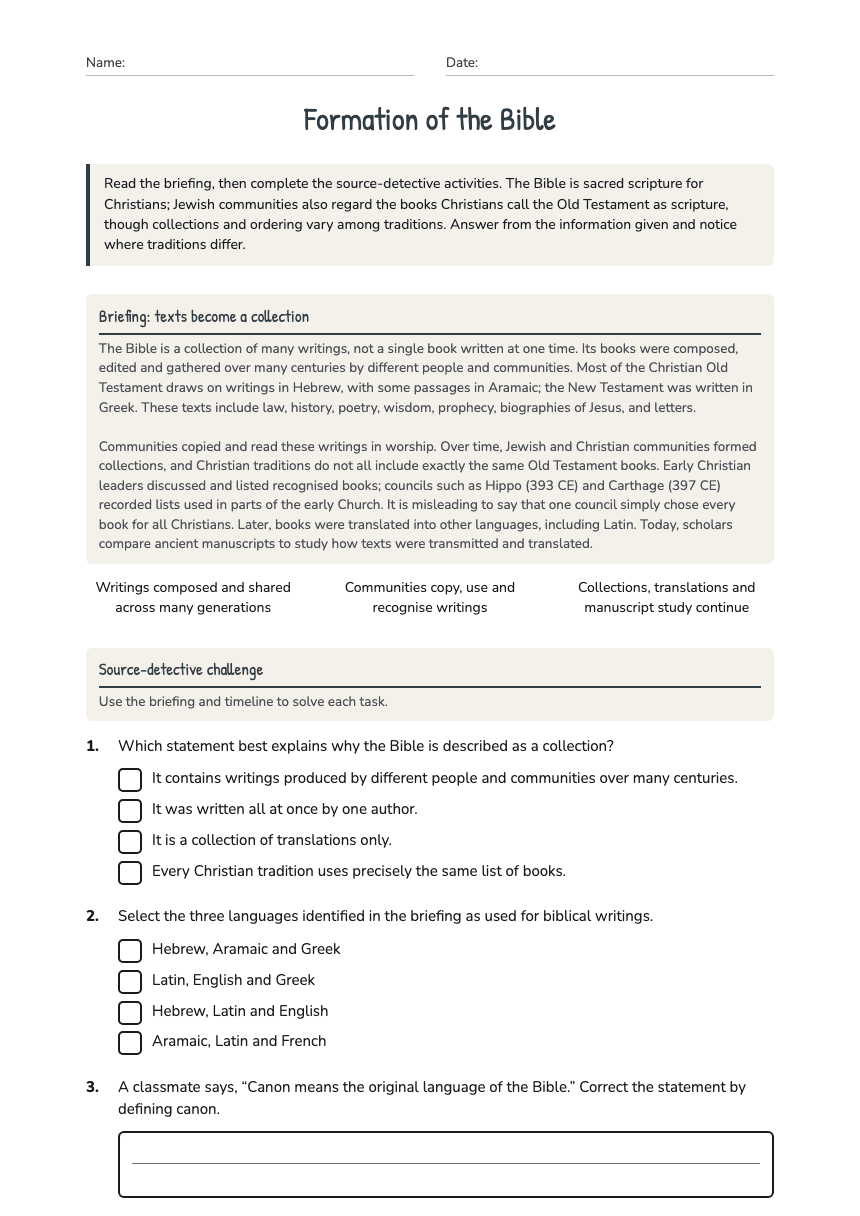
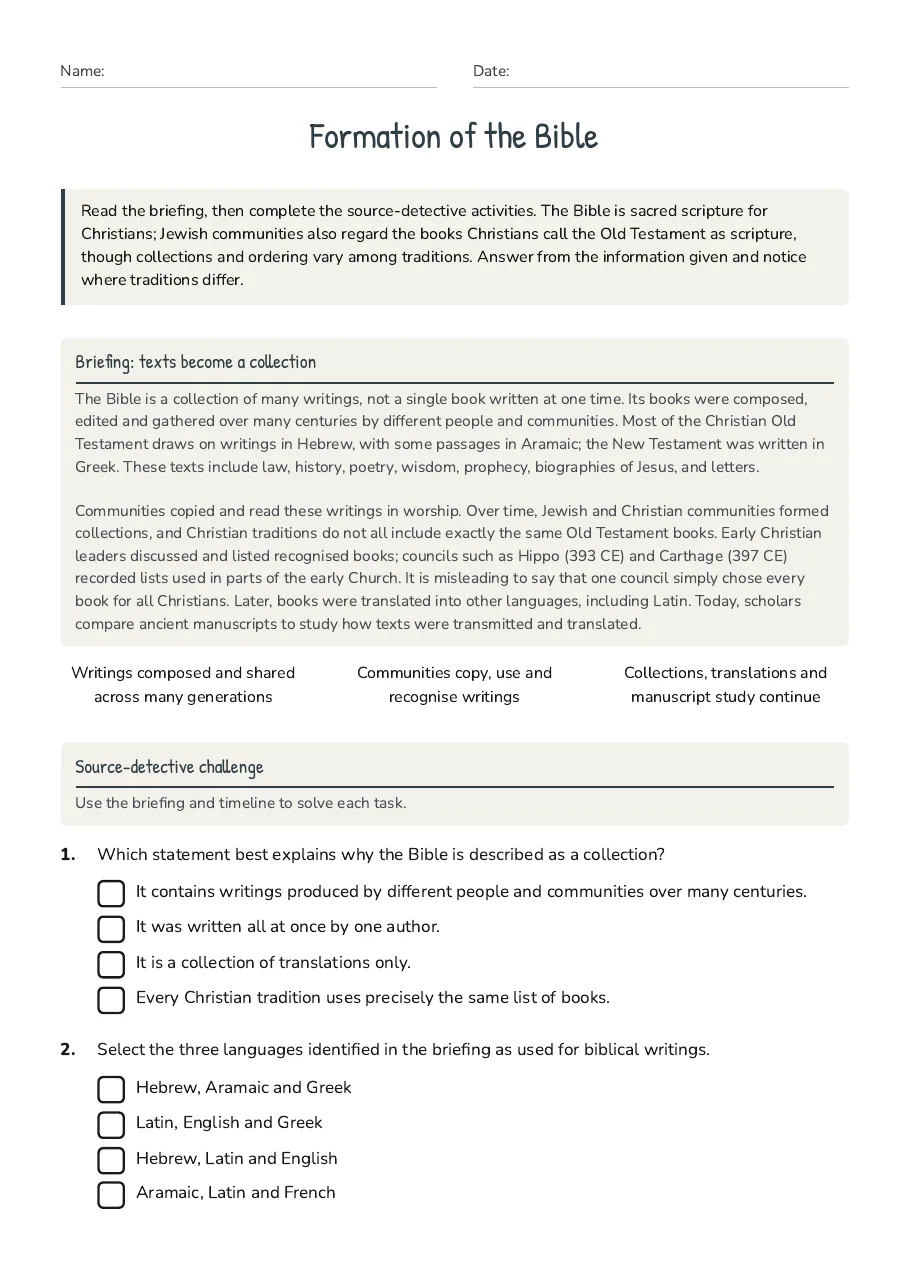
Formation of the Bible
Briefing: texts become a collection
The Bible is a collection of many writings, not a single book written at one time. Its books were composed, edited and gathered over many centuries by different people and communities. Most of the Christian Old Testament draws on writings in Hebrew, with some passages in Aramaic; the New Testament was written in Greek. These texts include law, history, poetry, wisdom, prophecy, biographies of Jesus, and letters. Communities copied and read these writings in worship. Over time, Jewish and Christian communities formed collections, and Christian traditions do not all include exactly the same Old Testament books. Early Christian leaders discussed and listed recognised books; councils such as Hippo (393 CE) and Carthage (397 CE) recorded lists used in parts of the early Church. It is misleading to say that one council simply chose every book for all Christians. Later, books were translated into other languages, including Latin. Today, scholars compare ancient manuscripts to study how texts were transmitted and translated.
Writings composed and shared across many generations
Communities copy, use and recognise writings
Collections, translations and manuscript study continue
Source-detective challenge
Use the briefing and timeline to solve each task.
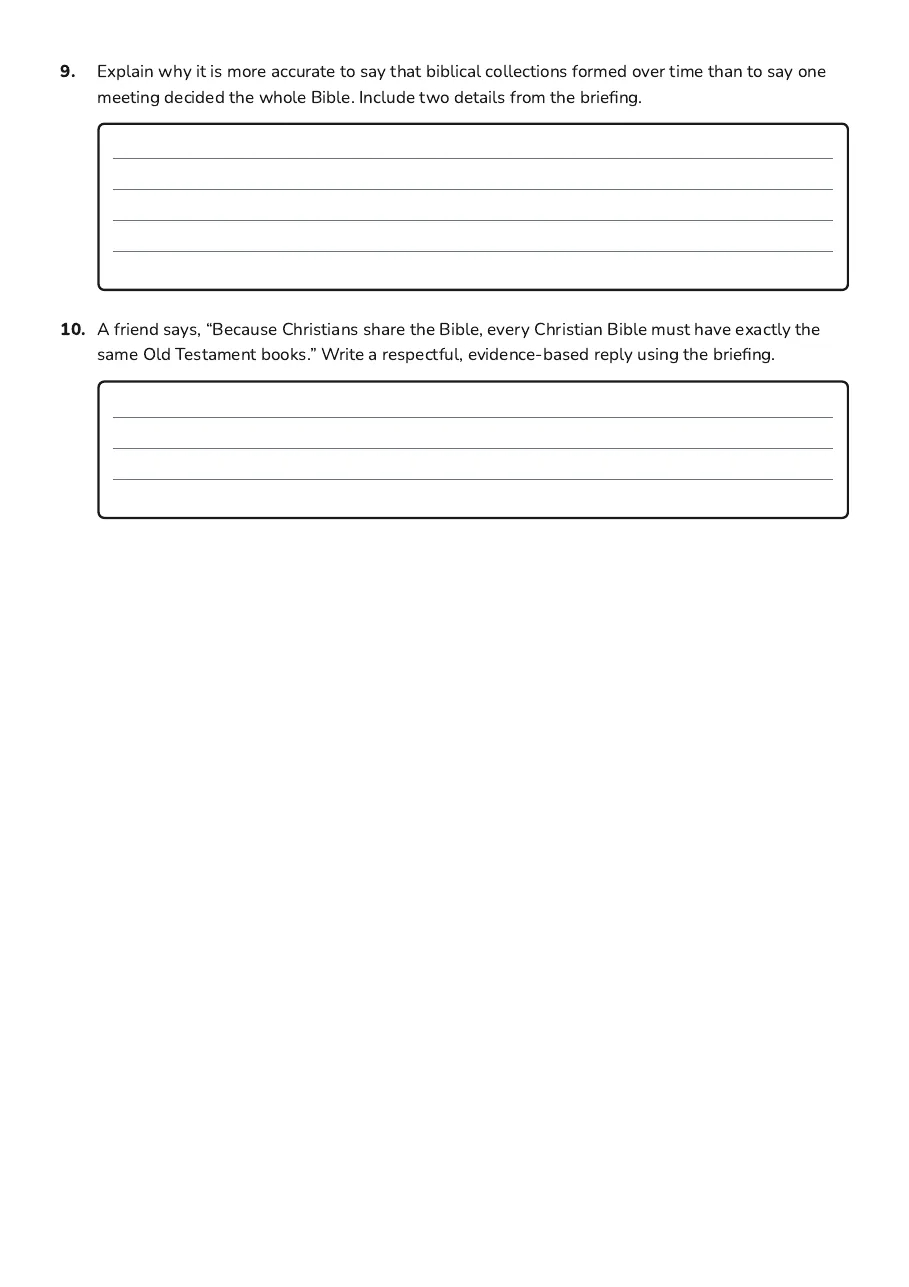
- It contains writings produced by different people and communities over many centuries.
- It was written all at once by one author.
- It is a collection of translations only.
- Every Christian tradition uses precisely the same list of books.
- Hebrew, Aramaic and Greek
- Latin, English and Greek
- Hebrew, Latin and English
- Aramaic, Latin and French
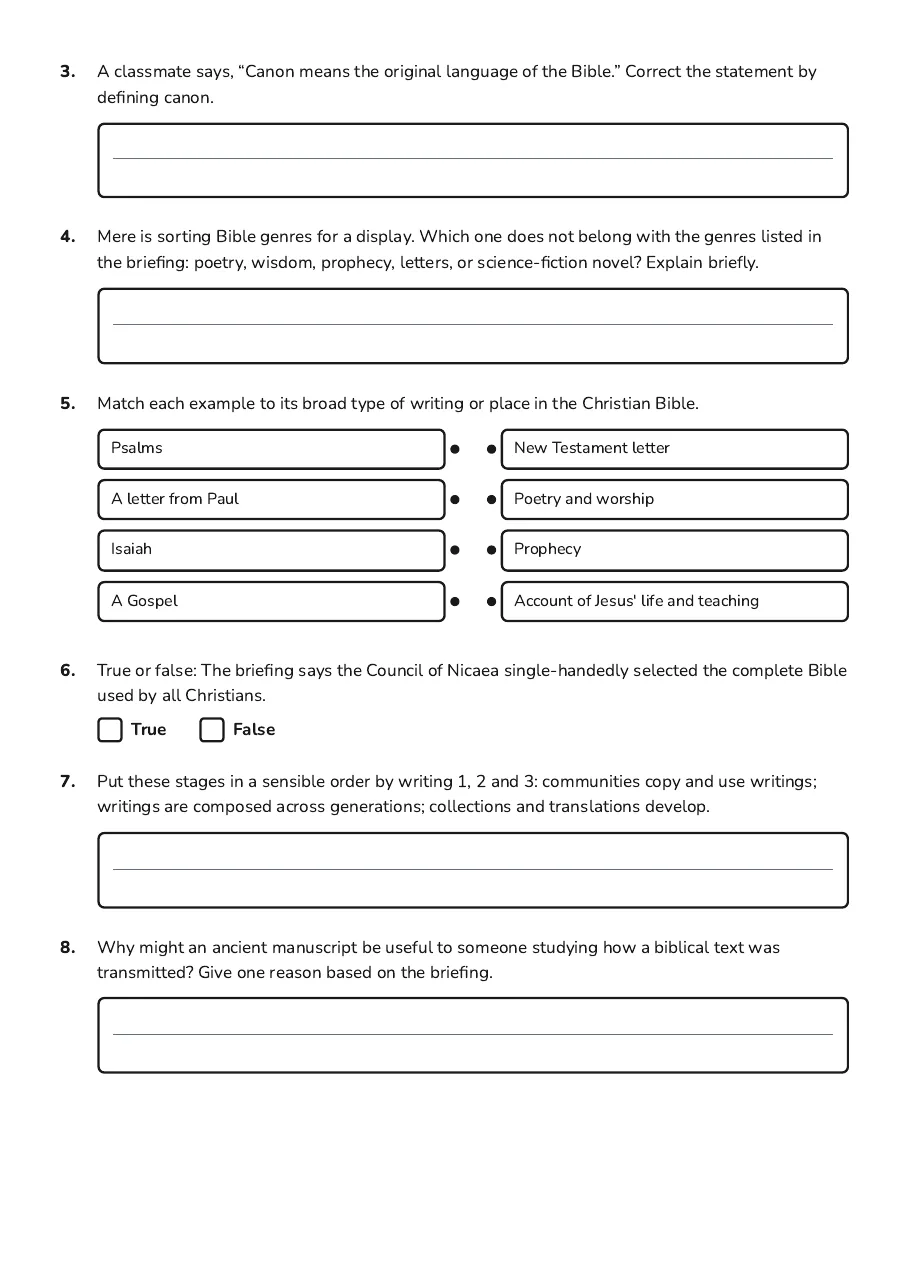
- Psalms
- A letter from Paul
- Isaiah
- A Gospel
- New Testament letter
- Poetry and worship
- Prophecy
- Account of Jesus' life and teaching
3 printable pages
Page 1
Page 2
Page 3
About This Worksheet
Free in Kuraplan
Sign up free, grab the PDF, and customize it for your class.
Print-Ready
Formatted for standard paper. Clean layout, easy to read.
AI-Generated
Created with Kuraplan's AI, designed for real classroom use.
For Teachers & Parents
Use in classrooms, for homework, tutoring, or homeschool.
Need a custom version of this worksheet?
Kuraplan's AI generates custom worksheets in seconds — differentiated for every learner, aligned to your curriculum.
Generate Custom Worksheets — FreeMore Religious Education Worksheets
Letter Formation Practice
Free
Tauranga Information Report Writing
Free
Geometry Transformations Practice
Free
Borax Crystal Formation Experiment
Free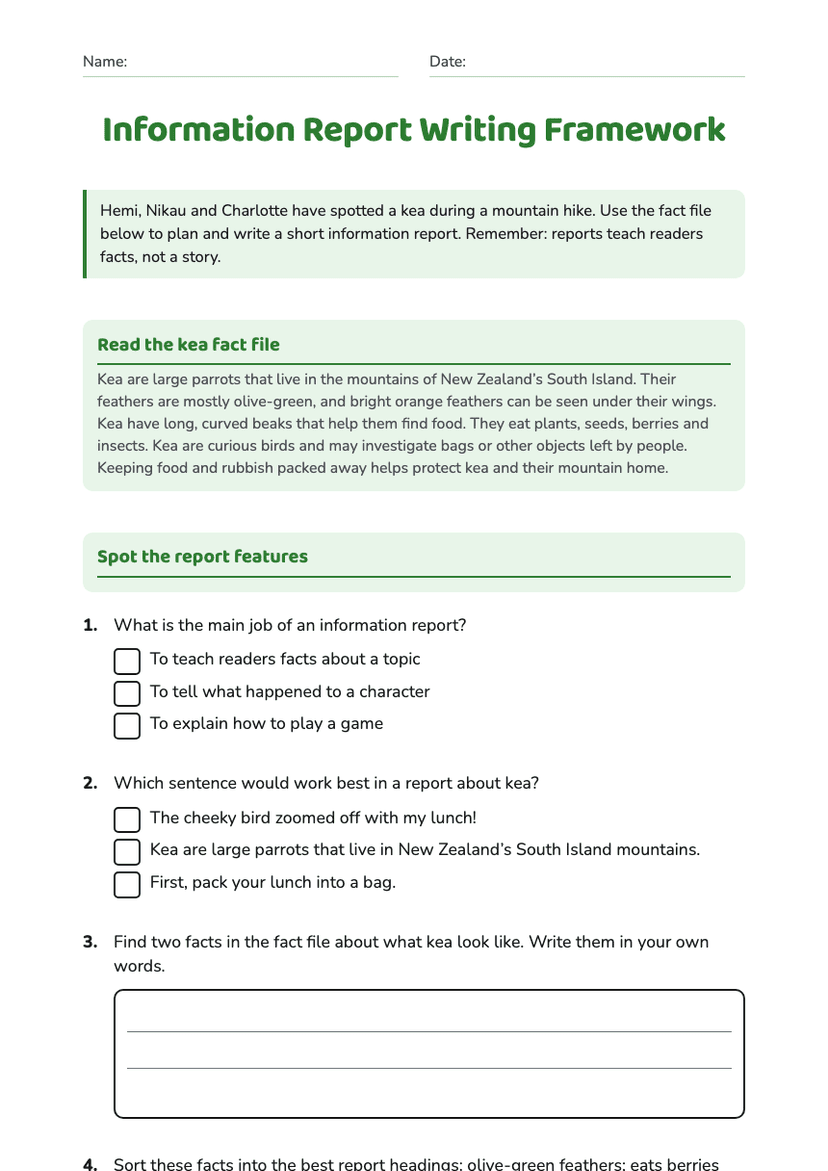
Information Report Writing Framework
Free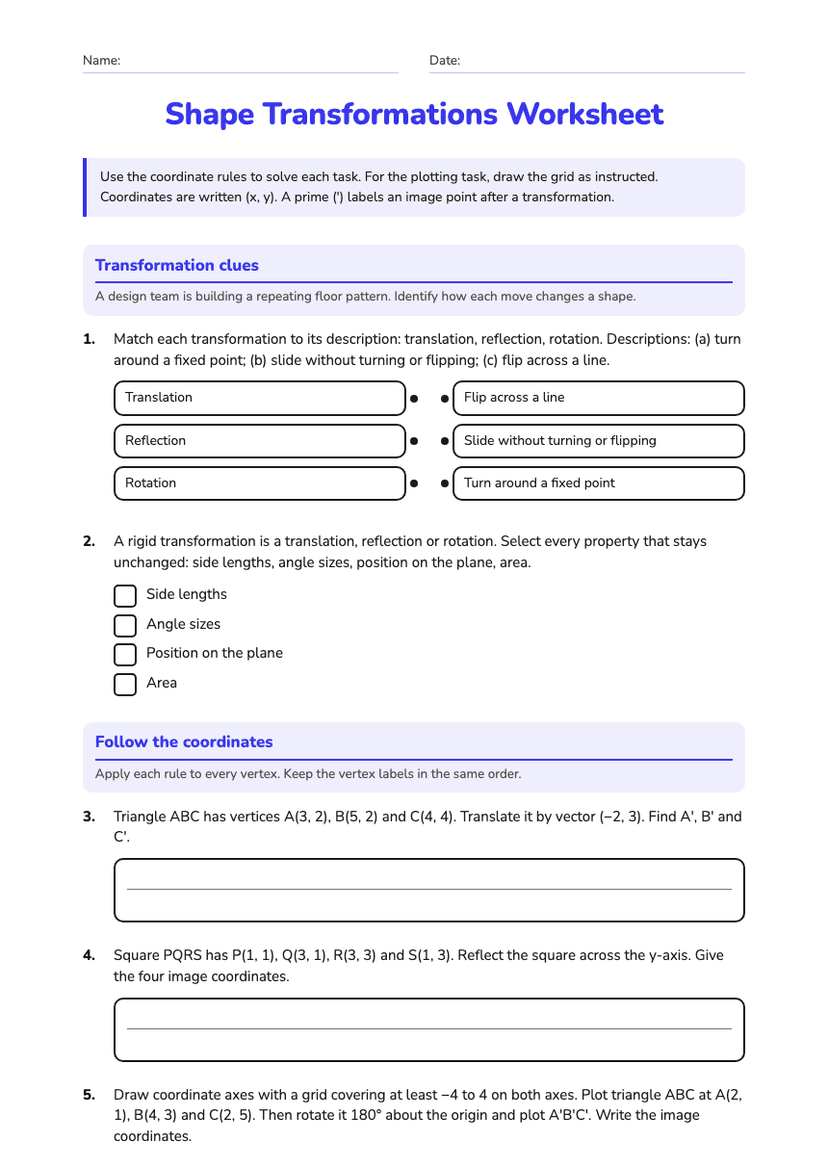
Shape Transformations Worksheet
Free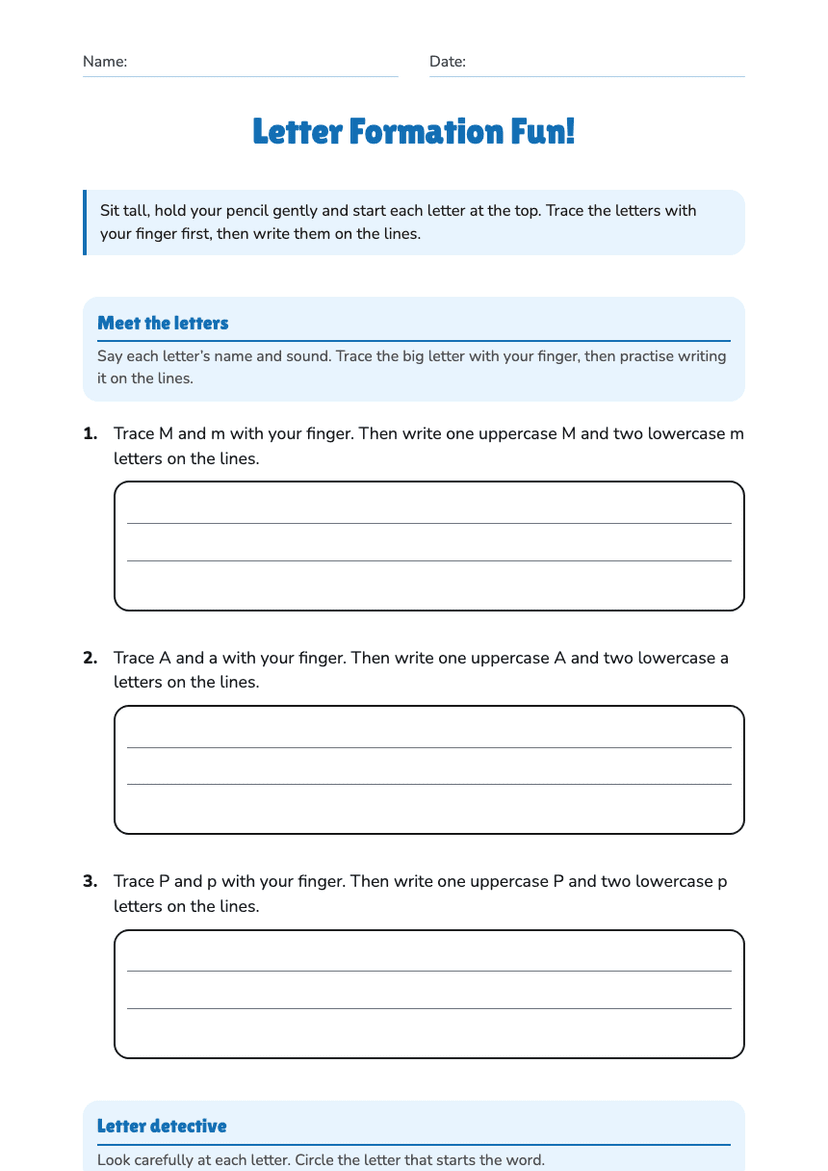
Letter Formation Fun!
Free