French Revolution Perspectives Worksheet
A free social sciences worksheet ready for your classroom. Open in Kuraplan to grab the print-ready PDF, customize it for your students, or generate a fresh version in seconds.
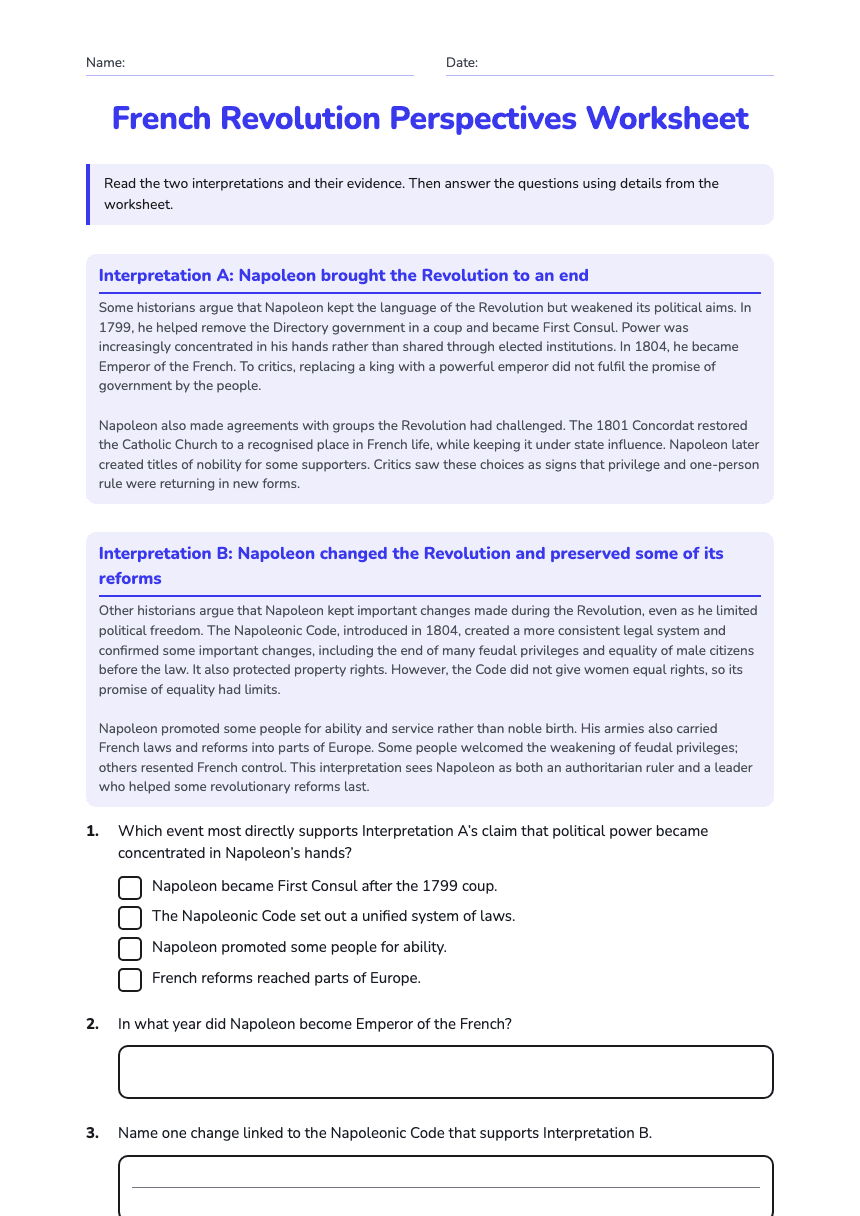
French Revolution Perspectives Worksheet
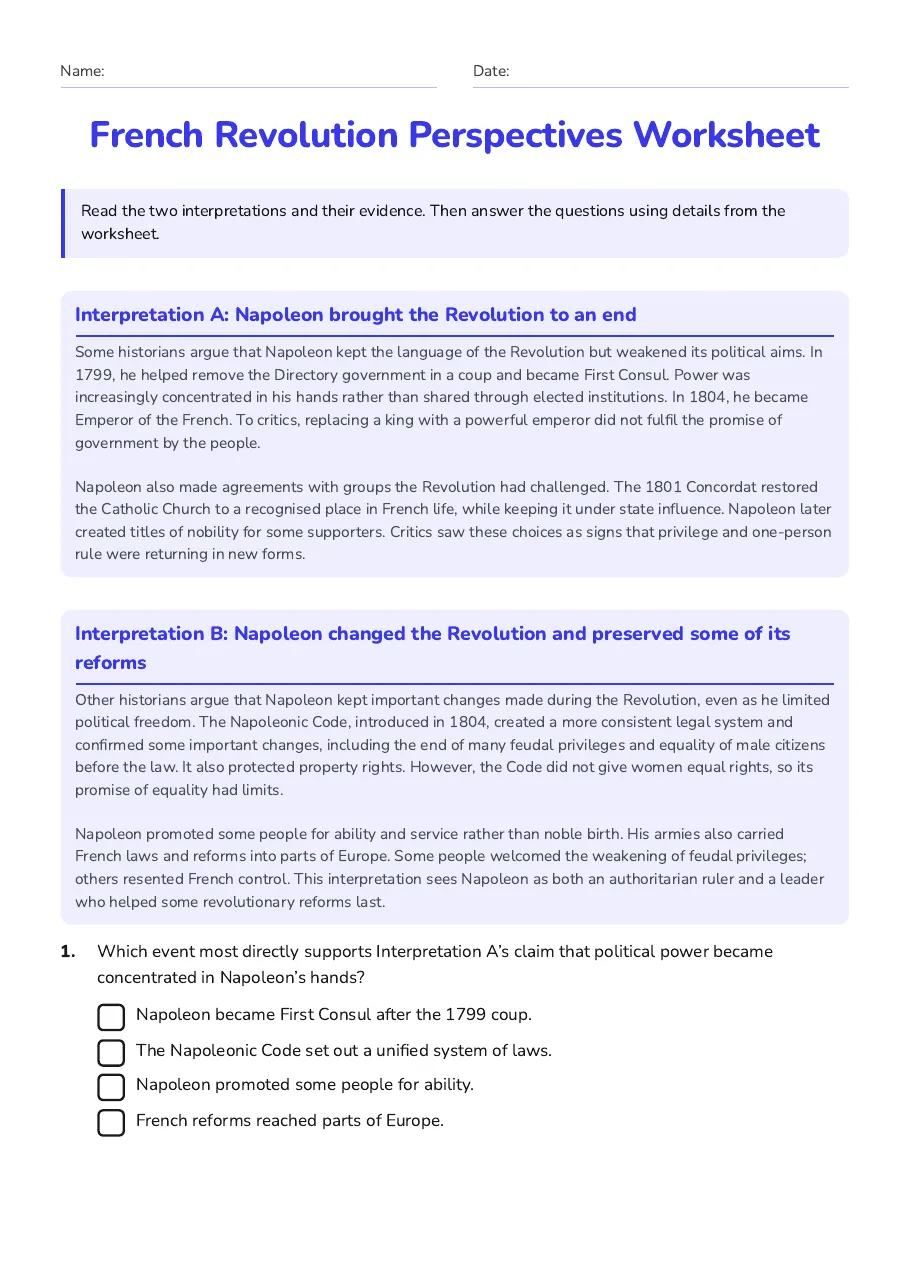
Interpretation A: Napoleon brought the Revolution to an end
Some historians argue that Napoleon kept the language of the Revolution but weakened its political aims. In 1799, he helped remove the Directory government in a coup and became First Consul. Power was increasingly concentrated in his hands rather than shared through elected institutions. In 1804, he became Emperor of the French. To critics, replacing a king with a powerful emperor did not fulfil the promise of government by the people. Napoleon also made agreements with groups the Revolution had challenged. The 1801 Concordat restored the Catholic Church to a recognised place in French life, while keeping it under state influence. Napoleon later created titles of nobility for some supporters. Critics saw these choices as signs that privilege and one-person rule were returning in new forms.
Interpretation B: Napoleon changed the Revolution and preserved some of its reforms
Other historians argue that Napoleon kept important changes made during the Revolution, even as he limited political freedom. The Napoleonic Code, introduced in 1804, created a more consistent legal system and confirmed some important changes, including the end of many feudal privileges and equality of male citizens before the law. It also protected property rights. However, the Code did not give women equal rights, so its promise of equality had limits. Napoleon promoted some people for ability and service rather than noble birth. His armies also carried French laws and reforms into parts of Europe. Some people welcomed the weakening of feudal privileges; others resented French control. This interpretation sees Napoleon as both an authoritarian ruler and a leader who helped some revolutionary reforms last.
- Napoleon became First Consul after the 1799 coup.
- The Napoleonic Code set out a unified system of laws.
- Napoleon promoted some people for ability.
- French reforms reached parts of Europe.
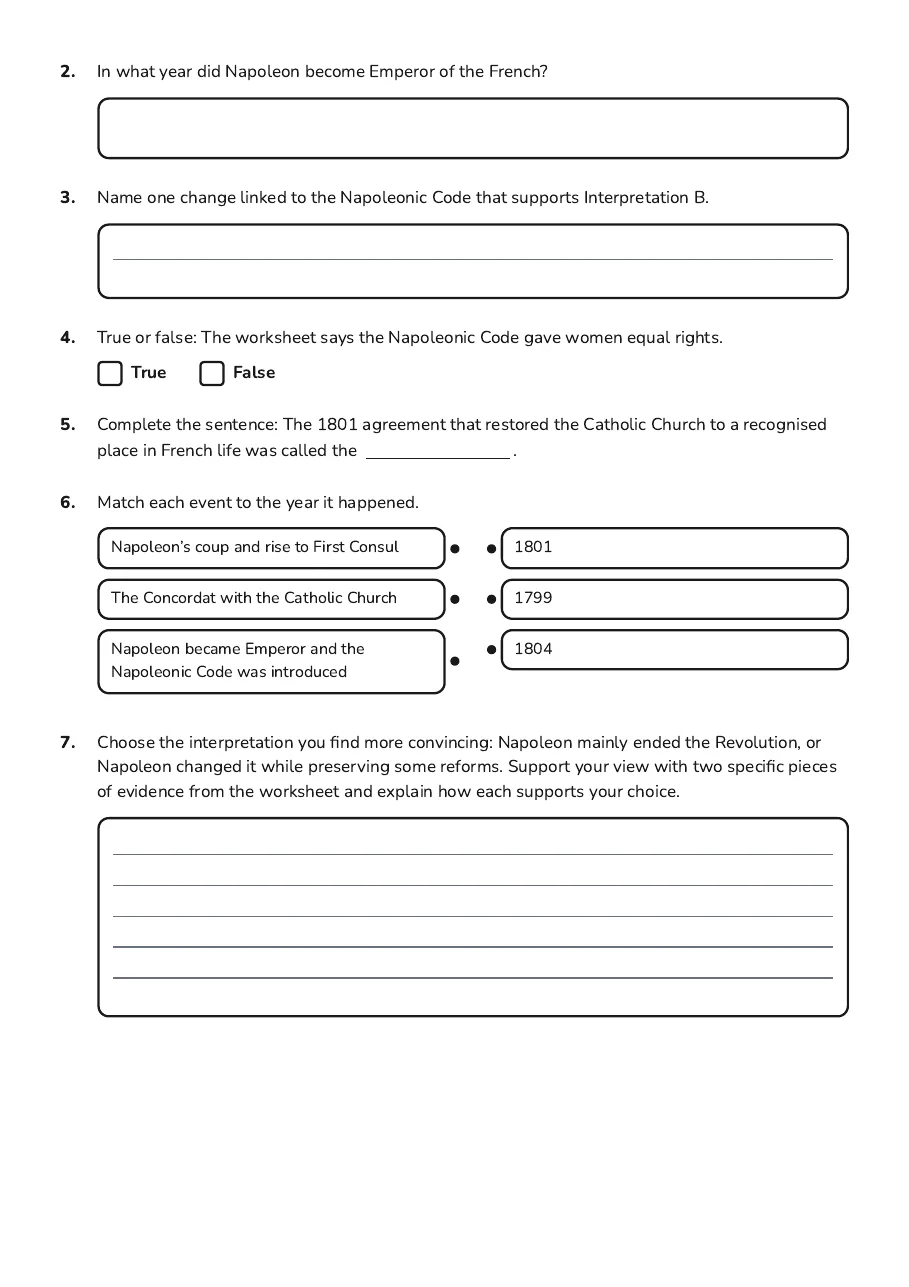
- Napoleon’s coup and rise to First Consul
- The Concordat with the Catholic Church
- Napoleon became Emperor and the Napoleonic Code was introduced
- 1801
- 1799
- 1804
2 printable pages
Page 1
Page 2
About This Worksheet
Free in Kuraplan
Sign up free, grab the PDF, and customize it for your class.
Print-Ready
Formatted for standard paper. Clean layout, easy to read.
AI-Generated
Created with Kuraplan's AI, designed for real classroom use.
For Teachers & Parents
Use in classrooms, for homework, tutoring, or homeschool.
Need a custom version of this worksheet?
Kuraplan's AI generates custom worksheets in seconds — differentiated for every learner, aligned to your curriculum.
Generate Custom Worksheets — Free