PEFreePrintable

Heart Rate Zone Analysis

A free pe worksheet ready for your classroom. Open in Kuraplan to grab the print-ready PDF, customize it for your students, or generate a fresh version in seconds.
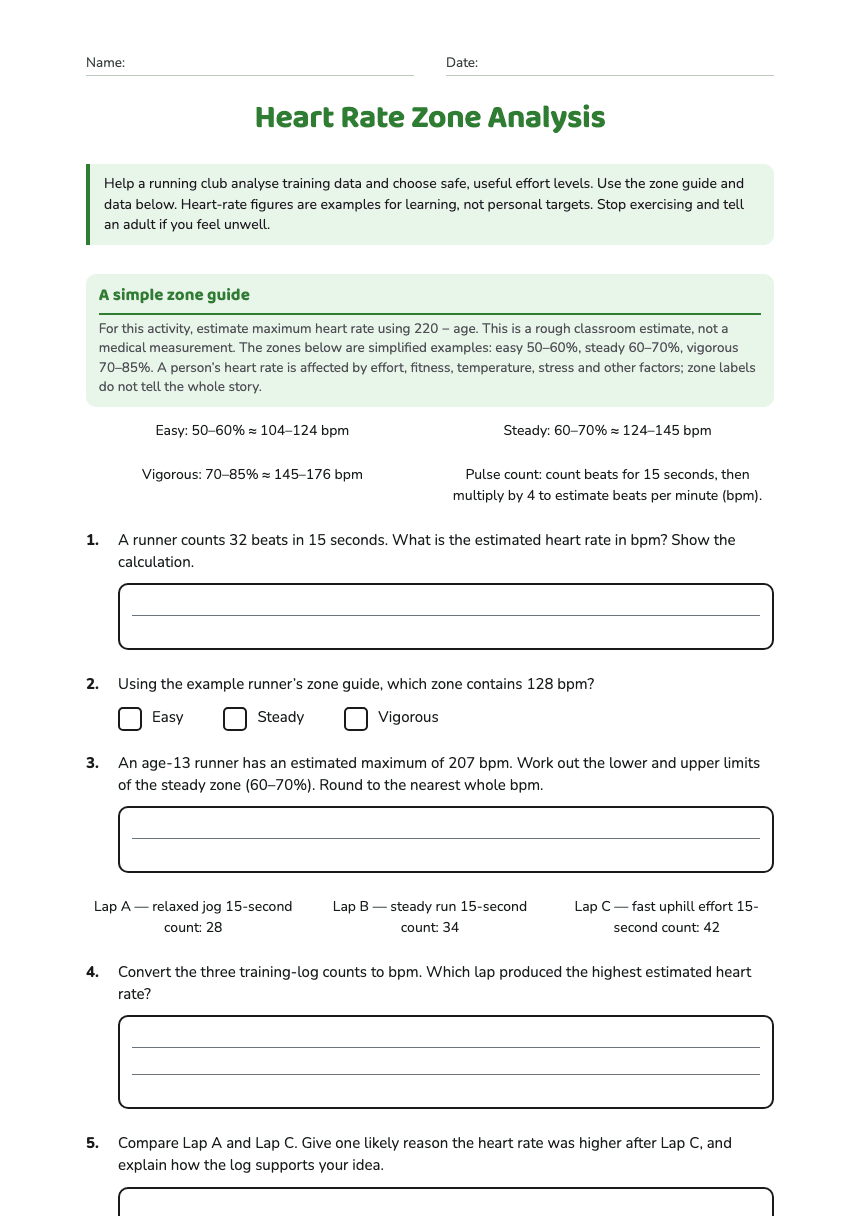
Heart Rate Zone Analysis worksheet preview
Name:Date:

Heart Rate Zone Analysis

Help a running club analyse training data and choose safe, useful effort levels. Use the zone guide and data below. Heart-rate figures are examples for learning, not personal targets. Stop exercising and tell an adult if you feel unwell.

A simple zone guide

For this activity, estimate maximum heart rate using 220 − age. This is a rough classroom estimate, not a medical measurement. The zones below are simplified examples: easy 50–60%, steady 60–70%, vigorous 70–85%. A person’s heart rate is affected by effort, fitness, temperature, stress and other factors; zone labels do not tell the whole story.

Easy: 50–60% ≈ 104–124 bpm

Steady: 60–70% ≈ 124–145 bpm

Vigorous: 70–85% ≈ 145–176 bpm

Pulse count: count beats for 15 seconds, then multiply by 4 to estimate beats per minute (bpm).

1.A runner counts 32 beats in 15 seconds. What is the estimated heart rate in bpm? Show the calculation.
2.Using the example runner’s zone guide, which zone contains 128 bpm?
  • Easy
  • Steady
  • Vigorous
3.An age-13 runner has an estimated maximum of 207 bpm. Work out the lower and upper limits of the steady zone (60–70%). Round to the nearest whole bpm.

Lap A — relaxed jog 15-second count: 28

Lap B — steady run 15-second count: 34

Lap C — fast uphill effort 15-second count: 42

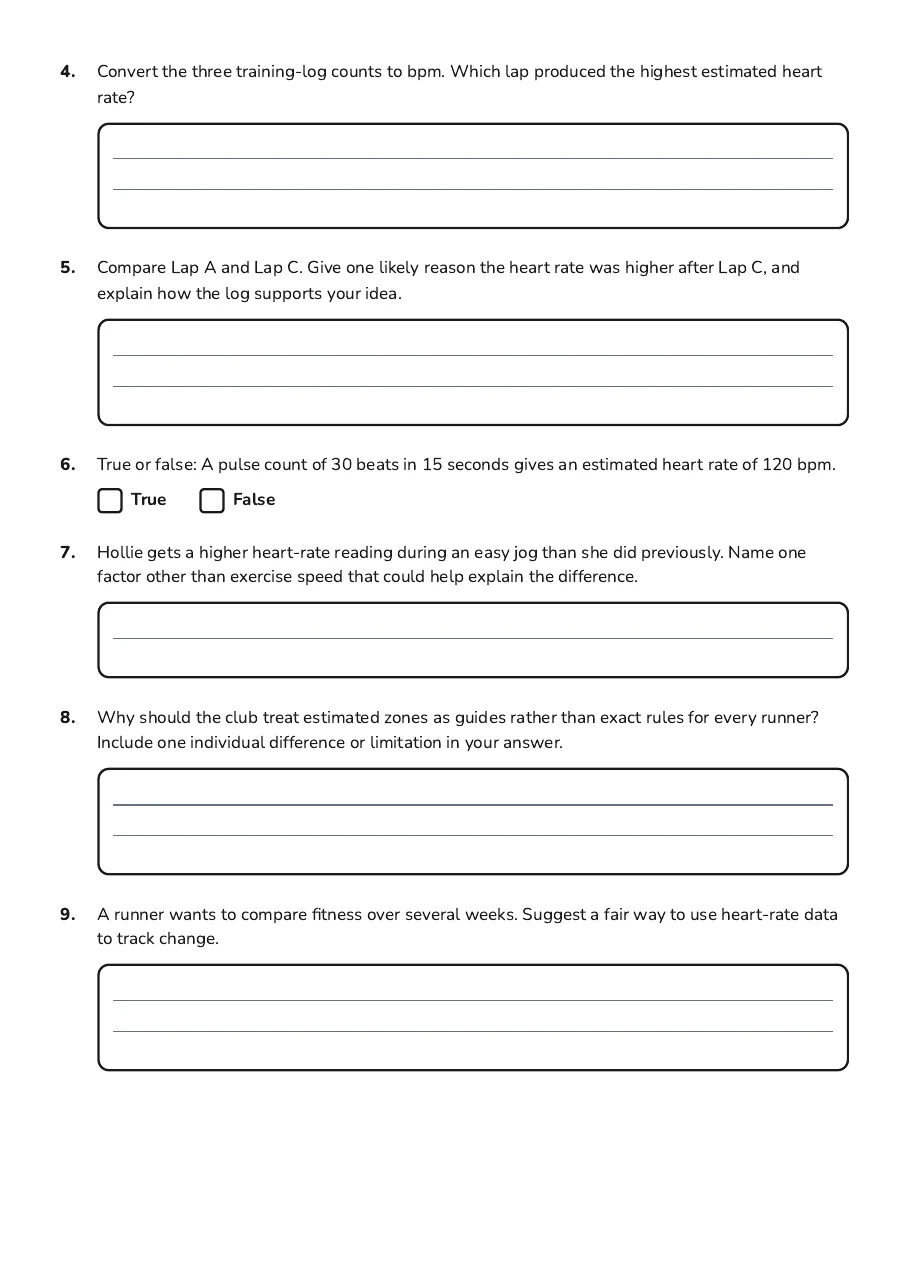
4.Convert the three training-log counts to bpm. Which lap produced the highest estimated heart rate?
5.Compare Lap A and Lap C. Give one likely reason the heart rate was higher after Lap C, and explain how the log supports your idea.
6.True or false: A pulse count of 30 beats in 15 seconds gives an estimated heart rate of 120 bpm.
TrueFalse
7.Hollie gets a higher heart-rate reading during an easy jog than she did previously. Name one factor other than exercise speed that could help explain the difference.
8.Why should the club treat estimated zones as guides rather than exact rules for every runner? Include one individual difference or limitation in your answer.
9.A runner wants to compare fitness over several weeks. Suggest a fair way to use heart-rate data to track change.
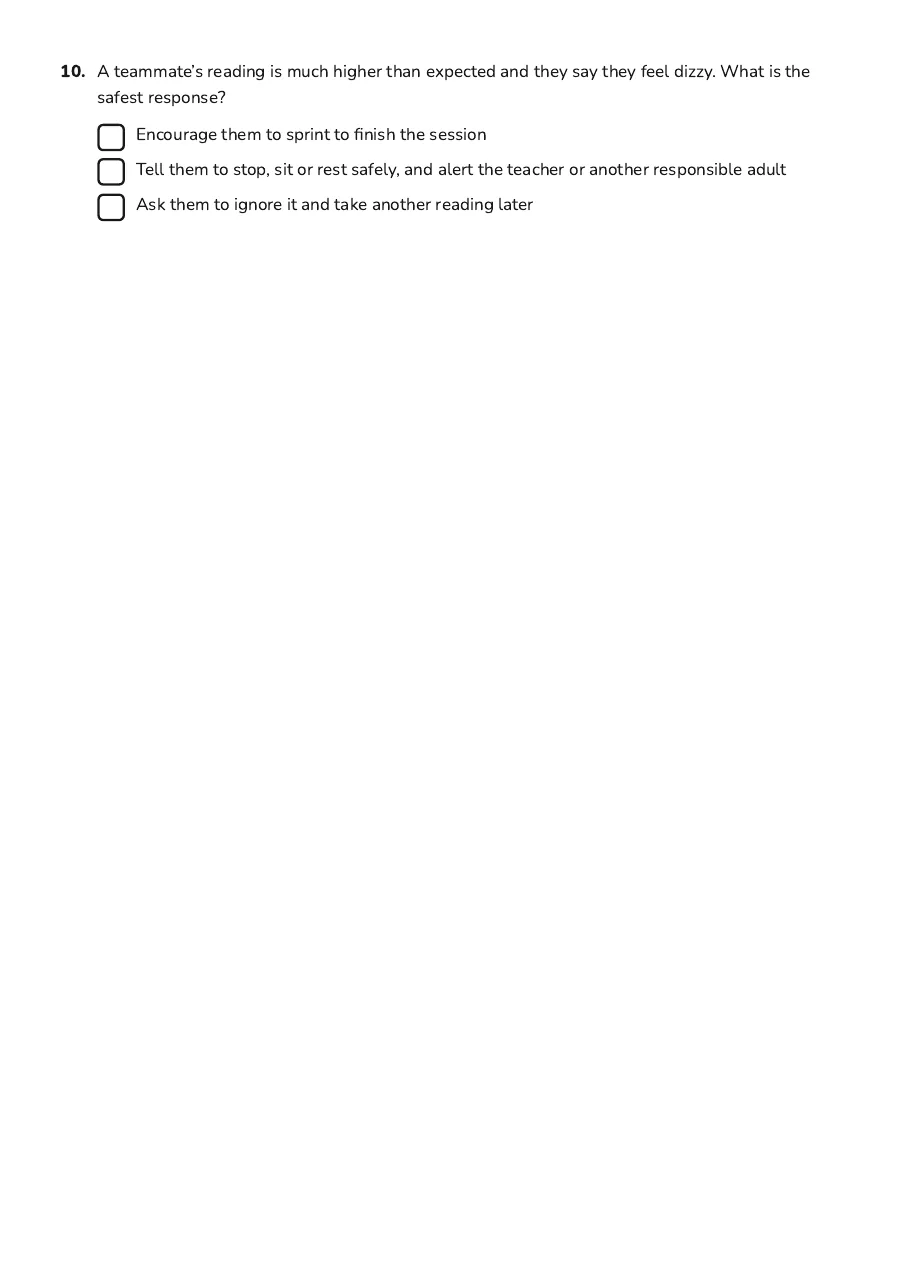
10.A teammate’s reading is much higher than expected and they say they feel dizzy. What is the safest response?
  • Encourage them to sprint to finish the session
  • Tell them to stop, sit or rest safely, and alert the teacher or another responsible adult
  • Ask them to ignore it and take another reading later

3 printable pages
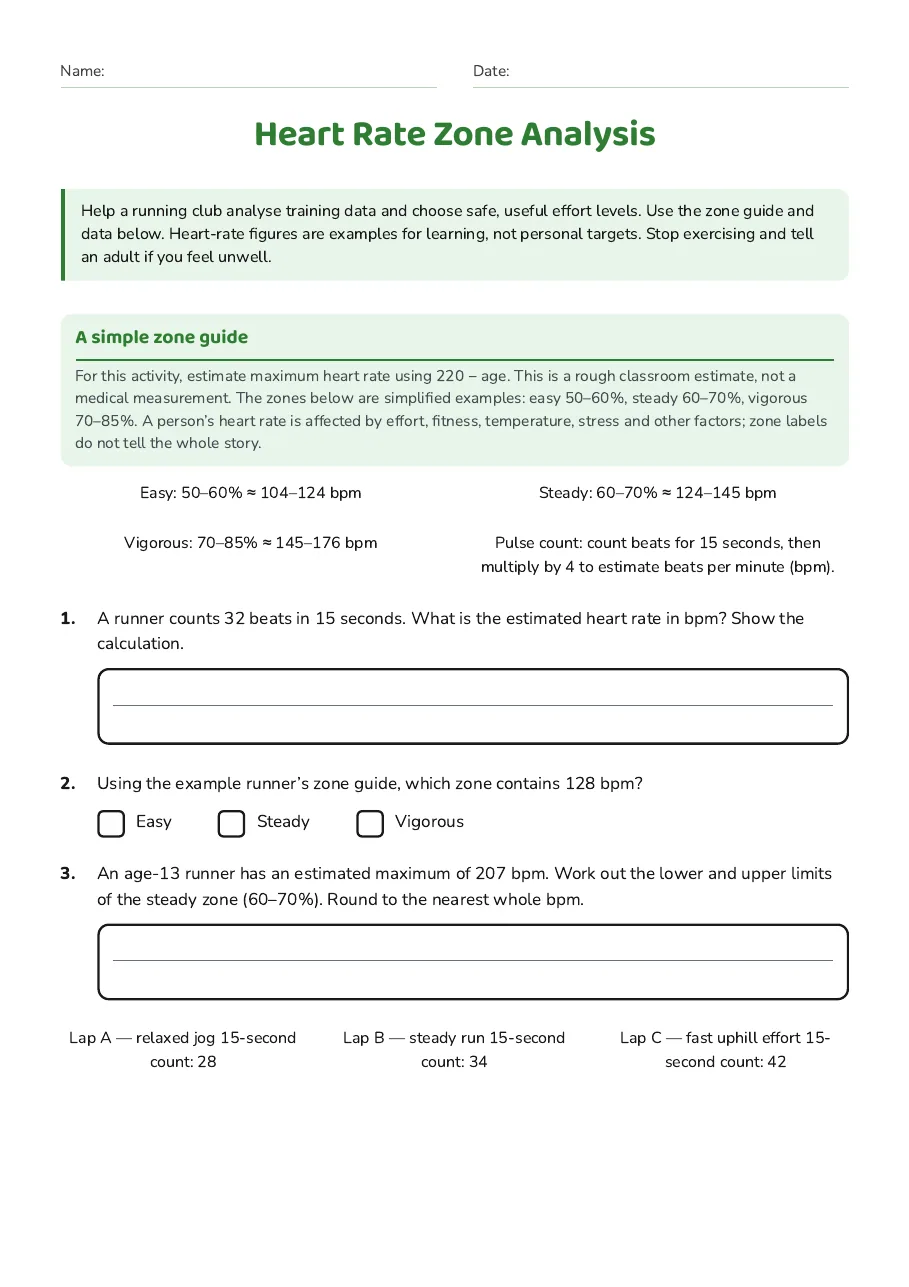
  • Heart Rate Zone Analysis, page 1 of 3: A simple zone guide

    Page 1

  • Heart Rate Zone Analysis, page 2 of 3: 4. Convert the three training-log counts to bpm. Which lap produced the highest estimated…

    Page 2

  • Heart Rate Zone Analysis, page 3 of 3: 10. A teammate’s reading is much higher than expected and they say they feel dizzy. What…

    Page 3

About This Worksheet

Free in Kuraplan

Sign up free, grab the PDF, and customize it for your class.

Print-Ready

Formatted for standard paper. Clean layout, easy to read.

AI-Generated

Created with Kuraplan's AI, designed for real classroom use.

For Teachers & Parents

Use in classrooms, for homework, tutoring, or homeschool.

Need a custom version of this worksheet?

Kuraplan's AI generates custom worksheets in seconds — differentiated for every learner, aligned to your curriculum.

Generate Custom Worksheets — Free
No credit card Curriculum-aligned Under 60 seconds