EnglishFreePrintable
Leonardo da Vinci Worksheet
A free english worksheet ready for your classroom. Open in Kuraplan to grab the print-ready PDF, customize it for your students, or generate a fresh version in seconds.
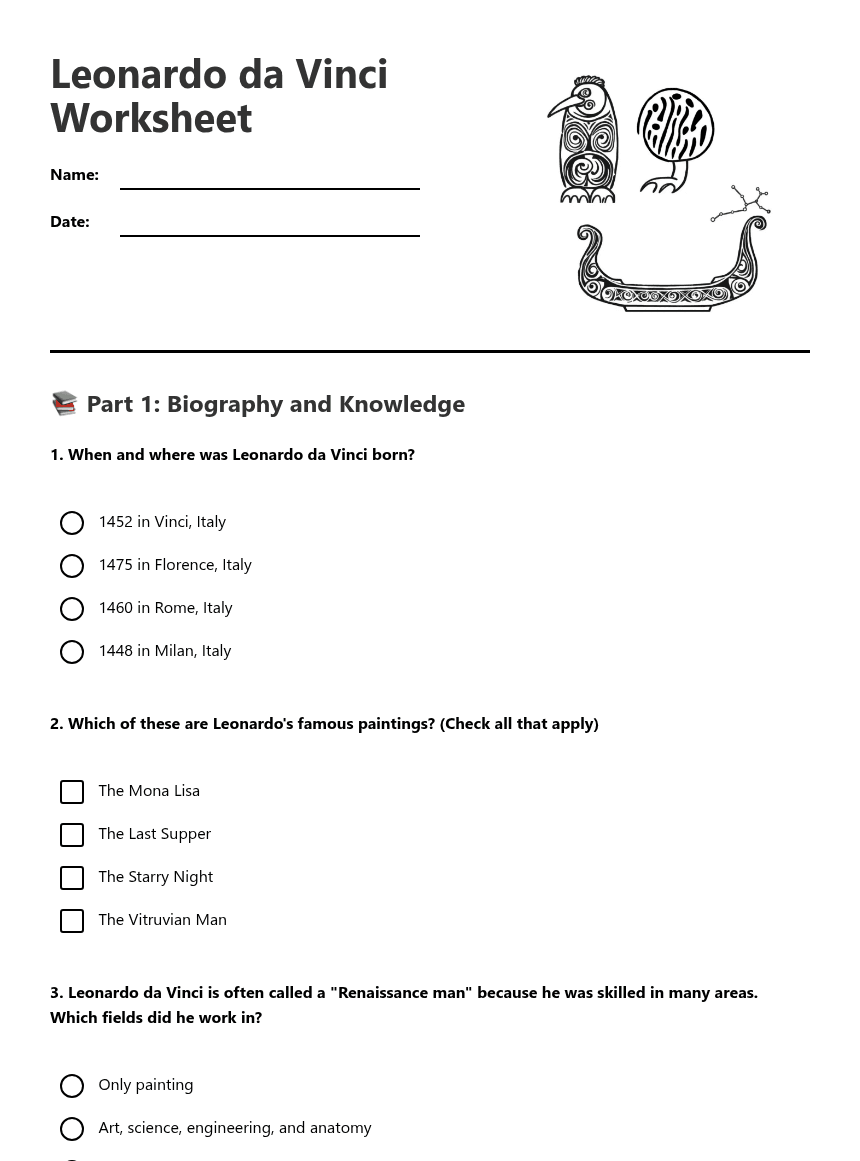
Leonardo da Vinci: Renaissance Genius Worksheet
📚 Part 1: About Leonardo da Vinci
1. Leonardo da Vinci exemplified the Renaissance ideal of a "polymath." Analyze why his interdisciplinary approach was revolutionary for his time period.
He focused exclusively on artistic perfectionHe integrated scientific observation with artistic expression and engineering innovationHe prioritized theoretical knowledge over practical application
2. Compare Leonardo's approach to learning with medieval scholars. How did his emphasis on empirical observation challenge the educational methods of his era?
3. Leonardo wrote many of his notes in mirror script (backward writing). Evaluate the possible reasons for this practice and what it reveals about his character and working methods.
To protect his ideas from being easily copied by competitorsBecause he was left-handed and it prevented smudgingTo demonstrate his intellectual superiorityAs a form of coded communication with other scholars
4. Critical Thinking: How did Leonardo's illegitimate birth and lack of formal Latin education paradoxically contribute to his innovative thinking? Provide specific examples.
🎨 Part 2: Art and Techniques
5. The Mona Lisa's enduring fascination stems from Leonardo's innovative techniques. What artistic and psychological elements contribute to its enigmatic quality?
The sfumato technique creating ambiguous facial expressions and atmospheric perspectiveThe use of vibrant, contrasting colors to create visual impactThe inclusion of symbolic religious iconography
6. Leonardo's "The Last Supper" demonstrates his mastery of perspective and emotional storytelling. Which techniques did he employ to create dramatic tension and focus? (Check all that apply)
Linear perspective converging on Christ's headGrouping disciples in clusters of three to show varied reactionsUsing chiaroscuro to highlight key figuresPositioning Christ as the central focal point through composition
7. Leonardo's unfinished works, including "St. Jerome in the Wilderness" and "The Adoration of the Magi," reveal his perfectionist nature. Analyze how his pursuit of perfection both advanced and hindered his artistic legacy.
8. Compare Leonardo's artistic techniques with those of his contemporaries Michelangelo and Raphael. What made Leonardo's approach distinctly different?
His integration of scientific study with artistic representationHis exclusive focus on religious themesHis preference for sculpture over paintingHis use of traditional Byzantine artistic conventions
9. Leonardo's treatise on painting emphasized the importance of understanding light, shadow, and atmosphere. How did his scientific approach to optics revolutionize Renaissance art?
🔬 Part 3: Inventions and Science
10. Leonardo's engineering designs were centuries ahead of their time. Which inventions demonstrate his understanding of aerodynamics, mechanics, and military strategy? (Check all that apply)
Ornithopter (flying machine based on bird wing mechanics)Aerial screw (precursor to helicopter rotor principles)Armored vehicle (early tank design with protective plating)
11. Leonardo's anatomical studies revolutionized medical understanding. What methods did he use to advance knowledge of human anatomy, and why were his findings significant?
He relied solely on ancient Greek texts and philosophical reasoningHe performed dissections on human corpses and created detailed observational drawingsHe used only animal dissections to theorize about human anatomy
12. Leonardo's study of water flow and hydraulics led to innovative engineering solutions. Which of his water-related inventions and observations were most significant? (Check all that apply)
Canal lock systems for navigationIrrigation and drainage systemsWater-powered machinery designsStudies of erosion and geological formation
13. Critical Analysis: Leonardo observed that "Obstacles cannot crush me; every obstacle yields to stern resolve." How did this philosophy manifest in his scientific methodology and approach to seemingly impossible challenges?
14. Leonardo's botanical studies influenced both his art and scientific understanding. How did his detailed observations of plant structure contribute to his broader understanding of natural patterns and design principles?
🌟 Part 4: Modern Impact and Legacy
15. Modern biomimicry in engineering often references Leonardo's nature-based designs. Which contemporary technologies can trace their conceptual origins to his work? (Check all that apply)
Helicopter rotor systems inspired by his aerial screwRobotic joints modeled after his anatomical studiesParachute and glider designs based on his flight studiesMedical imaging techniques influenced by his anatomical precision
16. Leonardo's notebooks contain over 13,000 pages of observations and inventions. Analyze the impact of his documentation methods on the preservation and transmission of knowledge during the Renaissance.
17. Compare Leonardo's interdisciplinary approach with modern STEAM (Science, Technology, Engineering, Arts, Mathematics) education. What lessons can contemporary educators learn from his methods?
Specialization in one field produces the best resultsIntegration of artistic and scientific thinking enhances innovation and problem-solvingTheoretical knowledge should be prioritized over practical applicationTraditional educational boundaries should remain rigid
18. Critical Analysis: Assess the statement "Leonardo da Vinci was the world's first modern scientist." Support or refute this claim using evidence from his methods, discoveries, and approach to knowledge.
19. Leonardo's famous quote "Learning never exhausts the mind" reflects his lifelong pursuit of knowledge. How does this philosophy challenge modern concepts of specialization and expertise?
20. Synthesis Question: If Leonardo da Vinci were alive today, which modern scientific or technological challenges do you think would most capture his interest, and why? Consider his historical interests and methodologies in your response.
About This Worksheet
Free in Kuraplan
Sign up free, grab the PDF, and customize it for your class.
Print-Ready
Formatted for standard paper. Clean layout, easy to read.
AI-Generated
Created with Kuraplan's AI, designed for real classroom use.
For Teachers & Parents
Use in classrooms, for homework, tutoring, or homeschool.
Need a custom version of this worksheet?
Kuraplan's AI generates custom worksheets in seconds — differentiated for every learner, aligned to your curriculum.
Generate Custom Worksheets — Free No credit card Curriculum-aligned Under 60 seconds